If you are specifying a new dry type transformer, replacing an ageing Cutler-Hammer unit, or looking for a second source for an Eaton dry type transformer, the deciding question is rarely “which brand” — it is “which unit actually fits my rating, my enclosure and my delivery date, at a price the project can carry.” This page compares the Eaton and Cutler-Hammer dry type transformer families against Kampa’s equivalent ranges, explains what the two brand names mean today, and gives you a nameplate-by-nameplate cross-reference checklist to work through before you request a quote.
Why Buyers Look for Eaton / Cutler-Hammer Dry Type Transformer Alternatives
Availability has become the binding constraint on low-voltage dry type projects. The U.S. Department of Energy has put production lead times for distribution transformers at more than 30 months, with only around 20% of U.S. demand met by domestic supply. Even where a distributor holds stock, project dates slip — which is why so many buyers now run a second source in parallel with the named brand.
The imported cost structure changed sharply in 2025, and metal content is now a visible line in every landed cost:
- On 1 August 2025, a 50% Section 232 tariff took effect on copper products, raising the cost of copper-wound units.
- On 18 August 2025, the Section 232 derivative list was extended to cover certain transformers and transformer parts — including electrical steel cores and laminations — at 50% of the declared steel or aluminium content (25% for UK-origin material).
- Country-based reciprocal tariffs are layered on top of those measures, typically in the 10–41% range depending on origin.
The efficiency target is moving as well. The current benchmark for low-voltage dry type units is the DOE 2016 level under 10 CFR 431. The amended rule published on 22 April 2024, effective 8 July 2024, applies to units manufactured in or imported into the United States on or after 23 April 2029, and calls for roughly a 30% reduction in losses for single-phase and 20% for three-phase low-voltage dry type transformers against 2016, plus a 20% reduction for medium-voltage dry type. Anything specified today against the 2016 levels will need reviewing before that date.
Two more practical drivers push buyers to look at alternatives:
- The legacy Cutler-Hammer fleet is old. Ratings, enclosures and terminal layouts that were catalogue items when those units were built are not always stock items now.
- Single units and unusual ratings are hard to buy. Distribution channels are set up for stock ratings and project quantities — not one-off replacements or non-standard voltage combinations.
Eaton and Cutler-Hammer: What the Two Names Actually Mean
Cutler-Hammer Manufacturing Co. was incorporated in Chicago in 1893 and became part of Eaton in 1978. Eaton added Westinghouse’s electrical distribution and control business to the same group in 1994. The two names describe one lineage, and the practical consequence is simple: a “Cutler-Hammer” dry type transformer is, in almost every case, an older Eaton unit.
That matters when you go looking for a replacement, because the catalogue number tells you the vintage. Older Cutler-Hammer units typically carry V-prefix catalogue numbers — for example V48M28B7516CU, a 75 kVA, 480 V delta to 208Y/120 V unit. Current Eaton literature describes the low-voltage ventilated ranges as Type DS-3 and Type DT-3, and the encapsulated range as Type EP / EPT.
| What you see on the nameplate |
Which era it belongs to |
What it tells you |
| V-prefix catalogue number (e.g. V48M28B7516CU) |
Cutler-Hammer era, carried into Eaton production after 1978 |
The current-production equivalent normally falls in the DS-3 / DT-3 class. Decode kVA, voltage combination and winding material from the number, then confirm every figure against the nameplate. |
| Type DS-3 |
Eaton low-voltage ventilated, single-phase |
600 V class general-purpose dry type transformer |
| Type DT-3 |
Eaton low-voltage ventilated, three-phase |
600 V class general-purpose dry type transformer |
| Type EP / EPT |
Eaton sand-and-resin encapsulated |
Totally enclosed, non-ventilated; EP single-phase, EPT three-phase |
| “Eaton” on a unit built after 1978 |
Eaton |
Same product family. Cutler-Hammer is the legacy brand name, not a different design. |
Eaton / Cutler-Hammer Dry Type Families at a Glance
These are the characteristics to cross-reference against. The figures below are taken from Eaton’s own low-voltage distribution transformer catalogue and product listings; availability varies by rating and by catalogue edition, so always confirm against current literature before you specify.
| Attribute |
Type DS-3 |
Type DT-3 |
Type EP / EPT |
| Construction |
Ventilated general purpose, two-winding, self-cooled |
Ventilated general purpose, two-winding, self-cooled |
Sand-and-resin encapsulated, totally enclosed, non-ventilated |
| Phase and standard range |
Single-phase, 7.5–333 kVA |
Three-phase, 7.5–1,500 kVA |
Single-phase (EP) to 37.5 kVA; three-phase (EPT) to 75 kVA |
| Voltage class |
600 V class; older catalogue editions list primary voltages to 4,160 V |
600 V class; to 4,160 V in older editions |
Primary voltages to 4,160 V |
| Insulation system |
220 °C |
220 °C |
185 °C |
| Temperature rise |
150 °C standard; 115 °C or 80 °C optional |
150 °C standard; 115 °C or 80 °C optional |
115 °C standard; 80 °C optional |
| Enclosure |
NEMA 2 standard; NEMA 3R with field-installed weathershields |
NEMA 2 standard; NEMA 3R with field-installed weathershields |
NEMA 3R, totally enclosed |
| Mounting |
Upright only; indoors, or outdoors with weathershields |
Upright only; indoors, or outdoors with weathershields |
Any position indoors; upright outdoors |
| Windings |
Aluminium or copper |
Aluminium or copper |
— |
| Frequency |
60 Hz standard, 50 Hz available |
60 Hz standard, 50 Hz available |
60 Hz standard |
| Sound |
Meets NEMA ST-20; optional low-sound build 3–5 dB below |
Meets NEMA ST-20; optional low-sound build 3–5 dB below |
— |
| Efficiency |
DOE 2016 levels; legacy NEMA TP-1 units also exist in the field |
DOE 2016 levels; legacy NEMA TP-1 units also exist in the field |
Sealed / non-ventilated construction sits outside the DOE 2016 scope |
| Overload capability (ANSI C57.96) |
200% for 30 minutes, 150% for 1 hour, 125% for 4 hours, with a constant 50% load before and after |
Same |
— |
| Typical duty |
Lighting and receptacle panels, small commercial step-down |
480 V to 208Y/120 V step-down in electrical rooms and data halls |
Washdown, damp, dirty or corrosive locations |
One detail worth knowing when you compare running costs: DOE 2016 units are optimised to reach maximum efficiency at around 35% of nameplate rating, which is close to the measured average loading of low-voltage dry type transformers over a 24-hour period. A lightly loaded unit is not automatically an inefficient one.
Kampa Equivalents, Side by Side
Kampa builds dry type transformers in the same construction families. Where a parameter is fixed by the standard, it follows the standard; where it is not, it is quoted to your specification.
| Parameter |
Eaton / Cutler-Hammer |
Kampa equivalent |
| Construction families |
Ventilated general purpose (DS-3 / DT-3); sand-and-resin encapsulated (EP / EPT) |
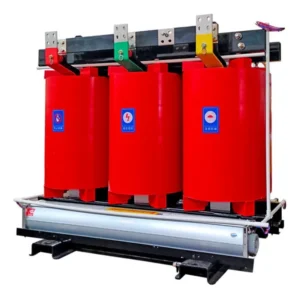
Ventilated VPI, cast resin (epoxy), vacuum pressure encapsulated (VPE) and open-wound, in single- and three-phase |
| Voltage class |
600 V class low voltage, with medium-voltage dry type elsewhere in the range |
Common builds at 0.4 kV, 6 kV and 10 kV; higher classes quoted per project |
| Insulation system |
220 °C ventilated; 185 °C encapsulated |
Class F (155 °C) and Class H (180 °C) systems in standard cast resin builds, selected to suit the required temperature rise |
| Temperature rise |
150 °C standard, 115 °C or 80 °C optional |
Agreed at enquiry — specify the rise you need to match the existing unit |
| Windings |
Aluminium or copper |
Copper or aluminium; the SCB series uses a vacuum-cast HV winding and copper-foil LV winding |
| Enclosure |
NEMA 2, NEMA 3R |
IP20 standard, IP23 optional for outdoor service; project-specific enclosures on request |
| Efficiency |
DOE 2016 today; DOE 2029 levels from 23 April 2029 |
Loss levels quoted per project — state the efficiency standard and the rating so the design is sized to hit it |
| Standards basis |
ANSI, NEMA and IEEE; UL listed in the 600 V class |
Manufacturing to IEC and ISO; specific UL or ANSI requirements confirmed on the enquiry |
| Customisation |
Standard catalogue ratings, plus a Flex Center for non-standard work |
Full OEM / ODM: non-standard ratios, unusual kVA, K-factor, extended tap ranges, special enclosures |
| Quality documentation |
Catalogue data and factory test reports |
Multi-stage inspection from raw material to final performance verification; test reports issued with the unit |
| Best fit |
Projects that name Eaton, or that contractually require UL listing and NEMA conformance |
New-build and export projects, retrofit and spares where an equivalent is permitted, and long-lead relief |
One honest caveat, because it affects your procurement route: a Kampa unit is not an Eaton unit. Where a specification explicitly names Eaton or Cutler-Hammer equipment, or makes UL listing and NEMA conformance a contractual condition, a substitution normally has to pass through the project engineer’s approved-equal process. We will supply the data package that review needs — losses, impedance, temperature rise, enclosure rating, test reports — but the substitution call belongs to the engineer, not to the supplier. If that is the route you are taking, custom dry type transformer options are the place to start.
Cross-Reference Checklist: What to Pull Off the Nameplate
Matching two dry type transformers is not just a kVA and voltage exercise. Work through this list and the quote will come back right the first time.
| Item |
Why it decides the match |
| kVA rating |
Sets the frame, the losses and the physical size |
| Phase (single or three) |
Changes the construction family entirely — DS-3 versus DT-3, EP versus EPT |
| Primary and secondary voltage, plus connection (delta / wye) and tap range |
A 480 V delta to 208Y/120 V unit is not interchangeable with a 480 V delta to 480Y/277 V unit even at the same kVA. A tap range beyond the DOE exclusion threshold — greater than 15% under the 2016 scope, 20% or more under the amended rule — also removes the unit from the efficiency scope, which changes what efficiency you may legally be sold. |
| Frequency |
60 Hz and 50 Hz units are not interchangeable without a redesign |
| Insulation system class and temperature rise |
Drives the allowable loading and the physical size; a 150 °C rise unit cannot simply be replaced by an 80 °C rise unit of the same kVA without checking the load |
| Impedance voltage (%) |
Governs voltage drop, short-circuit current and whether units can be paralleled |
| K-factor or harmonic duty |
VFD, rectifier and IT loads need K-rated or drive-isolation construction and, often, a 200% neutral |
| Winding material |
Copper and aluminium units differ in losses, weight and price, and the destination market may treat them differently at customs |
| Enclosure type and location |
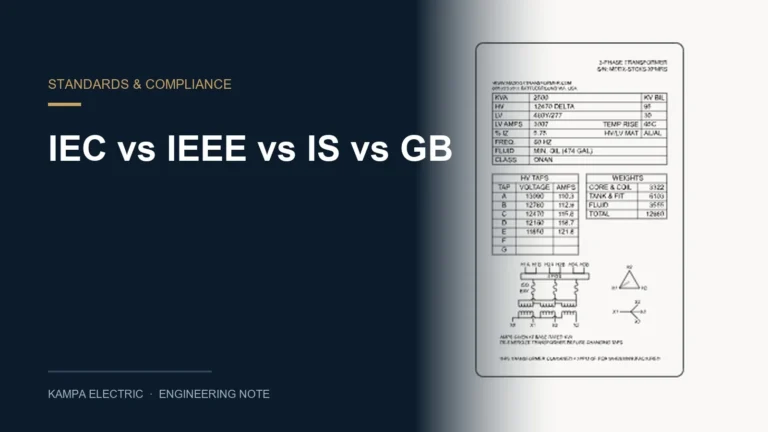
NEMA 2 indoors, NEMA 3R outdoors with weathershields, washdown areas need sealed construction. Getting this wrong is the most common retrofit failure. |
| Footprint, weight, terminal positions and lifting points |
On a like-for-like replacement these decide whether the unit physically fits the room and the existing cable runs. Measure and photograph them. |
| Sound requirement |
NEMA ST-20 is the baseline; low-sound builds run 3–5 dB below it. Public buildings, hospitals and data halls usually need the quieter option. |
| Required efficiency level for the destination market |
DOE 2016 now; DOE 2029 levels apply to units made or imported from 23 April 2029 |
| Accessories |
Forced-air fans, temperature controller and RTDs, electrostatic shielding, seismic qualification — each is a separate line on the quotation |
Photograph the nameplate and measure the footprint, the terminal positions and the lifting points before you send the enquiry. Those three measurements are the most common reason a cross-reference goes wrong.
Cost, MOQ and Lead Time: What Actually Moves the Number
| Factor |
Effect on the quotation |
| Rating and voltage class |
Larger kVA and higher voltage class mean more material and more robust insulation |
| Winding material |
Copper carries a premium; copper and electrical steel prices now feed directly into unit cost through the 2025 tariff measures |
| Efficiency target |
Hitting DOE 2029 loss levels needs more or higher-grade core steel, so the same kVA costs more than a 2016-level design |
| Enclosure and weathershields |
NEMA 3R, sealed or IP23 construction adds cost over a standard ventilated enclosure |
| K-factor and harmonic duty |
K-rated windings, oversized neutrals and electrostatic shields are quoted individually |
| Tap range |
Extended tap ranges increase winding complexity and can move the unit outside the DOE efficiency scope |
| Accessories and monitoring |
Fans, RTDs, controllers and surge protection are separate line items |
| Test scope and documentation |
Routine tests are standard; witnessed testing and extra documentation are quoted separately |
| Quantity and MOQ |
Project quantities get better unit pricing than a single replacement unit |
| Destination and Incoterms |
Landed cost depends on freight, duties and the destination market’s efficiency rules |
For context on where the market sits, Kampa publishes indicative dry type transformer pricing of roughly USD 60–120 per kVA for three-phase units, and that band moves with copper and electrical steel prices. Landed cost is a separate calculation: for imports into the United States, Section 232 duties apply to the steel and aluminium content of the unit and separately to copper, with country-based reciprocal tariffs potentially added. Any landed-cost figure you receive should show those lines explicitly rather than burying them in a total.
FAQ
Is a Cutler-Hammer dry type transformer the same as an Eaton dry type transformer?
Effectively yes, by lineage. Cutler-Hammer Manufacturing Co. was incorporated in 1893 and became part of Eaton in 1978, so units sold under the Cutler-Hammer name are older Eaton products. The current equivalents of the low-voltage ventilated ranges are the DS-3 and DT-3 types. Older units typically carry V-prefix catalogue numbers.
Can I replace an Eaton DS-3 or DT-3 with a Kampa dry type transformer?
In many projects yes, provided the kVA, voltage combination, temperature rise, impedance, enclosure rating and footprint all match or are approved by the project engineer. Where the specification names Eaton, or requires UL listing and NEMA conformance as a contractual condition, the substitution has to go through an approved-equal review — we supply the test and loss data that review needs.
What is the difference between a ventilated dry type transformer and an encapsulated one?
Ventilated units such as the DS-3 and DT-3 are open to air circulation, mount upright and suit indoor electrical rooms or outdoor locations with weathershields. Encapsulated units such as the EP and EPT have windings sealed in sand-and-resin in a totally enclosed case, which suits damp, dirty, washdown or corrosive locations where open windings would degrade.
What does DOE 2016 compliance mean, and what changes in 2029?
DOE 2016 sets minimum efficiency levels for distribution transformers under 10 CFR 431. For low-voltage dry type units it covers 60 Hz transformers with a primary of 34.5 kV or below and a secondary of 600 V or below, spanning roughly 10–833 kVA single-phase and 15–2,500 kVA three-phase. The amended rule published in April 2024 requires roughly a 30% further reduction in losses for single-phase and 20% for three-phase low-voltage dry type transformers, applying to units manufactured in or imported into the United States on or after 23 April 2029. Autotransformers, drive-isolation transformers, sealed and non-ventilated transformers, UPS transformers and units with tap ranges of 20% or more sit outside the scope.
What do I need from the nameplate to get a matching quote?
Send the kVA, phase, primary and secondary voltage with connection and tap range, frequency, temperature rise, impedance, enclosure type, mounting orientation, sound requirement, destination country, and the required efficiency level. A photograph of the nameplate plus the footprint, terminal positions and lifting points will let us confirm the physical fit as well as the electrical match.
Do I need UL listing or NEMA enclosures for a US installation?
That depends on the governing specification, the authority having jurisdiction and the inspector. If UL listing or NEMA conformance is a contractual requirement, treat it as a hard constraint and confirm it before the order, not after. Where an equivalent is permitted, we will state clearly what the supplied unit is certified to so you can document the decision.
How long does a custom dry type transformer take?
Standard ratings ship faster than custom builds. Non-standard voltage combinations, unusual kVA, K-factor construction or special enclosures add design and tooling time, so the honest answer is that it depends on how far the unit is from a stock rating. Send the specification and we will give you a firm date against the actual design rather than a generic figure.
Next Step
If you are cross-referencing an existing Eaton or Cutler-Hammer unit, send us the nameplate photograph and the measurements — kVA, voltages, temperature rise, impedance, enclosure and footprint are enough to price an equivalent. Kampa manufactures dry type transformers to IEC and ISO practice with full OEM and ODM customisation, so non-standard ratings are a normal request rather than an exception.
You can review the dry type power transformer range, read the dry type transformer specification guide, compare dry type against oil-immersed units, or look at the broader selection guide to transformer types if the construction family is still open. When the specification is settled, contact our engineering team for a quotation with losses, impedance and test scope stated explicitly.