Dry Type vs Cast Resin vs Oil-Immersed Transformer: A Three-Way Comparison
Published: Author: Kampa
If you are choosing between a dry type, a cast resin and an oil-immersed transformer, here is the short answer: cast resin wins indoor rooms that are humid, dirty or fire-restricted; VPI dry type wins clean, dry indoor rooms on budget; and oil-immersed wins outdoor pads, utility feeders and any site where a vault is not a problem.
But the short answer is not the whole story, because the cheapest unit to buy is rarely the cheapest unit to own. On a 25-year total cost of ownership (TCO) basis for a 1,000 kVA unit installed indoors, we calculate a VPI dry type at roughly USD 62,600 against USD 69,300 for oil-immersed — a gap of about USD 6,700 that comes almost entirely from vault construction and oil maintenance, not from the transformer itself. Move the same comparison outdoors to a pad, and the answer flips: oil-immersed becomes the cheaper option over 25 years.
This page compares all three constructions attribute by attribute, shows what the codes actually require, and then runs the numbers with a transparent 25-year model you can copy into your own RFQ.
Your constraint
Recommended construction
Why
Indoor electrical room, basement, or public building
Cast resin
No oil, no vault; qualifies under the Class 155 insulation exception in NEC 450.21(B) when fully enclosed except for ventilation openings
Indoor room, clean and dry, capex-sensitive
VPI dry type
Same code position as cast resin at a lower purchase price; suitable where humidity and contamination are controlled
Outdoor pad, rural feeder, utility distribution
Oil-immersed
Lowest cost per kVA, smaller footprint, higher standard impulse level, no enclosure premium
Coastal, chemical or heavily polluted site
Cast resin (E2 / F1)
Encapsulated winding tolerates humidity and contamination that an open VPI winding cannot; stainless enclosure where specified
Maximum continuous overload headroom
Dry type (80 K rise design)
Up to 30% continuous overload without loss of life, plus up to 33% short-time reserve with forced air
Longest transformer-room-free schedule
Dry type
2026 lead times run roughly 20–32 weeks for dry type against 40–65 weeks for pad-mount liquid-filled
The three types in plain terms
Before comparing, it helps to be precise about what each term means, because tenders frequently mix them up — and that leads to bids that cannot be compared.
What is a dry type transformer?
A dry type transformer uses solid insulation and air — natural or forced — instead of a liquid dielectric. Inside this family there are two dominant constructions you will actually be asked to price:
VPI (vacuum pressure impregnated). The wound coil is dried under vacuum and then impregnated with varnish, so the winding is bonded but not fully encapsulated. Air circulates over the winding surface and heat leaves by convection. VPI units are lighter, easier to repair, lower in cost, and need a reasonably clean, dry air supply.
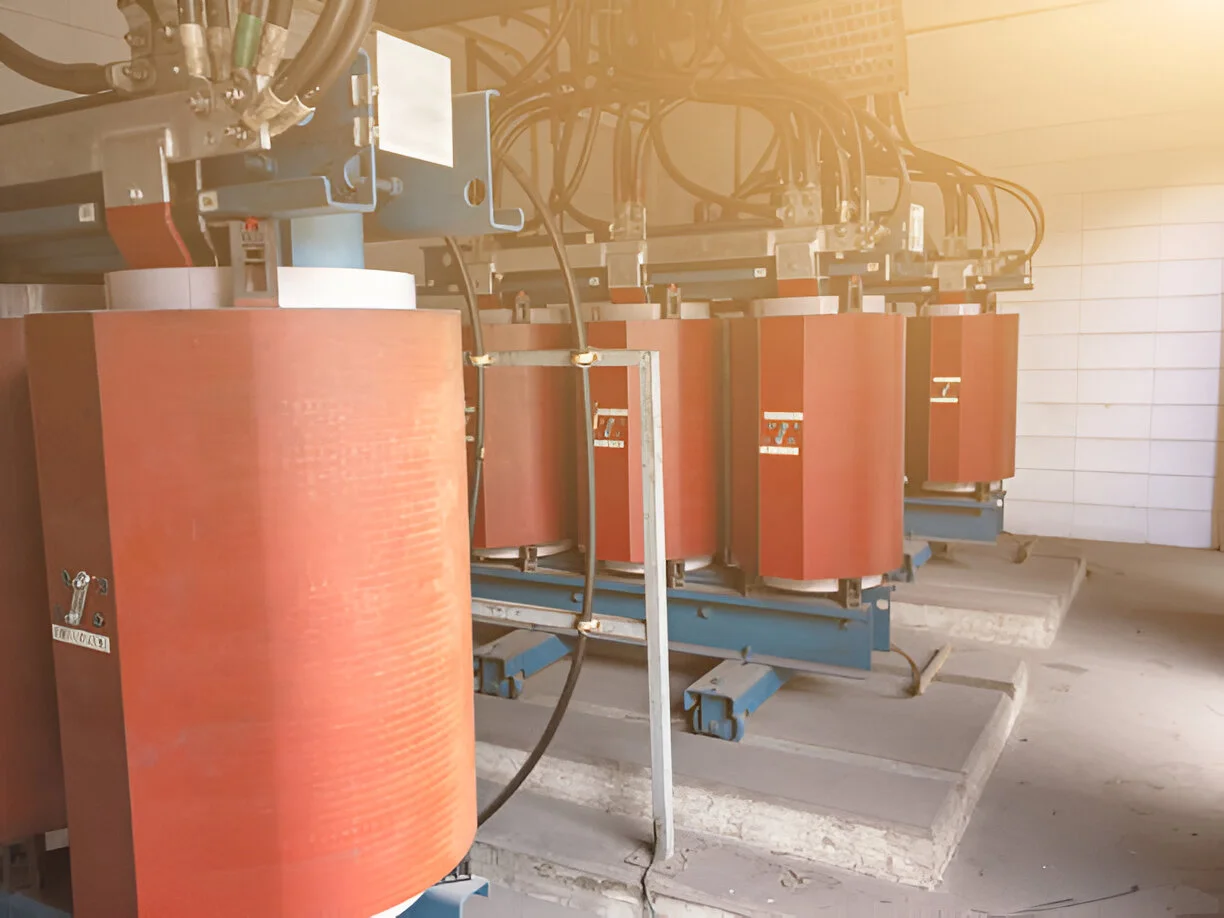
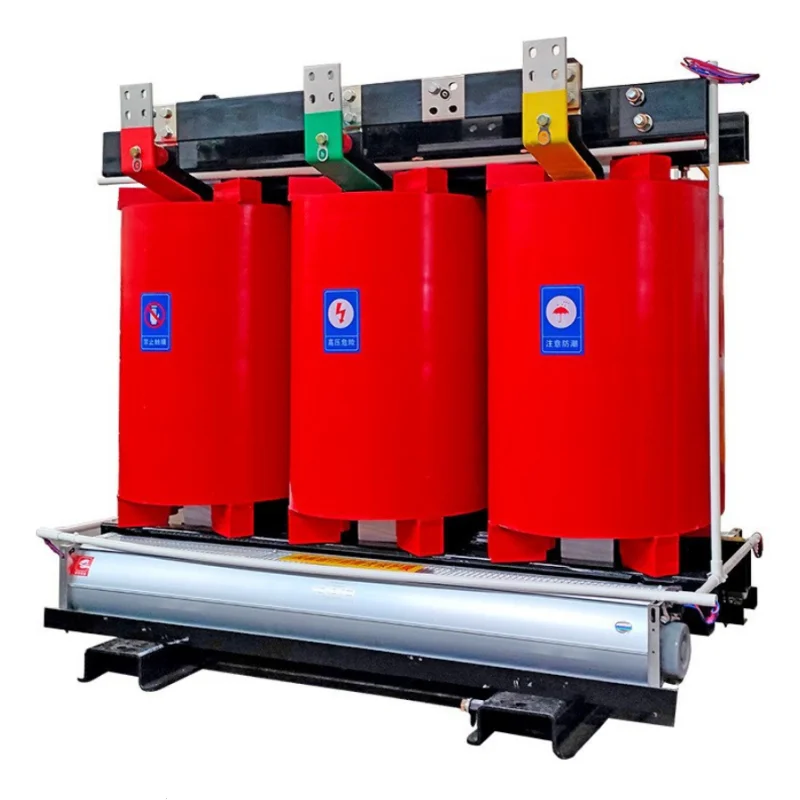
Cast resin. The winding is cast in epoxy resin under vacuum, so conductors are fully encapsulated in a solid dielectric. The casting protects the winding from moisture, dust and corrosive atmospheres, and gives the highest mechanical strength against short-circuit forces — which is why cast resin dominates indoor medium-voltage dry-type selection.
A useful rule of thumb: if the word “dry type” appears alone in a specification, ask which of the two is intended. The price difference between VPI and cast resin can exceed 15%, and the two are not interchangeable in a humid or contaminated room.
What is a cast resin transformer?
A cast resin transformer is a dry type transformer in which the core-coil assembly is encapsulated in cast epoxy resin. Under IEC 60076-11 it is normally specified with three class codes, and these three codes are where real projects are won or lost:
C1 or C2 — climatic class (C2 covers operation down to −25 °C)
E0, E1 or E2 — environmental class (E2 is the class for frequent condensation and high humidity)
F0 or F1 — fire behaviour class (F1 is self-extinguishing)
If the room is humid, coastal or unheated, insist on C2 / E2 / F1 and require the class codes to appear on the nameplate and the test certificate. Do not assume E2 simply because the datasheet says “dry type” — it is a design and test claim, not a category label. More detail on how VPI and cast resin differ in construction is covered separately, and cast resin benefits and limitations are set out in their own guide.
What is an oil-immersed transformer?
An oil-immersed transformer places the core-coil assembly in a sealed steel tank filled with mineral oil or a less-flammable ester fluid. Oil does two jobs at once: insulation and heat transfer. Because liquid convection removes heat far more effectively than air, the winding can run at a higher current density for the same temperature rise — which is why an oil-immersed unit at a given kVA is physically smaller and slightly lower in loss than a dry-type equivalent, and why the gap widens as ratings increase.
The trade-off is everything that comes with liquid: containment, fire-rated construction, oil testing, gasket maintenance and fluid disposal at end of life. For a broader treatment of the liquid-filled family, see our guide to what an oil-immersed transformer is and what it costs.
Three-way comparison table: dry type vs cast resin vs oil-immersed
The table below compares the three constructions on the attributes that actually drive a purchasing decision. Ratings assume a three-phase distribution or small power transformer in the 500–2,500 kVA range.
Combustible mineral oil; ester fluids have a fire point ≥300 °C
Indoor code position (NEC Art. 450)
450.21 — fire-resistant room above 112.5 kVA, unless the Class 155 exception applies
450.26 — vault required for mineral oil indoors
Short-circuit withstand
Good; winding bonded but not encapsulated
Highest — conductors locked in solid epoxy
Good; restrained by the tank and clamping structure
Sensitivity to humidity, dust, corrosive air
Highest — needs clean, dry air
Lowest — encapsulated winding
Low; tank is sealed, external parts still need coating specification
Footprint at equal kVA
Larger than liquid-filled; penalty grows with rating
Smallest of the three
Weight and floor loading
Moderate, concentrated under the core
Moderate to heavy; resin mass adds to steel and copper
Heaviest overall (tank + oil), but compact footprint
Audible noise
Higher; enclosure or acoustic treatment may be needed
Higher; enclosure or acoustic treatment may be needed
Lower — the tank and oil damp core noise
Losses at equal kVA
Slightly higher than liquid-filled; the gap narrows as efficiency tier rises
Lowest of the three at equal efficiency tier
Overload headroom
Up to +30% continuous with an 80 K rise design; +15% at 115 K; none at 150 K
+12% at a 55 K rise / 120 °C class; none at a 65 K rise
Forced-air cooling reserve
Up to +33⅓% for substation-type dry units (225–10,000 kVA)
+15% at 501–2,000 kVA, +25% at 2,501–10,000 kVA; no fan cooling on pad-mount units
Standard impulse (BIL) at 34.5 kV system
150 kV per IEEE C57.12.01 (optional ratings available)
150 or 200 kV per IEEE C57.12.00
Recurring maintenance
Cleaning, infrared thermography, insulation resistance or partial discharge test
Oil sampling, dielectric and dissolved gas analysis, gasket and bushing service
End-of-life disposal
Straightforward; higher metal scrap credit
Fluid handling and disposal, possible PCB screening under 40 CFR 761
Typical 2026 lead time
About 20–32 weeks for a comparable class
About 40–65 weeks for pad-mount liquid-filled
Efficiency and losses: what the standards actually say
Almost every comparison article on the internet makes the same mistake here. Under the US energy conservation standards in 10 CFR 431 Subpart K, the minimum efficiency tables for the three families are measured at different load points:
Low-voltage dry type — efficiency is stated at 35% of nameplate load
Medium-voltage dry type — stated at 50% of nameplate load
Liquid-immersed — stated at 50% of nameplate load
Putting a 35%-load figure next to a 50%-load figure and concluding that “dry type is 0.15% less efficient” is not a valid comparison. Load loss rises with the square of the load, so the two numbers are measuring different operating points. If you want a real answer, convert both to kW at your load factor — which is exactly what the TCO model further down this page does.
Rating (three-phase)
LV dry type @ 35% load
MV dry type @ 50% load (20–45 kV BIL)
Liquid-immersed @ 50% load
75 kVA
98.60%
98.33%
99.03%
150 kVA
98.83%
98.60%
99.16%
300 kVA
99.02%
98.82%
99.27%
500 kVA
99.14%
98.96%
99.35%
750 kVA
99.23%
99.07%
99.40%
1,000 kVA
99.28%
99.14%
99.43%
1,500 kVA
—
99.22%
99.48%
2,500 kVA
—
99.31%
99.53%
Minimum efficiency levels in force since 1 January 2016, from 10 CFR 431 Subpart K. Interpolate for ratings not listed.
Two conclusions follow from these tables, and both are useful in a bid evaluation:
First, the efficiency gap between technologies is small; the gap between efficiency tiers is large. At 1,000 kVA the dry-type and liquid-immersed floors differ by roughly 0.15 percentage points. The difference between an entry-tier design and a premium low-loss design within the same family is typically several times larger. Efficiency is a tier decision, not a technology decision — so specify the tier, then compare technologies on TCO.
Second, environmental and harmonic derating hits dry type harder. Under IEEE C57.110, for the same six-pulse rectifier load spectrum, an air-cooled dry-type unit may only be usable to roughly 77% of nameplate against about 87% for a liquid-filled unit, because harmonic eddy losses in the windings are harder to remove through air than through oil. If the load is a UPS, a rectifier, a variable-frequency drive bank or a data-centre white space, include a K-factor requirement — not just a kVA rating — and ask the supplier to show the derating calculation. Our nameplate and ratings guide explains which of these values belong on the rating plate, and the site-wide insulation class and temperature rise reference covers the class codes in full.
What the codes require: the installation cost nobody prices at tender stage
The single largest financial difference between dry type and oil-immersed usually has nothing to do with the transformer. It is the concrete, drainage, fire rating and ventilation the installation code demands around it. NEC Article 450 Part II draws the line:
Code clause
Applies to
Requirement
450.21(A)
Dry type indoors, ≤112.5 kVA
At least 300 mm (12 in) separation from combustible material, unless separated by a fire-resistant heat-insulating barrier or fully enclosed except for ventilating openings (≤600 V)
450.21(B)
Dry type indoors, >112.5 kVA
Fire-resistant transformer room, minimum 1-hour rating. Exception 1: Class 155 or higher insulation separated from combustibles by a barrier or ≥1.83 m horizontal and 3.7 m vertical. Exception 2: Class 155 or higher and completely enclosed except for ventilating openings
450.21(C)
Dry type indoors, >35,000 V
Vault complying with Part III
450.22
Dry type outdoors
Weatherproof enclosure; above 112.5 kVA keep 300 mm from building combustibles unless Class 155 or higher and enclosed
450.23
Less-flammable liquid insulators indoors
Permitted where the listed conditions are met — the dividing line is a fluid fire point not below 300 °C, plus liquid confinement and, in the heavier path, automatic fire suppression
450.26
Oil-insulated indoors
Vault required (six exceptions for small or special units)
450.27
Oil-insulated outdoors
Safeguards against fire spread to buildings, fire escapes and openings — space separation, fire barriers, automatic suppression or oil-confining enclosures
Part III (450.41–450.48)
Vault construction
Walls and roof 3-hour fire resistance (reducible to 1 hour with sprinkler, water spray, CO₂ or halon protection); concrete floor ≥100 mm; 3-hour outward-swinging doors; outside-air ventilation; drainage; no foreign pipes or ducts; no storage
Read 450.21(B) Exception 2 carefully, because it is the clause doing the real work on most data-centre and hospital projects: a dry-type unit above 112.5 kVA can avoid the fire-resistant room entirely if it carries a Class 155 or higher insulation system and is completely enclosed except for ventilating openings. That is a specification line item, not a default. If your tender does not state it, you may pay for a fire-rated room you did not need.
For oil-immersed units sited outdoors near buildings, separation distances are governed by loss-prevention guidance in addition to the code. As a reference point, an FM-approved liquid-insulated transformer is typically permitted at 3 ft from a wall, while a non-approved unit with under 500 gallons requires 5 ft to a 2-hour-rated wall, 15 ft to a non-combustible wall and 25 ft to a combustible wall. Concrete is not the cheap option — it is the option you pay for over 25 years.
Overload headroom, cooling reserve and surge withstand
These three attributes often decide a project after the price comparison has narrowed the field to two suppliers.
Continuous overload without loss of life. A dry-type unit built to an 80 K rise in a 220 °C insulation system can carry up to 30% above nameplate continuously; at a 115 K rise the figure is 15%; at 150 K there is no margin. A liquid-filled unit at a 55 K rise in a 120 °C class gives about 12%; at 65 K rise there is none. Note the direction of the trade: buying a lower temperature-rise design costs more up front and buys overload margin — and it buys more of it on the dry-type side, where the class structure runs higher.
Forced-air cooling reserve. If the load forecast is uncertain, the cheapest flexibility is often a fan kit rather than a larger transformer. Dry-type substation units from 225 to 10,000 kVA gain up to 33⅓% capacity with fans. Oil-filled substation units gain 15% between 501 and 2,000 kVA and 25% between 2,501 and 10,000 kVA, while pad-mount liquid-filled units typically have no fan cooling option at all. If growth is likely and the site is a pad, that limitation is worth knowing before you buy.
Surge withstand. Basic impulse level is where liquid-filled units keep a real advantage at medium voltage. At a 25 kV system voltage the standard dry-type BIL is 110 kV against 125 or 150 kV for a liquid distribution unit; at 34.5 kV the standard dry-type value is 150 kV against 150 or 200 kV. On exposed overhead-fed sites with high lightning exposure, that difference is a technical argument for oil, or for specifying a higher-than-standard BIL on the dry unit — an option that exists but costs money.
Maintenance, service life and end-of-life
Maintenance is the second-largest ongoing cost difference after civil works, and the only one that is almost entirely predictable.
Activity
VPI / cast resin dry type
Oil-immersed
Routine visual and thermal inspection
Annual — dust removal, infrared scan of terminations
Annual — tank, bushings, gaskets, oil level, silica gel
Dielectric condition monitoring
Insulation resistance (megger) and, on critical units, partial discharge testing
Oil sampling per ASTM D923 with dielectric strength, moisture and dissolved gas analysis
Consumables
None beyond cleaning materials
Oil, gaskets, seals, desiccant, occasional reconditioning or filtration
Typical spacing between major interventions
Insulation assessment on a 5–10 year cycle
Oil processing roughly every 5–8 years depending on results; gasket service as leakage appears
Design service life (IEEE C57.91 / C57.96)
Both are designed for 20–30 years, and both have been known to run beyond 40 years under normal loading and conditions. Neither standard can predict life precisely — loading history and thermal duty dominate.
End of life
Resin and metal; higher scrap credit, no fluid handling
Fluid handling, possible PCB screening; documentation burden is higher
Failure modes to watch
Winding contamination and partial discharge in wet or dusty rooms
One practical point on dry type: the maintenance advantage only holds if the room is clean. A VPI winding in a dusty, humid room will accumulate contamination and develop partial discharge. Either specify cast resin for that room, or commit to the cleaning programme. There is no third option where the low-maintenance claim survives contact with a bad room.
Total cost of ownership: the 25-year model
For distribution transformers, the standard way to evaluate losses is capitalisation: assign a present value to every watt of loss, then add it to the purchase price. The method is set out in the European harmonisation documents HD 428 and HD 538, and it reduces to one line:
TCO = purchase price + (A × P₀) + (B × Pk)
where P₀ is rated no-load loss in watts, Pk is rated load loss in watts, and A and B are the capitalised cost per watt:
A = [(1 + i)n − 1] ÷ [i × (1 + i)n] × energy price × 8,760 B = A × (actual load ÷ rated load)²
The first term is the annuity factor for lifetime n years at discount rate i. The 8,760 figure is simply the hours in a year, because no-load loss is present whenever the transformer is energised — around the clock, whether the building is busy or empty. That is why no-load loss dominates the loss bill at low load factors, and why load loss takes over at high ones.
Parameter
Value used on this page
Resulting capitalised cost
Discount rate (i)
8%
Annuity factor 10.673 for 25 years
Service life (n)
25 years
Energy price
USD 0.12 / kWh
A = USD 11.22 per watt of no-load loss
Average loading — 35%
B = A × 0.1225
USD 1.37 per watt of load loss
Average loading — 50%
B = A × 0.25
USD 2.81 per watt of load loss
Average loading — 75%
B = A × 0.5625
USD 6.31 per watt of load loss
Average loading — 100%
B = A
USD 11.22 per watt of load loss
Sanity check on the method: EU guidance shows that at an energy price of 100 EUR/MWh, a 5% discount rate and a 10-year capitalisation period, no-load loss capitalises to about 6.75 EUR per watt. Longer periods, higher discount rates and higher tariffs all push A upwards.
A very common procurement mistake is to ask for the losses after the supplier has been chosen. The HD 428 practice is the opposite: state A and B in the RFQ so that every bidder designs to the same loss evaluation. A bidder who knows that no-load loss is valued at USD 11.22 per watt will price a better core; a bidder who does not will price the cheapest core that passes the efficiency floor.
Worked example A: 1,000 kVA, 10 kV / 0.4 kV, indoor electrical room
Assume a 1,000 kVA three-phase unit in an indoor electrical room of a commercial or light industrial building, 50% average loading, the energy price and discount rate above, and a 25-year life. Loss figures are indicative for this rating — substitute the guaranteed losses from your supplier’s test report before you make a decision.
Cost block over 25 years
VPI dry type
Cast resin
Oil-immersed
1. Transformer purchase price
16,500
18,000
13,500
2. Freight, rigging, commissioning
990
1,080
1,100
3. Civil works — fire-rated room and ventilation; vault, 3-hour walls, drainage, oil pit and barriers
2,200
2,200
9,500
4. No-load loss energy, present value (A × 1,600 W / 1,600 W / 1,300 W)
17,952
17,952
14,586
5. Load loss energy at 50% loading, present value (B × 7,600 W / 7,600 W / 6,200 W)
21,356
21,356
17,422
6. Maintenance, testing and consumables
3,000
3,000
11,000
7. Cooling auxiliary power
0
0
0
8. End-of-life disposal, net of scrap value
600
600
2,200
25-year total cost of ownership (USD)
62,598
64,188
69,308
Three things are worth pulling out of this table:
The transformer itself is a minority of the cost. Purchase price is 22–26% of 25-year TCO here. Energy losses alone are worth more than the unit.
Oil-immersed is the cheapest to buy and the most expensive to own indoors. Its USD 3,000 purchase-price advantage is erased almost twice over by USD 7,300 of extra civil works and USD 8,000 of extra maintenance. The losses are actually in oil’s favour by about USD 7,300 over 25 years — the vault and the oil programme are what decide the outcome.
VPI and cast resin are close, so decide on the room. The USD 1,590 gap between them is a construction and environment decision, not a loss decision. If the room is clean and dry, VPI is the better buy. If there is condensation, dust or corrosive air, the cast resin premium is insurance you should take — and the TCO difference is under 3%.
Worked example B: the same 1,000 kVA unit, outdoors at 60% loading
Now move the unit to an outdoor pad beside the building, raise average loading to 60%, and keep everything else the same. Civil works collapse to a pad plus spill containment and separation distances, and the oil programme still applies.
Cost block over 25 years
VPI dry type (NEMA 3R)
Cast resin (E2 / F1)
Oil-immersed (pad)
1. Transformer purchase price
16,500
18,000
13,500
2. Weatherproof enclosure premium
1,200
1,200
included
3. Freight, rigging, commissioning
990
1,080
1,100
4. Civil works — pad, spill containment, separation
800
800
1,500
5. No-load loss energy, present value
17,952
17,952
14,586
6. Load loss energy at 60% loading, present value (B = 4.04/W)
30,704
30,704
25,048
7. Maintenance, testing and consumables
3,000
3,000
11,000
8. End-of-life disposal, net of scrap value
600
600
2,200
25-year total cost of ownership (USD)
71,746
73,336
68,934
The ranking has inverted. Outdoors, oil-immersed is now the lowest-TCO option by about USD 2,800 against VPI, because the civil penalty that dominated the indoor case has almost disappeared. This is the whole argument in one pair of tables: the transformer did not change, the site did.
Sensitivity: when does the answer flip?
Two variables move the indoor comparison more than anything else: how hard the unit is loaded, and what electricity costs. Holding civil works, maintenance and purchase price at the indoor levels above, the table below shows the 25-year cost difference between oil-immersed and a VPI dry type. A positive number means oil-immersed costs more over 25 years; a negative number means it is the cheaper choice.
Energy price
35% loading
50% loading
75% loading
100% loading
USD 0.06 / kWh
+11,365
+10,363
+7,908
+4,473
USD 0.12 / kWh
+8,720
+6,710
+1,810
−5,064
USD 0.20 / kWh
+5,193
+1,855
−6,326
−17,780
25-year cost difference, oil-immersed minus VPI dry type, for the indoor 1,000 kVA case. Positive = oil costs more.
Three practical readings:
Lightly loaded, cheap power: dry type wins comfortably indoors. Most commercial and institutional buildings sit here.
Heavily loaded or expensive power: oil-immersed’s lower losses overtake the vault penalty and it becomes the cheaper 25-year choice even indoors. Continuous-process plants and high-tariff markets sit here.
The crossover is real and predictable. At USD 0.12/kWh the flip happens at full continuous loading; at USD 0.20/kWh it happens around 70% loading. Run this table with your own tariff before you assume the answer.
Two further variables are worth noting. Higher discount rates compress future energy savings and favour the cheaper unit up front; rising tariffs do the opposite. And any load profile that is idle overnight massively increases the weight of no-load loss, because no-load loss is capitalised over 8,760 hours a year whether or not there is any load — a point that matters for solar and storage projects especially.
Application decision matrix
Application
Typical choice
Deciding factor
Data centre white space
Cast resin
Fire code and indoor siting; K-factor for harmonic load; N+1 redundancy changes the loading profile
Hospitals and healthcare
Cast resin
Fire safety, indoor siting, low maintenance in restricted areas
Commercial building main substation
Cast resin or VPI
Room quality and budget; either qualifies under the 450.21(B) exception if Class 155 or higher and enclosed
Industrial plant, outdoor substation
Oil-immersed
Cost per kVA, overload serviceability, harsh ambient
Metro, tunnel, confined space
Cast resin
No flammable liquid in an occupied or hard-to-access space
Coastal or chemical plant
Cast resin with E2 / F1 classes
Encapsulated winding and stainless enclosure where specified
Utility distribution, pole or pad
Oil-immersed
Cost per kVA and standard lead-time class
Solar and storage collector substation
Oil-immersed outdoors, dry indoors
Long idle hours make no-load loss the dominant loss; PCS harmonics require a K-factor check either way
Mining and heavy industry
Oil-immersed outdoors, cast resin underground
Dust, vibration and thermal cycling outside; no flammable liquid where access is restricted
What to put in the RFQ
Most comparison mistakes are specification mistakes. These are the items that let you evaluate bids on equal terms — and the ones that let you run the TCO model above with real numbers instead of estimates.
Require from every bidder
Why it matters
Guaranteed no-load loss P₀ and load loss Pk in watts, with the reference temperature stated
Without both figures you cannot capitalise losses, and you cannot compare a dry-type quote to a liquid-filled quote
Efficiency tier and the standard it is claimed against
Tier, not technology, is the main efficiency lever
Insulation system class and temperature rise class
Determines overload headroom and eligibility for the NEC 450.21(B) exception
IEC 60076-11 class codes C / E / F for dry units
E2 and F1 are the difference between surviving a humid room and failing in one
Forced-air cooling reserve, and the kVA it unlocks
Often cheaper growth capacity than buying a larger transformer now
Impedance, vector group, tap range and BIL
Needed for protection coordination and for surge-exposed sites
K-factor or derating calculation for harmonic loads
IEEE C57.110 derating differs materially between air-cooled and liquid-filled units
Enclosure rating, finish standard and material
Drives coastal and outdoor service life; specify stainless where corrosion applies
Routine, type and special test reports, and whether a witness test is required
Test data is the evidence behind every loss guarantee above
Site conditions — ambient, altitude, humidity and indoor or outdoor
All three change the rating and the derating calculation
Delivery schedule and shipping basis
With 2026 lead times running 20–32 weeks for dry type against 40–65 weeks for pad-mount liquid-filled, schedule is a real cost
Loss evaluation factors A and B, stated by the buyer
The HD 428 practice: when every bidder prices the same loss valuation, the bids become comparable
One standards trap worth knowing: UL 1561 covers dry-type general-purpose and power transformers rated 600 V and below, while UL 1562 covers dry-type distribution transformers above 600 V. Specifications that pair “cast coil” with “UL 1562” on a 480 V unit are describing a listing that does not exist for that product — and those bids will not be comparable. Voltage class sets the standard; check it before the tender goes out.
Is a cast resin transformer the same as a dry type transformer?
No — cast resin is a type of dry type transformer. Dry type is the wider family of transformers that use solid insulation and air instead of liquid. Within it, VPI (vacuum pressure impregnated) and cast resin are the two constructions you will be asked to price. The distinction matters commercially: cast resin typically carries a premium of roughly 10–15% over an equivalent VPI unit, and it buys you an encapsulated winding that tolerates humidity, dust and corrosive air.
When should an engineer choose a cast resin transformer?
Choose cast resin when the unit goes indoors in a room that is humid, dusty, coastal or unheated; when the site is fire-restricted or the presence of oil is unacceptable; when short-circuit forces are high and you want the maximum mechanical strength; or when the specification calls for C2 / E2 / F1 class codes. For a clean, dry, air-conditioned electrical room on a tight budget, VPI is usually the better value.
Are dry type transformers more expensive than oil-immersed?
On purchase price, yes — typically 20–30% more at the same rating. On 25-year total cost of ownership the answer depends on the site. Indoors, the dry-type premium is usually recovered because an oil-immersed unit needs a vault with 3-hour fire-rated construction, drainage and ventilation, plus a continuing oil testing and maintenance programme. Outdoors on a pad, where civil works are minor, oil-immersed usually wins on TCO — and at high load factors or high electricity prices its lower losses make it the cheaper choice even indoors.
Do dry type transformers need maintenance?
Less than liquid-filled units, but not none. Plan on an annual inspection with dust removal and infrared thermography of the terminations, plus insulation resistance measurement and, on critical units, partial discharge testing. The low-maintenance reputation only holds in a clean, dry room. In a dusty or humid room a VPI winding will contaminate and develop partial discharge — in that environment, specify cast resin rather than relying on the maintenance programme to compensate.
Can I compare stated efficiency percentages from a dry-type and an oil-immersed datasheet directly?
No, and this is the most common error in transformer bid evaluation. Under 10 CFR 431 Subpart K the efficiency floor for low-voltage dry-type transformers is stated at 35% of nameplate load, while the floors for medium-voltage dry-type and liquid-immersed transformers are stated at 50% of nameplate load. Load loss rises with the square of the load, so those two numbers describe different operating points. Convert both datasheets to total loss in kW at your own average load factor before comparing them.
What is the realistic service life of each construction?
Both families are designed against a 20–30 year life, and both have run beyond 40 years in service under normal conditions. IEEE C57.91 for liquid-immersed and IEEE C57.96 for dry type both state that life cannot be predicted with precision. In practice loading history and thermal duty dominate: a unit run continuously at high temperature will age faster than its nameplate suggests, whichever construction you buy. That is another reason to specify a lower temperature-rise design where overload margin is expected.
Choosing between the three: the decision in one paragraph
Start with the site, not the transformer. If the unit has to sit indoors in a fire-restricted, humid or contaminated room, cast resin is the answer and the modest premium over VPI is well spent. If the room is clean and dry, VPI gives you the same code position for less money. If the unit can live outdoors on a pad, oil-immersed will usually be the lowest-cost choice over its life — unless you are indoors, lightly loaded and paying high tariffs, in which case the vault penalty outweighs the loss advantage and dry type wins. Then confirm the decision with the 25-year model, using loss figures from the supplier’s test report and loss evaluation factors A and B written into the RFQ.