
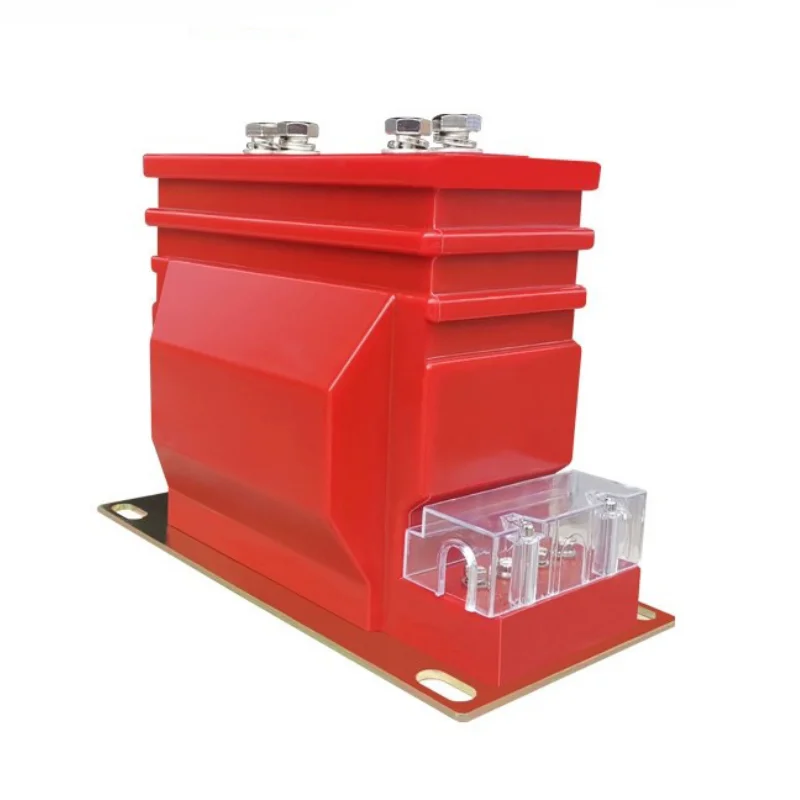


Description
LZZBJ9-10 at a Glance
The LZZBJ9-10 current transformer is a pillar-type, epoxy-resin cast unit for indoor 10 kV switchgear, covering primary currents from 5 A to 1,000 A with secondary outputs of 5 A, 1 A or 2 A. It is used for current measurement, energy metering and relay protection in air-insulated cubicles, ring main units and compact distribution boards.
The LZZBJ9-10 current transformer series is built around a ratio matrix rather than a single rating. Thermal and dynamic withstand scale with the primary current, and the accuracy class can be combined across two cores, so the specification work is about picking a row from that matrix rather than choosing a model number.
Reading the Type Designation
| Element | Meaning | What it decides |
|---|---|---|
| L | Current transformer (电流互感器) | CT, not a voltage transformer |
| Z | Pillar / post type (支柱式) | Stands on a base plate inside the cubicle |
| Z | Cast-resin insulation (浇注绝缘) | Epoxy body, no oil |
| B | With protection winding (带保护级) | A protection core is part of the design |
| J | Enhanced design variant | Distinguishes this frame from the LZZB family |
| 9 | Design sequence | Frame family |
| 10 | Voltage class in kV | 10 kV indoor |
The Ratio Matrix: 5 A to 1,000 A
This table is the working document for selection. Every row is a primary current range with its own short-time thermal and dynamic withstand, and the withstand does not scale smoothly with the ratio.
| Primary current | Accuracy class combinations | Rated output | 1 s thermal current | Rated dynamic current |
|---|---|---|---|---|
| 5 – 100 A | 0.2/0.5; 0.2S/0.2; 0.5/10P10; 0.2S/10P10 | 10/10 VA; 10/15 VA | 150 × I1n | 375 × I1n |
| 150 A | As above | 10/15 VA | 22.5 kA | 44 kA |
| 200 – 300 A | As above | 10/15 VA | 24.5 kA | 44 kA |
| 400 – 600 A | As above | 10/15 VA | 45 kA | 90 kA |
| 800 – 1,000 A | As above | 10/15 VA | 63 kA | 100 kA |
Two things stand out. First, at the small ratios the withstand is expressed as a multiple of primary current, so a 50/5 unit carries 7,500 A for one second. Second, the jump between the 150 A and 200 A rows is small, but the jump from 300 A to 400 A nearly doubles the withstand. A feeder whose fault level sits just above the 300 A row has to move to the 400 A frame, and that is a different casting rather than a different nameplate.
Accuracy Class Combinations
The LZZBJ9-10 current transformer normally carries two cores, and the class of each is chosen independently. The published combinations are 0.2/0.5, 0.2S/0.2, 0.5/10P10 and 0.2S/10P10.
- 0.2 and 0.2S are metering classes. The S variant holds its error limit down to 1 percent of rated current rather than 5 percent, which matters where the load swings wide.
- 0.5 is the standard metering class for sub-metering and internal energy accounting.
- 10P10 is a protection class: composite error within 10 percent up to an accuracy limit factor of 10 times rated current.
Rated output is 10/10 VA or 10/15 VA depending on the pairing. That is a modest burden, enough for a digital meter and a relay but not for a panel full of electromagnetic instruments. If the connected burden is higher, state it, because the class and the output are tied together and cannot be upgraded independently.
Dual Ratio Windings
Beyond the standard single ratio, the LZZBJ9-10 current transformer can be wound for two ratios on the same primary, marked as 200/5/5 A or 400/5/5 A. This is a practical answer to a common problem: a substation built for one load level that will later be expanded.
A dual-ratio unit lets the metering be set to the lower ratio at commissioning and changed to the higher one when the load grows, without replacing the transformer. The secondary terminals carry both circuits, and the ratio in use is selected by linking the secondary terminals rather than by rewiring the primary.
Specify dual ratio at the order stage. It changes the winding and the terminal arrangement, and it cannot be added to a unit already cast.
Thermal and Dynamic Withstand
These two figures are what a switchgear designer checks against the busbar rating, and they are often left off a CT quotation.
- Short-time thermal current, 1 second is the current the primary winding carries for one second without exceeding its temperature limit. It must be at least the fault level at the installation point.
- Rated dynamic current is the peak of the first asymmetric half-cycle, roughly 2.5 times the thermal value. It sets the mechanical stress on the primary bar and its supports.
A mismatch here is not a performance issue but a safety one: a CT whose thermal rating is below the board’s fault level can burst its casting under a close-in fault. Compare both figures with the switchgear rating before ordering, not after.
Insulation Level Options
The unit is published at 12/42/75 kV, and a 24 kV version is available at 24/65/125 kV. The higher option is not a marketing upgrade: it is used where the same physical cubicle is specified for a 24 kV system, or where a 10 kV board is built into equipment rated for the higher class.
Confirm the insulation level against the cubicle’s type test rather than the nominal system voltage. A 10 kV board built to 24 kV class needs the higher-rated CT, or the bay’s insulation coordination no longer holds.
Mounting in Air-Insulated Switchgear
The LZZBJ9-10 current transformer mounts on a base plate with the primary bar passing through the window, and the secondary terminals are brought out at the base. The compact footprint is what allows the unit to sit in a dense cubicle alongside a voltage transformer and an earth switch.
Two outline drawings cover the frame sizes in the published data; the correct one depends on the ratio and the number of cores. Send the cubicle drawing and the required ratio, and the matching outline is returned for approval before manufacture.

When a Different CT Fits Better
- Shielded terminals and anti-tamper metering. The LZZBJ12-10 current transformer uses a different secondary arrangement with shielded outlets, which suits revenue metering where the terminals are accessible.
- Outdoor 35 kV duty. The LZZBW-35 outdoor current transformer covers that class.
- Higher accuracy at larger burden. Where the burden exceeds 15 VA at 0.2 class, a larger frame is required; state the burden and the ratio together.
The full range sits under current transformers.
Service Conditions
Indoor installation at altitudes up to 1,000 m, ambient from -5 °C to +40 °C, relative humidity below 90 percent at 20 °C, and no corrosive gas, conductive dust or explosive atmosphere. The cast body resists moisture, which is why it is used in humid and tropical switchrooms.
Above 1,000 m the external insulation needs correction. State the altitude with the inquiry rather than assuming the standard build applies.
Standards and Routine Tests
Routine tests on every unit cover power-frequency withstand, insulation resistance, ratio and polarity, ratio error and phase displacement at the rated output for each core, and a partial-discharge check. Type test reports for temperature rise, short-time thermal and dynamic current, and impulse withstand are available for project documentation.
Manufacturer Supply, OEM and Wholesale
The LZZBJ9-10 current transformer is manufactured and supplied direct. Switchgear builders order against a frozen ratio and class specification under OEM or private-label marking; distributors hold a standing specification for repeat supply; project buyers receive drawings and test reports for consultant approval.
Dual-ratio windings, non-standard secondary currents and specific class combinations are quoted because the winding is built to order rather than taken from stock.
Price, MOQ and Lead Time
- MOQ. Single units for standard ratios. Dual-ratio windings and private-label marking carry a higher minimum.
- Price drivers. Primary current, number of cores, accuracy classes, rated output and quantity. Dual-ratio windings sit above single ratio at the same primary current.
- Lead time. Confirmed against the production schedule at order.
- Payment. Deposit with balance against the bill of lading copy; letter of credit for project quantities.
What to Send With Your Inquiry
- System voltage and the cubicle insulation class
- Primary current, or the transformer rating to derive it
- Secondary current: 5 A, 1 A or 2 A
- Accuracy class for each core, and the connected burden
- Single ratio or dual ratio, and the two ratios if dual
- Fault level at the installation point, for the withstand check
- Quantity, destination port and required delivery date
Send those through the quote form on this page. The ratio and the burden together decide the frame, so including both avoids a second round.
FAQ
What primary current range is available?
What is the difference between 0.2 and 0.2S?
What does dual ratio 200/5/5 A mean?
Can I get 0.2 class at 30 VA?
What is the 24 kV option for?
What is the MOQ?
Request Quote
Tell us your specifications, quantity, or application scenario and we will reply with a tailored quote.