
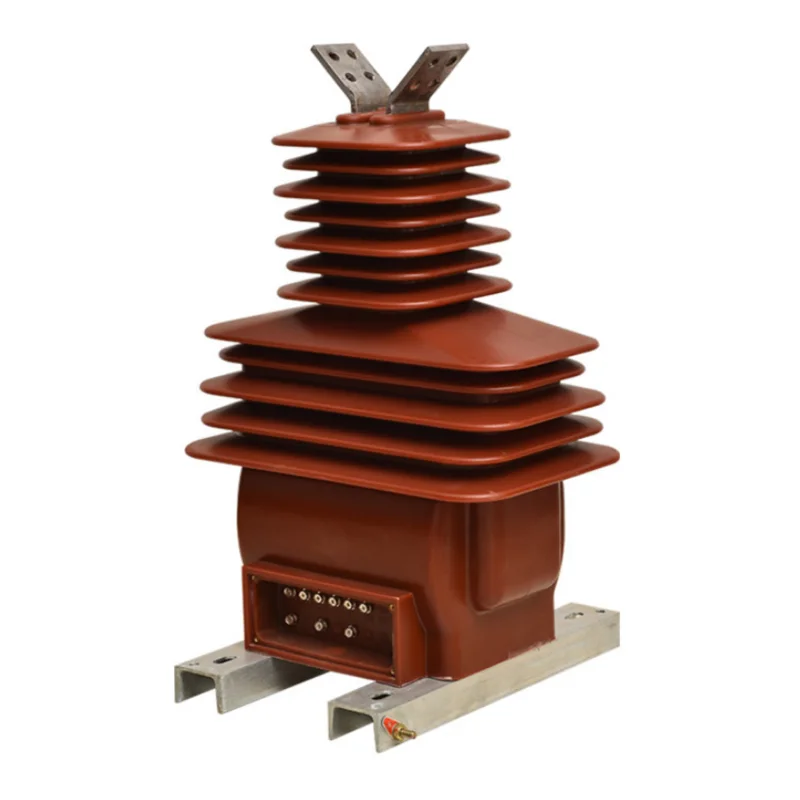

Description
The LZZBW-35 outdoor current transformer is a pillar-type, fully enclosed epoxy-resin cast unit for 35 kV distribution systems. It steps primary current down to a standard 5 A or 1 A secondary signal for meters, protection relays and monitoring equipment, and it is built to sit outdoors on a structure rather than inside a switchgear cubicle.
The series covers two versions, LZZBW-35A and LZZBW-35B, with accuracy classes 0.2S, 0.5 and 10P, rated output of 10 to 20 VA, and short-time thermal capability up to 80 kA for 1 s. Typical installations are 35 kV feeder bays in outdoor substations, industrial plant distribution yards and utility metering points.
Technical Parameters
The figures below are the published ratings for the standard series. Where a value is marked as project-specific, it is fixed at order confirmation against your single-line diagram.
| Parameter | Value |
|---|---|
| Rated voltage | 35 kV |
| Highest voltage for equipment (Um) | 40.5 kV |
| Rated insulation level | 40.5 / 95 / 185 kV (power frequency / lightning impulse) |
| Rated frequency | 50 Hz or 60 Hz |
| Rated primary current | Specified per project |
| Rated secondary current | 5 A or 1 A |
| Accuracy class | 0.2S, 0.5 (metering); 10P (protection) |
| Rated output (burden) | 10 – 20 VA |
| Short-time thermal current (Ith) | up to 80 kA / 1 s |
| Rated dynamic current (Idyn) | up to 160 kA |
| Installation | Outdoor, pillar type, base mounting |
| Pollution level | Class II or Class III (customizable) |
| Standards | IEC 60044-1, GB 1208 |
How to Read the LZZBW-35 Type Designation
The code on the LZZBW-35 outdoor current transformer follows the Chinese instrument transformer naming convention (GB 1208 / JB/T series), and every letter tells you something about how the unit is built. Buyers comparing offers from different Chinese suppliers can use this to spot a mismatched quotation quickly.
| Character | Meaning | What it tells the buyer |
|---|---|---|
| L | Current transformer (电流互感器) | This is a CT, not a voltage transformer |
| Z | Pillar / post type (支柱式) | Stands on a base plate; not a through-wall or bushing type |
| Z | Cast resin insulation (浇注绝缘) | Epoxy cast body, no oil, no gas |
| B | With protection winding (带保护级) | A 10P protection core is part of the design, not an add-on |
| W | Outdoor (户外) | UV and pollution resistant casting; not for indoor cubicles |
| 35 | Rated voltage 35 kV | Highest voltage for equipment is 40.5 kV |
| A / B | Mechanical version | Two outline variants of the same electrical design |
LZZBW-35A and LZZBW-35B: What Actually Differs
Both versions of the LZZBW-35 outdoor current transformer share the same insulation level, the same accuracy classes and the same short-circuit ratings. What separates them is the outline, and that is the part that decides whether the unit bolts straight onto your existing bracket or needs an adapter plate.
Because the dimensions differ, picking A or B from a catalogue is a reliable way to end up with a unit that does not fit. Send the bracket drawing or the busbar spacing from your structure, and we return the dimension sheet for the matching version before you commit to a purchase order. If you already have a reference number from an earlier project, send that as well and we will confirm the equivalent.
Choosing the Accuracy Class: 0.2S, 0.5 or 10P
Accuracy class is where most specification errors happen, and it is usually because the metering core and the protection core get treated as one requirement.
- 0.2S holds its error limit across 1% to 120% of rated current, which makes it the right choice where the load swings widely: utility billing points, renewable feeders and plant main incomers.
- 0.5 is the workhorse metering class for sub-metering and internal energy accounting, where the load stays closer to rated current.
- 10P is a protection class. The composite error stays within 10% up to the accuracy limit factor, so it is specified alongside an ALF value rather than a burden figure.
One unit can carry both a metering core and a protection core, which is the normal configuration for a feeder bay. If your inquiry lists only one accuracy class and the bay also needs overcurrent protection, say so, because a dual-core design changes the secondary terminal arrangement and the price. The relationship between ratio, burden and accuracy is covered in more detail in our guide to current transformer ratios, 0.5 class accuracy and VA ratings.
Secondary current is the other half of that decision. A 1 A secondary is worth specifying on long cable runs from a remote structure, because the lower current cuts the burden the leads impose on the core. For short runs inside a compound, 5 A is cheaper and more common.
When LZZBW-35 Is the Wrong Choice
This LZZBW-35 outdoor current transformer is built for that position on the structure and nothing else. The W in the code is not decorative, and using the unit inside a metal-clad cubicle creates clearance and pollution-tracking problems that no amount of derating fixes.
- Indoor 10 kV switchgear: use a cast-resin indoor CT instead. Our LZZBJ9-10 indoor current transformer covers the standard 10 kV cubicle, and the LZZBJ12-10 covers the same duty where a different outline or larger ratio set is needed.
- Systems above 35 kV: outside the range of this series.
- Currents beyond the thermal rating: if your prospective short-circuit current exceeds 80 kA for 1 s, the standard unit will not hold and a higher-rated frame is required.
If you are not sure which of these applies, send the single-line diagram and the switchgear type. Getting the classification right before quoting is faster than correcting a wrong shipment.
Service Conditions and Altitude Correction
For the LZZBW-35 outdoor current transformer, the standard service envelope is a 1,000 m altitude limit, ambient temperature from -25 °C to +40 °C, outdoor installation, and pollution Class II or Class III. Those are the conditions the published insulation figures assume.
Above 1,000 m, air density falls and the external insulation has to be corrected, which is why you will sometimes see 2,500 m quoted for units in this class. Altitudes up to 2,500 m are available, but the design should be confirmed at order rather than assumed, because the correction affects creepage and the applicable test voltages.
Pollution level is the other condition worth stating explicitly. Class III covers most coastal and industrial sites; if your site has salt fog or heavy conductive dust, say so and we will confirm the creepage distance against the drawing instead of shipping the standard casting.
Standards, Tests and Documentation
Units are manufactured and tested to IEC 60044-1 and GB 1208. Routine tests on every unit cover insulation resistance, power-frequency withstand on the primary and between sections, ratio and polarity, ratio error and phase displacement, and secondary winding resistance.
Type test reports covering temperature rise, short-time thermal and dynamic current, and lightning impulse are available on request for project documentation packs. If your tender requires third-party witnessing or a specific laboratory, tell us at the inquiry stage, because that changes the schedule rather than the price. Construction details of the cast body and the core arrangement are described in our note on current transformer construction, materials and insulation.
Mounting and Outline Dimensions
The LZZBW-35 outdoor current transformer mounts on a base plate with fixing holes, primary connections at the top and the secondary terminal box accessible from the side. The drawing below gives the outline for the series. Confirm the version against it before ordering, since the A and B outlines differ.

What to Send With Your Inquiry
A complete request lets us quote a firm price in one reply instead of three rounds of questions. The list below covers what actually changes the answer.
- System voltage and highest voltage for equipment
- Rated primary current, or the transformer capacity and voltage ratio to derive it
- Secondary current: 5 A or 1 A
- Accuracy class and rated output for the metering core
- Protection class and accuracy limit factor, if a protection core is needed
- Rated frequency, 50 Hz or 60 Hz
- Installation: bracket drawing or busbar spacing, and the required A or B version if known
- Pollution level and site altitude
- Quantity, destination port and required delivery date
Standard versions ship from single units, so a trial order is possible. Custom ratios, non-standard nameplate marking and private labeling carry a higher minimum, and the exact figure depends on the winding setup. Browse the full current transformer range if you are still comparing frame sizes, or send the parameters above and we will confirm the LZZBW-35 configuration that matches your bay.
FAQ
What is the difference between LZZBW-35A and LZZBW-35B?
Can one unit supply both metering and protection?
What is the standard altitude limit?
Which documents come with the shipment?
Can the ratio and accuracy class be customized?
What is the minimum order quantity?
Request Quote
Tell us your specifications, quantity, or application scenario and we will reply with a tailored quote.