


Description
JCZ5 Series at a Glance
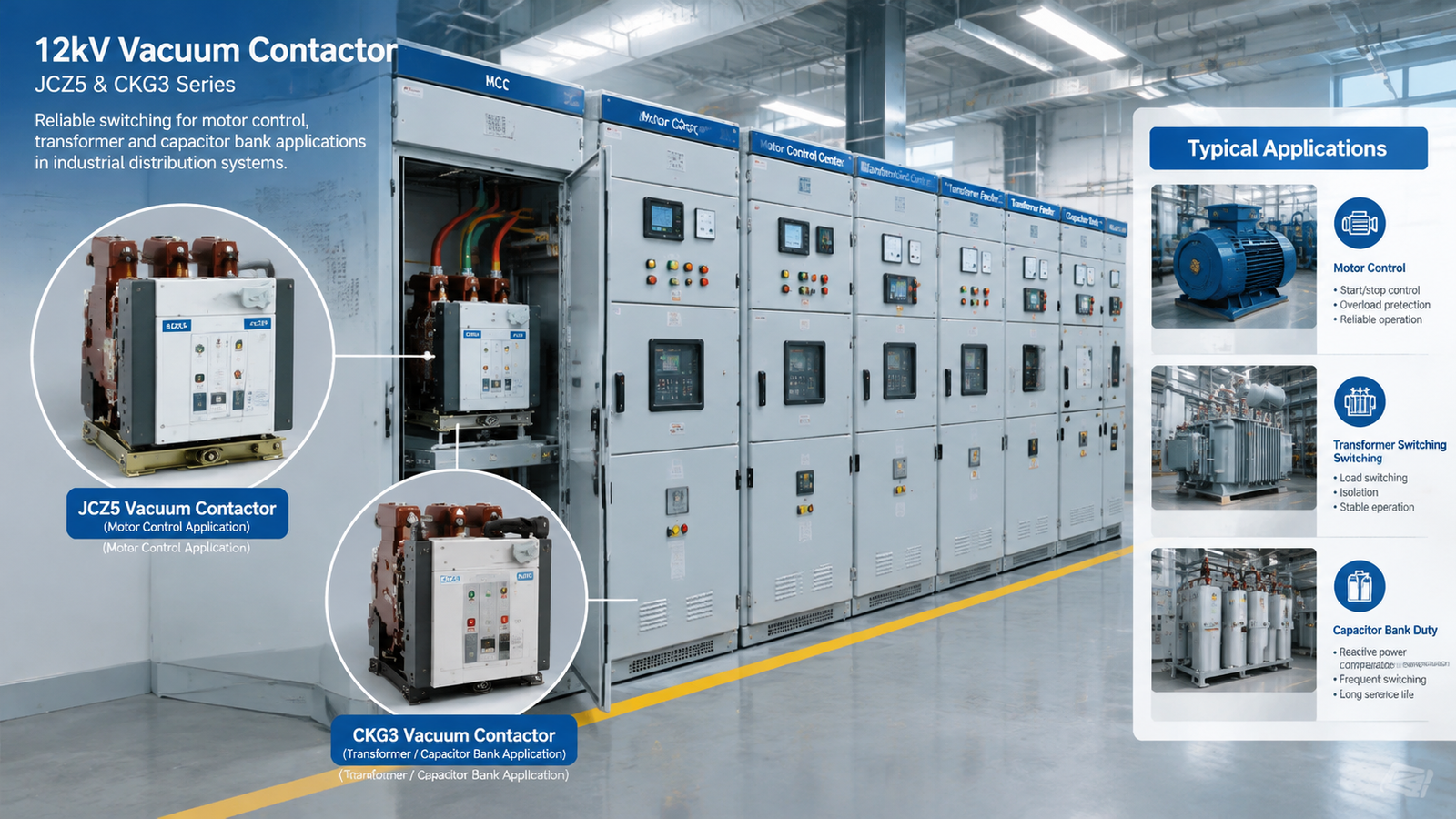
The JCZ5 7.2kV AC vacuum contactor is an indoor unit for three-phase 50 Hz systems where a circuit is switched often enough that a circuit breaker would wear out. It covers 250 A, 400 A and 630 A primary ratings, with 7.2 kV and 12 kV variants built on the same insulation platform. Typical duty is motor starting, transformer switching and capacitor bank control in plant distribution rooms.
Unlike a breaker, the JCZ5 7.2kV AC vacuum contactor is built for a high number of operations rather than for clearing fault current. That distinction drives almost every selection decision on this page, from the current rating to the duty category.
Reading the JCZ5 Type Designation
The code follows the Chinese high-voltage contactor convention, and each element narrows down what you are ordering.
| Element | Meaning | Why it matters |
|---|---|---|
| J | Contactor (接触器) | Switching device for frequent duty, not a fault-clearing breaker |
| C | Vacuum arc-quenching chamber | Sealed vacuum interrupter, no oil or gas |
| Z | General-purpose / direct-acting design | Standard frame, indoor installation |
| 5 | Design sequence | Distinguishes this generation from CKJ and CKG3 frames |
| 250 / 400 / 630 | Rated current in amps | The number that sets the load you can switch |
Electrical Ratings by Current Variant
The three current options of the JCZ5 7.2kV AC vacuum contactor share insulation and control data. What changes is the current the unit can carry and break, which is the row that should decide your selection.
| Parameter | Unit | 250 A | 400 A | 630 A |
|---|---|---|---|---|
| Rated voltage | kV | 7.2 / 12 | ||
| Rated current | A | 250 | 400 | 630 |
| Rated making capacity | A | 2,500 | 4,000 | 6,300 |
| Rated maximum breaking current | A | 2,000 | 3,200 | 5,040 |
| 4 s short-time thermal current | A | 2,500 | 4,000 | 6,300 |
| Power-frequency withstand, main circuit | kV | 42 | ||
| Permitted operating frequency | ops/hour | 300 | ||
| Electrical life, AC-3 | operations | 250,000 | ||
| Electrical life, AC-4 | operations | 100,000 | ||
The series is built on the 12 kV insulation level, so the 42 kV power-frequency withstand applies to both the 7.2 kV and 12 kV variants. If your specification asks for a lower withstand figure at 7.2 kV, this unit exceeds it rather than matching it exactly.
Control and Mechanical Data
| Parameter | Published value |
|---|---|
| Control-circuit rated voltage | AC 110 / 220 V |
| Closing-coil current | ≤ DC 6 / 3 A |
| Holding-coil current | D: DC 0.32 / 0.16 A |
| Shunt-trip coil current | J: DC 2.5 / 1.3 A |
| Contact gap | 1.5 ± 0.5 mm |
| Average closing speed | 0.1 – 0.25 m/s |
| Average opening speed | 0.3 – 0.6 m/s |
| Three-phase opening synchronism | ≤ 2 ms |
| Closing / opening time | ≤ 150 / ≤ 50 ms |
| Resistance at 20 °C | ≤ 250 μΩ |
Choosing Between 250 A, 400 A and 630 A
Choosing a frame for the JCZ5 7.2kV AC vacuum contactor starts with the motor’s full-load current, plus margin, rather than its nameplate amps alone. Two rules cover most of the cases we quote:
- Continuous current. Take the motor full-load current and add the margin your site standard requires, usually 10 to 25 percent for a contactor in a ventilated cubicle.
- Making current. A direct-online motor draws roughly six times full-load current at start. The making capacity of the unit, 2,500 A at the 250 A rating, is what has to absorb that, and it is the figure that most often forces a step up in frame size.
For a 110 kW 6 kV motor running near 130 A, the 250 A frame covers continuous duty with room to spare. For a 200 kW motor pulling 230 A with direct-online starting, the start current lands near 1,400 A, still inside the 250 A making capacity, so the jump to 400 A is usually driven by site margin policy rather than by the switching duty itself. Send the motor data and we will confirm which frame you actually need instead of quoting the largest one.
AC-3 and AC-4 Duty: Where the Life Figures Come From
The published electrical life differs by a factor of two and a half between the two utilisation categories, and that difference is the single most common reason a contactor is replaced early.
- AC-3 covers squirrel-cage motors switched while running. The contactor makes at roughly six times rated current and breaks at rated current, so the arc is mild. Published life is 250,000 operations.
- AC-4 covers plugging, inching and reversing, where the contactor breaks the starting current. The arc energy goes up sharply and life drops to 100,000 operations.
If your application inches a motor or reverses it under load, specify against AC-4 even if the datasheet headline quotes AC-3. Sizing on AC-3 for an AC-4 duty is how a unit ends up failing inside its warranty period. The difference between contactors and breakers in this respect is covered in our comparison of vacuum contactors versus breakers.
Mechanical Latch or Electromagnetic Hold
Both arrangements are available. An electromagnetic hold keeps the contactor closed only while the coil is energised, so a control-power loss drops the load. A mechanical latch stays closed without holding current, which suits circuits that must remain energised through a control-supply interruption, and it removes continuous coil consumption from the panel.
The trade-off is that a latched unit needs an explicit trip command to open, which changes the control scheme and the interlocking logic. Tell us which behaviour your panel is designed for before the order, because the coil set and the wiring terminals differ.
When JCZ5 Is the Wrong Choice
The JCZ5 7.2kV AC vacuum contactor is not a breaker, and this frame is an indoor unit. Two mistakes account for most of the mismatched orders we see.
- Fault current protection. A contactor does not clear short-circuit current on its own. It is used with fuses or upstream protection. If you need a device that interrupts fault current, look at our CKG3 12 kV vacuum contactor range for the switching duty, or a vacuum circuit breaker for the protective function.
- Ratings above 12 kV. The JCZ5 tops out at 12 kV. For 40.5 kV duty, a different frame is required.
- Higher switching current at 7.2 kV. If you need the 1.6 kA to 6.3 kA making range with plateau altitude options, the CKG3 7.2 kV contactor is the closer match.
The full frame range sits under vacuum contactor series if you are still comparing sizes.
Service Conditions and What Changes Outside Them
The published envelope is 1,000 m altitude, ambient from -5 °C to 40 °C with a 24-hour average no higher than 35 °C, relative humidity up to 50 percent at 40 °C, and pollution degree 3.
Above 1,000 m the reduced air density lowers the external withstand, so the insulation has to be corrected or the current derated. Ambient above 40 °C has the same effect on the current rating. Neither condition is unusual in tropical or highland projects, but both need to be stated at the quotation stage, because the standard unit is tested to the envelope above and nothing more.
Standards and Routine Tests
Units are built and tested to the high-voltage contactor standards referenced in the published data. Routine tests on every unit cover power-frequency withstand on the main circuit, on the auxiliary circuit and on the control circuit, contact resistance, and a mechanical operation check.
Type test reports for temperature rise, short-time withstand and electrical life are available for project documentation. If your tender requires third-party witnessing, raise it at the inquiry stage, because it changes the schedule.
Manufacturer Supply, OEM and Wholesale
Kampa Electric manufactures this frame and supplies it both to end projects and to the trade. That covers three common purchasing patterns:
- Project supply. Single units or a full switchgear bill of materials, with test reports and outline drawings issued for approval.
- OEM and private label. Nameplate marking, terminal labelling and documentation sets under your own brand, with the coil voltage and control arrangement fixed to your scheme.
- Wholesale and distributor supply. Repeat orders against a fixed specification, packed for export and consolidated with other frames from the same category.
Because the unit is made rather than traded, non-standard control voltages, alternative coil arrangements and specific terminal layouts can be quoted instead of refused. We do not publish factory capacity figures, but we will confirm the production slot for your quantity in the quotation.
Price, MOQ and Lead Time
There is no single list price for this frame, because the coil arrangement, the latch type and the quantity all move it. What we can state clearly:
- MOQ. Standard configurations ship from single units, so a trial order or a spares purchase is possible. Custom nameplates and private-label packaging carry a higher minimum.
- Price drivers. Current rating, control voltage, mechanical latch versus electromagnetic hold, and order quantity. The 630 A frame carries more copper and sits above the 250 A.
- Lead time. Confirmed against the production schedule at order. Standard configurations move faster than custom coil or label work.
- Payment. Standard terms are a deposit with the balance against the bill of lading copy. Larger project quantities can be quoted on letter of credit.
Send the quantity with the technical data and you get a firm figure rather than a range.
What to Send With Your Inquiry
A complete request for the JCZ5 7.2kV AC vacuum contactor gets a firm quotation in one reply. The list below covers what actually changes the answer:
- System voltage and rated current required
- Load type: motor, transformer or capacitor bank
- Utilisation category, AC-3 or AC-4
- Expected operations per hour
- Control-circuit voltage and latch arrangement
- Installation altitude and ambient temperature range
- Quantity, destination port and required delivery date
Send those details through the quote form on this page, or start with our overview of what a vacuum contactor is and where it is used if the duty category is still unclear.
FAQ
What current ratings does the JCZ5 range cover?
What is the difference between AC-3 and AC-4 for this unit?
Does a contactor clear short-circuit current?
What control voltage is available?
What is the difference between mechanical latch and electromagnetic hold?
What is the MOQ and lead time?
Request Quote
Tell us your specifications, quantity, or application scenario and we will reply with a tailored quote.