


Description
JDZ10 Series at a Glance
The JDZ10 cast voltage transformer is a single-phase, fully enclosed epoxy-resin unit for indoor 3 kV, 6 kV and 10 kV systems. It steps primary voltage down to a standard secondary level for meters, transducers and protection relays, and its fully cast body means there is no oil to test and no gas to monitor over the service life.
The three voltage classes of the JDZ10 cast voltage transformer share one design, so a project with mixed 6 kV and 10 kV boards can standardise on a single frame and change only the ratio and the accuracy class. Both A and B mechanical variants are available within each class.
Reading the JDZ10 Type Designation
| Element | Meaning | Practical effect |
|---|---|---|
| J | Voltage transformer (电压互感器) | This is a PT, not a current transformer |
| D | Single-phase | One unit per phase; three units for a three-phase set |
| Z | Cast-resin insulation (浇注绝缘) | Epoxy body, no oil |
| 10 | Design sequence | Frame family, not the rated voltage |
| 3 / 6 / 10 | Voltage class in kV | The figure that has to match your system |
| A / B | Mechanical variant | Outline and mounting differ; electrical data does not |
The one trap in this code is the number in the model name. JDZ10 is the frame designation, and it is used across 3 kV, 6 kV and 10 kV builds. Ordering “JDZ10” without stating the voltage class leaves the ratio undefined.
Voltage Class and Ratio Selection
The voltage class has to match the system’s highest voltage for equipment, not the nominal system voltage alone. A 10 kV nominal system typically uses a 10 kV or 12 kV class device depending on the insulation coordination in the switchgear.
| Parameter | JDZ10-3 | JDZ10-6 | JDZ10-10 |
|---|---|---|---|
| Voltage class | 3 kV | 6 kV | 10 kV |
| Phase | Single phase | ||
| Rated frequency | 50 Hz or 60 Hz | ||
| Insulation | Fully insulated epoxy-resin cast | ||
| Enclosure | Fully enclosed | ||
| Installation | Indoor | ||
| Secondary voltage | Fixed per project | ||
| Accuracy class | Fixed per project | ||
| Rated output | Fixed per project | ||
Secondary voltage, accuracy class and rated output are set at order because they follow the metering scheme rather than the frame. Sending the ratio and the burden you need with the inquiry is faster than picking from a list, because the winding is built for the project.
Accuracy Class for Metering and Protection
The JDZ10 cast voltage transformer is usually specified with two cores doing two different jobs, and treating them as one requirement is the most common specification error on this type of unit.
- Metering cores are specified at 0.2, 0.5 or 1.0 class. The class applies over a defined voltage range and burden range, so the burden value matters as much as the class number. A 0.5 class unit run at double its rated burden will not hold 0.5.
- Protection cores are specified at 3P or 6P. These are selected for behaviour during faults, particularly residual voltage performance, rather than for accuracy at normal voltage.
If the switchgear bay does both metering and protection, say so, because a dual-core design changes the secondary terminal arrangement and the frame height. The relationship between ratio, class and burden is covered in more depth in our guide to voltage transformers and instrument PT accuracy.
Insulation and Construction
The body of the JDZ10 cast voltage transformer is cast in epoxy resin with full insulation and full enclosure. In practice that gives you three things worth knowing:
- No oil maintenance. There is no oil level to check and no oil test schedule, which matters in a panel that is not frequently opened.
- Surface behaviour in humid switchrooms. A cast body is less sensitive to condensation than an open construction, but the creepage still has to be right for the pollution level on site.
- Mounting flexibility. The unit can be installed in more than one orientation, which is what allows it to fit into existing cubicle layouts without a redesign.


Where the JDZ10 Fits
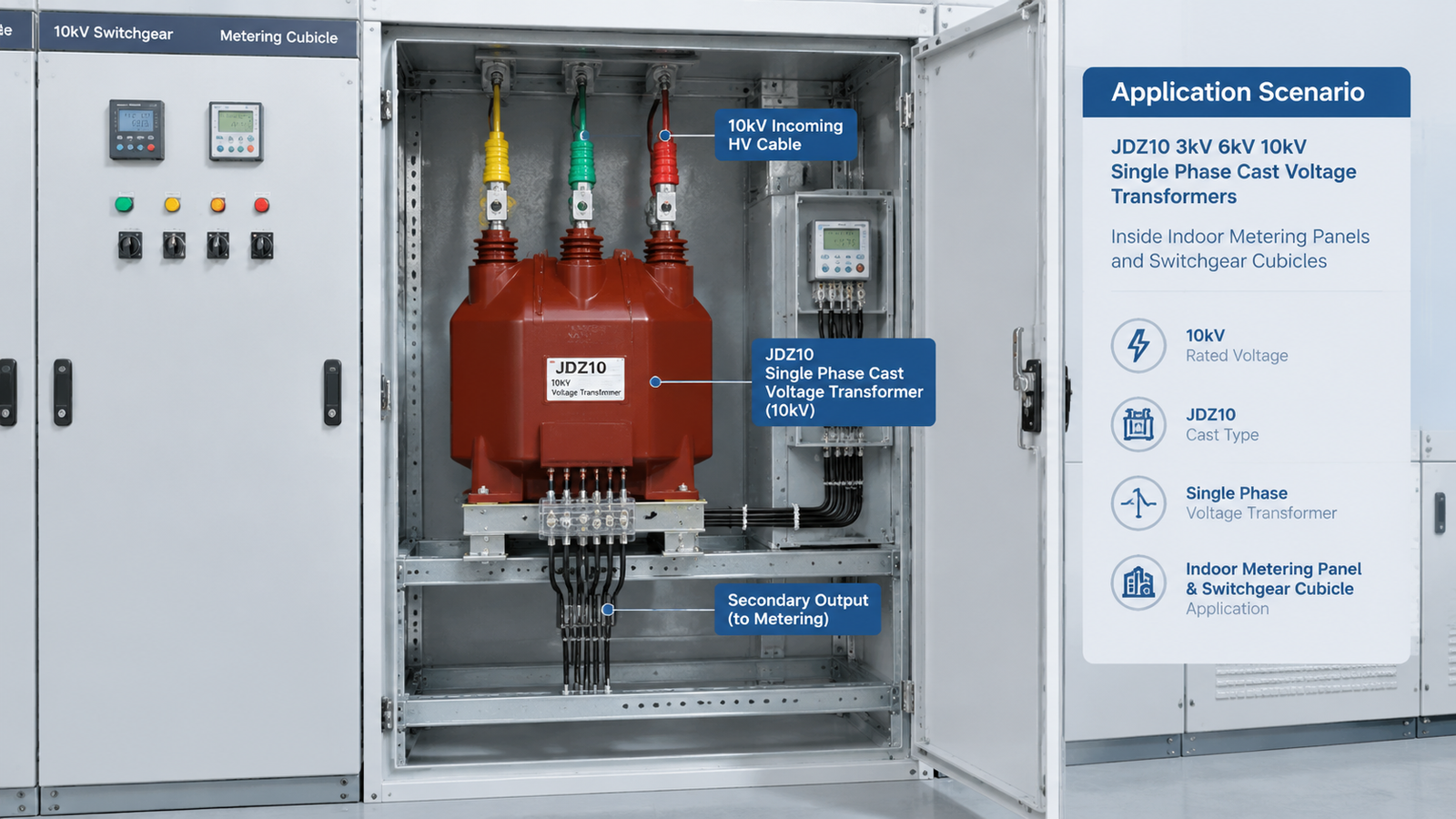
The JDZ10 cast voltage transformer is an indoor unit. It is normally bolted inside a metal-clad cubicle or a metering panel, with the primary connection taken from the busbar and the secondary wiring run to the meter or relay compartment.
Typical installations are substation switchgear, distribution panels, industrial plant boards and commercial metering cabinets. If the unit is destined for an outdoor structure or a pad-mounted enclosure, this is the wrong frame, and the outdoor construction should be quoted instead.
When the JDZ10 Is the Wrong Choice
- Circuits that need integrated fuse protection. Where the PT is fed from a tap that requires a fuse in the primary circuit, use the JDZX18 voltage transformer with fuse, which carries the fuse in the same enclosure.
- Outdoor installation. This frame is indoor. An outdoor structure needs a unit rated and built for it.
- Current measurement. This is a voltage transformer. For current measurement in the same panel, see the voltage transformer range for voltage duty and the current transformer category for current duty.
Service Conditions
The published envelope covers indoor installation at altitudes up to 1,000 m, ambient from -25 °C to +40 °C, and pollution Class II or Class III. Where a site needs Class III or heavier, state it at the inquiry: the creepage distance is set during casting and cannot be changed afterwards.
Above 1,000 m the external insulation has to be corrected for reduced air density. Units for higher altitudes are available, but they are not the standard build, so the altitude belongs in the inquiry rather than in a footnote.
Standards and Routine Tests
Units are manufactured and tested to the instrument transformer standards referenced for this family. Routine tests on every unit cover power-frequency withstand on the primary, insulation resistance, ratio and polarity, and ratio error and phase displacement at the specified burden.
Type test reports covering temperature rise and impulse withstand are available for project documentation. If your tender requires a specific laboratory or third-party witnessing, raise it at the inquiry stage, since it affects the schedule rather than the unit price.
Manufacturer Supply, OEM and Wholesale
The JDZ10 cast voltage transformer is manufactured and supplied direct, covering three purchasing patterns:
- Project supply. Units matched to a switchgear bill of materials, with drawings and test reports issued for approval.
- OEM and private label. Nameplate marking and documentation under your brand, with the ratio, class and burden fixed to your metering scheme.
- Wholesale and distributor supply. Repeat orders against a frozen specification, packed for export and consolidated with current transformers and contactors from the same category.
Because the winding is built per order, non-standard ratios and dual-core arrangements are quoted rather than refused.
Price, MOQ and Lead Time
- MOQ. Standard configurations ship from single units, so a spares purchase or a trial order is possible. Custom ratios and private-label marking carry a higher minimum.
- Price drivers. Voltage class, accuracy class, rated output, single or dual core, and quantity. A 0.2 class unit sits above a 0.5 class unit at the same ratio.
- Lead time. Confirmed against the production schedule at order. Standard ratios move faster than custom windings.
- Payment. Standard terms are a deposit with the balance against the bill of lading copy. Project quantities can be quoted on letter of credit.
What to Send With Your Inquiry
- System voltage and the required voltage class
- Voltage ratio, primary and secondary
- Accuracy class and rated output for the metering core
- Protection core class, if a dual-core unit is needed
- Rated frequency, 50 Hz or 60 Hz
- Pollution level and site altitude
- Panel or cubicle type, and the mounting orientation if it is constrained
- Quantity, destination port and required delivery date
Send those details through the quote form on this page and the ratio, class and burden come back confirmed together, rather than as three separate questions.
FAQ
Which voltage classes are available?
Is the JDZ10 suitable for outdoor installation?
Can one unit provide both metering and protection?
What is the difference between the A and B variants?
Is a primary fuse integrated?
What is the MOQ and lead time?
Request Quote
Tell us your specifications, quantity, or application scenario and we will reply with a tailored quote.