



Description
What This Transformer Does
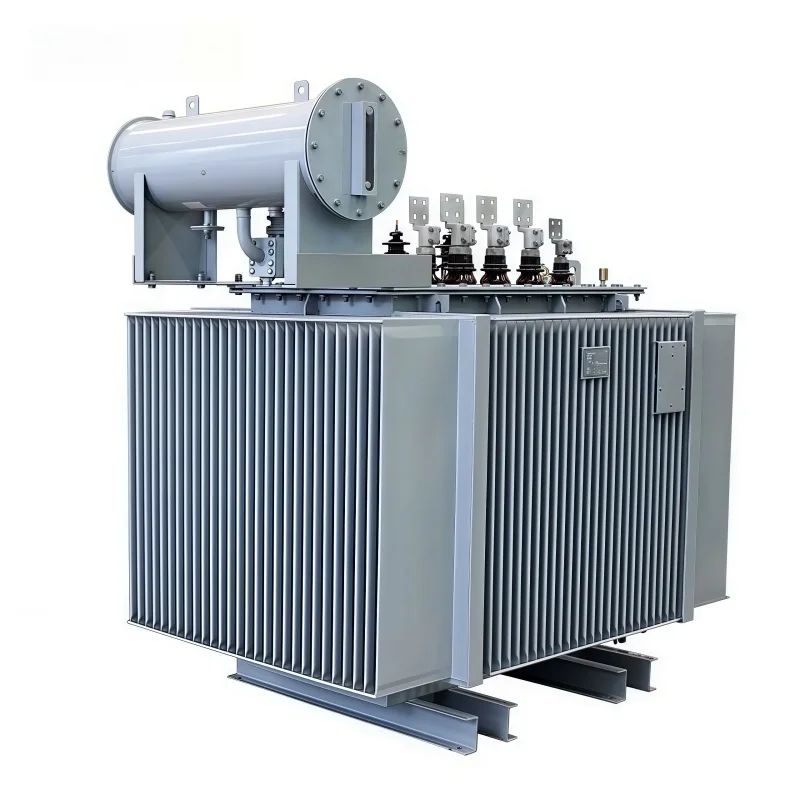
A 35kV oil-immersed distribution transformer steps a 35 kV or 38.5 kV distribution feeder down to 0.4 kV for plant use. The winding sits in insulating oil that also carries the heat away, which is why this type holds up under continuous load and costs less per kVA than a dry-type unit at the same rating.
The 35kV oil-immersed distribution transformer range on this page covers 50 kVA to 2,500 kVA, with off-circuit tap ranges of ±5 percent or ±2 × 2.5 percent. Every rating is built to order, so the capacity, voltage combination and winding material are fixed against your single-line diagram rather than picked from stock.
35 kV Transformer Duty: Step-Down and Feeder Supply
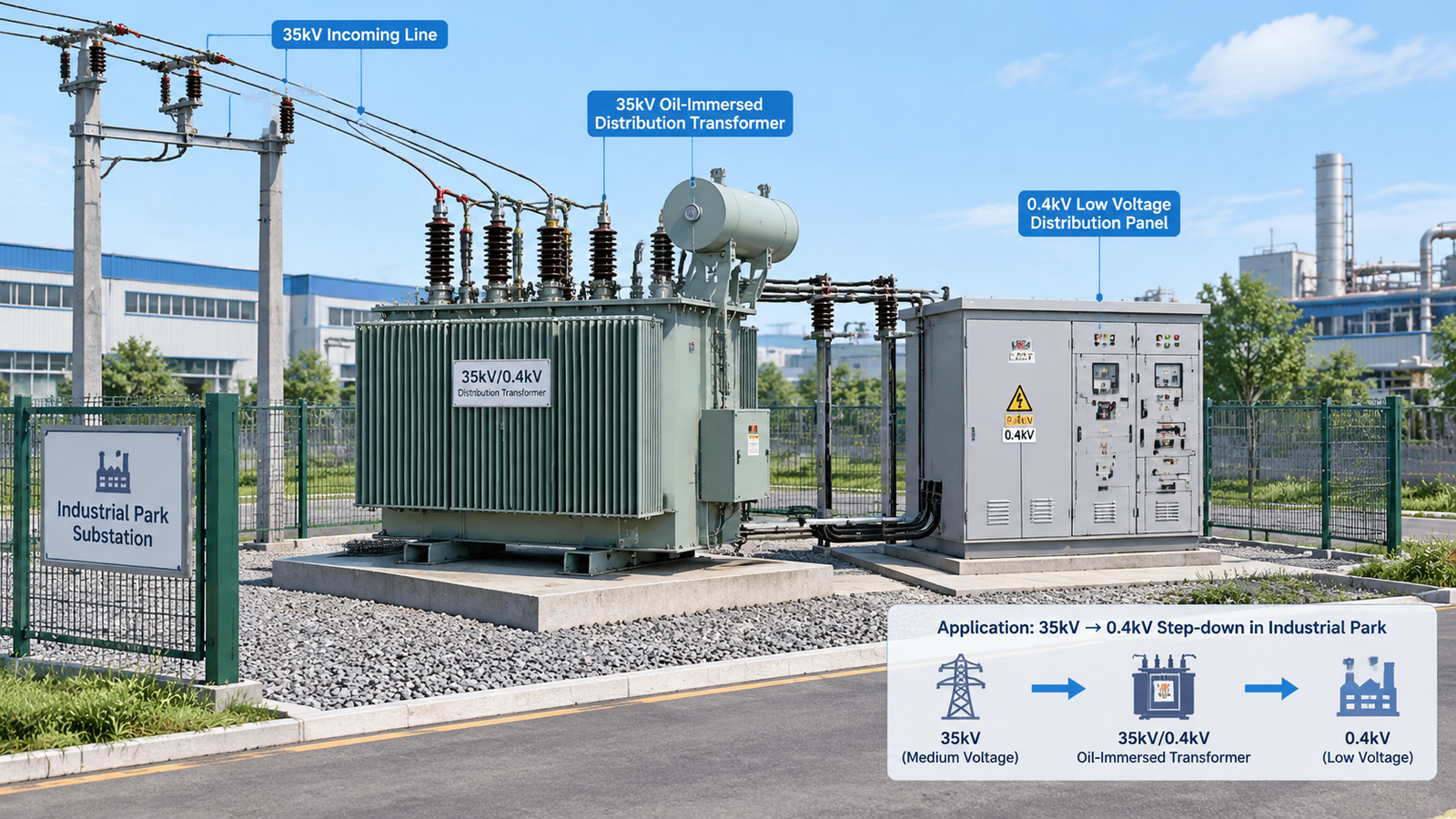
A 35 kV transformer sits one class above the 10 kV and 11 kV equipment most plants start with, and it is ordered for one of two duties. The first is a step-down unit at the boundary of a 35 kV supply, taking the incoming feeder to 0.4 kV for the plant board. The second is a distribution transformer on a 35 kV feeder that runs too far for 10 kV to stay economic.
That distinction decides the specification more than the kVA does. A boundary step-down unit is judged on impedance and on how it behaves downstream of the utility protection. A feeder unit is judged on losses, on voltage regulation at the far end, and on how much unbalanced load it has to carry. Both are built on this frame, and both are quoted from the network data rather than from a catalogue rating.
Where the project sits at 10 kV, 20 kV or 33 kV instead, the oil-immersed distribution transformer range covers those classes at 25 to 2,500 kVA.
Selection Table: 50 to 2,500 kVA
The table gives published no-load and load losses, dimensions and weights for the standard design at each capacity. Loss figures are the values for the standard build; the guaranteed values for your order are confirmed on the routine test report.
| Capacity (kVA) | No-load loss (W) | Load loss (W) | No-load current (%) | L × W × H (mm) | Core section (mm) | Total weight (kg) |
|---|---|---|---|---|---|---|
| 50 | 160 | 1,200 / 1,140 | 1.3 | 1,135 × 935 × 1,825 | 300 × 330 | 860 |
| 100 | 230 | 2,010 / 1,910 | 1.1 | 1,200 × 995 × 1,935 | 470 × 383 | 1,130 |
| 125 | 270 | 1,370 / 2,260 | 1.1 | 1,235 × 940 × 1,955 | 550 × 465 | 1,335 |
| 160 | 280 | 2,820 / 2,680 | 1.0 | 1,235 × 995 × 1,950 | 580 × 465 | 1,475 |
| 200 | 340 | 3,320 / 2,760 | 1.0 | 1,310 × 1,150 × 1,985 | 680 × 595 | 1,755 |
| 250 | 400 | 3,950 / 2,760 | 0.95 | 1,450 × 1,090 × 2,000 | 880 × 650 | 2,000 |
| 315 | 480 | 4,750 / 4,530 | 0.25 | 1,930 × 1,065 × 2,320 | 980 × 765 | 2,290 |
| 400 | 580 | 5,740 / 5,740 | 0.55 | 1,850 × 1,165 × 2,015 | 1,170 × 885 | 2,725 |
| 500 | 680 | 6,910 / 6,580 | 0.55 | 2,045 × 1,205 × 2,415 | 1,340 × 860 | 3,090 |
| 630 | 830 | 7,860 | 0.65 | 2,085 × 1,200 × 2,515 | 1,550 × 855 | 3,810 |
| 800 | 980 | 9,400 | 0.55 | 2,305 × 1,615 × 2,685 | 1,991 × 1,030 | 4,510 |
| 1,000 | 1,150 | 11,500 | 0.60 | 2,445 × 2,000 × 2,550 | 2,450 × 1,405 | 5,055 |
| 1,250 | 1,900 | 13,900 | 0.60 | 2,680 × 2,100 × 2,775 | 2,500 × 1,490 | 5,450 |
| 1,600 | 1,690 | 16,600 | 0.60 | 2,690 × 2,100 × 2,770 | 2,500 × 1,490 | 5,450 |
| 2,000 | 1,990 | 19,700 | 0.55 | 2,790 × 2,180 × 2,860 | 2,720 × 1,590 | 5,600 |
| 2,500 | 2,360 | 23,200 | 0.55 | 2,900 × 2,250 × 2,980 | 2,830 × 1,720 | 5,760 |
Where two load-loss figures are listed, the pair corresponds to the copper and aluminium winding options at that rating. The standard impedance voltage for this range is 6.5 percent, listed against the smallest rating; if your protection coordination calls for a different value, state it at the inquiry, because it changes the winding design.
Voltage Combination and Tap Range
- High voltage: 35 kV or 38.5 kV. The 38.5 kV option gives headroom on a 35 kV system where the supply voltage runs at the upper tolerance.
- Tap range: ±5 percent, or ±2 × 2.5 percent for finer adjustment. Taps are off-circuit, changed with the unit de-energised.
- Low voltage: 0.4 kV as standard. Other secondary voltages are quotable.
- Vector group and impedance: fixed at order against your protection study.
If a replacement unit has to match an existing board, send the old nameplate. The tap range and vector group have to agree, and they are the two items that most often differ between a catalogue unit and the one already installed.
Choosing the kVA Rating
Two calculations decide the rating for a 35kV oil-immersed distribution transformer, and only one of them is about normal load.
- Continuous load. Add the connected load you expect to run simultaneously, apply your diversity factor, and leave the margin your standard requires. A 630 kVA unit is a common answer for a plant with roughly 500 kVA of coincident demand.
- Motor starting and future load. A large direct-online motor can drop voltage across the transformer during start. If the site plans to add load in three to five years, sizing one step up costs far less than replacing the unit later.
As a working example, a plant with 480 kVA of coincident demand and one 200 kW motor starting direct-online usually lands on 630 kVA rather than 500 kVA, because the voltage dip during starting decides it rather than the steady-state load. Send the load list and the largest motor rating and we will run the check instead of quoting by rule of thumb.
Losses and Lifetime Cost
For a 35kV oil-immersed distribution transformer, the purchase price is the smaller half of what the unit costs over its life. No-load loss runs 8,760 hours a year whether the plant is busy or idle, so it is worth capitalising at the quotation stage rather than comparing nameplate prices.
A simple total cost of ownership model:
| Term | Formula | Worked value |
|---|---|---|
| Capitalised no-load loss coefficient A | annuity factor × energy price × 8,760 | 11.22 USD per watt at 8% over 25 years and 0.12 USD/kWh |
| Capitalised load loss coefficient B | A × load factor² | 2.81 USD per watt at a 50% load factor |
| Total cost of ownership | purchase price + A × P0 + B × Pk | — |
Run the numbers on a 630 kVA unit against a cheaper alternative with 40 percent higher no-load loss and the difference in first cost is usually recovered within four to six years. That calculation is also why we ask for the energy price and the expected load factor when a buyer is comparing two quotes on price alone.
Oil-Immersed or Dry-Type
Oil wins on cost per kVA, overload capability and outdoor installation. Dry-type wins on fire safety and on installations where an oil containment vault is not practical.
- Choose oil-immersed for outdoor pad-mounted or fenced installations, plant substations and projects where the budget per kVA matters.
- Choose dry-type for indoor installation in occupied buildings, basements and areas where a fire load of insulating oil is not acceptable. Our medium voltage dry type transformer range covers that side.
The comparison in more depth, including the building-code consequences, is in our guide to oil-immersed transformer selection and cost.
Why 35 kV Instead of 10 kV
A 35 kV distribution level carries the same power at roughly a third of the current, which cuts line losses and cable size over distance. For a plant spread across a large site, or a feeder run of more than a few kilometres, the saving in cables usually outweighs the higher cost of 35 kV switchgear.
The trade-off is that 35 kV equipment needs more clearance and larger cable terminations. If the load centre is close to the supply point, a 10 kV scheme is often cheaper overall. Both voltage levels are supplied, so the choice can be made on the layout rather than on what happens to be in stock.
Installation, Testing and Documentation
The standard build of the 35kV oil-immersed distribution transformer is outdoor, on a concrete plinth with the cable box and the conservator accessible for maintenance. Clearances to walls and to other equipment follow the local code for the voltage class, and the foundation drawing is issued for approval before shipment.


Routine tests on every unit cover winding resistance, ratio and polarity, no-load loss and current, load loss and impedance, applied voltage withstand and induced voltage withstand. Type test reports covering temperature rise and impulse withstand are available for project documentation, and third-party witnessing can be arranged at the inquiry stage.
Standards and Compliance
Applicable standards and what each one fixes
The datasheet should name the edition, not just the family. The table below lists the standards this product is designed, manufactured and tested against; where a project names a different basis, the equivalent national standard is applied and stated on the test report.
| Standard | Scope | What it fixes for this unit |
|---|---|---|
| IEC 60076-1 | Power transformers, general | Rating definitions, tolerances, routine and type test list |
| IEC 60076-2 | Temperature rise | Winding and top-oil rise limits for the declared cooling class |
| IEC 60076-3 | Insulation levels, dielectric tests | Impulse and AC withstand values for the declared Um class |
| IEC 60076-5 | Ability to withstand short circuit | The short-circuit withstand proof required for the winding |
| IEC 60076-10 | Sound level determination | The measurement basis behind the guaranteed dB(A) figure |
| GB 1094.1 and GB 1094.3 | Chinese national equivalent | The reference standard on Chinese-sourced export contracts |
| GB 20052 | Energy efficiency grades | Grade 1, 2 or 3 loss limits for the declared capacity |
| IEC 60296 / IEC 60156 | Mineral insulating oil | Oil specification and the breakdown voltage acceptance test |
| IEEE C57.12.00 / C57.12.10 | US general and distribution basis | Applied when the project specifies IEEE rather than IEC |
| DOE 10 CFR 431 | US minimum efficiency | Liquid-filled units are assessed at 50 % of rated load, not 35 % |
Routine tests are performed on every unit and the report ships with it. Type tests — temperature rise, short-circuit withstand, breaking and making capacity, mechanical endurance and sound level — are performed once on a representative design, so the type test report is design-specific and cannot be transferred to a different rating or configuration.
Manufacturer Supply, OEM and Wholesale
Kampa Electric builds the 35kV oil-immersed distribution transformer range and supplies it direct, which covers three ways buyers usually purchase:
- Project supply. A single unit or a package with switchgear, with drawings and test reports issued for consultant approval before manufacture.
- OEM and private label. Nameplate, rating plate and documentation under your brand, with the voltage combination and vector group fixed to your scheme.
- Wholesale and distributor supply. Repeat orders against a frozen specification, with export packing and consolidation.
Because the unit is manufactured rather than resold, non-standard capacities, alternative secondary voltages and specific tap arrangements are quoted instead of declined. Factory acceptance testing can be witnessed at our works if your project requires it.
Price, MOQ and Lead Time
- MOQ. One unit. Standard distribution ratings do not carry a minimum quantity.
- Price drivers. Capacity, winding material (copper or aluminium), tap range, losses specified, accessories and quantity. Copper windings sit above aluminium at every rating.
- Lead time. Confirmed against the production schedule at order. Higher capacities and non-standard voltages take longer than standard ratings.
- Payment. Standard terms are 30 percent deposit with the balance against the bill of lading copy. Larger projects can be quoted on letter of credit or against milestones.
More detail on cost structure is in our power transformer price guide, and the commercial terms are covered in MOQ and lead time for power transformers.
What to Send With Your Inquiry
- Capacity in kVA
- High voltage and low voltage, and the tap range required
- Vector group and impedance, if specified by the protection study
- Winding material: copper or aluminium
- Loss values your specification requires, if they are capped
- Indoor or outdoor installation, and the ambient conditions
- Accessories: temperature control, Buchholz relay, pressure relief, cable box type
- Quantity, destination port and required delivery date
Send those through the quote form on this page, or compare against the oil-immersed transformer range if the capacity is still open.
Request a Quotation
Send the duty and the destination and the reply comes back as a datasheet with guaranteed values, an outline drawing and a test list — not a price range. For this oil-immersed power transformer the five figures that fix the design are the voltage class, the rated current or capacity, the breaking or short-circuit rating, the installation environment and the applicable standard.
- System nominal voltage and the highest voltage for equipment (Um)
- Rated current or capacity, and the expected continuous load
- Short-circuit level at the point of installation, or the breaking rating required
- Indoor or outdoor, ambient temperature, altitude, pollution and humidity
- Destination country, required standard (IEC 60076-1) and any certification the project demands
Standard configurations are supplied from one unit. Private-label marking, custom ratings and project packages carry a higher minimum. Lead time is confirmed against the production schedule once the configuration is fixed.
Send your specification and request a quotation — include the destination country, and the reply will confirm the certification path along with the drawing and the test list.
FAQ
What capacity range is available?
What is the standard impedance voltage?
Copper or aluminium windings?
What is the MOQ?
What tests come with the unit?
What payment terms apply?
Request Quote
Tell us your specifications, quantity, or application scenario and we will reply with a tailored quote.