
Description
ZW32-40.5 at a Glance
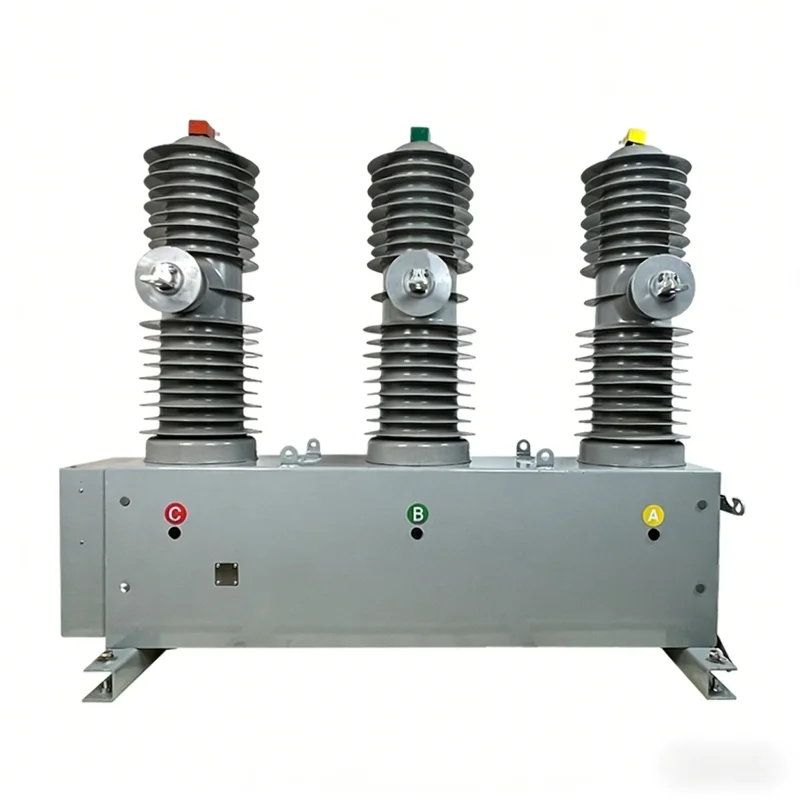
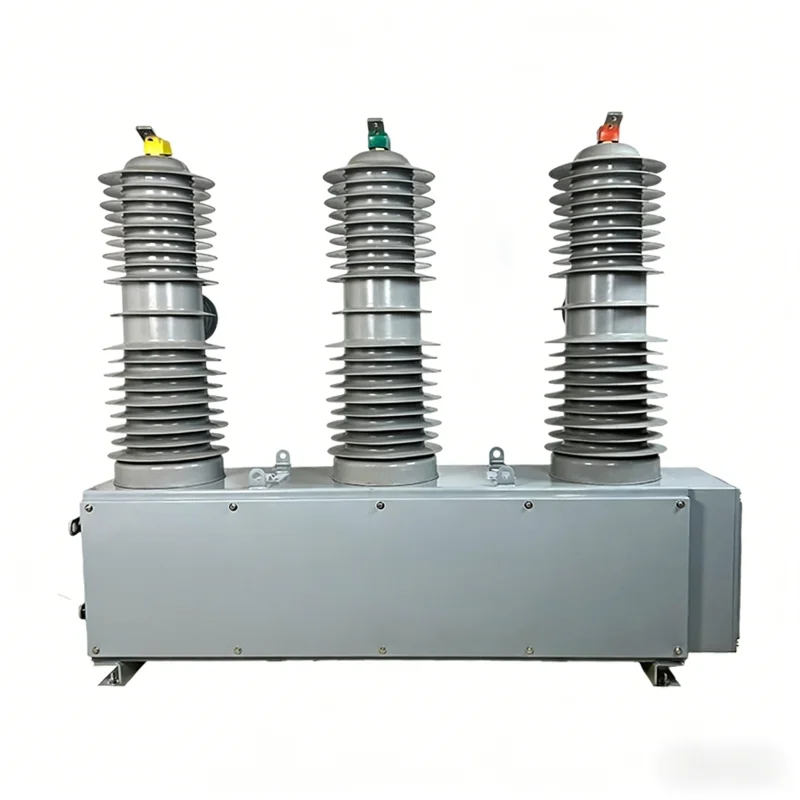
The ZW32 40.5kV outdoor vacuum circuit breaker is a pole-mounted unit for 40.5 kV distribution networks, covering 630 A, 1,250 A and 1,600 A with 25 kA short-circuit breaking capacity. It integrates current transformers in the same frame and can be supplied with an intelligent controller for reclosing and protection, or with an optional disconnecting switch to give a visible break.
The design intent is a complete outdoor switching point: breaker, current measurement and control in one column, mounted on a pole or a frame rather than inside a building. That removes the need for a substation building at the point where the circuit is switched.
Reading the ZW32-40.5 Designation
| Element | Meaning | What it tells you |
|---|---|---|
| Z | Vacuum (真空) | Vacuum interrupter, no SF6 |
| W | Outdoor (户外) | Weatherproof housing, pole or frame mounted |
| 32 | Design sequence | Frame family |
| 40.5 | Voltage class in kV | 40.5 kV, for 35 kV nominal systems |
The 40.5 figure is the highest voltage for equipment, not the nominal system voltage. A 35 kV network runs at 40.5 kV at the upper tolerance, which is why the class is named for that value.
Ratings
| Parameter | Published value |
|---|---|
| Rated voltage | 40.5 kV |
| Rated current | 630 A / 1,250 A / 1,600 A |
| Rated frequency | 50 / 60 Hz |
| Power-frequency withstand, wet / dry | 80 / 95 kV, 1 minute |
| Lightning impulse withstand, peak | 185 kV |
| Rated short-circuit breaking current | 25 kA |
| Rated short-circuit making current, peak | 80 kA |
| Rated peak withstand current | 80 kA |
| 4-second short-time withstand current | 31.5 kA |
| Short-circuit breaking operations | 30 |
| Mechanical life | 20,000 operations |
| Intelligent-mechanism control voltage | DC 220 V |
| Secondary-circuit withstand, 1 minute | 2 kV |
The wet and dry withstand figures are separate for a reason. Outdoor equipment is tested with artificial rain on the external insulation, and the wet value is lower because water films bridge part of the creepage. A quotation that lists only the dry figure is not comparable with one that lists both.
33 kV, 35 kV and 36 kV Systems on a 40.5 kV Breaker
An enquiry for a 33 kV vacuum circuit breaker, a 35 kV vacuum circuit breaker or a 36 kV unit lands on the same frame. The 40.5 kV rating is the equipment maximum voltage, one class above the 36 kV nominal system, which is what gives insulation coordination and impulse withstand their headroom. If the tender states 33 kV, 34.5 kV, 35 kV or 36 kV, this is the breaker class.
That range is why a 33 kV outdoor vacuum circuit breaker compared against a 35 kV quotation from another supplier is usually the same product with different paperwork. Ask for the equipment maximum voltage rather than the system voltage and the comparison resolves itself.
The same logic settles 25 kV. A 24 kV frame does not reach it, because its equipment maximum voltage would sit below the system nominal and insulation coordination fails. A 25 kV distribution or traction feeder therefore needs the 36 kV class, which means it is quoted on this 40.5 kV frame rather than on the 24 kV indoor range.
Ratings on this frame run 630 A to 1,600 A with 25 kA breaking and 185 kV lightning impulse, so the whole voltage range up to 36 kV is covered without a frame change. The next class above is 72.5 kV, which falls outside this range and outside our supply.
What 25 kA and 30 Operations Mean in Service
Two numbers on this unit get read incorrectly more often than any others.
The 30 operations is the number of times the interrupter can clear its full 25 kA rating before it is considered spent. It is not the total number of operations the breaker will perform; it is the count of full-rated fault interruptions. A breaker that trips at 8 kA consumes a fraction of that allowance, and one that never sees a fault beyond load current never touches it.
The 20,000 mechanical operations is the separate figure for no-load and load-current switching. In a pole-mounted recloser duty, where the controller may reclose several times per fault, the mechanical count is consumed faster than buyers expect: a circuit with 50 fault events a year and three recloses each uses 200 operations annually, which is 1 percent of the mechanical life and a much larger share of the interrupting allowance.
Ask for both figures when comparing offers. A breaker quoted with a high mechanical life and a low interrupting count is not the same product as one with the reverse.
Integrated Current Transformers
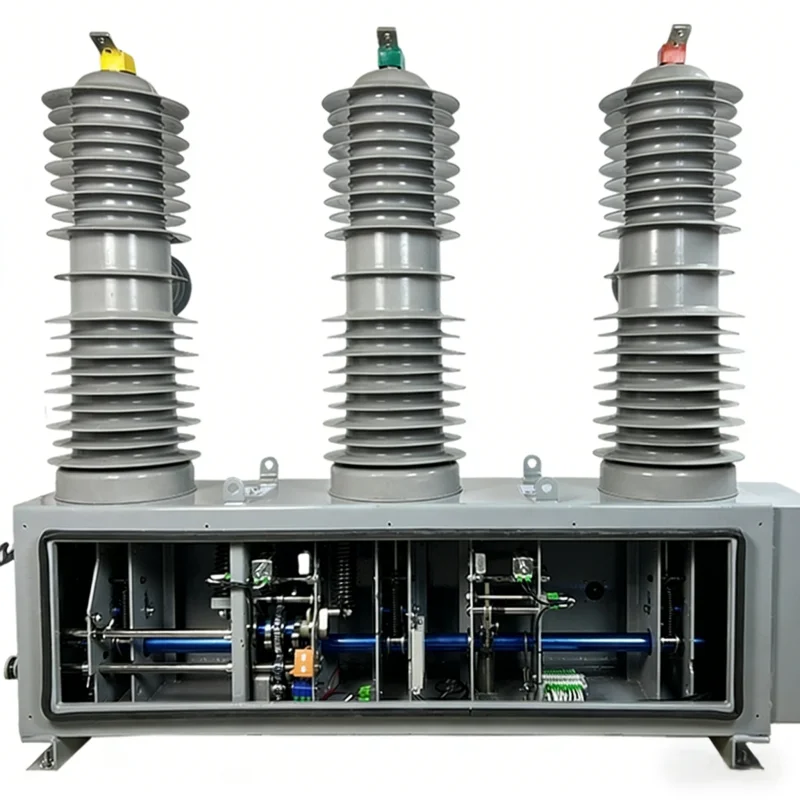
The ZW32 40.5kV outdoor vacuum circuit breaker carries current transformers inside the column, with published ratios of 100:5, 200:5, 400:5, 800:5, 1,000:5 and 1,600:5, and up to four windings per phase.
Four windings is enough for a full protection and metering scheme without external CTs: one for overcurrent protection, one for earth fault, one for metering, and one spare or for a second protection scheme. That integration is what makes a pole-mounted installation practical, because external CTs on a 40.5 kV pole need their own support structure and clearances.
Specify the winding allocation with the order. Which core feeds which relay is a design decision that has to be settled before the unit is built, since the ratios and the core allocation are fixed in the casting and the terminal block.
Intelligent Control
The intelligent mechanism of the ZW32 40.5kV outdoor vacuum circuit breaker runs on DC 220 V and can be configured for reclosing and protection functions. What that means in practice depends on the controller selected, so the controller and its supply arrangement belong in the specification rather than the accessories list.
Three things to settle at the inquiry stage:
- The protection functions required, and whether they sit in the controller or in a separate relay.
- The reclosing sequence, including the dead time and the number of shots.
- The auxiliary supply, including battery capacity and how it is charged from the line side.
A breaker ordered with an intelligent mechanism but without a defined protection scheme arrives with capability that nobody has configured. That is a commissioning problem, not a product problem, but it is cheaper to settle it before shipment.
The Optional Disconnecting Switch
A visible break can be built into the frame, acting as a disconnecting switch in series with the breaker. For maintenance work this removes the need for a separate isolating device upstream, which on a pole means fewer components at height.
It also changes the interlock logic and the operating sequence, so state whether it is required at the inquiry stage rather than at the drawing approval stage.
Outdoor Installation
The ZW32 40.5kV outdoor vacuum circuit breaker mounts on a pole bracket or a frame, with the primary connections taken to overhead conductors or cable terminations. At 40.5 kV the phase spacing and the clearance to earth are set by the outdoor insulation requirement, not by the panel layout, so the mounting arrangement needs to be confirmed against the pole design.
Where the site is exposed to wind-blown contamination, state the pollution level. The creepage on the external insulation cannot be increased after manufacture, and a unit built for a clean rural site will track in a coastal or industrial environment.

Service Conditions
Outdoor installation at altitudes up to 1,000 m with ambient from -30 °C to +40 °C is the usual envelope for this class; confirm the exact figure for your project, because cold-climate variants use different lubricants and seals. Humidity, pollution level and wind loading all belong in the inquiry.
Above 1,000 m the external insulation is corrected for reduced air density, which changes the column height rather than the electrical ratings.
When a Different Device Fits Better
- Indoor 12 kV duty. The CKG3 12 kV vacuum contactor covers indoor switching at that class.
- Feeder switching without fault interruption. A load break switch such as the VZF(R) 12 kV switch-fuse combination is cheaper where protection is provided upstream.
- Other 40.5 kV arrangements. Both the ZW32 and the ZW7 40.5 kV breaker are listed under the vacuum circuit breaker category; compare the mounting arrangement and the CT integration before choosing.
Standards and Routine Tests
Routine tests on every unit cover power-frequency withstand on the primary at 95 kV dry and on the secondary circuit at 2 kV, main-circuit resistance, contact travel and a mechanical operation sequence including the reclosing function where fitted.
Type test reports covering temperature rise, short-circuit making and breaking, and wet withstand are available for project documentation.
Manufacturer Supply, OEM and Wholesale
The ZW32 40.5kV outdoor vacuum circuit breaker is supplied direct. Utility and EPC buyers receive drawings, CT allocation and test reports for approval; distributors hold a standing specification for repeat supply; OEM arrangements cover private-label marking and controller configuration to your scheme.
Because the CT ratios, winding allocation and controller are fixed per order, a non-standard scheme is quoted rather than declined.
Price, MOQ and Lead Time
- MOQ. Single units. Custom CT allocation and controller configuration carry a higher minimum.
- Price drivers. Rated current, number of CT windings, controller type, disconnecting switch requirement and quantity.
- Lead time. Confirmed against the production schedule. Controller configuration extends it beyond a bare breaker.
- Payment. Deposit with balance against the bill of lading copy; letter of credit for utility and project quantities.
What to Send With Your Inquiry
- System voltage and rated current
- Prospective short-circuit current at the installation point
- CT ratio and winding allocation, up to four per phase
- Controller functions required: protection, reclosing, communication
- Auxiliary supply arrangement and battery requirement
- Whether a visible disconnecting break is required
- Pollution level, altitude and ambient temperature range
- Pole or frame mounting arrangement
- Quantity, destination port and required delivery date
Send those through the quote form on this page. The CT winding allocation and the controller functions are the two items that decide the configuration, so both belong in the first message.
FAQ
What do the 30 short-circuit breaking operations mean?
How many CT windings can be fitted?
Is a disconnecting switch available?
What does the intelligent controller cover?
Why are wet and dry withstand figures different?
What is the MOQ and lead time?
Request Quote
Tell us your specifications, quantity, or application scenario and we will reply with a tailored quote.