
Description
LZZBJ12-10 at a Glance
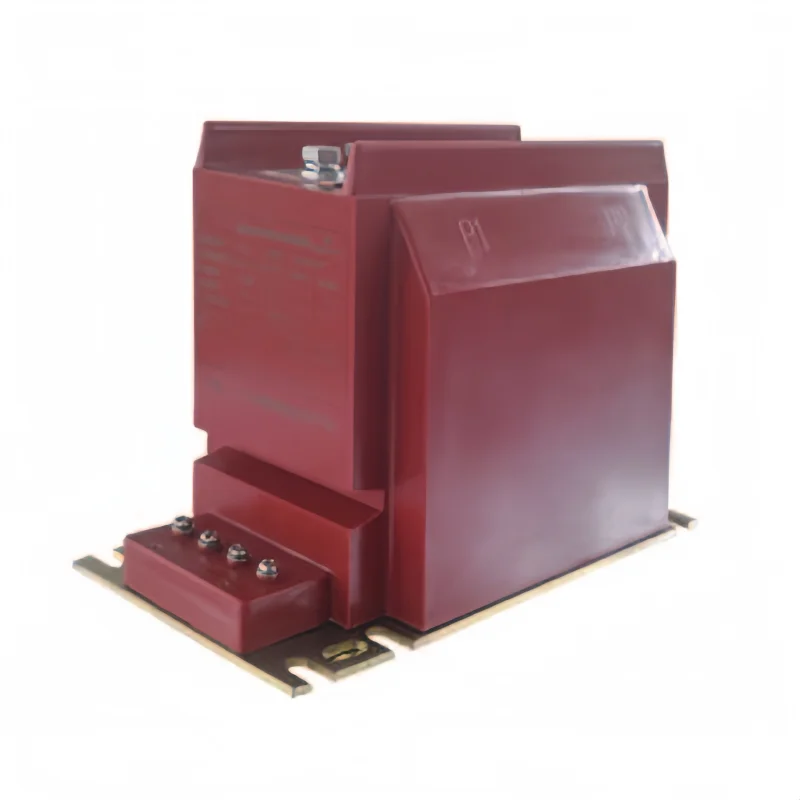
The LZZBJ12-10 current transformer is a pillar-type, fully enclosed epoxy-resin cast unit for indoor 10 kV systems. What separates this frame from a standard cast CT is the secondary side: the outlet terminals sit behind a shield with three possible exit directions, and the shield is closed over the wiring in a way that makes the metering circuit difficult to tap into.
The LZZBJ12-10 current transformer carries two secondary windings as standard, one measurement class and one protection class, and it is built for humid and tropical switchrooms where surface contamination and condensation would degrade an open construction.
Reading the Type Designation
| Element | Meaning | Practical effect |
|---|---|---|
| L | Current transformer (电流互感器) | CT for current measurement |
| Z | Pillar / post type (支柱式) | Base-mounted inside the cubicle |
| Z | Cast-resin insulation (浇注绝缘) | Epoxy body, no oil |
| B | Protection winding (带保护级) | Protection core included |
| J | Design variant | Distinguishes it from the LZZBJ9 frame |
| 12 | Design sequence | Later frame in the same family |
| 10 | Voltage class in kV | 10 kV indoor |
The 12 in this code is a design sequence, not the voltage. Both the LZZBJ9 and LZZBJ12 frames are 10 kV units; the difference is in the casting, the core and the secondary arrangement, not in the insulation class.
Construction: Cast Body and Core Treatment
The body of the LZZBJ12-10 current transformer is cast in epoxy resin as a single fully enclosed pillar. That gives the usual benefits of a cast CT: no oil, no gas, and nothing to top up over the service life. Two construction details are worth calling out because they affect long-term accuracy rather than just durability.
- Imported core with controlled heat treatment. The core is annealed after stamping to relieve the stress introduced by punching. Stress in the core raises no-load loss and makes the ratio error drift with age, which is why a metering CT built from untreated cores reads low after a few years.
- Shield at the secondary outlet. The shield sits over the terminal area rather than around the winding, so it protects the connection point where moisture and interference actually enter.
The Shielded Secondary Outlet
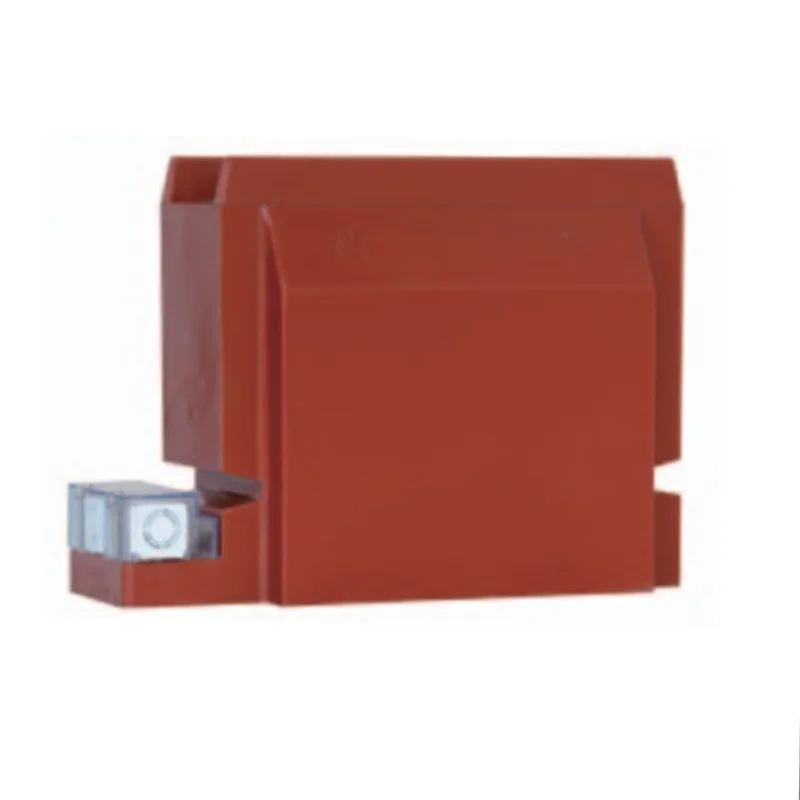
The shield has a hole on the face and another on the side, both used for the secondary connection. That arrangement is what allows the wiring to leave in one of three directions without dismantling the shield.
In practice it solves a layout problem that comes up in every compact cubicle: the relay compartment is not always where the CT terminal ends up. With three exit paths, the same unit fits a panel where the secondary duct runs below, one where it runs to the side, and one where the meter sits directly in front.
The shield also masks the secondary terminals from the front of the panel. For revenue metering installations that is the point: with the shield closed, the metering circuit cannot be shorted or tapped without opening the sealed cover, which is the physical basis of the anti-tamper claim on this frame.
Mounting Freedom
The LZZBJ12-10 current transformer can be installed in any direction and at any position within the cubicle. That is a property of the fully cast body: there is no oil level, no vent and no orientation-dependent insulation, so the pillar can sit horizontally, vertically or inverted depending on where the busbar runs.
For retrofit work this matters more than it sounds. A replacement CT that only mounts one way forces a busbar modification; one that mounts any way drops into the existing space.
Two Cores: Metering and Protection
The standard build carries one measurement winding and one protection winding, with the option of two measurement windings where the scheme needs two metering points.
Keeping them separate is not only a wiring convenience. A protection core needs different behaviour from a metering core: it is specified by composite error at the accuracy limit factor, not by ratio error at rated current. Winding both functions on one core forces a compromise that satisfies neither, which is why a dual-core unit is the normal specification for a feeder bay that both bills and protects.
Rated output, accuracy class and ratio are confirmed per project. The published figures for this family are not a fixed table, so state the ratio, the class for each core and the connected burden together.
Tropical and Humid Installations
The cast body is anti-pollution and moisture-proof, and the frame is intended for humid and tropical zones. In a switchroom where the relative humidity stays above 80 percent, an open or oil-immersed CT needs heaters and inspection; a fully cast unit does not.
Surface contamination still matters. Where the site has salt fog, cement dust or heavy industrial fallout, state the pollution level: the creepage is set in the casting, and a unit built for a clean room cannot be upgraded afterwards.
Anti-Tamper Metering
For utility billing points and landlord metering, the shield arrangement is a specification item rather than a detail. State at the inquiry stage that the application is revenue metering, because it affects how the shield is sealed and how the secondary cover is fixed.
Pair it with a tamper-evident seal on the meter itself: the CT shield prevents access to the secondary circuit, but it does not stop someone from working on the meter terminals downstream.
Selection Inputs
The LZZBJ12-10 current transformer has no fixed public ratings table, so selection is driven by the project data rather than by picking a row.
| Input | What it decides |
|---|---|
| Primary current | Ratio and the physical size of the primary bar |
| Secondary current | 1 A or 5 A, and the terminal arrangement |
| Accuracy class per core | Metering class and protection class, specified separately |
| Connected burden | Whether the required class can be held at that output |
| Fault level at the point | Short-time thermal and dynamic withstand |
| Number of cores | Single metering, dual metering, or metering plus protection |
Send those six items and the configuration comes back confirmed rather than estimated.

When a Different CT Fits Better
- Published ratio matrix and dual-ratio windings. The LZZBJ9-10 current transformer has a documented table from 5 A to 1,000 A and supports 200/5/5 or 400/5/5 windings, which suits a project that needs the ratings fixed up front.
- Outdoor 35 kV duty. The LZZBW-35 outdoor current transformer covers that class.
- Voltage measurement in the same cubicle. See the voltage transformer range.
Service Conditions and Tests
Indoor installation, 50 or 60 Hz, at altitudes up to 1,000 m with ambient from -25 °C to +40 °C. Routine tests cover power-frequency withstand, insulation resistance, ratio and polarity, ratio error and phase displacement, and a partial-discharge check against the cast body.
Type test reports for temperature rise, short-time thermal and dynamic current, and impulse withstand are available for documentation packages.
Manufacturer Supply, OEM and Wholesale
The LZZBJ12-10 current transformer is supplied direct. Switchgear builders order against a frozen ratio, class and core specification under OEM or private-label marking; distributors hold a standing specification for repeat supply; project buyers receive drawings and test reports for consultant approval.
Price, MOQ and Lead Time
- MOQ. Single units for standard configurations. Non-standard ratios and private-label marking carry a higher minimum.
- Price drivers. Ratio, number of cores, accuracy classes, rated output and quantity.
- Lead time. Confirmed against the production schedule at order.
- Payment. Deposit with balance against the bill of lading copy; letter of credit for project quantities.
What to Send With Your Inquiry
- System voltage and installation indoor or outdoor
- Primary and secondary current
- Accuracy class for each core, and the connected burden
- Number of cores and the function of each
- Fault level at the installation point
- Whether the metering is revenue metering, for the shield sealing
- Cubicle layout and the preferred secondary exit direction
- Quantity, destination port and required delivery date
Send those through the quote form on this page. The exit direction and the core count are what distinguish this frame from the standard cast CT, so both belong in the first message.
FAQ
What makes this frame different from a standard cast CT?
Why does core heat treatment matter?
Can it be mounted in any orientation?
Is it suitable for revenue metering?
How many secondary windings does it have?
What is the MOQ?
Request Quote
Tell us your specifications, quantity, or application scenario and we will reply with a tailored quote.