


Description
CKG3 12kV Series at a Glance
The CKG3 12kV AC vacuum contactor is the 12 kV build of the CKG3 frame, for three-phase systems where the highest voltage for equipment reaches 12 kV. It covers 160 A, 250 A, 400 A and 630 A, with 42 kV power-frequency withstand and 75 kV lightning impulse, and it closes onto 10 times rated current for 100 operations.
Buyers who already know the 7.2 kV version of this frame should note one thing early: the 12 kV build is not the same unit with a different label. The contact gap grows from 4 mm to 5.5 mm, the mechanical life drops from one million operations to 500,000, and the breaking capability is expressed as a multiple of rated current rather than as an absolute figure. Those differences follow from the higher voltage and they change how the unit is specified.
Reading the Voltage Suffix
The CKG3 family is used across two voltage classes, and the only thing separating the frames in a quotation is the suffix and the ratings behind it.
| Item | 7.2 kV build | 12 kV build (this page) |
|---|---|---|
| Highest voltage for equipment | 7.2 kV | 12 kV |
| Power-frequency withstand, main circuit | 32 kV | 42 kV |
| Lightning impulse withstand | 60 kV class | 75 kV |
| Contact gap | 4 ± 0.5 mm | 5.5 ± 0.5 mm |
| Mechanical life | 1,000,000 operations | 500,000 operations |
| Breaking capability stated as | Absolute amperes at 10 and 3 operations | 8 Ie at 25 operations |
A quotation that lists a 12 kV contactor with 32 kV withstand, or a 7.2 kV unit with 42 kV, has the two data sets crossed. It happens often enough to be worth checking before the order is placed.
What the 42/75 kV Insulation Level Buys
Insulation level is not a marketing figure. It decides how much transient overvoltage the unit absorbs before the vacuum interrupter flashes over, and it has to match the switchgear the contactor sits in, not the nominal system voltage alone.
- 42 kV power-frequency withstand is the one-minute test the unit passes at commissioning and after any repair. A 12 kV metal-clad cubicle is tested to this level, so a contactor rated below it becomes the weak point in the bay.
- 75 kV lightning impulse sets the surge margin. On an overhead-fed 12 kV system, or a cable run exposed to direct strikes upstream, this is the figure that keeps the interrupter intact until the surge arrester clips.
If your switchgear is 12 kV class, specify a 12 kV contactor even where the actual system runs at 11 kV or lower. Matching the contactor to the lower operating voltage leaves the bay with an insulation mismatch that shows up in the type test report, not in service.
Ratings by Current Variant
| Parameter | 160 A | 250 A | 400 A | 630 A |
|---|---|---|---|---|
| Rated voltage | 12 kV | |||
| Rated breaking capacity | 8 Ie, 25 operations | |||
| Rated closing capacity | 10 Ie, 100 operations | |||
| Rated short-time withstand current, 10 Ie | 1.6 kA | 2.5 kA | 4 kA | 6.3 kA |
| Rated peak withstand current, 25 Ie | 4 kA | 6.3 kA | 10 kA | 16 kA |
| Rated contact gap | 5.5 ± 0.5 mm | |||
| Overtravel | ≥ 1.5 mm | |||
| Closing synchronism | ≤ 2 ms | |||
| Mechanical life | 500,000 operations | |||
| Electrical life, AC-3 | 250,000 operations | |||
| Electrical life, AC-4 | 100,000 operations | |||
Breaking Capacity Stated as 8 Ie
The CKG3 12kV AC vacuum contactor is specified in multiples of rated current rather than in fixed amperes, and that changes how you read a quotation.
At the 400 A rating, 8 Ie means the unit interrupts 3,200 A for up to 25 operations. At 630 A it interrupts 5,040 A for the same count. The absolute figure scales with the frame, so a larger contactor does not automatically give a larger margin in relative terms.
The 25-operation limit is the part buyers miss. It is not a continuous rating and it is not the same as the electrical life figure. It states how many times the unit can interrupt its maximum breaking current before the interrupter is considered spent, which is a different question from how many times it can switch normal load. A contactor used mainly for motor starting will never approach 25 fault interruptions, but one used as a backup switching device in a feeder bay might.
Short-Time and Peak Withstand Against the Cubicle Rating
These two figures are the ones a switchgear designer checks against the busbar rating, and they are frequently left off a contactor datasheet.
- Short-time withstand, 10 Ie runs from 1.6 kA on the 160 A frame to 6.3 kA on the 630 A. This is the current the unit carries for the short-circuit duration without being damaged, and it has to be at least the fault level at the point of installation.
- Peak withstand, 25 Ie runs from 4 kA to 16 kA. This is the asymmetric first-cycle peak, roughly 2.5 times the symmetrical value, and it is what the busbar supports and the contactor mounting have to survive.
A common mismatch is a 25 kA busbar with a 630 A contactor whose peak withstand is 16 kA. The cubicle passes its type test, the contactor does not, and the difference only appears when someone reads both documents side by side.
Why the Mechanical Life Is 500,000, Not 1,000,000
The CKG3 12kV AC vacuum contactor is rated at half the mechanical life of its 7.2 kV sibling, and the reason is visible in the gap figure: 5.5 mm against 4 mm.
A larger contact gap means a longer travel and a heavier closing impact. The bellows in the vacuum interrupter flex through a greater stroke on every operation, and the mechanism absorbs more energy at each close. That is the trade for the higher insulation level, and it is why the two builds cannot share one life figure.
In practice 500,000 operations is still a long service interval for a plant contactor. At 100 operations a day it represents roughly thirteen years of mechanical life, so the electrical life at the duty category, not the mechanical figure, will normally decide when the unit is replaced.
When 12 kV Is Right, and When It Is Waste
Two situations call for the CKG3 12kV AC vacuum contactor, and one does not.
- Right: a 12 kV switchgear lineup, even if the system runs at 10 or 11 kV. The bay’s insulation coordination is set by the cubicle, and the contactor has to match it.
- Right: a 6 kV or 7.2 kV system where the specification calls for 12 kV class equipment by site standard, common in mining and utility networks that standardise on one voltage class across the site.
- Waste: a 7.2 kV system with no standardisation requirement. The 12 kV frame costs more, has half the mechanical life, and delivers insulation margin the system will never call on. Use the 7.2 kV build instead. For 250 A to 630 A duty where the control data matters more than making capacity, see the JCZ5 7.2 kV vacuum contactor; the full frame list sits under vacuum contactor series, and the contactor versus breaker decision is covered separately.
The 7.2 kV frame is covered on the CKG3 7.2 kV vacuum contactor page, including its plateau build for high-altitude sites.
Mounting in Fixed and Withdrawable Cubicles
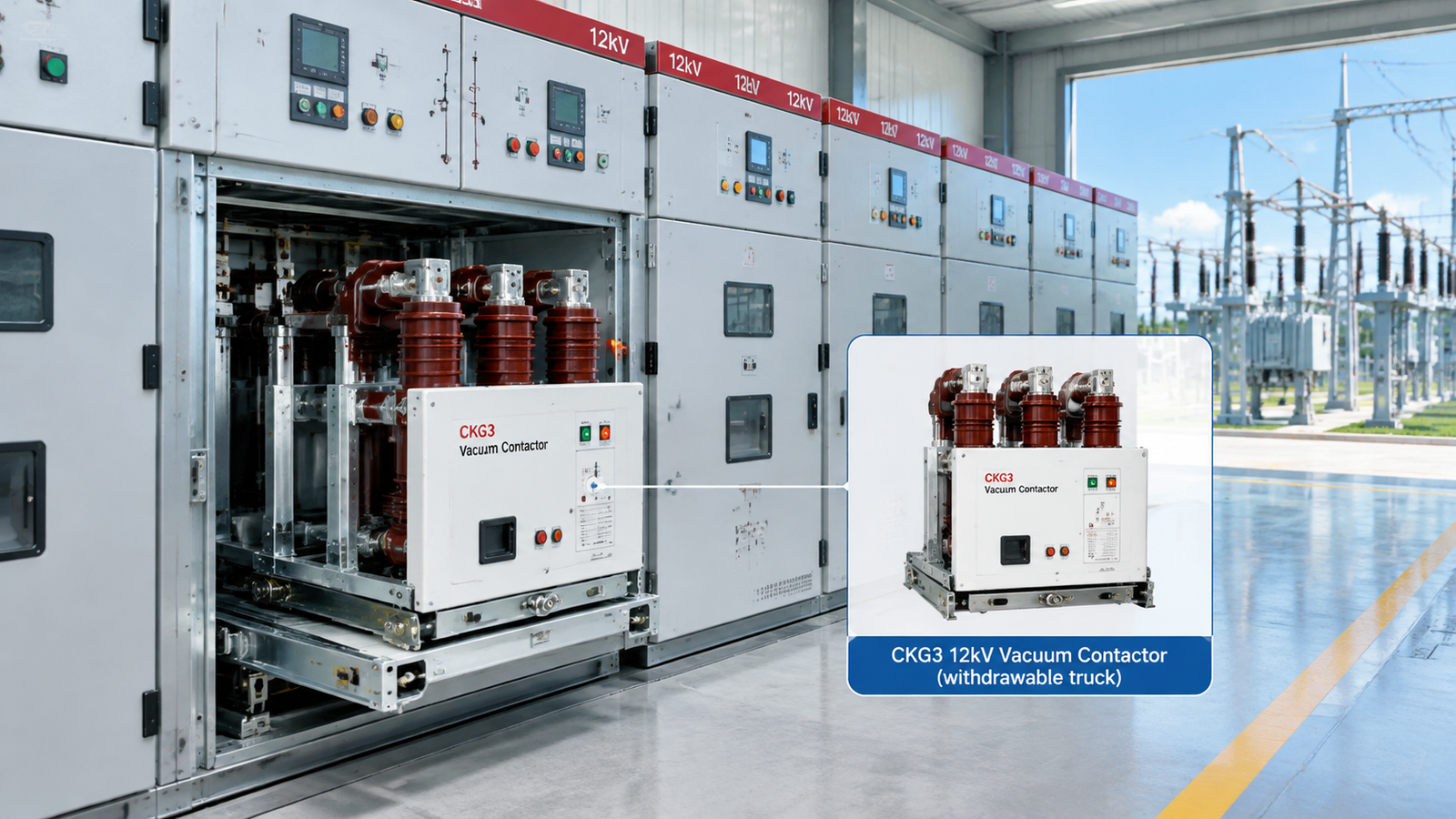
The CKG3 12kV AC vacuum contactor mounts in both fixed and withdrawable arrangements, and the choice changes the accessory set rather than the contactor itself.
In a fixed installation the unit bolts to the cubicle floor or a bracket, and the primary connections are made directly. In a withdrawable arrangement it sits on a chassis with isolating contacts, which adds the interlocking and the position indication to the panel design. Tell us which arrangement your cubicle uses at the inquiry stage, because the terminal configuration and the auxiliary contact block differ.
Service Conditions
The published envelope is 1,000 m altitude for the ordinary build, or 4,000 m for the plateau build, with ambient from -10 °C to 40 °C and a maximum monthly average relative humidity of 90 percent. The installation must be indoors, sheltered from rain and snow, without explosive hazard and without conductive dust.
Above 40 °C ambient or above the rated altitude, the current rating needs derating. State both conditions with the inquiry; the standard unit is tested to the envelope above and nothing more.
Standards and Routine Tests
Routine tests on every CKG3 12kV AC vacuum contactor cover power-frequency withstand on the main circuit at 42 kV, on the auxiliary circuit at 2.5 kV and on the control circuit at 2 kV, plus contact resistance and a mechanical operation check against the 5.5 mm gap and the 1.5 mm overtravel.
Type test reports for temperature rise, short-time withstand and electrical life are available for project documentation. Third-party witnessing can be arranged at the inquiry stage.
Manufacturer Supply and Mixed-Voltage Ordering
Because both voltage builds come from the same works, a project that uses 12 kV main boards and 7.2 kV sub-distribution can be supplied in one shipment with a single documentation set. That covers:
- Mixed-class orders. 12 kV and 7.2 kV frames on one purchase order, with each unit’s test report matched to its own ratings.
- OEM and private label. Nameplate and documentation under your brand across both classes.
- Spares and repeat supply. Frozen specifications held for future orders, so a replacement unit matches the one already installed.
Price, MOQ and Lead Time
- MOQ. Single units for standard configurations. Private-label marking and mixed-class documentation sets carry a higher minimum.
- Price drivers. Current rating, fixed or withdrawable arrangement, auxiliary contact count and quantity. The 12 kV build sits above the 7.2 kV at every current rating.
- Lead time. Confirmed per line item against the production schedule. Mixed-class orders ship together only when every line is ready, so state if partial shipment is acceptable.
- Payment. Deposit with balance against the bill of lading copy as standard; letter of credit for project quantities.
What to Send With Your Inquiry
- System voltage and the switchgear voltage class
- Continuous current and the largest motor rating if applicable
- Fault level at the point of installation, for the withstand check
- Fixed or withdrawable mounting arrangement
- Control-circuit voltage and auxiliary contact requirement
- Site altitude and ambient temperature range
- Quantity, destination port and required delivery date
Send those through the quote form on this page. If the choice between the 12 kV and 7.2 kV builds is still open, state the switchgear class and we will confirm which one the bay actually requires.
FAQ
What is the difference between the 12 kV and 7.2 kV CKG3 builds?
What does 8 Ie breaking capacity mean?
How do the short-time and peak withstand figures compare with the busbar rating?
Can it be mounted in a withdrawable truck?
Why is the mechanical life half that of the 7.2 kV build?
What is the MOQ and lead time?
Request Quote
Tell us your specifications, quantity, or application scenario and we will reply with a tailored quote.