Power Transformer MOQ, Lead Time, Payment Terms & Incoterms
Published: Author: Lisa
Power transformer lead time is the number that decides whether a project energizes on schedule. In 2026, factory-direct distribution units typically move in roughly 20–32 weeks for dry-type and 40–65 weeks for oil-immersed ratings, while medium-power and large-power units run from 18 months to well over two and a half years. The date you are given depends far less on the salesperson’s optimism than on the class of unit, the state of the core steel and copper supply chain, and how early the drawing is frozen.
This guide covers the four commercial questions that decide a power transformer purchase — lead time, minimum order quantity (MOQ), payment terms and Incoterms — and shows where each one is genuinely negotiable, where it is not, and which contract clauses keep a delivery date meaningful.
Power transformer lead time in 2026: the honest numbers
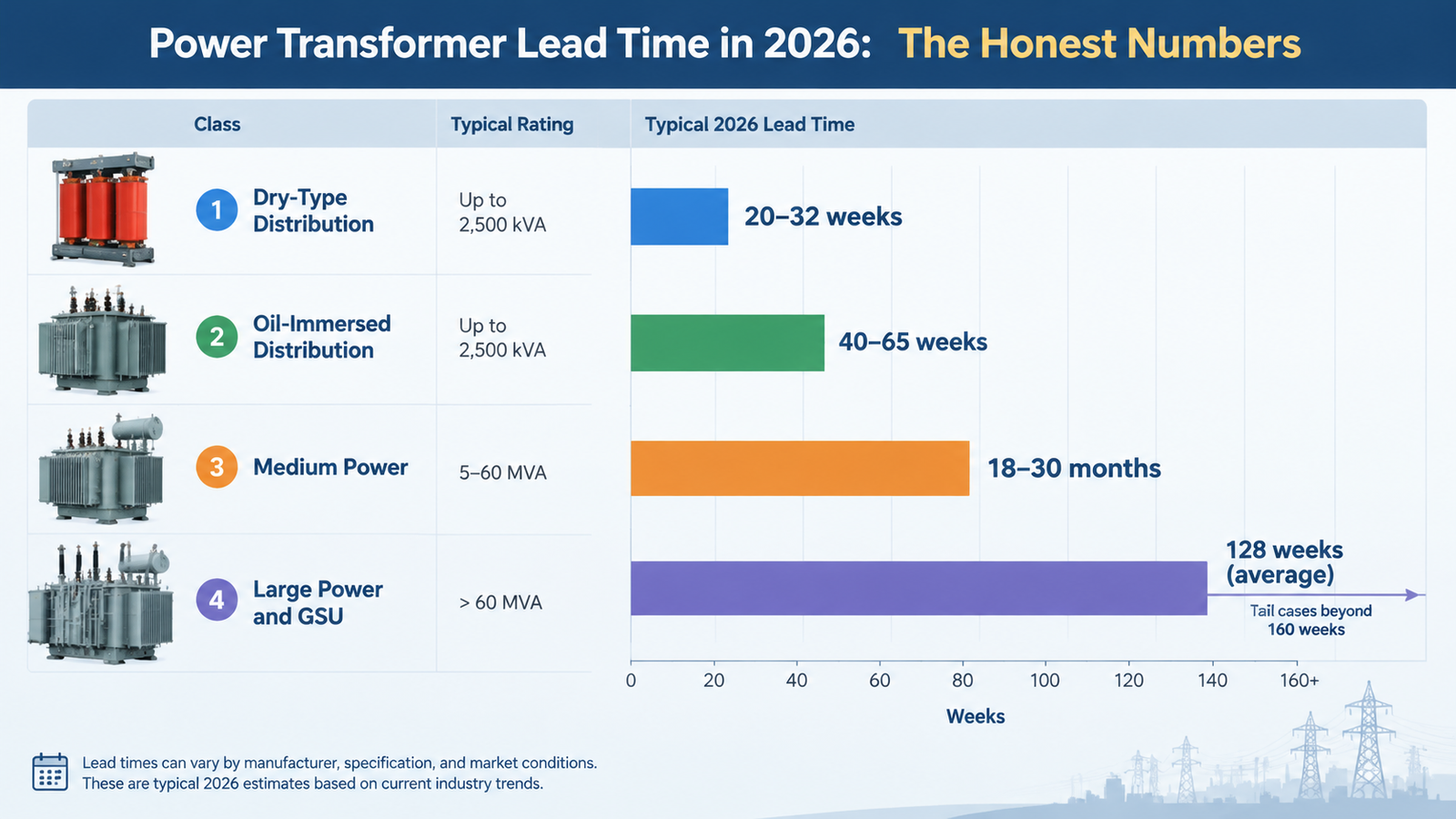
There is no single lead time for “a transformer”. The distance between a 1,000 kVA dry-type unit for a building and a 100 MVA generator step-up unit is measured in years, not weeks. The table below summarizes how the market looks in 2026.
Class and rating
Typical 2026 lead time
What drives it
Dry-type distribution, up to 2,500 kVA / 36 kV
About 20–32 weeks
No oil impregnation step and shorter winding stacks — the fastest-recovering class in the market
Oil-immersed distribution and pad-mounted
About 40–65 weeks
Tank fabrication, oil processing, bushing and tap changer availability
Medium power, 5–60 MVA
18–30 months
Custom design, type-test scope and competition for factory slots
Large power / generator step-up, above 60 MVA
About 128 weeks average, tail cases 160 weeks and beyond
Only a handful of qualified plants, and custom design dominates the schedule
Typical 2026 lead times by transformer class — dry-type distribution units remain the fastest route to energization.
Two caveats matter more than the table itself. First, the widely quoted 128-week average describes the US utility market, where Wood Mackenzie’s 2026 surveys put power transformer demand roughly 116–119% above 2019 levels and generator step-up demand up around 274%. A China-based factory with its own winding and core processing capability can quote standard distribution ratings considerably faster, because the constraint sits in order books rather than in physics.
Second, the fast lane is narrow. The same material constraints that stretch utility orders — grain-oriented electrical steel, copper, bushings, on-load tap changers and high-grade insulating pressboard — put a floor under any custom build, wherever it is made. A quotation that promises a custom 33 kV unit in eight weeks is describing an empty factory slot, not a repeatable schedule.
Where the weeks actually go in a transformer order
When a buyer asks why a certified unit takes eight months, the honest answer is a calendar rather than a defence. Every part of the schedule is attached to a material, a test bay or a freight booking.
1. Design freeze and drawings
Nothing starts until the specification is closed: voltage ratio, impedance, vector group, tap range, cooling class, loss limits, accessory list and test scope. This is the stage buyers most often drag out — internal sign-off, a late change of harmonic profile, a shift in site conditions — yet every change after the freeze reopens the bill of materials and pushes the slot.
2. Core steel and copper
Grain-oriented electrical steel (GOES) is the real bottleneck of the industry. Mill delivery alone can run 10–16 weeks, and GOES prices have sat 50–80% above pre-pandemic levels. Copper has traded in a roughly $8,500–10,500 per tonne band, with the US copper tariff raised to 50% in 2025 and transformer components brought onto the derivative list. Ordering core and winding material is the first irreversible commitment a factory makes on your behalf, and it is why the deposit conversation and the delivery conversation are the same conversation.
3. Winding, core assembly and tanking
Winding is batch-processed: coils are wound, insulated and processed in runs so that quality stays repeatable. Oil-immersed units then add tank fabrication, oil filling and sealing; dry-type units skip the oil step entirely, which is a large part of why they lead the field on delivery.
4. Testing and factory acceptance
Routine tests run on every unit. Type tests, impulse tests, temperature-rise tests and third-party witnessed factory acceptance tests add weeks, and the test bay is genuinely contested space at a busy plant. Buyers frequently treat testing as an afterthought and are then surprised to find it is the longest remaining line in the schedule. Fixing the test and documentation scope in the contract is worth the effort — the full test breakdown and acceptance tolerances are set out in our power transformer testing and FAT guide.
5. Packing, inland haulage and booking
Export packing, heavy-lift handling, inland transport to port, space on a flat rack or breakbulk vessel, and ocean transit add another layer. For oversized units the freight itself can add 4–10 weeks, and port and vessel options are limited, so the booking is often made before the unit leaves the test bay.
Why the same rating can be quoted two different ways
Two factories can quote the same nameplate rating with a 20-week difference in delivery, and both can be honest. The variables that move the date are usually the ones the buyer controls.
Specification flexibility. A standard rating that fits an existing winding and tank design can be scheduled against a live production slot. A one-off design has to queue for engineering, drawings and tooling first.
Accessory lead times. Bushings, on-load tap changers and protection panels are themselves backlogged. Approving an equivalent brand early protects the date; insisting on a single source can break it.
Test scope. Independent witness testing, extra temperature-rise checks or extended impulse testing each add days to a contested test calendar.
Slot status. A deposit converts a quotation into a production slot. Until it is paid, the delivery date is a forecast, not a commitment.
What is the MOQ for a power transformer?
For standard distribution ratings, the minimum order quantity from a Chinese factory is normally one unit or one set. Transformers are built to order rather than stocked, so there is no economic reason to force a batch minimum onto a catalogue rating. In practice, “what is your MOQ?” is really a question about customization — and the answer changes as soon as the specification leaves the standard range.
When MOQ actually rises
Custom ratings and OEM/ODM builds. Non-standard voltage ratios, unusual vector groups, special IP or NEMA enclosures, seismic bracing or non-standard paint all require dedicated design and tooling work. Factories spread that fixed cost across a batch, which is how a minimum of four, ten or more units appears.
Private label and enclosure work. If the unit carries your brand, your nameplate layout or a bespoke tank, tooling and first-article inspection apply, and they are charged either in price or in volume.
Project packages. Large infrastructure tenders often carry a minimum package size simply because the factory reserves a production block for the campaign.
How to handle MOQ in the contract
Ask for the MOQ in writing against your exact specification, not against a generic catalogue line, and separate the minimum order quantity from the minimum billing quantity. Some suppliers will build a single custom unit at a price that reflects the full engineering load, which is legitimate and better than a flat refusal. Where the volume question is genuinely commercial, splitting a first order into a standard pilot unit plus a follow-up batch is usually cheaper than forcing one large custom run. Whichever route you take, the vendor deserves at least as much scrutiny as the number — our guide to qualifying a power transformer manufacturer sets out the audit points.
Payment terms: what a normal 2026 structure looks like
Transformer payment terms are not a bargaining chip to be improvised in the final email. They are the risk-sharing structure of the order, and they should be tied to milestones the buyer can actually verify.
Structure
How it works
Best suited to
T/T deposit and balance
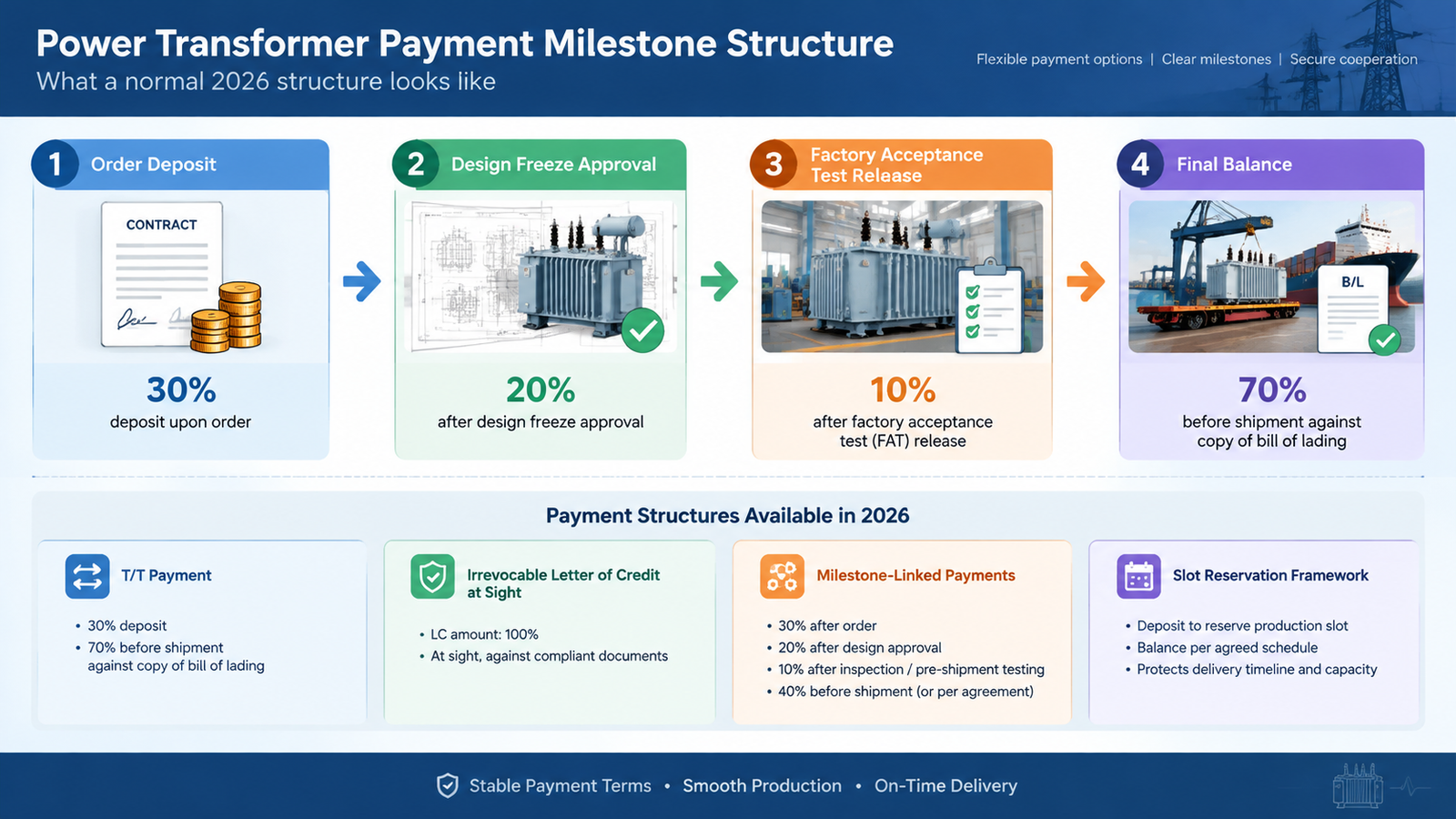
Typically 30% with the order, 70% before shipment against a copy of the bill of lading
Standard distribution units and established supplier relationships
Letter of credit
100% by irrevocable L/C at sight, or 30% by T/T plus an L/C for the balance
First orders, new suppliers and larger values
Milestone-linked
Deposit, then progress payments tied to design approval, inspection and pre-shipment testing
Medium and large power transformers
Slot reservation
A framework agreement with a smaller non-refundable deposit that holds production capacity
Projects with long or uncertain approval cycles
A milestone-linked payment structure ties money to design approval, inspection and factory acceptance testing rather than to the calendar.
Two points are worth insisting on whatever the structure. First, tie at least one payment to a passed factory acceptance test rather than to a calendar date, so money moves when evidence does. Second, make the balance condition explicit: “against copy of bill of lading” and “against original bill of lading” are different contracts with different risk profiles. On a high-value unit, an L/C or a milestone structure costs a modest bank fee and removes most of the counterparty risk on both sides.
Incoterms for transformer shipments
Incoterms decide where your cost and your risk both stop. They are frequently confused with payment terms, and they are not the same thing. The table below covers the terms you will actually see on a transformer proforma invoice.
Term
Seller delivers and risk transfers
Who pays ocean freight
Who clears import
EXW
At the factory gate
Buyer
Buyer
FCA
To the named carrier or terminal
Buyer
Buyer
FOB
Loaded on board at the port of loading
Buyer
Buyer
CFR
On board at loading port; seller pays freight to destination port
Seller
Buyer
CIF
On board at loading port; seller pays freight and minimum insurance
Seller
Buyer
DAP
At the named destination, ready for unloading
Seller
Buyer
DDP
At the named destination with duties paid
Seller
Seller
For most industrial transformer buyers, FOB or CIF on a port-to-port basis is the practical middle ground, because it keeps import clearance and inland haulage under the buyer’s control. Two details catch people out. Under CIF, risk passes when the goods are loaded at origin even though the seller pays the freight, so the insurance cover level is what bridges the gap and should be checked rather than assumed. And an oversized unit may not fit a standard container at all, which turns the conversation into flat rack or breakbulk booking and moves the freight cost decisively. Packing grades, HS classification and the paperwork that supports a claim are covered in more depth in our HS code, packing and sea freight guide.
One regional note for 2026: if the destination is the United States, the tariff position changed on 6 April 2026. Section 232 duties on steel, aluminium and copper are now assessed on the full customs value of the imported article rather than on metal content, with a tiered structure — 50% for predominantly metal articles, 25% for derivative articles, and a temporary 15% rate for metal-intensive industrial and grid equipment through 31 December 2027. Separately, Executive Order 14420, signed on 26 August 2026, restricts foreign-made bulk-power equipment rated at or above 69 kV, with implementing rules due from the Department of Energy. Neither measure applies to shipments into Africa, Latin America, Russia, Central Asia or South-East Asia, but they do mean a US-destination quotation needs a proper landed-cost model instead of a rule of thumb. It is also worth remembering that the price base is set by material cost as much as by schedule, and our oil immersed transformer price guide sets out the 2026 cost-per-kVA bands that sit underneath any negotiation.
Contract clauses that make a delivery date mean something
A milestone calendar in the appendix. Design approval, core and copper order, winding start, tank completion, test date, packing and sailing. A single “delivery date” hides the fact that the first month is often on the buyer’s side.
Delay liquidated damages. A pre-agreed amount per week of late delivery, with a cap usually expressed as a percentage of contract value. It will not recover a delayed project, but it changes behaviour.
A named test and inspection gate. Payment or shipping release made conditional on a passed factory acceptance test witnessed by an inspector you appoint.
A drawing approval window. Put dates on your own reviews. Suppliers lose more calendar time to late approvals than to late steel.
Slot reservation terms. If capacity is being held, define the deposit, the holding period, and what happens on cancellation.
How to compress lead time without paying a panic premium
Freeze the specification early. Feasibility-stage engagement lets a factory check capacity and design feasibility before the drawings lock and before the schedule becomes reactive.
Standardize across the programme. Holding voltage ratio, impedance and tap range constant across several units lets a supplier batch production, and lets you move volume between suppliers if one slips.
Pre-qualify a second source. Qualifying two vendors costs a little engineering time up front and buys real optionality later.
Consider dry-type where the project allows. Dry-type ratings have the shortest schedules because they skip oil impregnation; where the MVA ceiling, noise and footprint constraints permit, that is the fastest route to energization. Our oil-immersed power transformers range is the right comparison point when oil-immersed is unavoidable.
Split the scope. If full capacity cannot be secured at once, phase the energization and power the critical loads first.
Reserve capacity with a deposit. In a market where production slots are rationed, a small deposit on a framework agreement is cheap insurance against a multi-year queue.
Where a project packages switchgear, protection and transformers together, coordinating them as one scope usually shortens the critical path more effectively than optimizing any single item. Our medium and high voltage power solutions show how the substation scope fits together.
Common mistakes buyers make
Treating “lead time” as a single number instead of a class-by-class question.
Asking for a price before asking for a delivery date, then discovering the production slot is the real constraint.
Leaving drawing approval on an internal desk for six weeks and blaming the factory for the delay.
Signing a balance clause that releases money before the factory acceptance test.
Assuming CIF means the seller carries the risk all the way to the destination port.
Tendering a one-off custom specification and then being surprised by the MOQ and the engineering premium.
Frequently asked questions
How long does a power transformer take to deliver in 2026?
Dry-type distribution units typically run about 20–32 weeks, oil-immersed distribution and pad-mounted units about 40–65 weeks, medium-power units 18–30 months, and large power or generator step-up transformers around 128 weeks on average, with tail cases running beyond 160 weeks.
What is the minimum order quantity for a power transformer?
For standard distribution ratings, one unit. Custom, OEM or private-label builds usually carry a minimum batch, because design and tooling costs have to be spread across the production run.
What payment terms are normal for a transformer order?
30% by T/T with the order and 70% before shipment against a copy of the bill of lading is the most common structure for distribution units. Larger units are more often financed by an irrevocable letter of credit, or split into milestones tied to design approval, inspection and factory acceptance testing.
Which Incoterm is best for shipping a transformer?
FOB or CIF is the practical default for port-to-port shipments, because the buyer keeps control of import clearance and inland haulage. DAP suits buyers who want door delivery; DDP only makes sense when the seller has a genuine import capability in your country.
Can transformer lead time be shortened?
Yes, but rarely by negotiation alone. Freezing the specification early, standardizing ratings across a programme, pre-qualifying a second supplier, reserving a production slot with a deposit and choosing dry-type where the project permits are the levers that actually move the date.
Does the 2026 US tariff change affect lead time?
Indirectly. Section 232 duties of up to 50% on full customs value, together with the restrictions on foreign bulk-power equipment from 26 August 2026, redirect demand between supply channels and add compliance steps, which lengthens effective delivery for US destinations. Other export markets are not directly affected.
Next step
MOQ, lead time, payment terms and Incoterms all resolve the same way — against a specific specification, not a catalogue line. Send us the rating, voltage class, cooling method and destination port, and we will confirm what is achievable on the current schedule, what the commercial terms look like, and where a small change in scope would buy back weeks. You can contact us for a delivery assessment and a written quotation against your specification.
How transformers are classified under HS 8504, what the 2026 duty treatment looks like, and how to pack, containerise and document an export shipment so customs clears it without delays.
Routine, type and special power transformer tests under IEC 60076 explained for buyers — acceptance limits, what a FAT dossier must contain, red-flag readings and how to witness testing.
A practical 12-point checklist for auditing power transformer manufacturers in China: certifications by market, factory tests, materials, capacity and commercial terms.