Power Transformer Testing & FAT: IEC 60076 Tests Explained
Published: Author: Lisa
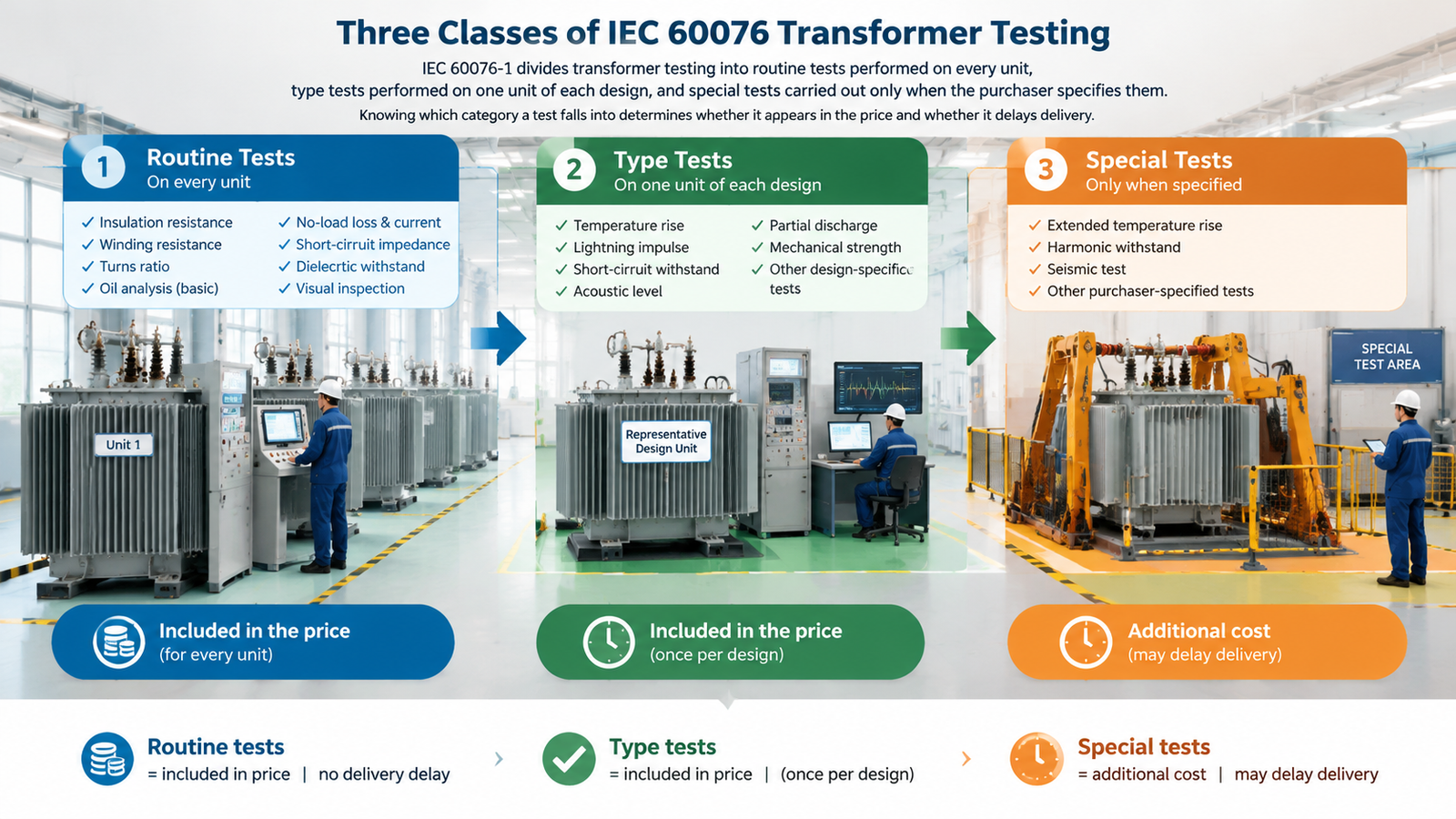
If you are buying a transformer from an overseas factory, power transformer testing is the last part of the purchase you can still influence after the design is frozen — and it is where a specification turns into evidence. IEC 60076 sorts every test a transformer can undergo into three classes: routine, type and special. Which class a test belongs to decides whether it is inside the quoted price, whether it delays delivery, and whether a certificate from an earlier project can be accepted instead of a new test.
This guide is written for procurement managers, EPC contractors, MEP consultants and distributors who have to sign off a factory acceptance test (FAT) on a unit built in China or anywhere else. It covers what each test class proves, the acceptance limits in IEC 60076-1, what a complete FAT dossier must contain, and the readings that should stop a shipment.
The three test classes, and what each one actually proves
Mixing up the three classes is the most common misunderstanding in a transformer test report. Routine tests confirm that the individual unit in front of you was built correctly. Type tests prove a design, once, on one representative unit. Special tests are everything the buyer asks for beyond that.
Class
Performed on
Inside the price
What it proves
Routine
Every unit
Yes, standard
This serial number matches its rating plate and is free of manufacturing defects
Type
One unit of each design
Usually yes, once per design
The design itself meets the guaranteed performance
Special
Only when specified
No — extra cost
A characteristic beyond the standard requirement
A type-test certificate from an identical design built earlier is normally acceptable, provided it covers the same rating range and the same core and winding construction. Routine tests are never transferable — they belong to the specific unit you are buying. A FAT is not a fourth class of test either: it is the routine programme run with you, or your inspector, watching. Nothing extra is measured.
Routine tests: the checks every unit must pass
Routine tests are defined in IEC 60076-1 and cannot be waived by either side. They are non-destructive and repeatable, which is why they can be applied to a whole production run.
Test
What it verifies
Typical acceptance check
Winding resistance, all windings and taps
Bad joints, wrong conductor cross-section, wrong number of turns
Phase-to-phase deviation within about 2% of the average
Voltage ratio and phase displacement
Turns ratio at every tap and the correct vector group
Within ±0.5% of the specified ratio at the principal tapping
Short-circuit impedance and load loss
Conductor losses and the impedance your fault study assumed
Inside the IEC 60076-1 tolerance of the guaranteed value
No-load loss and no-load current
Core steel grade and core assembly quality
Inside tolerance of the guarantee; no-load current within +30% of design
Separate-source AC withstand
Insulation from each winding to earth and between windings
No flashover for the full applied test duration
Induced overvoltage withstand
Turn-to-turn and interlayer insulation
No collapse, and partial discharge within limits where measured
Insulation resistance
Dryness and cleanliness of the insulation at the moment of test
Recorded as a baseline value, not as pass or fail
Oil tests, liquid-immersed units
Dielectric strength, moisture, acidity and a dissolved-gas baseline
Per IEC 60156 and the limits in your specification
Tank leak and pressure test
Weld, gasket and bushing-seal integrity
No leakage and no pressure drop over the hold period
The three numbers that decide acceptance
Losses and impedance are the commercial heart of the routine test, because they are measured on the unit you are actually buying rather than on a sibling. Load loss is measured at rated current and every result has to be corrected to the 75 °C reference temperature; if the report does not state the correction method, ask for it. No-load loss is measured at rated voltage and frequency with the secondary open, and it is the clearest signal of core quality and assembly.
One caution. A no-load loss well below the guarantee is not automatically good news. Check the test voltage and frequency waveform, the calibration record, and whether the tested unit matches the approved design before you treat the saving as real. An unexplained low reading is a question, not a bonus.
Dielectric tests: what the applied voltage should be
Dielectric routine tests follow IEC 60076-3. For the medium-voltage classes most export orders fall into, the standard separate-source AC test levels are:
Highest voltage for equipment (Um)
Separate-source AC test
Standard lightning impulse level
12 kV
28 kV, 60 s
75 kV
24 kV
50 kV, 60 s
125 kV
36 kV
70 kV, 60 s
170 kV
52 kV
95 kV, 60 s
250 kV
72.5 kV
140 kV, 60 s
325 kV
A report that records “applied voltage: PASS” with no voltage level and no duration is not evidence. Insist on numeric values, the test duration, and the connection diagram used.
Partial discharge and the limits that matter
Where partial discharge (PD) is measured, IEC 60076-3 sets a ceiling of 100 pC at 1.1 Um for equipment up to and including 72.5 kV. PD is a routine test on many higher-voltage orders and a special test on others, so confirm where it sits in your contract rather than assuming it is included. A quiet PD reading taken in a noisy bay at the wrong time of day is worth very little — ask when the measurement was taken and what the background noise level was.
Oil tests and the baseline you will need later
On oil-immersed units, add oil dielectric strength (breakdown voltage, per IEC 60156), moisture content, acidity and interfacial tension, plus a dissolved gas analysis (DGA) baseline before shipment. That baseline is the reference your site team will compare against after transport and again after six months in service. If you attend the FAT, watch the sample being drawn — a DGA result with no chain of custody is hard to defend in a warranty discussion.
Type tests: proving the design, once
Type tests are performed on one unit representative of a design family. Once the design passes, the certificate normally covers later units of the same design, which is why the tests are not repeated for every order. Two of them carry most of the weight.
Temperature-rise test (IEC 60076-2). This is the only test that proves the transformer can carry rated load continuously without exceeding the thermal limits of its insulation — the factor that sets service life. For oil-immersed units with class A insulation, the IEC limits are 60 K top-oil, 65 K average winding and 78 K hot-spot rise above ambient. Dry-type limits depend on the insulation class: 60 K for class A, 80 K for class B, 100 K for class F and 125 K for class H. A heat run occupies the test bay for a full day or more, which is exactly why it is done once per design and never per unit.
Lightning impulse test (IEC 60076-3). A 1.2/50 µs full-wave impulse is applied at the basic impulse level (BIL) of the unit’s insulation class, with chopped-wave impulses where the specification requires them.
Dry-type units add partial discharge measurement and, where the site demands it, sound-level verification. The ratings a compliant dry-type unit has to state — voltage class, temperature class, PD level, clearances and enclosure — are set out in our reference on dry-type transformer specifications.
How to check a type-test certificate is valid for your order
Three checks settle it. First, does the certificate cover the same design family and rating range, not merely the same manufacturer? Second, is it issued against the edition of the standard your contract names? Third, does the laboratory’s accreditation actually cover that test? Where a certificate is borderline, the cheapest protection is a clause stating that the accepted type-test evidence is attached to the purchase order as an annex.
Special tests: what to specify, and when it is worth paying for
Special tests are the ones agreed between buyer and supplier at contract stage. They are not required by the standard, and every one of them adds cost — and sometimes weeks.
Special test
Reference
Specify it when
Short-circuit withstand
IEC 60076-5
Utility, infrastructure or high-fault-level duty, where mechanical withstand must be demonstrated instead of calculated. Run at an independent high-power laboratory; the tested unit is generally not saleable afterwards
Switching impulse withstand
IEC 60076-3
Transmission-level units where switching surges govern the insulation design
Sound level measurement
IEC 60076-10
The substation sits near housing, a hospital or offices, or planning consent sets a noise limit
Partial discharge measurement
IEC 60270
High-voltage, cast-resin, data centre, offshore and renewable duty — anywhere long insulation life under continuous stress matters
Zero-sequence impedance
IEC 60076-1
Earth-fault protection settings must be calculated precisely, typically with star windings and solidly earthed neutrals
Harmonics of no-load current
IEC 60076-1
The unit feeds or is fed by converters, variable-frequency drives or rectifiers
Frequency response analysis (FRA)
IEC 60076-18, IEEE C57.149
Large units where you want a fingerprint to compare against after transport and installation
Capacitance and dissipation factor (tan δ)
IEC 60076-3
Oil-immersed units where a condition-monitoring baseline is part of the asset strategy
DGA before and after testing
—
You want a gas baseline and confirmation that the tests themselves generated no fault gases
Do not order the whole menu by reflex. The practical rule is to pick the two or three that your application actually drives. A data centre or an offshore platform justifies partial discharge and sound measurement in a way a rural distribution station does not, and unnecessary tests buy cost and time rather than confidence.
Acceptance limits in IEC 60076-1: the tolerances to hold a supplier to
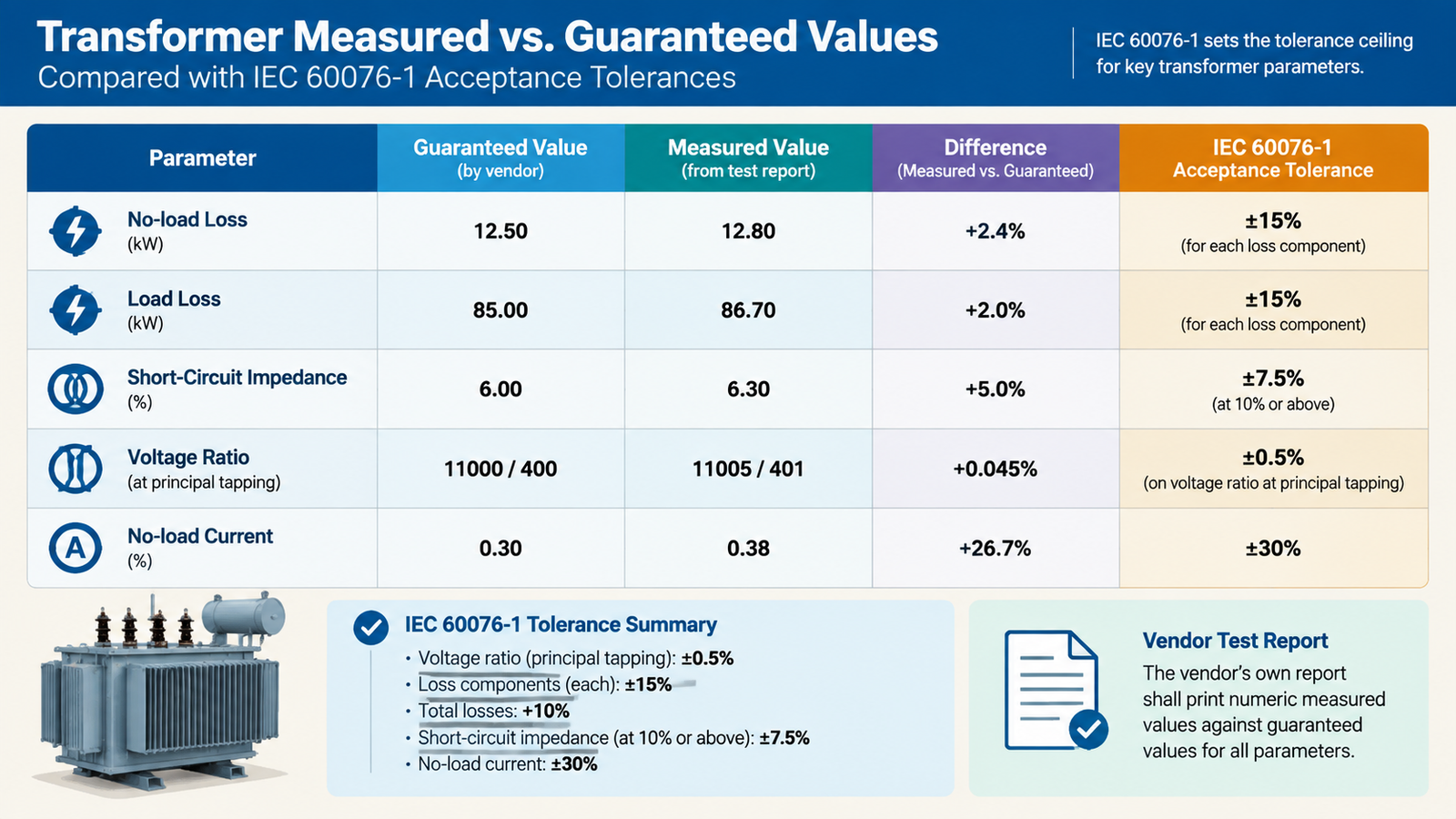
The standard sets a ceiling, not your target. These are the principal-tapping limits for a two-winding transformer:
Parameter
IEC 60076-1 tolerance
Total losses
+10% of the total losses
Each loss component (no-load and load)
+15% of that component, provided the total-loss tolerance is not exceeded
Voltage ratio at the principal tapping
±0.5% of the specified ratio, or one tenth of the actual percentage impedance, whichever is lower
Voltage ratio at other tappings
±0.5% of the design turns ratio
Short-circuit impedance at the principal tapping
±7.5% where the impedance is 10% or above; ±10% where it is below 10%
No-load current
+30% of the design value
Notice the asymmetry. The loss tolerances are one-sided and positive, so a supplier can deliver a transformer whose losses are up to 15% worse than quoted, per component, and still be compliant with the standard. If an energy budget or a green-building target depends on those figures, write a tighter contractual tolerance — many buyers negotiate zero positive tolerance on no-load loss — and attach it to a liquidated-damages clause. Also confirm which edition of the standard your contract references, because older editions number the test clauses differently and the numbers move with the edition.
The factory acceptance test: the routine programme, witnessed
A FAT adds no new measurements. What it adds is your presence when the measurements are taken, and the right to challenge a reading before the unit is crated. On an export order the FAT is the last cheap moment to find a problem: correcting a defect at the factory costs a fraction of correcting it after a long sea voyage, a crane lift and a site crew on standby.
What a complete FAT dossier must contain
Signed routine test reports with numeric measured values printed against the guaranteed values — not pass/fail ticks.
Calibration certificates for every instrument used, valid on the test date.
Test circuit diagrams and the nameplate data block, which should match your purchase order line by line. Our guide to transformer ratings and nameplates explains what each field should say.
Type-test certificates covering the design family.
Special-test reports where ordered, with the laboratory’s accreditation reference.
Oil test results and the DGA baseline for liquid-immersed units.
Approved final drawings, accessory and spare-parts lists, packing specification, and a written record of any deviation, concession or retest.
Witnessed, remote or third-party: choosing your coverage
There are three options and they are not mutually exclusive. Attending in person gives the strongest evidence, because your engineer can watch the zero check on each instrument before any measurement is taken. Remote witnessing by live video works when it is structured: a fixed agenda, a camera that shows the serial number plate, the instrument displays and the test connections, and the same signed report package afterwards — plus a realistic time-zone plan, since dielectric tests on a quiet bay are often run at night. Third-party inspection through SGS, Bureau Veritas, TÜV or Intertek is the usual compromise when travel is not possible, and it also covers the packing check.
Whichever route you choose, fix it in the contract: notice period, test agenda, accepted remote method, report language, and a rule that shipment is not released until open points are closed.
Readings that should stop a shipment
Reading
What it usually means
Winding resistance imbalance above 2% between phases
Wrong number of turns, a bad tap connection or a failed crimp
Load loss more than 5% above the guaranteed value
Undersized conductor or poor-quality copper, and higher operating temperature in service
Impedance more than 5% away from the specified value
Fault levels and voltage regulation fall outside your system study
Applied voltage test recorded as passed with no voltage level or duration
The test as described cannot be verified, so it is not evidence
No-load loss far below the guarantee with no explanation
Check test voltage, frequency and whether the tested unit matches the approved design
Any test run with out-of-calibration instruments
Every reading taken with that instrument is void
Writing the test requirements into the purchase order
Most FAT disputes are created at quotation stage, not on the test floor. Close these points before the order is confirmed:
Name the standard and the edition, IEC 60076-1 with parts -2, -3, -5 and -10 as applicable, plus any utility or national standard that takes priority over it.
List the guaranteed values explicitly: no-load loss, load loss, impedance, sound level and temperature-rise limits.
State the tolerance you will accept and say whether it is the IEC default or tighter than it.
Mark every special test as required or not required. Never leave it implied.
Define the accepted type-test evidence, including design family and certificate date.
Set the witness arrangement, notice period, agenda and report language, and make an approved FAT a condition of the shipment-release payment milestone.
Define what happens on a non-conformity: written notification, root-cause analysis, corrective action, retest, and who authorises release.
A transformer can pass the FAT and still fail at site. Transport can shift a core, moisture can enter a poorly sealed unit, and a tap changer can move. The site acceptance test repeats the fast checks — insulation resistance, winding resistance and ratio, oil tests, and on larger units a capacitance and dissipation factor measurement — and compares them with the FAT numbers corrected for temperature. That comparison is only possible if you received the FAT data, which is the real reason to insist on the full dossier rather than a certificate of conformity.
What to take away
Power transformer testing is not paperwork to be collected at the end of a project. It is the mechanism that converts a specification into verified performance, and the three-class structure in IEC 60076 tells you whether a given test is standard, once-per-design, or an extra worth paying for. Put the tolerance table in your contract, require numeric results rather than ticks, agree the witness arrangement in advance, and treat FAT approval as the gate that releases the balance payment. Buyers who do those four things rarely discover problems at commissioning.
Kampa Electric builds oil-immersed and dry-type transformers from 11 kV to 35 kV with in-house routine testing, type-test documentation and support for witnessed or third-party FAT, including dry-type power transformers for industrial, utility and commercial projects. If you have a specification sheet ready, send it to our engineering team for a factory-direct quotation with a proposed test plan.
Frequently asked questions
How long does power transformer testing take?
Routine testing on a single unit typically takes a few hours to a day, so a full witnessed FAT usually fits into three to five days including visual inspection, dimensional checks and the accessory review. Add 24 to 48 hours if a temperature-rise test is running on the bay at the same time, and allow extra days if impulse or special tests are scheduled.
What is the difference between a routine test and a type test?
A routine test is performed on every unit and proves that this particular transformer was built correctly. A type test is performed once on a representative unit and proves that the design meets the specified performance. Routine results are never transferable between units; a type-test certificate normally is, provided the design family and rating range match.
Is a factory acceptance test the same as a type test?
No. A FAT is the routine test programme witnessed by you or your appointed inspector, and it measures nothing extra. A type test is a separate, more severe programme — temperature rise, impulse withstand — carried out once per design, often years before your order.
Which tests must appear in every transformer test report?
The routine set under IEC 60076-1: winding resistance, voltage ratio and phase displacement, short-circuit impedance and load loss, no-load loss and current, and the dielectric routine tests per IEC 60076-3. Insulation resistance and, on oil-immersed units, oil dielectric strength, moisture and a DGA baseline are standard practice even where they are not strictly mandatory.
Can I accept a type-test certificate from an earlier project?
Usually yes, if the certificate covers the same design family, the same rating range and the same core and winding construction, and if it was issued against the edition of the standard your contract references. Check the accreditation of the issuing laboratory as well, and attach the accepted certificate to the purchase order as an annex.
What are the IEC 60076-1 tolerances for losses and impedance?
Total losses +10%, each individual loss component +15% provided the total is not exceeded, no-load current +30%, voltage ratio ±0.5% at the principal tapping, and short-circuit impedance ±7.5% where the impedance is 10% or above and ±10% where it is below. Tighter tolerances must be agreed in writing before the order is placed.
Does a transformer need a partial discharge test?
Not always. It is a routine requirement in many higher-voltage specifications and a special test in others. Specify it where insulation life under continuous stress matters — cast-resin dry-type units, data centres, offshore substations and renewable projects — and confirm in the contract whether it is routine or special for your order.
A practical 12-point checklist for auditing power transformer manufacturers in China: certifications by market, factory tests, materials, capacity and commercial terms.
How to size and specify a transformer for EV charging stations and hubs: AC input kVA, continuous load rules, demand factors, K-factor selection and site matching.
How to specify a dry type transformer for mining: flameproof Group I protection, overload for direct-on-line motor starting, dust design and mobile substations.