If you’re searching for detailed dry type transformer specifications, you’ve come to the right place. Whether you’re an electrical engineer, procurement specialist, or facility manager, understanding the key parameters like kVA ratings, insulation class, cooling methods, and efficiency is crucial for selecting the perfect transformer for your project. This guide cuts through the technical jargon to help you decode essential specs, compare options like cast resin and vacuum pressure impregnated transformers, and navigate standards such as IEC 60076-11. Ready to make informed decisions backed by solid data and reliable supplier insights? Let’s dive into everything you need to know about dry type transformer specifications.
Understanding Dry Type Transformer Basics
Definition and Operating Principle
A dry type transformer is an electrical device that transfers power between circuits without using liquid insulation like oil. Instead, it relies on air for cooling and solid insulation materials such as epoxy resin or varnish. These transformers operate on electromagnetic induction, where a magnetic core and primary and secondary windings transfer voltage and current safely.
Comparison with Oil-Filled Transformers
| Feature |
Dry Type Transformer |
Oil-Filled Transformer |
| Cooling Medium |
Air |
Oil |
| Fire Risk |
Low |
Higher due to flammable oil |
| Maintenance |
Minimal |
Regular oil checks and testing |
| Environmental Impact |
Eco-friendly, no oil spills |
Risk of oil leaks & contamination |
| Installation Location |
Suitable indoors and sensitive areas |
Often located outdoors or in substations |
| Size and Weight |
Typically larger and heavier |
More compact for same rating |
Common Types of Dry Type Transformers
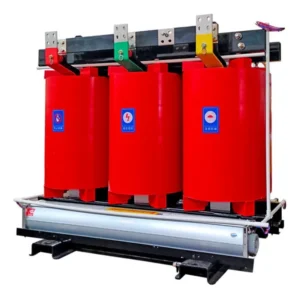
- Cast Resin Dry Type Transformer: Uses epoxy resin for insulation; excellent for damp or polluted environments.
- Vacuum Pressure Impregnated (VPI) Transformer: Windings are impregnated with varnish under vacuum, improving insulation and moisture resistance.
- Open-Wound Transformer: Simple construction with exposed coils; used where environment is controlled.
Each type offers specific benefits depending on insulation needs, cooling, and application demands. Choosing between these depends on your facility’s environment, safety requirements, and performance expectations.
Key Specifications Explained
Understanding the key specifications of a dry type transformer helps ensure you pick the right one for your needs. The table below covers the parameters that appear on a specification sheet, and what each one actually decides. Most of these fields are also mandatory on the rating plate — see how to read them in our dry type transformer ratings and nameplate guide.
| Specification |
What it defines |
Typical range or options |
| Rated power (kVA) |
The maximum continuous load the unit can carry |
Standard ratings from 30 kVA to 2,500 kVA — see the rating table below |
| Voltage class |
Primary and secondary voltages, and therefore the insulation level required |
Common builds at 0.4 kV, 6 kV and 10 kV; higher classes up to 36 kV |
| Insulation class |
The temperature the winding insulation system is rated to withstand |
Class F (155 °C) and Class H (180 °C) in standard dry type builds |
| Temperature rise |
How far the winding may rise above ambient at rated load. Lower rise means a longer life |
Typically 80 K to 115 K, selected inside the insulation class |
| Cooling method |
How heat leaves the windings, and how much extra capacity is available |
AN (air natural), AF (air forced), ANAF (natural plus forced) |
| Overload capability |
How far and for how long the unit may exceed rated load safely |
Set by the temperature rise and the thermal margin; stated per project |
| Impedance voltage |
Voltage drop on load, short-circuit current, and whether two units can be paralleled |
Usually 4–6% at distribution ratings, higher on large units |
| Short circuit withstand |
Ability to survive the mechanical forces of a through-fault without damage |
Tested or calculated against the system fault level |
| Basic impulse level (BIL) |
Withstand against surge voltages such as lightning or switching transients |
Set by the voltage class and the surge arrester coordination |
| Partial discharge |
Insulation quality. Lower readings mean fewer internal defects |
Routine check on cast resin units; specified in pC |
| Efficiency and losses |
No-load (core) and load (copper) losses, and the running cost that follows |
Efficiency normally above 97%; loss levels set by the destination market |
| Frequency |
Design frequency. A 50 Hz and a 60 Hz unit are not interchangeable |
50 Hz or 60 Hz depending on region |
| Vector group |
Winding connections and phase displacement, critical when paralleling |
Dyn11 and Yyn0 are the common distribution groups |
These parameters interact rather than sitting independently on the sheet. A higher insulation class permits a higher temperature rise, which allows a more compact design or more overload tolerance at the same rating. Air forced cooling raises usable capacity but introduces fans and a maintenance item. Impedance and short-circuit withstand have to be read together with the protection settings.
Two of them are routinely confused. Insulation class is a property of the materials — the temperature the insulation system will survive. Temperature rise is a design choice made inside that class, and it is the rise that decides how hot the winding actually runs and therefore how long the transformer lasts. Specifying a Class H system at an 80 K rise buys a long-life unit; the same class at 125 K buys a smaller and cheaper one.
These specs directly impact performance, reliability, and suitability. For example, higher insulation classes enable higher temperature rise limits, allowing for more compact designs or greater overload tolerance. Cooling methods like Air Forced (AF) enhance capacity but may increase maintenance.
For detailed performance under specific loads or environments, choosing the right combination of these specs is key to optimizing your dry type transformer’s life and efficiency.
If you’re evaluating transformers alongside switchgear, also check out products like the VSG-12 indoor high voltage vacuum circuit breaker for integrated power system solutions.
Standard Ratings and Dimensions
Dry type distribution transformers are built to a standard ladder of preferred ratings. That is what makes quotations from different suppliers comparable at all — and it is also why “what sizes does a dry type transformer come in” has a shorter answer than most buyers expect.
| Capacity band |
Phase |
Common voltage combination |
Typical insulation system |
Typical application |
| 30–100 kVA |
3 |
0.4 kV / 0.4–0.23 kV |
VPI ventilated |
Lighting and power distribution in commercial buildings |
| 125–315 kVA |
3 |
0.4 kV, or 6 kV / 0.4 kV |
VPI ventilated or encapsulated |
Building service, workshops, small industrial plants |
| 400–630 kVA |
3 |
6 kV or 10 kV / 0.4 kV |
Cast resin (SCB type) |
Industrial plants and high-rise main distribution |
| 800–1,250 kVA |
3 |
10 kV / 0.4 kV |
Cast resin (SCB type) |
Data centres and large industrial distribution |
| 1,600–2,500 kVA |
3 |
10 kV / 0.4 kV |
Cast resin (SCB type) |
Heavy industrial and utility-adjacent distribution |
Those are the ratings and voltage combinations; the dimensions are a different question, because physical size is not fixed by the kVA rating alone. Four things move the footprint and the weight:
- Winding material — a copper winding is more compact than an aluminium one at the same rating, but heavier.
- Insulation system — a cast resin unit has a larger sealed envelope than a ventilated VPI unit of the same kVA.
- Temperature rise — a lower rise needs more cooling surface, so an 80 K unit is physically larger than a 115 K unit at the same rating.
- Enclosure and cooling — IP rating, weather protection, fans and cable boxes all add to the outer dimensions.
Because of this, Kampa issues a dimensioned outline drawing with every quotation rather than quoting a generic size table. Ask for that drawing before you finalise the switchroom layout, the cable routing or the lifting plan — it is the only figure that is actually binding on your installation. For typical bare-unit envelopes, weights and rail gauges at each rating, see the dry type transformer sizes and dimensions chart.
Insulation Classes and Temperature Rise
Insulation class and temperature rise are the two numbers that decide how long a dry type transformer lasts. The class is fixed by the materials in the insulation system. The rise is the design margin chosen inside that class.
| Insulation class |
Maximum winding temperature |
Typical material in dry type construction |
Rise commonly specified |
| Class B |
130 °C |
Older impregnated paper and varnish systems |
60 K or 80 K |
| Class F |
155 °C |
Cast epoxy resin; vacuum pressure impregnated windings |
80 K or 100 K |
| Class H |
180 °C |
Higher-temperature VPI and encapsulated systems |
100 K or 115 K |
| Class C |
Above 180 °C, commonly 200 °C or 220 °C |
Special high-temperature systems for traction and marine duty |
125 K or 150 K |
The permissible rise is the class temperature minus the site ambient and a hot-spot margin. That is why a Class F system is normally specified at 80 K or 100 K rather than at its full rating. Adding the ambient (40 °C is the usual reference), the allowable rise and a hot-spot allowance gives the maximum winding temperature the design is expected to reach in service.
The reason this matters commercially is ageing. Insulation degradation roughly doubles for every 7–10 °C above the rated class limit, so running a winding 15 °C hotter can take years off the unit. A transformer specified at a lower rise costs more and takes up more space for the same kVA, but it runs cooler, ages more slowly and tolerates more overload — which is why industrial specifications often insist on an 80 K rise on a Class F system even though 100 K would be permissible.
Environmental and Performance Classes
When specifying a dry type transformer, considering its environmental and performance classes is crucial for long-term reliability and safety.
Climatic Classes for Temperature and Humidity
Dry type transformers are designed to handle various climatic conditions. Their temperature and humidity ratings dictate where they can be installed, from dry, controlled indoor spaces to more challenging environments. These climatic classes ensure the transformer operates efficiently without overheating or moisture damage.
Pollution Levels and Fire Safety Classes
Pollution categories indicate how resilient a transformer is against dust, chemicals, and other contaminants. Dry type transformers are often rated to withstand pollution levels common in urban or industrial areas. Additionally, fire safety classes focus on minimizing fire risks—the non-flammable insulation materials in cast resin and vacuum pressure impregnated (VPI) transformers improve safety where fire hazards are a concern.
Enclosure Ratings and Indoor/Outdoor Suitability
The IP (Ingress Protection) rating gives a clear idea of a dry type transformer’s resistance to solids and liquids. Higher IP ratings are essential for outdoor installations or harsh industrial sites. Most dry type transformers are designed primarily for indoor use but can be customized with suitable enclosures to meet outdoor and high-pollution area demands.
Understanding these environmental and performance classes helps ensure the dry type transformer meets your site-specific needs for safety, durability, and regulatory compliance. For an example of a cast resin dry type unit built for robust environmental ratings, see the SCB series 10 kV epoxy resin dry type transformer.
Design and Construction Features
Dry type transformers are carefully designed for safety, performance, and longevity. Here’s a quick breakdown of the main construction elements:
Core Materials and Construction Techniques
- Core: Usually made from high-quality silicon steel laminations to reduce losses and improve magnetic properties.
- Construction: Core is either stacked or wound, with precise assembly to minimize noise and vibration.
Winding Materials and Insulation Systems
- Winding: Copper or aluminum conductors are used, with copper offering better conductivity but at a higher price.
- Insulation: Advanced insulation systems like epoxy resin (cast resin types) or vacuum pressure impregnated (VPI) tapes protect the windings, ensuring a strong dry type transformer insulation class and high temperature rise tolerance.
Tap Changers and Voltage Adjustment
- Tap changers allow fine adjustment of output voltage to maintain steady performance under varying load conditions. They can be:
- Off-load tap changers (OLTC)
- Load tap changers (LTC)
This flexibility is crucial for applications sensitive to voltage fluctuations.
Accessories: Temperature Monitors, Fans, Surge Arresters
- Temperature Monitors: Sensors track winding and ambient temperatures to prevent overheating.
- Fans: Used in Air Forced (AF) or Air Natural + Forced (ANAF) cooled transformers for better heat dissipation.
- Surge Arresters: Protect transformer windings from voltage spikes and ensure reliability.
| Feature |
Description |
| Core Material |
Silicon steel laminations |
| Winding Material |
Copper or aluminum |
| Insulation System |
Cast resin or Vacuum Pressure Impregnated (VPI) |
| Tap Changers |
Off-load and load tap changers |
| Temperature Control |
Sensors for thermal monitoring |
| Cooling Accessories |
Fans for AF/ANAF cooling |
| Protection Devices |
Surge arresters |
These design choices ensure dry type transformers deliver high efficiency, withstand short circuit stresses, and meet key international standards like IEC 60076-11.
For more on dry type transformer insulation and protection, see the dry type transformer insulation series and the guide to dry type transformer insulation.
Standards and Compliance
Dry type transformers must meet strict international standards to ensure safety, performance, and reliability. The primary standards include:
| Standard |
Description |
| IEC 60076-11 |
Defines requirements for dry type transformers globally |
| IEEE C57 Series |
US-based standards focusing on design, testing, and rating |
| UL Certification |
Safety certification mainly for North American markets |
| CSA Certification |
Canadian safety and performance standard |
| KEMA Certification |
European third-party testing and certification |
What the IEC 60076-11 Classes Actually Mean
IEC 60076-11 governs dry type transformers, and the part most buyers overlook is that it defines three separate classification systems. A specification that says only “to IEC 60076-11” is incomplete, because the environmental, climatic and fire classes change the materials and the test programme.
| Classification |
Codes |
What each code means |
Typical specification |
| Environmental class |
E0 / E1 / E2 |
Exposure to condensation and pollution. E0: no condensation, negligible pollution. E1: occasional condensation (for example when de-energised), limited pollution. E2: frequent condensation, or more significant pollution, or both. |
E0 for clean, dry, climate-controlled rooms; E1 for standard ventilated indoor substations; E2 for dusty, humid or heavy industrial locations |
| Climatic class |
C1 / C2 / C3 |
Minimum ambient the unit must tolerate. C1: operation down to −5 °C, transport and storage down to −25 °C. C2: operation, transport and storage down to −25 °C. C3: transport and storage down to −40 °C, operation down to −25 °C. |
C1 for heated indoor rooms; C2 for outdoor and unheated installations in temperate climates; C3 where the unit may be stored in severe cold |
| Fire behaviour class |
F0 / F1 |
F0: no special fire performance required, with emissions minimised by design. F1: restricted flammability, the unit must self-extinguish, and emissions of toxic substances and opaque smoke must be minimised. |
F0 where there is no external fire hazard; F1 for occupied buildings and any location with a fire risk. The standard defines F0 and F1 only. |
Written onto a specification sheet, the codes are compact: a 1,000 kVA cast resin unit specified as C2 E1 F1 is one rated for outdoor-capable ambient, occasional condensation, and restricted flammability with self-extinguishing behaviour. That is a different build from a C1 E0 F0 ventilated unit in a plant room, at the same kVA and the same voltage class.
Energy Efficiency and Testing
Efficiency standards are critical due to growing energy regulations. Dry type transformers undergo routine loss and efficiency testing to comply with local and international mandates. This includes checking temperature rise limits, insulation integrity, and short circuit withstand capabilities.
Why It Matters
- Safety: Certified transformers reduce fire risks and electrical hazards.
- Performance: Compliance ensures consistent operation under rated loads.
- Market Access: Certified products can be sold worldwide without restrictions.
At Kampa, we ensure all dry type transformers meet or exceed these standards, delivering reliable products that align with the latest regulations. This focus guarantees safety and efficiency in every unit we supply.
For more on related products and insulation standards, explore our dry type transformer insulation series.
How to Select the Right Dry Type Transformer
Choosing the right dry type transformer means balancing your power needs, environment, and budget. Here’s a straightforward guide to help:
Step-by-Step Selection Guide:
- Determine Rated Power (kVA): Start with the total load your transformer must handle. Always factor in future load growth or peak demand to avoid undersizing.
- Check Voltage Classes: Ensure compatibility with your supply and load voltages, including primary and secondary voltage ratings.
- Consider Overload Factors: Dry type transformers typically tolerate light overloads for limited time. Define your overload allowance and select a transformer with adequate thermal margin.
- Choose Cooling Method: Options like Air Natural (AN), Air Forced (AF), or a combination (ANAF) affect performance. Select based on heat dissipation needs and installation environment.
Sizing and Overload Considerations:
- Account for continuous and transient loads.
- Confirm insulation class and temperature rise capacity match your operational conditions.
- Select impedance and short circuit withstand levels suitable for system protection.
Common Applications:
Dry type transformers fit many sectors including commercial buildings, data centers, hospitals, renewables, and industrial plants. Their compact design and safety profile make them ideal where fire risk or environmental hazards are a concern.
For a deeper dive on selecting dry type transformers that precisely fit your project’s needs, explore our detailed step-by-step guidance at how to select the right dry type transformers for your project.
This approach ensures you get the best mix of efficiency, durability, and cost-effectiveness, tailored to your unique application.
Customization Options with Kampa
Kampa offers extensive dry type transformer customization options to meet your exact needs. We tailor designs based on your required voltage, kVA ratings, and cooling methods—whether you prefer cast resin, vacuum pressure impregnated (VPI), or other dry type transformer types.
What You Can Customize:
| Feature |
Options Available |
| Voltage Classes |
Low, medium, and high voltage up to 36kV |
| kVA Ratings |
From small distribution to large industrial sizes |
| Cooling Methods |
AN (Air Natural), AF (Air Forced), ANAF (Air Natural + Forced) |
| Materials |
Copper or aluminum windings; various core steel grades |
| Enclosure Types |
IP20 to IP54, indoor and outdoor ratings |
| Accessories |
Temperature monitors, fans, surge arresters |
Kampa’s competitive pricing and fast delivery make these tailored dry type transformer solutions accessible without compromising quality. Our ability to adjust product specs lets you get exactly what fits your application, whether it’s for a data center, hospital, or industrial site.
See the custom dry type transformer options for the full list of what can be varied, or browse the dry type power transformer range.
Choose Kampa for flexible, reliable, and efficient dry type transformer solutions built around your project’s needs.
Maintenance and Long-Term Performance
Dry type transformers require minimal maintenance compared to their oil-filled counterparts. Thanks to their sealed, dry insulation systems like cast resin or vacuum pressure impregnated windings, routine upkeep is straightforward and less frequent. Regular visual inspections, cleaning to remove dust or debris, and periodic temperature monitoring are usually enough to ensure reliable operation.
For monitoring, installing temperature sensors or fans can help prevent overheating and extend the lifespan. Troubleshooting is easy; common issues often relate to partial discharges or insulation wear, which can be detected early through condition monitoring equipment.
Typically, a well-maintained dry type transformer enjoys a service life of 30 to 40 years. Most manufacturers back this with warranties covering materials and workmanship, giving confidence in long-term performance. To maximize value, choose transformers with proven durability and consider suppliers offering ongoing support and warranty services.
For specific models and their maintenance implications, see the SCB series 10 kV epoxy resin dry type transformer — its sealed cast-resin windings remove most of the routine upkeep that ventilated designs require.
Installation, Operation, and Testing
Proper installation and operation are vital for reliable dry type transformer performance. Following the right procedures helps avoid downtime and extends transformer life.
Site and Mounting Requirements
- Location: Dry type transformers work best in clean, dry, well-ventilated areas, free from dust and corrosive gases.
- Mounting: Secure on a solid, level foundation to avoid vibrations. Use anti-vibration pads if necessary.
- Clearances: Maintain recommended clearances for airflow and maintenance access.
- Enclosure: Ensure the enclosure rating (IP rating) suits indoor or outdoor use, protecting against moisture and pollution.
Recommended Clearances and Access
Clearance is what turns a valid specification into an installable one. Two forces set the numbers: airflow for a ventilated unit, and safe access for cable termination and testing.
| Clearance |
Typical minimum |
Why it is needed |
| Front access face |
800–1,000 mm |
Door swing, HV cable termination, torque checks and testing access |
| Sides and rear to wall (ventilated units) |
300–500 mm |
The air inlet and outlet must stay unobstructed. A blocked inlet raises winding temperature and shortens life. |
| Above the enclosure |
300 mm minimum |
Heat dissipation, plus space for lifting and for the outgoing cable box |
| Between adjacent transformers |
Per the outline drawing |
Prevents heat recirculation between units and allows them to be isolated separately |
| Live parts to grounded metalwork |
Per the applicable standard for the voltage class |
Insulation coordination and a safe working distance for maintenance |
Treat these as planning figures rather than a substitute for the drawing. Actual clearances depend on the enclosure, the cable box arrangement and the local electrical code. Confirm them against the outline drawing and the applicable code before the room is laid out — moving a transformer after the walls are up is expensive.
Testing Procedures and Routine Checks
Before energizing, conduct these essential tests:
| Test Type |
Purpose |
Frequency |
| Insulation Resistance Test |
Ensures no insulation breakdown |
Before commissioning |
| Turns Ratio Test |
Confirms correct winding ratio |
At installation |
| Winding Resistance Test |
Checks winding integrity |
During commissioning |
| Power Factor Test |
Verifies insulation health |
Periodic |
| Partial Discharge Test |
Detects early insulation defects |
According to standards |
Routine checks should include:
- Monitoring temperature and noise levels during operation
- Inspecting for dust or moisture buildup
- Verifying cooling systems (fans, ventilation) function properly
- Checking accessories like temperature monitors and surge arresters
For specialized switchgear and substation solutions that complement transformer setups, consider exploring detailed options from Kampa Electric’s switchgear and substation solutions.
Following these installation and testing steps ensures your dry type transformer operates safely and efficiently from day one.
Applications and Advantages of Dry Type Transformers
Dry type transformers are a smart choice in many sectors due to their safety, reliability, and low maintenance. Popular applications include:
- Data Centers: Provide efficient, fire-safe electrical power distribution.
- Hospitals: Offer clean power with low electromagnetic interference.
- Commercial Buildings: Ideal for indoor installation with minimal fire risk.
- Renewable Energy Sites: Handle fluctuating loads from solar and wind power setups.
Dry Type vs Oil-Filled Transformers
This page covers specification rather than selection, so it does not repeat the full comparison. For the side-by-side breakdown — efficiency, lifetime cost, and where each type actually wins — see dry type vs oil immersed transformers.
Load Calculations and Future Proofing
When sizing dry type transformers, consider:
- Expected Load Growth: Design for 10-20% future overload capacity.
- Load Type: Account for non-linear loads common in data centers and hospitals.
- Operating Environment: Temperature and humidity affect transformer life.
- Energy Efficiency Needs: Higher efficiency models may cost more upfront but save energy long-term.
These points ensure your transformer investment lasts and adapts as your power needs evolve.
Dry type transformers stand out for their safety, energy efficiency, and adaptability—making them a preferred option in sensitive environments. For a detailed look at the differences and advantages, you can explore our insights on dry type vs oil immersed transformers for industrial applications.
Pricing and Supplier Guidance
When considering a dry type transformer, pricing often depends on several key factors:
- Rated Power (kVA): Higher kVA ratings generally increase cost due to larger materials and design complexity.
- Voltage Classes: Transformers built for higher voltages require more insulation and stricter design standards.
- Cooling Methods: Options like AN (Air Natural), AF (Air Forced), or ANAF (Air Natural/Forced) can impact pricing based on complexity.
- Customization: Tailored solutions for specific voltage, enclosure (IP ratings), or environmental requirements can add to the cost.
- Materials and Design: Using premium core materials, cast resin, or vacuum pressure impregnated (VPI) winding methods influences the price point.
- Standards Compliance: Meeting international standards such as IEC 60076-11 or certifications like UL and CSA may increase cost but ensures reliability.
Kampa specializes in custom dry type transformer designs that balance quality and budget, offering competitive pricing without compromising performance. Our extensive case studies demonstrate how we optimize material choices, cooling methods, and insulation systems to deliver cost-effective solutions tailored for various industries. For reliable and efficient transformers, exploring Kampa’s custom solutions and comprehensive support ensures you get the right product for your needs without overspending.
Discover more about Kampa’s expertise as a leading dry type transformer supplier for reliable power solutions and explore our range of medium and high voltage power solutions.