Transformer Insulation Class & Temperature Rise (A/E/B/F/H)
Published: Author: Lisa
Transformer insulation class is the single number that sets how hot a winding is allowed to run, how long the insulation will last, and how much physical material the manufacturer has to put into the core and coils to keep it there. Get it wrong and you either pay for thermal margin you never use, or you buy a unit that ages twice as fast as it should. The classes you will see on drawings are A (105 °C), E (120 °C), B (130 °C), F (155 °C) and H (180 °C), each with its own permitted temperature rise.
This guide walks through the IEC 60076-11 temperature classes and rise limits, explains how they relate to oil-immersed practice, and then covers the second half of the compliance picture that buyers often miss: the environmental, climatic and fire classes, and where IS 11171 fits for projects specifying to Indian standards.
What transformer insulation class actually means
An insulation class is a thermal endurance rating for the complete insulation system — conductor enamel, impregnating varnish or resin, and the paper or film between turns. It states the temperature the system can be exposed to continuously without its expected service life collapsing. The letters come from the IEC 60085 temperature classification, and every class carries two obligations: a maximum permitted temperature, and a permitted temperature rise above the surrounding ambient.
That second obligation is the one that actually governs design. Ambient temperature is not yours to choose, so the only lever the designer has is how much temperature the winding is allowed to add on top of it.
The A/E/B/F/H classes and their temperature rise limits
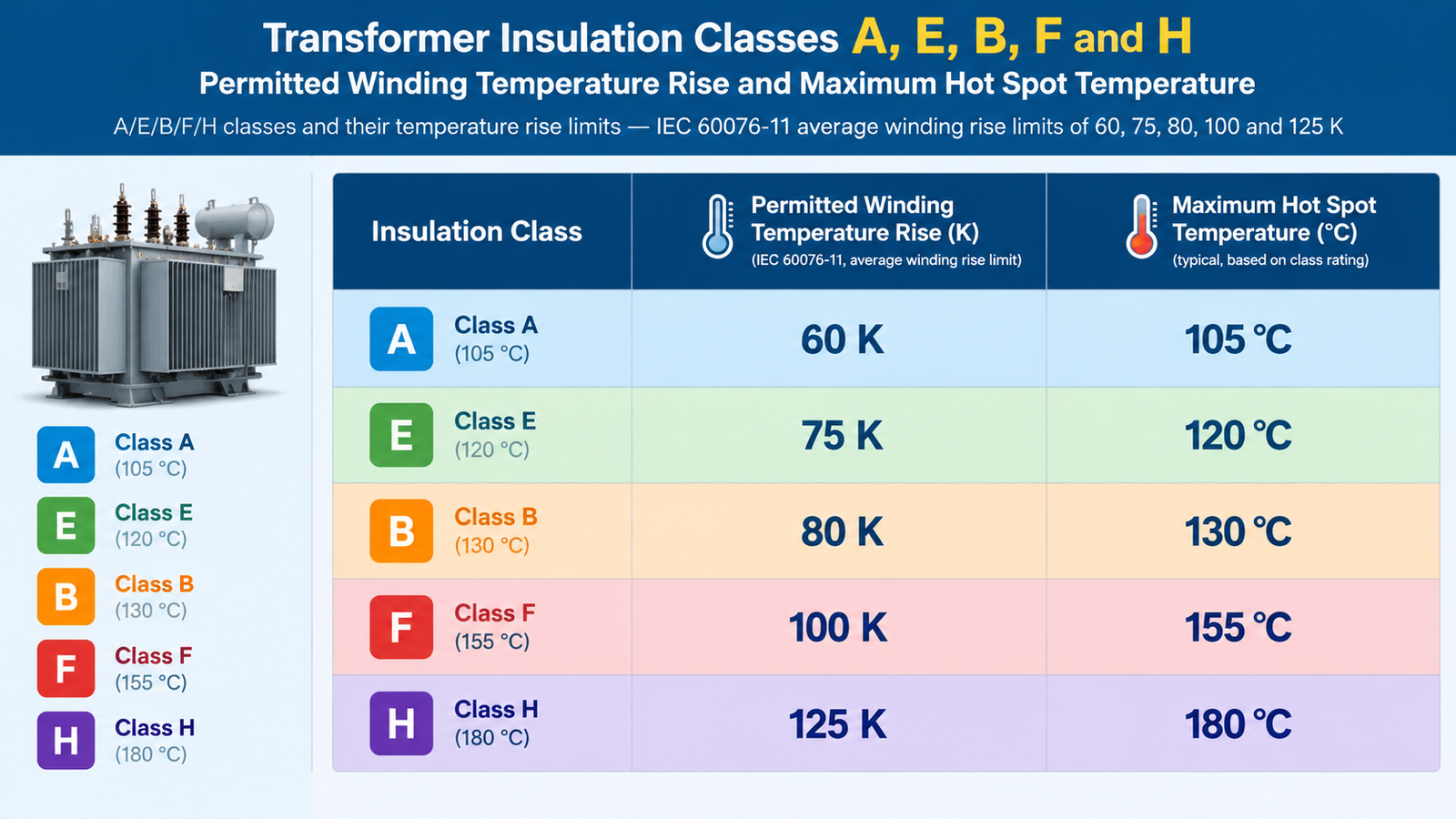
IEC 60076-11 defines both the average winding temperature rise at rated current and the maximum hot-spot winding temperature for each insulation system temperature. The table below reproduces those limits.
Insulation system temperature
Class (IEC 60085)
Average winding rise limit at rated current
Maximum hot-spot temperature
105 °C
A
60 K
130 °C
120 °C
E
75 K
145 °C
130 °C
B
80 K
155 °C
155 °C
F
100 K
180 °C
180 °C
H
125 K
205 °C
200 °C
—
135 K
225 °C
220 °C
—
150 K
245 °C
In commercial dry-type practice, Class F and Class H dominate. Class A and Class E designs belong to older equipment or to niche low-temperature duty, and the 200 °C and 220 °C rows exist mainly for special materials that rarely appear in distribution transformers.
Temperature class versus hot-spot: why the numbers do not match
Readers frequently notice that Class A is rated 105 °C but the hot-spot allowance in the table reads 130 °C. This is not a typo. The class figure describes the temperature classification of the insulation system as a material property. The hot-spot figure is a separate permitted excursion measured at the hottest point of the winding, where local heating is always higher than the average. Both limits must be respected, and they are checked by different parts of the same temperature-rise test.
Temperature rise class: 60 K, 75 K, 80 K, 100 K and 125 K
Because the rise limits map directly onto the classes, buyers and consultants often quote a “temperature rise class” instead of an insulation class — you will see specifications written as “Class F, 100 K rise” or, more conservatively, “Class F, 80 K rise”. These describe the same insulation system working at different stress levels.
For oil-immersed units the numbers are different. Under IEC 60076-2, a mineral-oil distribution transformer is typically designed for an average winding rise of 65 K, with top-oil limits around 55–60 K depending on the standard edition. Oil removes heat far more effectively than air, which is exactly why an oil-immersed unit of a given rating is physically smaller and cheaper than a dry-type equivalent.
Choosing a lower rise: what you pay and what you gain
Choice
Effect on the transformer
When it is worth it
Standard rise (for example Class F at 100 K)
Smallest, lightest, lowest cost for the rating
Continuous duty well below rating, temperate climate, good ventilation
One step lower rise (for example Class F at 80 K)
Larger core and conductor, higher mass and cost
High ambient, poor ventilation, frequent cyclic loading
Higher class at the same rise (for example Class H at 100 K)
Better thermal margin without a larger frame
Hot environments, harmonic-rich loads, long service-life targets
The trade is straightforward: a lower rise buys insulation life and overload headroom, paid for in size, mass and money. The classical rule of thumb for ageing is that insulation life halves for roughly every 6–8 K of sustained operation above the design hot-spot temperature, which is why thermal margin is rarely wasted money in a hot plant.
How insulation class changes physical size
Insulation class is not a label bolted onto a finished design — it is an input to it. A unit specified at an 80 K rise instead of 100 K needs lower losses to reach those temperatures, and lower losses mean more conductor cross-section and more core steel. That is why two 1000 kVA dry-type transformers quoted against different temperature rise guarantees can differ noticeably in both footprint and price. If your electrical room is tight, the rise class may be the constraint that decides the layout, so review it alongside our dry type transformer sizes and clearance chart rather than after it.
IEC 60076-11: environmental, climatic and fire classes
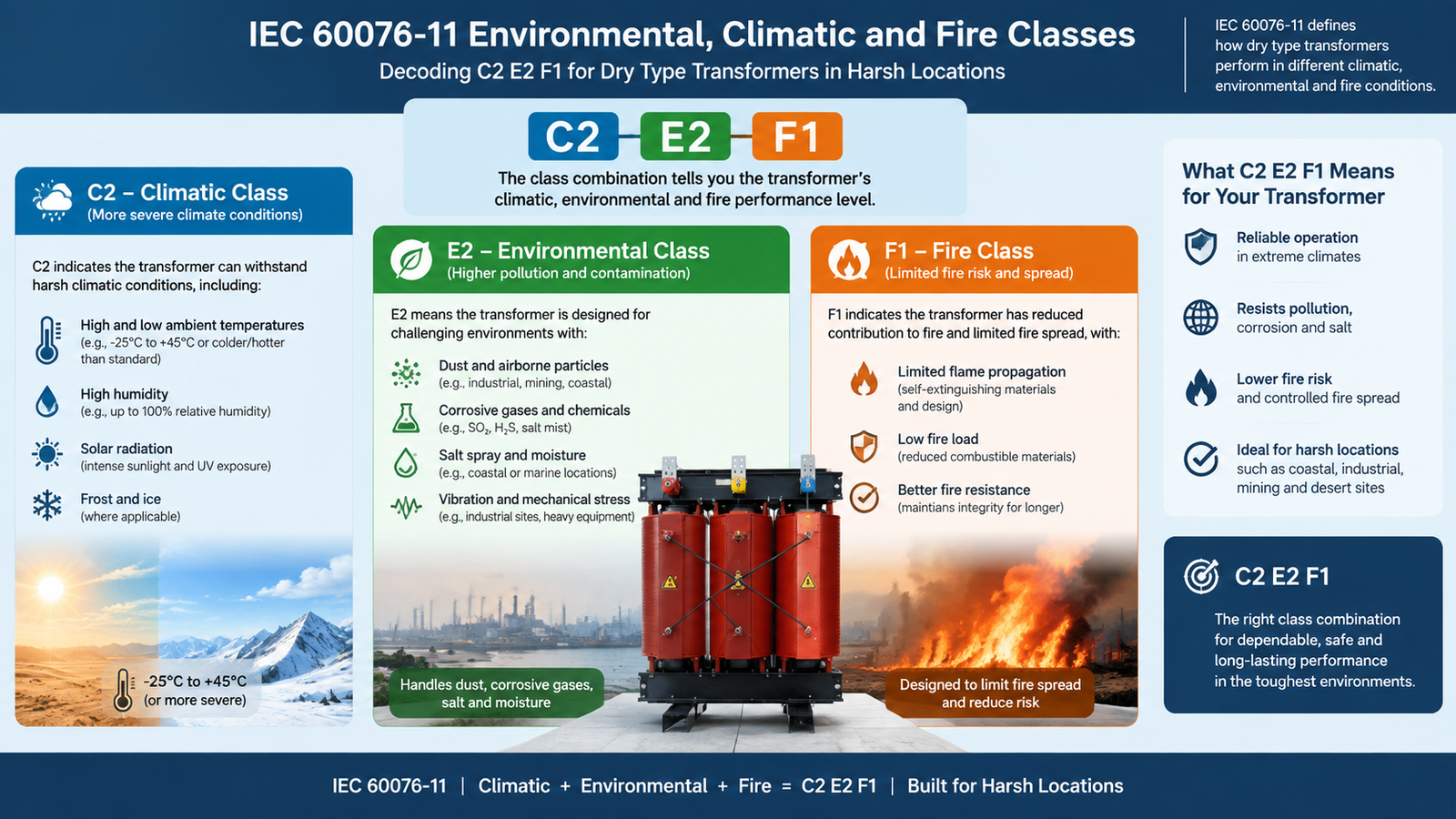
Temperature is only one of four class systems a dry-type transformer carries. The other three describe the conditions the unit must survive and the behaviour it must exhibit if something goes wrong.
Class family
Designations
What they mean
Climatic
C1, C2
Minimum ambient the unit is rated for — C1 to −5 °C, C2 to −25 °C
Environmental
E0, E1, E2
Condensation and pollution exposure. E1 covers occasional condensation, E2 covers frequent condensation or heavy pollution
Fire behaviour
F0, F1
F0 requires no flammable liquids; F1 adds demonstrated resistance to fire, limited flammability, self-extinguishing behaviour and low toxic emissions
Decoding C2 E2 F1
You will see C2 E2 F1 on a large share of commercial cast resin quotations. Read it as: rated for ambient down to −25 °C, suitable for environments with frequent condensation or heavy pollution, and certified for fire behaviour that limits flammability and toxic emissions. For a hospital, tunnel, metro station, data centre or high-rise basement, that is the combination most fire and building codes actually require, and it is usually the reason a cast resin unit was specified instead of an oil-immersed one. Our dry type transformer insulation guide covers the materials that deliver these classes, and the cast resin dry type transformer overview explains the encapsulation process behind them.
Where IS 11171 fits
IS 11171 is the Indian Standard for dry-type power transformers, normally read together with IS 2026, the general power transformer standard. For projects in India, Nepal, Bangladesh and parts of Africa and Southeast Asia where Indian standards are referenced, the purchase specification will typically call for design, manufacture and testing to IS 11171 with routine tests to IS 2026.
IS 11171 versus IEC 60076-11
The two are not competitors — they overlap heavily and are usually specified together. IS 11171 is the regional standard for dry-type transformers; IEC 60076-11 is the international equivalent, and it superseded IEC 60726, which many older Indian catalogues still cite. In practice, a compliant quotation for an Indian project will offer units built to IS 11171 with class F or H insulation, a specified temperature rise, and routine test certificates, and it will also state IEC 60076-11 environmental and fire classes where the buyer’s consultant requires them.
When comparing offers, the important point is not which standard number appears on the cover page but whether the temperature rise is declared, whether the class is stated, and whether per-unit routine test certificates will be supplied. A supplier who cannot state the guaranteed rise is not really offering a compliant unit.
For a step-by-step view of how these classes sit alongside ratings, impedance and loss data, see the technical fields in our dry type transformer specification guide.
Reading insulation data off a dry-type nameplate
Find the insulation system class — F (155 °C) or H (180 °C) on most modern units.
Find the declared or guaranteed temperature rise. If it is absent, ask for it in writing.
Confirm the climatic, environmental and fire classes, typically written as C2 E2 F1.
Note the IP rating if an enclosure is fitted.
Check the rated ambient and altitude assumptions — IEC assumes a 40 °C maximum ambient and sea-level to 1,000 m, with derating above. The full transformer nameplate field guide explains the remaining fields.
The materials behind those plate values are worth understanding if you are comparing suppliers on quality rather than price. Aramid paper insulation and vacuum pressure impregnation behave differently from epoxy encapsulation under sustained overload, and the dry type transformer insulation series sets out where each approach is the better fit.
Five specification mistakes that shorten insulation life
Specifying a temperature rise without stating the ambient temperature it assumes. A 100 K rise on a 40 °C design is not a 100 K rise in a 50 °C plant room.
Choosing Class F at the maximum permitted rise for a continuously loaded industrial duty, then adding harmonics later.
Ignoring the environmental class and installing an E0-rated unit in a damp basement.
Omitting fire class F1 where building codes require limited flammability and low toxic emissions.
Accepting a quotation that states an insulation class but no hot-spot or rise guarantee, which leaves nothing to verify at the temperature-rise test.
Conclusion
Insulation class A, E, B, F and H sets both the maximum temperature and the permitted temperature rise, and IEC 60076-11 ties those limits to 60 K, 75 K, 80 K, 100 K and 125 K respectively. Class F at 100 K and Class H at 125 K cover most dry-type projects, but the rise you accept is a commercial decision as much as a technical one: a lower rise costs more size and money and buys insulation life and overload headroom. Pair the thermal class with the environmental and fire classes your building code requires, confirm IS 11171 or IEC 60076-11 as your project standard, and insist that both the class and the guaranteed rise appear on the nameplate.
For units built to these classes with declared rises, the practical starting points are the SCB series dry type transformer page and our overview of dry type transformer safety for how thermal and fire behaviour combine in practice.
FAQ
What are the transformer insulation classes A, E, B, F and H?
They are thermal endurance classifications from IEC 60085 with limiting temperatures of 105 °C, 120 °C, 130 °C, 155 °C and 180 °C. Under IEC 60076-11 the corresponding average winding rise limits at rated current are 60 K, 75 K, 80 K, 100 K and 125 K.
What temperature rise is allowed for Class F and Class H dry type transformers?
A Class F (155 °C) insulation system permits a 100 K average winding rise with a 180 °C maximum hot-spot. Class H (180 °C) permits 125 K with a 205 °C hot-spot. Many buyers specify a lower rise, such as 80 K on Class F, for extra thermal margin.
What is the difference between insulation class and temperature rise class?
Insulation class describes the thermal capability of the insulation system. Temperature rise class describes the permitted temperature increase above ambient at which the transformer is designed to operate. They are linked — a rise limit is defined for each class — but the buyer can choose a more conservative rise within the same class.
Is IS 11171 the same as IEC 60076-11?
No, but they overlap. IS 11171 is the Indian Standard for dry-type power transformers, usually applied with IS 2026. IEC 60076-11 is the international dry-type standard and superseded IEC 60726. Projects in South Asia commonly specify both.
What does C2 E2 F1 mean on a transformer nameplate?
It is the IEC 60076-11 class combination: C2 climatic class rated to −25 °C, E2 environmental class for frequent condensation or heavy pollution, and F1 fire behaviour class indicating limited flammability, self-extinguishing performance and low toxic emissions.
Why do oil-immersed transformers have lower temperature rise limits than dry type?
Because oil is a far better heat-transfer medium than air. A mineral-oil unit is typically designed for around a 65 K average winding rise, while a dry-type Class H unit may be designed for 125 K. The oil-immersed design therefore reaches the same kVA with less material, which is why it is smaller and cheaper.
How long does transformer insulation last at its rated temperature?
Design life assumptions typically run to 20–30 years when the winding operates at or below its rated hot-spot temperature. Ageing accelerates sharply above that — as a rule of thumb, life halves for roughly every 6–8 K of sustained excess hot-spot temperature.
Routine, type and special power transformer tests under IEC 60076 explained for buyers — acceptance limits, what a FAT dossier must contain, red-flag readings and how to witness testing.
A practical 12-point checklist for auditing power transformer manufacturers in China: certifications by market, factory tests, materials, capacity and commercial terms.
How to size and specify a transformer for EV charging stations and hubs: AC input kVA, continuous load rules, demand factors, K-factor selection and site matching.