An outdoor dry type transformer is not simply an indoor unit standing on a concrete pad. It is the same coils exposed to a different set of loads: solar radiation that heats the enclosure above air temperature, night-time condensation that forms on the coldest surface in the box, wind-driven rain that reaches louvres designed for falling drops, and a thermal path through the enclosure that the coil design never accounted for. None of these appear in a kVA figure, and all of them change what the unit can carry.
The engineering is manageable, and it is almost entirely a question of deciding what the enclosure must do before the transformer is ordered. Once the outline drawing is fixed, the coil-to-wall distance and the airflow path are fixed with it, and an outdoor installation cannot be corrected by adding a canopy afterwards.
What changes when the unit moves outside
Inside a plant room, the transformer sees filtered air at a temperature somebody has taken responsibility for. Outside, it sees the site. Four things change at once. The air temperature is the ambient plus whatever the enclosure absorbs from the sun. The moisture is not controlled, and the enclosure itself creates a daily breathing cycle. Water arrives horizontally, not vertically. And the unit is now the tallest earthed metal object on the pad, which is a lightning question as much as an electrical one.
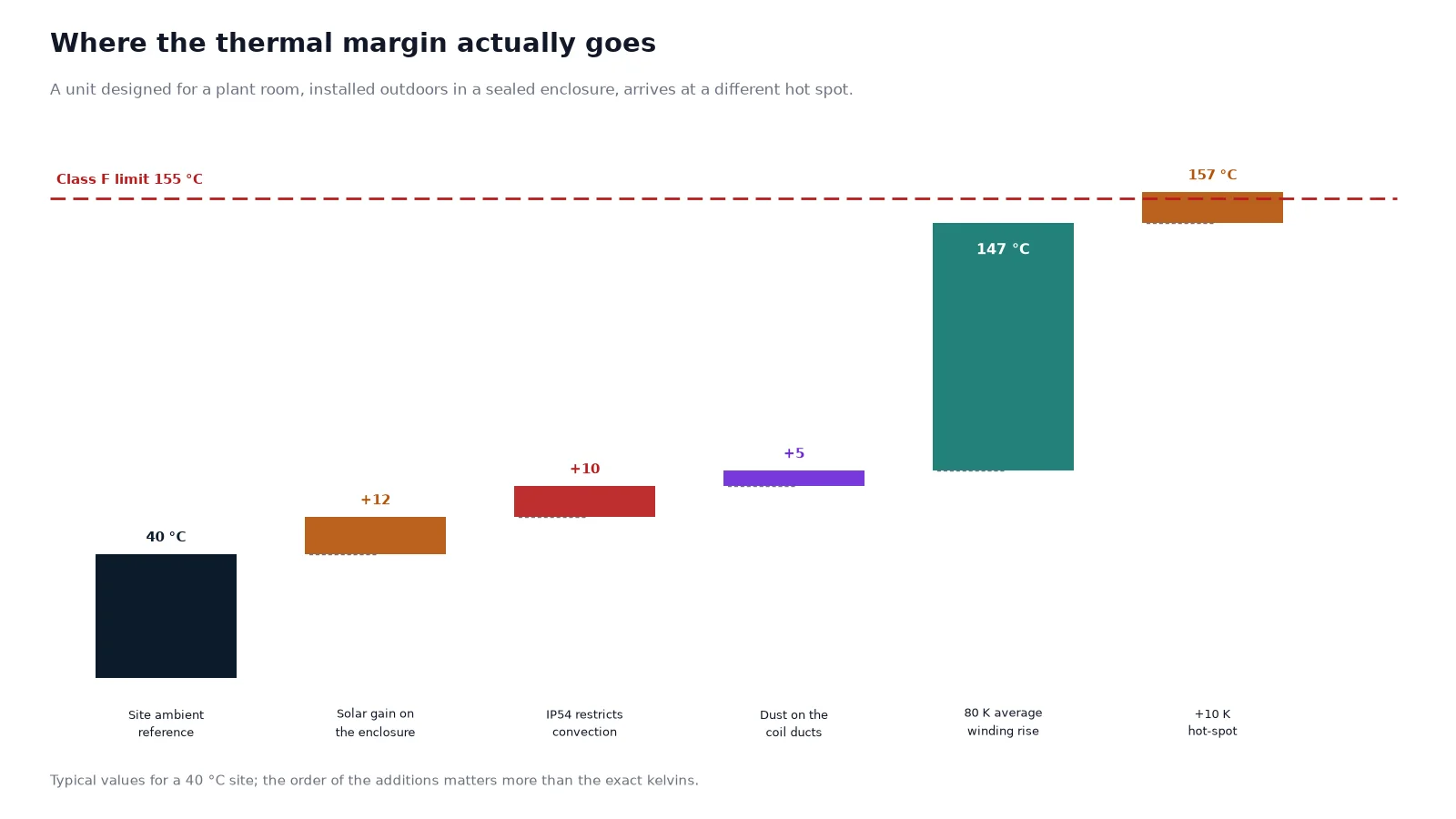
The clean way to handle all four is to treat them as deductions from the thermal budget rather than as accessories added later. A cast resin unit designed at an 80 K average winding rise has a certain margin against its insulation class. Solar gain, a tighter IP rating and a dust-loaded louvre each consume part of that margin, and the sum is what decides whether the unit reaches its design life or its first hot summer.
Sun load: the 10 to 15 K that nobody prices in
A dark painted enclosure in direct sun runs 10 to 15 K above the surrounding air, and the air inside it follows. That figure is not a safety factor; it is a load. It arrives every afternoon, on the west and south faces first, and it peaks at exactly the hour when the plant load is usually highest.
Three measures reduce it, in order of cost-effectiveness:
- A double roof with an air gap. A canopy fixed above the enclosure roof, open at the ends, breaks the direct path from sun to steel. It is the cheapest single measure and it also sheds rain away from the door seals.
- A light, high-reflectance finish. RAL 7035 or an aluminium finish absorbs far less than a dark green or black. Where the colour is fixed by the client’s standard, the canopy is doing the work instead.
- Orientation and shading. A unit placed on the shaded side of a building, or under an existing canopy, sees a different duty from one in an open yard. If the site layout is still open when the transformer is ordered, this is free.
What does not work is specifying a higher IP rating to keep the heat out. A sealed box does not reject solar gain; it traps it. The enclosure that runs coolest in sun is the one with the largest free ventilation area and the best shade, not the tightest seal.
Condensation: the unit gets wet on clear nights, not in the rain
This is the failure mode that catches operators by surprise, because it happens when it is not raining and the transformer is often de-energised.
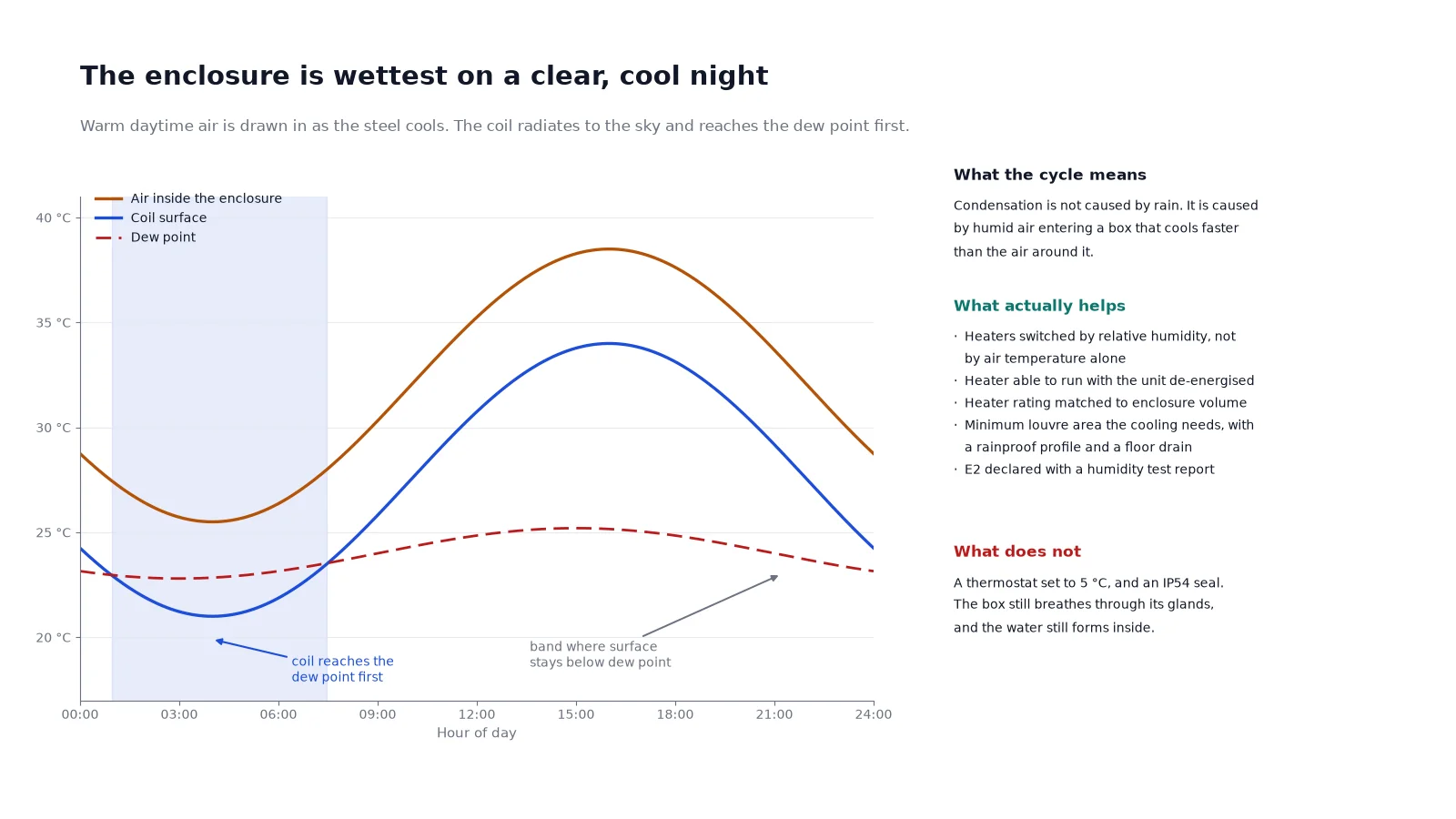
The mechanism is a daily pump. During the day the enclosure warms and the air inside holds more moisture. At night the steel cools, the air inside contracts, and the enclosure draws in more outside air through every louvre and cable gland. The coil surface, which radiates to the sky, cools faster than the air around it and drops below the dew point. Water then forms on the epoxy — the one surface in the box that is coldest first. In the morning it evaporates, and the cycle repeats. Dust deposited on the coil turns that film of water into a conductive path, and repeated wetting is what eventually produces surface tracking.
IP54 does not stop this. A sealed enclosure still breathes through its glands and door seals, and the condensation forms inside it. The measures that do work are directed at keeping the coil above the dew point:
- Anti-condensation heaters switched by humidity, not only by temperature. A thermostat alone switches the heater on when the air is cold, which is not the same as when it is near saturation. Use a controller that reads relative humidity and energises the heater when the margin to dew point disappears, and require it to operate with the transformer de-energised, since that is when condensation actually forms.
- Heater rating written into the order. A heater sized for a 1 m³ terminal box will not hold a 3 m³ transformer enclosure above dew point. State the enclosure volume and the lowest expected ambient.
- Fewer unnecessary openings. Every louvre is a breathing path. Ventilation has to exist for cooling, but its area should be the minimum the thermal design needs, with a rainproof profile and a drain below.
- A declared environmental class. Frequent condensation is exactly what IEC 60076-11 class E2 describes, and the E2 designation is only meaningful when it comes with the humidity penetration test report for the design.
IP23 versus IP54: what each digit excludes, and what it costs
The two digits answer different questions. The first digit covers solids: 2 means fingers and objects over 12.5 mm, 5 means dust protected, 6 means dust tight. The second covers water: 3 means spraying water up to 60° from vertical, 4 means splashing from any direction, 5 means low-pressure jets. IP23 is a rainproof louvred enclosure. IP54 is a dust-protected, splash-proof enclosure. They are not adjacent points on a quality scale; they are different thermal designs.
| Rating |
Stops |
Free ventilation area |
Thermal cost on the coil |
| IP20 |
Fingers and tools, indoors only |
Full |
Reference case |
| IP23 |
Falling and 60° spray, rainproof louvres |
Reduced by louvre geometry |
Modest, typically a few K |
| IP54 |
Dust protected, splash from any direction |
Small, filtered |
Expect 8 to 12 K more rise, or a 10 to 15% derating |
| IP55 |
Dust protected, low-pressure jets |
Very small, forced |
Requires forced ventilation or a heat exchanger |
The practical consequence is that the IP rating and the rating must be bought together. Asking for IP54 on a unit sized for IP20 does not add protection; it removes capacity, and the winding temperature will report the difference within the first summer. The three honest options are a larger transformer, forced ventilation with filters, or a documented derating accepted by the designer. Anything else is a thermal debt that gets paid at the end of the insulation life. The wider set of enclosure decisions, including louvre profiles and door interlocking, is covered in the guide to transformer enclosure IP ratings.
Rain, dust and animals
Rain outside is a louvre question; rain that reaches the coil is usually a cable entry question. Water runs down a cable and into a bottom-entry gland that faces upward, and no IP rating on the enclosure prevents it. Specify the entry direction, require a sealed gland plate, and require a drain at the lowest point of the enclosure floor.
Dust is a slower problem with the same result. A layer on the coil ducts insulates the surface that is supposed to shed heat, and in a cement, flour or metal-working environment the layer builds within a season. Filters help only if they are accessible without tools and are on a cleaning schedule; a blocked filter is worse than no filter, because it silently converts an IP54 unit into a sealed oven. Specify removable cassettes and put the cleaning interval in the maintenance manual.
Animals are not a minor point in warm climates. Rodents enter through cable openings and chew insulation; birds nest on top of the enclosure and block the outlet louvre; lizards and snakes bridge terminals. Stainless mesh over all openings, a closed top, and a skirt at the base cost very little at the factory and are difficult to retrofit.
Lightning and surge
An outdoor unit fed from an overhead line is exposed in a way an indoor unit is not. The minimum protection is a surge arrester on the high voltage side, mounted at or near the transformer, with a short and direct earth connection to the same earth bar as the enclosure. A long, looping earth lead defeats the arrester, because the impulse voltage it develops across its own inductance is added to the residual voltage seen by the winding.
Two details are worth writing into the order. First, the enclosure must be bonded to the earthing system at a dedicated terminal, not through the mounting bolts. Second, where the low voltage side feeds electronics, a separate surge protective device at the distribution board is a different purchase from the arrester at the transformer, and both are usually needed.
Cold, ice and the C2 class
Cold brings its own set of decisions, and they are not symmetrical with heat. IEC 60076-11 climatic class C1 allows operation to −5 °C with transport and storage to −25 °C; C2 allows operation, transport and storage to −25 °C, verified by a cold test. A site that expects −20 °C in service needs C2, and needs it declared with evidence rather than assumed from the fact that the coils are cast in epoxy.
Ice matters mechanically as well as electrically. A louvre that ices over stops the convection path and the unit overheats while the ambient is −10 °C. A canopy that holds snow adds load to a structure designed for wind. Both are cheap to design in and awkward to fix on site.
Corrosion and ultraviolet exposure
Two different ageing processes act on the outside of an outdoor unit. The steel corrodes, and the exposed resin changes. For the steel, specify the corrosivity category rather than the paint system: ISO 12944 C3 for rural and urban inland, C4 for industrial and coastal, C5 for salt-laden coastal or chemical plant. Hot-dip galvanised construction with a topcoat is the usual answer for C4, and stainless fixings avoid the dissimilar-metal corrosion that appears at brackets and hinges two years after commissioning.
For the resin, prolonged sunlight breaks the polymer chains at the surface. The casting chalks, yellows and becomes brittle, and the day-night expansion swing then produces micro-cracks that admit moisture. A UV-stable topcoat or a physical sun shield is the countermeasure, and the timescales involved are covered in the discussion of where cast resin units stop. The important point for an outdoor installation is that the canopy is doing two jobs — it reduces solar gain and it shields the resin — and that both are decided at the enquiry.
Siting and mounting
A few site decisions determine whether the thermal design survives contact with the yard. The pad should raise the unit 150 to 200 mm above finished grade with the surface falling away from it, so that standing water never reaches the base. Clearance to walls and fences should follow the outline drawing rather than the fence line, because the outlet louvre needs somewhere for the air to go. Doors need swing room, and the winding temperature display should be readable without opening a live compartment.
Access also means access for maintenance: a filter cassette that needs a ladder and two people will not be cleaned. The full set of clearances and cable arrangements is in the guide to transformer installation requirements, and it is worth reading before the pad is poured rather than after. On a 10 kV unit, the pad, the clearances and the cable route are usually decided in one drawing, which is why the three are best fixed together.
Outdoor versus indoor: a short decision table
| Question |
Indoor unit in a plant room |
Outdoor unit on a pad |
| Ambient used for design |
Room temperature, often controlled |
Site maximum, plus solar gain |
| Moisture |
Occasional, if the room is ventilated |
Daily cycle, driven by the enclosure |
| Water ingress |
Leaks and cleaning |
Driven rain, cable entries, louvres |
| Thermal path |
Open convection to the room |
Through the enclosure, derated by IP |
| Lightning exposure |
Low |
High if fed from overhead line |
| Corrosion category |
C2 to C3 typical |
C4 to C5 typical |
| Maintenance load |
Filters, occasionally |
Filters, heaters, seals, paint |
Outdoor specification checklist
Six lines carry most of the risk: the site maximum and minimum ambient, the required IP rating with its thermal consequence stated, a double roof or canopy, humidity-controlled anti-condensation heaters sized for the enclosure volume, ISO 12944 corrosivity category, and the IEC 60076-11 classes declared with test evidence. Add the arrester and its earthing, the cable entry direction, and the mesh over every opening. Everything else is detail that follows from those decisions.
Where the outdoor duty is severe — strong sun, high ambient, dust, coastal salt — it is worth comparing the total installed cost against a sealed oil-immersed unit before committing. Cast resin outdoors is a good engineering answer when the enclosure has been designed for the transformer’s heat load, and a poor one when a generic weatherproof box has been put around a unit sized for a plant room. The specification conventions that make the comparison fair are set out in the guide to dry type transformer specification.
FAQ
Can a cast resin dry type transformer be installed outdoors?
Yes, with an enclosure that is designed for outdoor duty. The minimum is an IP23 rainproof louvred enclosure with a canopy; a dusty or coastal site needs IP54 with a documented thermal derating, a UV-stable finish and a corrosion category of C4 or C5.
Is IP54 better than IP23 outdoors?
Only if the site needs it. IP54 excludes dust and splashing water but restricts convection, which typically costs 8 to 12 K of winding temperature rise or a 10 to 15% derating. For a sheltered pad on a clean site, IP23 with a canopy often delivers the longer life.
Why does the transformer get wet when it is not raining?
Condensation. The enclosure breathes as it cools at night, drawing in humid air, and the coil surface radiates to the sky and falls below the dew point. Humidity-controlled anti-condensation heaters, sized for the enclosure volume and able to run with the unit de-energised, are the countermeasure.
How much extra capacity does solar gain cost?
A dark enclosure in direct sun runs 10 to 15 K above ambient air, and the winding follows. A double roof with an air gap and a light finish removes most of that gain; it is far cheaper than buying the next rating up.
What IP rating does an outdoor dry type transformer need?
IP23 is the practical minimum for a rainproof outdoor enclosure. IP54 is appropriate where dust, driven rain or washdown is present, and IP55 where low-pressure jets are expected. Each step up requires a thermal check, not just a purchase order line.
Does the enclosure need a lightning arrester?
If the unit is fed from an overhead line, yes. Fit an arrester at the transformer, bond the enclosure to the same earth bar with a short direct lead, and treat low voltage surge protection at the distribution board as a separate requirement.