The benefits of cast resin dry-type transformers are real, measurable and frequently oversold. The technology genuinely removes oil from the building, genuinely survives a humid shutdown without drying out, and genuinely needs less routine maintenance than an oil-immersed unit. It also stops working, or stops being economic, under four specific conditions that most supplier pages leave out: where heat cannot leave the coil, where ultraviolet light reaches the epoxy, where a failed winding has to be replaced rather than repaired, and where the rating climbs past the point at which oil is simply cheaper.
This article sets out the advantages in the terms that decide a project — fire case, moisture, maintenance, fault strength — and then sets out where each one stops being true. If you are choosing between technologies on a live project, the second half is the half that saves money.
What cast resin actually is
A cast resin transformer encapsulates the winding in a solid block of epoxy resin mixed with a mineral filler, usually silica flour or alumina trihydrate. The coil is wound, placed in a mould, and the resin is cast under vacuum so that no air remains in the insulation. After curing, the winding is a monolithic cylinder with the conductor completely embedded in solid insulation.
That construction is not the same as VPI, where the coil is evacuated and flooded with varnish under pressure but the surface stays open, and it is not the same as an open-wound design held together by conductor insulation and a dip coat. Most of the advantages below follow from the encapsulation itself, which means they apply to a void-free casting and only weakly to the other two families. The manufacturing differences are set out in our comparison of cast resin, VPI and open-wound construction.
Advantage one: the fire case disappears
There is no oil, so there is no flash point, no pool fire, no bund, no fire wall and, in most jurisdictions, no deluge requirement. The epoxy formulation is flame-retardant and self-extinguishing, reaching UL 94 V0, and a well-made unit can be certified to fire class F1 under IEC 60076-11, which limits heat release and requires minimised smoke and toxic emission.
The practical consequence is siting. A cast resin unit can go in a basement plant room, on a mezzanine, inside a building next to the switchroom, or in a tunnel gallery, without the civil works that an oil unit forces on the design: no oil containment pit, no sump, no fire-rated separation, no drainage to an interceptor. On a building project those items often cost more than the difference in transformer price.
F1 is a tested property, not a marketing phrase. Ask for the test report against the current edition of IEC 60076-11 rather than a certificate that names an older edition, because the fire classes were revised when the standard moved to its 2018 edition.
Advantage two: moisture and pollution cannot reach the conductor
Because the conductor is sealed inside the casting, humidity, salt fog, conductive dust and corrosive vapour cannot reach the insulation surface that matters. This is the difference that operators notice. A cast resin unit that has been de-energised for a year in an unconditioned room can be re-energised without a drying-out procedure. A VPI unit in the same room usually cannot, because its insulation resistance will have fallen and it needs anti-condensation heaters or a dry-out before it is safe to energise.
This is what the climatic and environmental classes in IEC 60076-11 are for. C2 covers operation, transport and storage down to minus 25 degrees Celsius, verified by a cold test. E2 covers frequent condensation combined with heavy pollution. A premium cast resin unit is certified C2, E2 and F1 together, and those three letters are the most useful shorthand on a dry-type nameplate. Coastal plants, chemical plants, paper mills and water treatment works are the classic cases where E2 is doing real work.
Advantage three: maintenance drops to inspection
An oil-immersed transformer is a machine with a fluid system attached. It needs oil sampling, dissolved gas analysis, moisture checks, gasket inspection, breather silica gel replacement, conservator level checks and, eventually, oil processing or replacement. None of that exists on a cast resin unit.
What remains is visual inspection, an infrared scan of terminations, a partial discharge survey, cleaning of the insulator surfaces in dusty locations, and a fan and controller check. The routine labour is roughly half that of an oil unit, and there is no oil to dispose of at end of life. The partial discharge survey is the one test worth doing properly, because it is the only routine measurement that sees inside the casting — the method is covered in partial discharge testing on cast resin transformers.
Advantage four: short-circuit strength
A cast coil is a solid cylinder. Under a short circuit the radial forces that try to push the outer winding outward and crush the inner winding inward are carried by the whole epoxy mass rather than by spacers and clamping pressure alone. Cast resin units routinely withstand short-circuit tests that would deform a lightly supported disc winding, and they do so repeatedly, not just once in type test.
This matters where the transformer sits close to a strong source: a unit substation fed directly from a high-voltage board, a transformer on the load side of a generator, or a plant with a high fault level and a small transformer. The verification is the short-circuit test certificate to IEC 60076-5, and it should name the actual rating tested, not a sister model.
Advantage five: siting close to the load
With no radiators and no oil containment, the footprint is smaller than an oil unit of the same rating, and the unit can stand on the floor of the electrical room. That lets you put the transformer near the load rather than in a yard, which shortens the low-voltage run. On a 400 V board, cable is often the largest single line item in the distribution budget, and voltage drop over 80 metres of busbar or cable can force a larger conductor than the load needs.
Shortening that run reduces cable cost, reduces voltage drop, and reduces the fault energy that reaches the load side. It is a systems argument rather than a transformer argument, and it is the one that most often justifies the price premium in a building project.
Advantage six: low partial discharge, when it is genuinely low
Vacuum casting exists to eliminate voids, and voids are where partial discharge starts. A void-free casting can be certified at partial discharge below 10 pC at 1.5 times rated voltage, and that figure — not the insulation class, not the temperature rise — is the single best predictor of service life in a cast resin unit.
Which is also the caveat. If a supplier cannot state a partial discharge limit with a test method and a voltage, the advantage is a claim rather than a property. Poor vacuum, a wrong resin ratio or a badly controlled cure will leave voids in a casting that looks identical from the outside, and the unit will fail in service years later with no external sign beforehand. Specify the limit, and witness the test.
Where they stop: heat cannot leave the coil
This is the first and largest boundary. Oil moves heat by convection from the winding to a radiator. Epoxy only conducts it, and it conducts poorly — roughly a quarter of a watt per metre-kelvin, against copper at around 400. The heat generated in the conductor has to travel through several millimetres of resin before it reaches air.
Three consequences follow. The unit is larger and heavier than an oil unit of the same rating, because the core and the cooling duct area have to compensate. The short-time overload capability is lower, because there is no oil mass to absorb a surge and no circulation to spread it. And the hot spot sits inside the casting where no thermometer can reach it, which is why units above roughly 500 kVA carry PT100 detectors embedded in the low-voltage winding, with alarm typically at 130 to 140 degrees Celsius, trip at 150 to 155, and fan control at around 100.
| Insulation class |
Permitted average winding rise |
Average at 40 degrees ambient |
Hot spot limit |
Margin left for hot spot |
| Class B (130) |
80 K |
120 degrees C |
130 degrees C |
10 K |
| Class F (155) |
100 K |
140 degrees C |
155 degrees C |
15 K |
| Class H (180) |
125 K |
165 degrees C |
180 degrees C |
15 K |
| Class 220 |
150 K |
190 degrees C |
220 degrees C |
30 K |
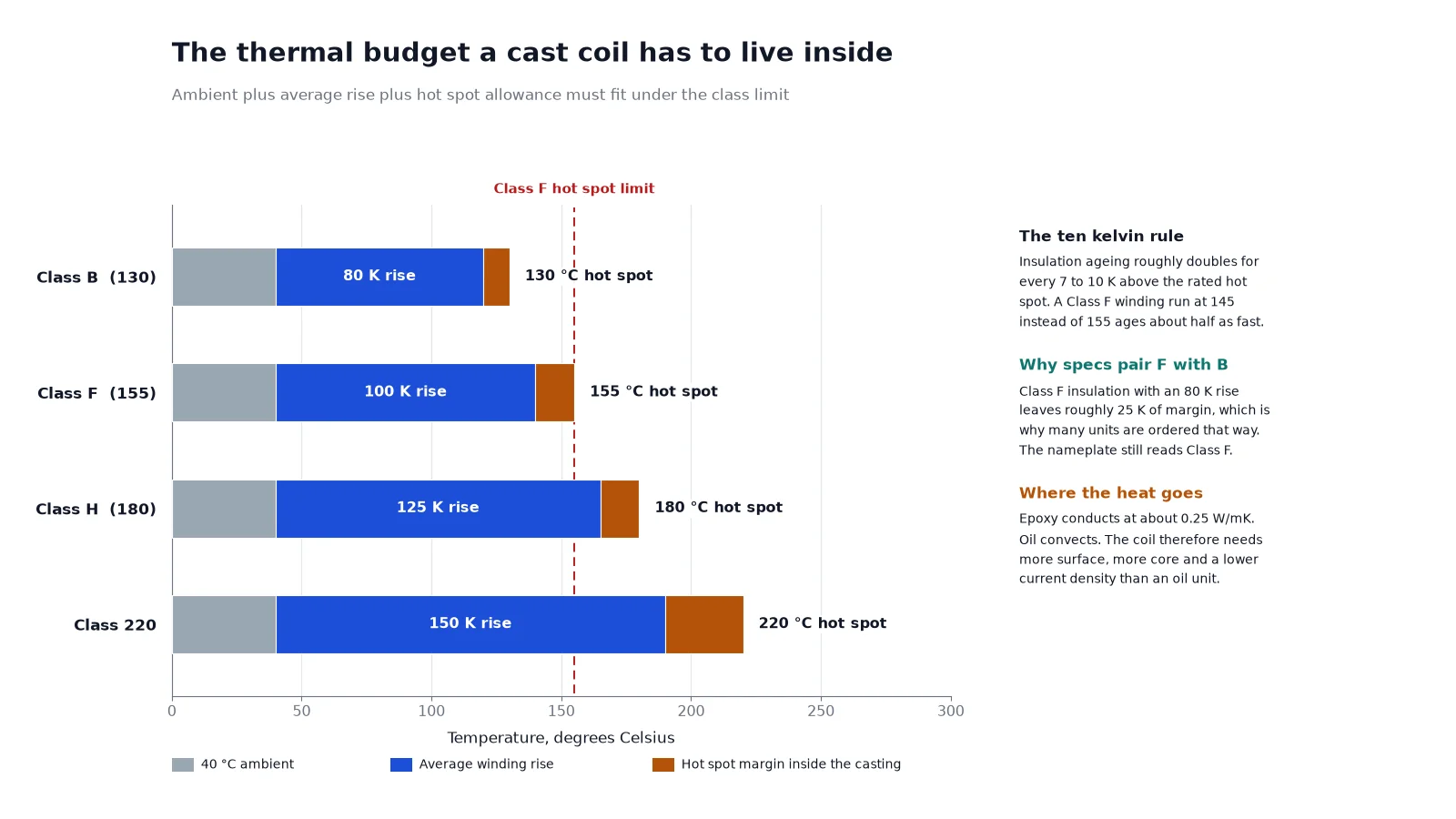
The arithmetic in that table is the whole thermal story. A Class F winding at 40 degrees ambient and a 100 K rise sits at 140 degrees average, leaving 15 K for the hot spot inside the coil. Thermal ageing roughly doubles for every 7 to 10 K above the rated hot spot, so running the same winding at 145 instead of 155 degrees roughly halves the ageing rate and doubles the expected life.
That is why many specifications pair Class F insulation with a Class B temperature rise of 80 K. The nameplate reads Class F, the design is run cooler, and the unit earns a substantial life margin at the cost of a little more copper and core. It is the cheapest reliability purchase available on a cast resin transformer, and it is invisible unless the temperature rise is stated separately from the insulation class.
Harmonic loads attack the same thermal boundary from a different direction. Non-linear loads add losses in the winding and in the core without adding useful output, and the encapsulated coil has less ability to shed that extra heat than an oil unit. A K-factor rating or an explicit derating curve is the answer, and it has to be specified — see K-factor rating and harmonic derating. The same thermal boundary is what limits short-time overload, covered in dry-type transformer overload capacity.
Where they stop: sunlight and thermal cycling
This is the boundary that supplier literature skips, and it is the one that causes premature failures.
Epoxy is not ultraviolet-stable. Prolonged sunlight breaks the polymer chains at the surface, and the resin chalks, yellows and becomes brittle. A brittle surface plus a day-night swing of 20 K or more produces differential expansion between the copper inside and the resin outside, and that produces micro-cracks. Moisture enters the cracks, the cracks widen, and partial discharge starts in exactly the place the casting was designed to protect.
Field experience is blunt about the timescale. Unprotected cast resin outdoors in a hot, humid climate can show surface failure in three to five years. In a temperate climate with less intense sun the same construction may last seven to ten years without protection. Those are not service lives; they are the intervals before the encapsulation starts to degrade.
The engineering answer is straightforward but has a catch. Outdoors, a cast resin unit needs an enclosure: IP23 at minimum for a ventilated weatherproof design, IP54 where dust or driven rain is present, and a UV-stable finish or a sun shield on top. The catch is that each step up the IP scale reduces airflow, and reduced airflow erodes the thermal margin that was the reason for choosing cast resin in the first place. An IP54 enclosure in direct sun can turn a well-designed transformer into an oven, and the winding temperature will tell you so within the first summer.
The honest guidance: if the unit must sit outdoors in strong sun and high ambient, a sealed oil-immersed transformer is often the better engineering choice, and it will usually be cheaper. Cast resin outdoors belongs inside an enclosure that was designed with the transformer’s heat load in mind, not a generic weatherproof box. IP and ventilation practice is covered in transformer enclosure IP ratings.
Where they stop: a failed winding cannot be repaired
Encapsulation is a one-way process. A shorted turn or an insulation breakdown inside the casting cannot be reached, rewound or re-impregnated in the field. The coil assembly is replaced at the factory, or the unit is scrapped. In practice, the economic answer is often a new transformer.
That changes the spares policy. For a critical building — a hospital, a data hall, a water treatment works — the decision to use cast resin should come with a spare unit or with an accepted replacement lead time. Oil-immersed units can also fail, but a failed unit can often be rewound, and the repair is a workshop job rather than a rebuild.
Where they stop: cost and the size ceiling
Cast resin carries a premium of roughly 20% to 40% over VPI for an equivalent rating, and against oil-immersed it is commonly 1.3 to 2 times the price at the same rating, widening as the rating grows. The premium buys the fire case, the moisture immunity and the maintenance reduction. On a 630 kVA building unit that is easy to justify. On a 25 MVA plant auxiliary transformer it is usually not.
There is also a practical ceiling. Catalogue ranges typically reach 2,500 kVA at 10 to 11 kV, with custom designs to around 20 MVA at 35 kV. IEC 60076-11 in its 2018 edition extended the scope to 72.5 kV, but the economics past a few tens of MVA fall away quickly, because the core and cooling mass needed to keep the hot spot inside the casting makes an oil unit cheaper, smaller and more efficient.
Where they stop: noise
A cured rigid coil has a higher natural frequency than an oil-immersed winding immersed in a fluid, so it transmits core vibration to the structure more efficiently. For the same rating, a cast resin unit is generally noisier, and the difference is more noticeable at the low frequencies that travel through a building.
In a hospital plant room, a residential podium or a hotel basement this can decide the design. Damping pads, flexible connections and, in the worst case, an acoustic enclosure are the remedies, and each adds cost that belongs in the comparison. Noise and vibration control measures are set out in transformer noise and vibration control.
Choosing between the technologies
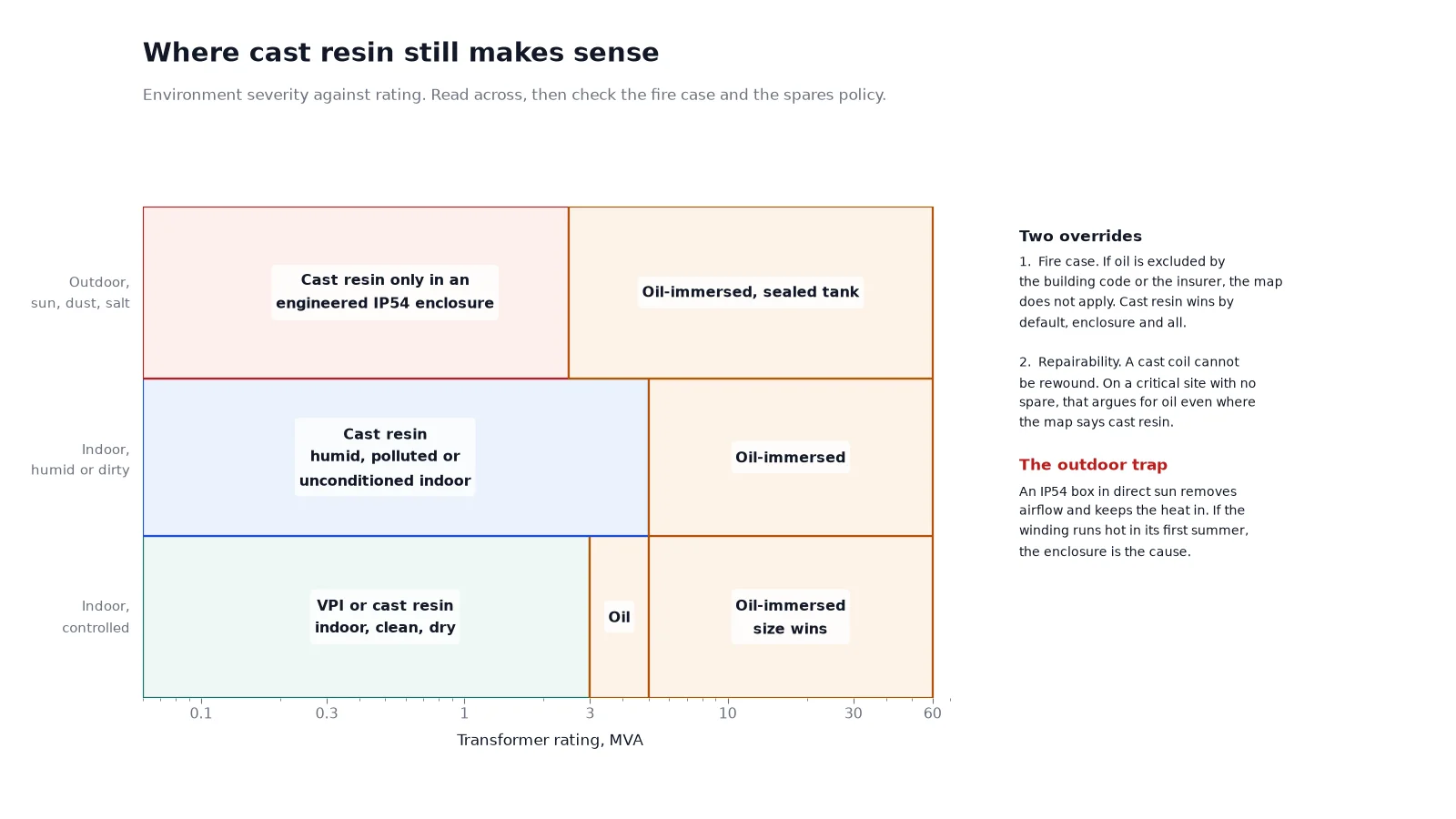
Read the map as a first filter, then check the two binding constraints — the fire case and the available maintenance — before committing.
| Scenario |
Recommendation |
Reason |
| Hospital basement, 1,000 kVA, 10 kV |
Cast resin |
No oil containment, low maintenance, fire case closed |
| Data hall, 2,000 kVA, 10 kV |
Cast resin |
Indoor siting next to the load, no oil in the white space |
| Humid, unconditioned warehouse, 630 kVA |
Cast resin, E2 rated |
Re-energise after long shutdown without drying out |
| Coastal pad outdoors in strong sun, 1,500 kVA |
Sealed oil-immersed, or cast resin in a designed IP54 enclosure |
UV and thermal cycling degrade unprotected epoxy |
| Plant auxiliary board, 25 MVA, 35 kV |
Oil-immersed |
Size, cost and overload behaviour all favour oil |
| Arc furnace or heavy harmonic load |
Oil-immersed, or K-rated cast resin with derating |
Additional winding loss in an encapsulated coil |
| Remote site with no maintenance crew |
Oil-immersed, unless fire rules exclude it |
No oil testing to perform, but oil units are easier to repair |
How to specify a cast resin unit so the advantages hold
- Partial discharge limit, with method and voltage: below 10 pC at 1.5 times rated voltage.
- Insulation class and temperature rise stated separately, for example Class F with 80 K rise.
- Fire class F1 against the current edition of IEC 60076-11, with the test report.
- Climatic and environmental classes: C2 and E2, or a documented justification for lower.
- Embedded PT100 detectors with alarm, trip and fan setpoints written into the datasheet.
- IP rating matched to the actual location, not copied from a template, with the ventilation design stated.
- K-factor or a derating curve if the load is non-linear.
- Altitude and ambient derating table, since capacity falls above 1,000 m and above 40 degrees ambient.
- Short-circuit test certificate to IEC 60076-5 naming the rating tested.
- Weight and dimensions at the offered rating, because the enclosure and the floor loading depend on them.
Frequently asked questions
What are the main benefits of cast resin dry-type transformers?
No oil and therefore no fire load, sealed windings that resist humidity and pollution, low routine maintenance with no oil testing, high short-circuit strength from the monolithic coil, and low partial discharge when the casting is void-free. They can be sited inside a building close to the load, which also shortens the low-voltage run.
Are cast resin transformers suitable for outdoor installation?
Only inside a suitable enclosure. Epoxy is not UV-stable, and unprotected outdoor exposure in a hot climate can degrade the surface in three to five years through a combination of ultraviolet attack and thermal cycling cracks. An IP54 enclosure with a sun shield works, but the reduced airflow must be allowed for in the thermal design, or the unit will run hotter than its rating assumes.
Can a cast resin transformer be repaired if it fails?
No. The winding is encapsulated, so a failed coil cannot be rewound or re-impregnated in the field. The coil assembly is replaced at the factory or the unit is scrapped. For critical installations that means planning a spare unit or accepting the replacement lead time as part of the design.
What is the difference between Class F and Class H in a cast resin transformer?
Class F permits a 100 K average winding rise at 40 degrees ambient, giving a 155 degree hot spot limit. Class H permits 125 K, giving 180 degrees. Class H buys roughly 25 K of extra thermal headroom, which is useful in a hot plant room or under cyclic overload, at the cost of more expensive insulation materials.
Do cast resin transformers handle harmonics well?
Less well than oil-immersed units, because the additional harmonic loss has to leave the winding through solid insulation with limited thermal conductivity. Where non-linear loads are significant, specify a K-factor rating or an explicit derating curve, and size the unit on the derated capacity rather than the nameplate.
The practical summary
Cast resin wins on fire, moisture, maintenance and fault strength, and it wins decisively where the transformer has to live inside a building. It stops where heat has to leave a large coil, where sunlight reaches the epoxy, where the unit must be repairable on site, and where the rating is large enough that oil is cheaper and better behaved.
The four specification lines that decide whether you get the advantage or the claim are the partial discharge limit, the temperature rise stated separately from the insulation class, the fire class against the current standard, and the IP rating matched to the real location. Get those four right and the rest follows.
If you are selecting between cast resin and oil for a specific duty, send us the rating, the ambient and the siting, and we will tell you which family we would quote and why. The full range is catalogued under dry-type power transformers, the construction details are in our cast resin dry-type transformer guide, and the engineering team can be reached at Kampa Electric.