A dry-type transformer is defined less by the absence of oil than by how its winding is insulated. Three construction families dominate the medium-voltage market — open-wound, vacuum pressure impregnated (VPI), and cast resin — and they sit on a ladder of rising moisture immunity, fire performance and first cost. Picking the wrong rung is one of the most expensive specification errors in a distribution project, because the price gap between the cheapest and the most expensive option is small next to the cost of an unplanned outage in a hospital, a data hall or a metro tunnel.
This guide compares the three insulation systems on the metrics that actually decide the outcome: environment class, voltage ceiling, harmonic and cyclic duty, short-circuit strength, repairability and cost. If you are still deciding between dry-type and liquid-filled at all, the broader three-way comparison of dry-type, cast resin and oil-immersed transformers is the better starting point. Everything below assumes the decision to go dry has already been made.
The Three Families in One Sentence Each
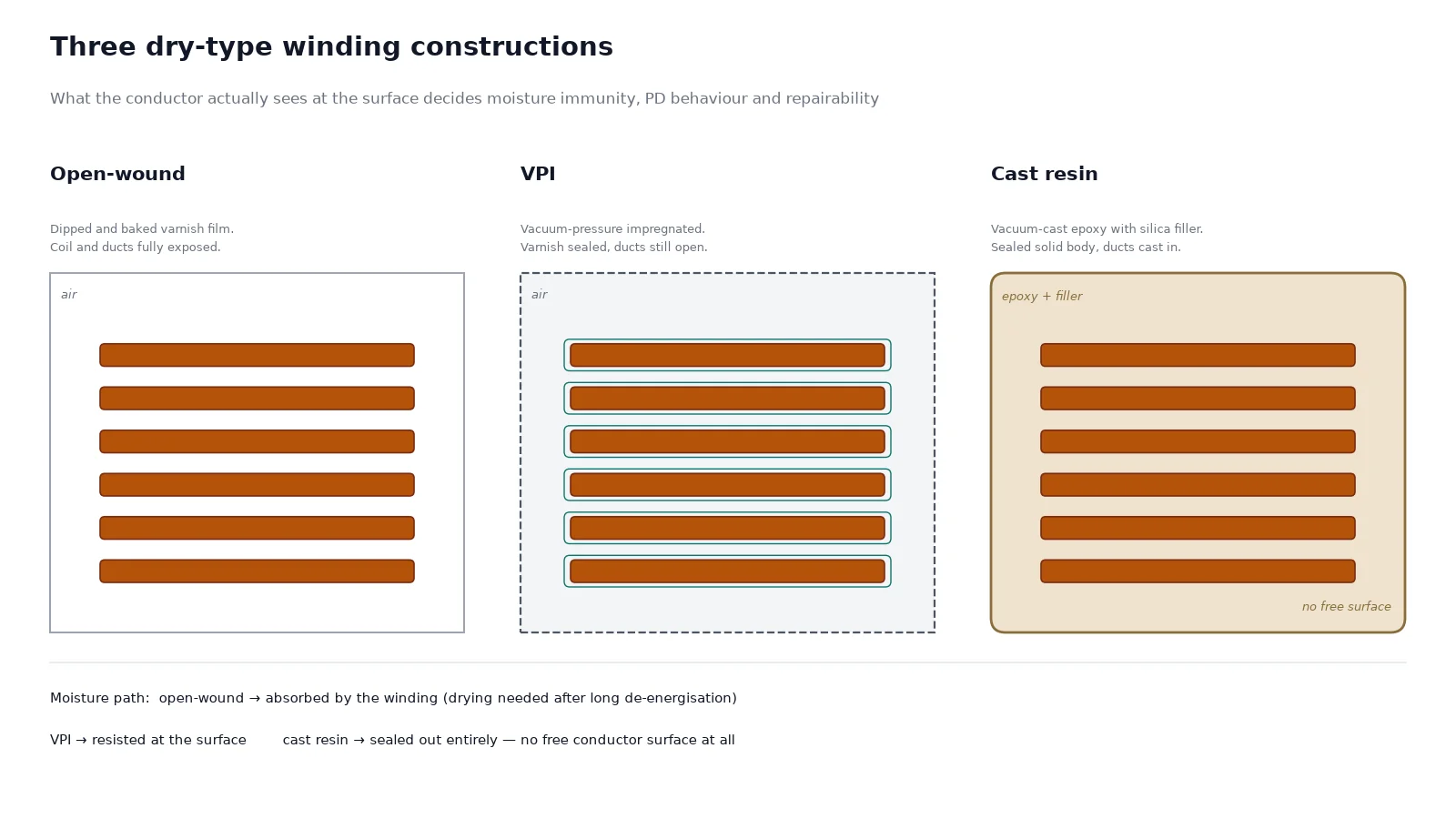
Open-wound (also sold as open ventilated or dip-and-bake): the winding is wound, dipped in varnish, baked, and left exposed to air circulation. Cheapest, lightest, and limited almost entirely to low-voltage distribution in clean, conditioned rooms.
VPI: the same open winding is placed in a vacuum chamber, dried, then impregnated under pressure with polyester or epoxy varnish that penetrates the insulation layers and the gaps between turns. The coil stays ventilated, so it cools well, but the conductor system is sealed against moisture ingress.
Cast resin: the medium-voltage winding is placed in a mould and encapsulated in epoxy resin filled with quartz or silica powder, cured under vacuum so that no internal voids remain. The coil becomes a solid, sealed, self-supporting body.
What the Vacuum Actually Does
The word “vacuum” appears in both VPI and cast resin marketing, which causes a great deal of confusion in tender evaluation. The processes are not the same and they do not solve the same problem.
Cast resin: removing voids from a solid
In casting, the risk is a cavity. Any bubble trapped between conductor, glass-fibre reinforcement and resin becomes a region of lower dielectric strength than the surrounding insulation, and partial discharge concentrates there under the operating field. Vacuum casting removes the air before the resin gels, so the cured body is homogeneous. The quartz filler reduces the resin’s thermal expansion coefficient and raises its thermal conductivity, which matters because epoxy alone expands roughly three times more than copper under the same temperature change.
The result is a winding with no accessible surface for moisture or contamination, high mechanical rigidity against through-fault forces, and a partial discharge level that can be held at or below 10 pC at 1.2 times the rated voltage — the acceptance figure written into IEC 60076-11 and applied on every unit we test. The construction detail that produces that number is covered in our note on partial discharge in cast resin transformers.
VPI: sealing a winding that stays open
In VPI, the risk is not a void inside a solid but an unsealed interface between conductor insulation and air. The vacuum stage draws air and moisture out of the winding; the pressure stage then forces varnish into the interstices. The coil keeps its cooling ducts, which is precisely why VPI units run cooler than cast resin units of the same rating and can be built with less conductor copper for the same temperature rise.
The trade-off is that the winding surface is still exposed. Varnish is a coating, not a barrier. It resists humidity far better than dip-and-bake, but it does not give the sealed-body immunity of a cast coil.
Open-wound: a coating, not a system
Dip-and-bake applies a film of varnish to the conductor insulation. In a dry, dust-free, temperature-controlled electrical room this is entirely adequate and has been for decades. The failure mode appears after a long de-energisation in a damp space: the winding absorbs moisture, insulation resistance falls, and the unit needs drying before it can be re-energised safely. That is an operational constraint, not a defect, but it has to be written into the maintenance procedure.
Side-by-Side Comparison
| Attribute |
Open-wound |
VPI |
Cast resin |
| Winding insulation |
Dipped and baked varnish film |
Vacuum-pressure impregnated polyester or epoxy varnish |
Vacuum-cast epoxy with quartz/silica filler |
| Typical voltage ceiling |
1.1 kV, mostly LV distribution |
36 kV |
36 kV common; designs to 52 kV exist |
| Cooling ducts |
Fully open |
Retained, open to air |
Internal ducts cast into the body |
| Moisture ingress |
Absorbed by the winding |
Resisted at the surface |
Sealed out entirely |
| Contaminant tolerance |
Low — dust accumulates on bare coil |
Moderate |
High — smooth, cleanable surface |
| IEC 60076-11 env./climatic class achievable |
E0–E1, C1 |
E1–E2, C1–C2 |
E2, C2 as standard |
| Fire behaviour class |
F1 with correct varnish system |
F1 |
F1, self-extinguishing formulation |
| Partial discharge at 1.2 Um |
Not routinely specified |
Void-dependent, typically 10–50 pC |
≤10 pC achievable and routinely tested |
| Through-fault mechanical strength |
Baseline |
Baseline plus varnish bonding |
Highest — resin supports the coil |
| Repairability |
Good |
Good — coil can be re-impregnated |
Poor — a failed coil is replaced |
| Relative first cost |
Lowest |
Middle |
Highest |
Specify the Class, Not the Adjective
Every dry-type datasheet claims “high moisture resistance” and “self-extinguishing”. Neither phrase is testable. IEC 60076-11 replaced them with three classification axes, and these are the only environmental claims worth putting in a purchase order.
| Axis |
Class |
What it certifies |
| Environmental (E) |
E0 / E1 / E2 |
Ability to operate in polluted or dusty atmospheres; E2 is the severe class, verified by a contamination test on the complete unit |
| Climatic (C) |
C1 / C2 |
Ability to withstand humidity and condensation, including operation after a cold-soak and rapid re-energisation; C2 is the severe class |
| Fire behaviour (F) |
F0 / F1 |
Fire performance of the complete transformer; F1 requires low heat release, limited flame spread and self-extinction |
A unit specified as “C2 E2 F1” has been type-tested to survive the harshest combination the standard defines. A unit specified only as “cast resin” has not. When two bids differ by 8% and one of them quietly omits the C2 test, the class declaration is what you are actually buying.
The 2018 edition of IEC 60076-11 also widened the scope beyond 36 kV to 72.5 kV, introduced altitude correction for dielectric and thermal behaviour, and tied the enclosure to IEC 60529. That last point is worth stating separately: the environmental class of the winding and the IP rating of the enclosure are two independent specifications, and a C2 winding inside an IP21 enclosure in a dusty plant is still a dusty installation.
Where Each System Wins — and Where It Fails
Humidity and pollution decide against open-wound
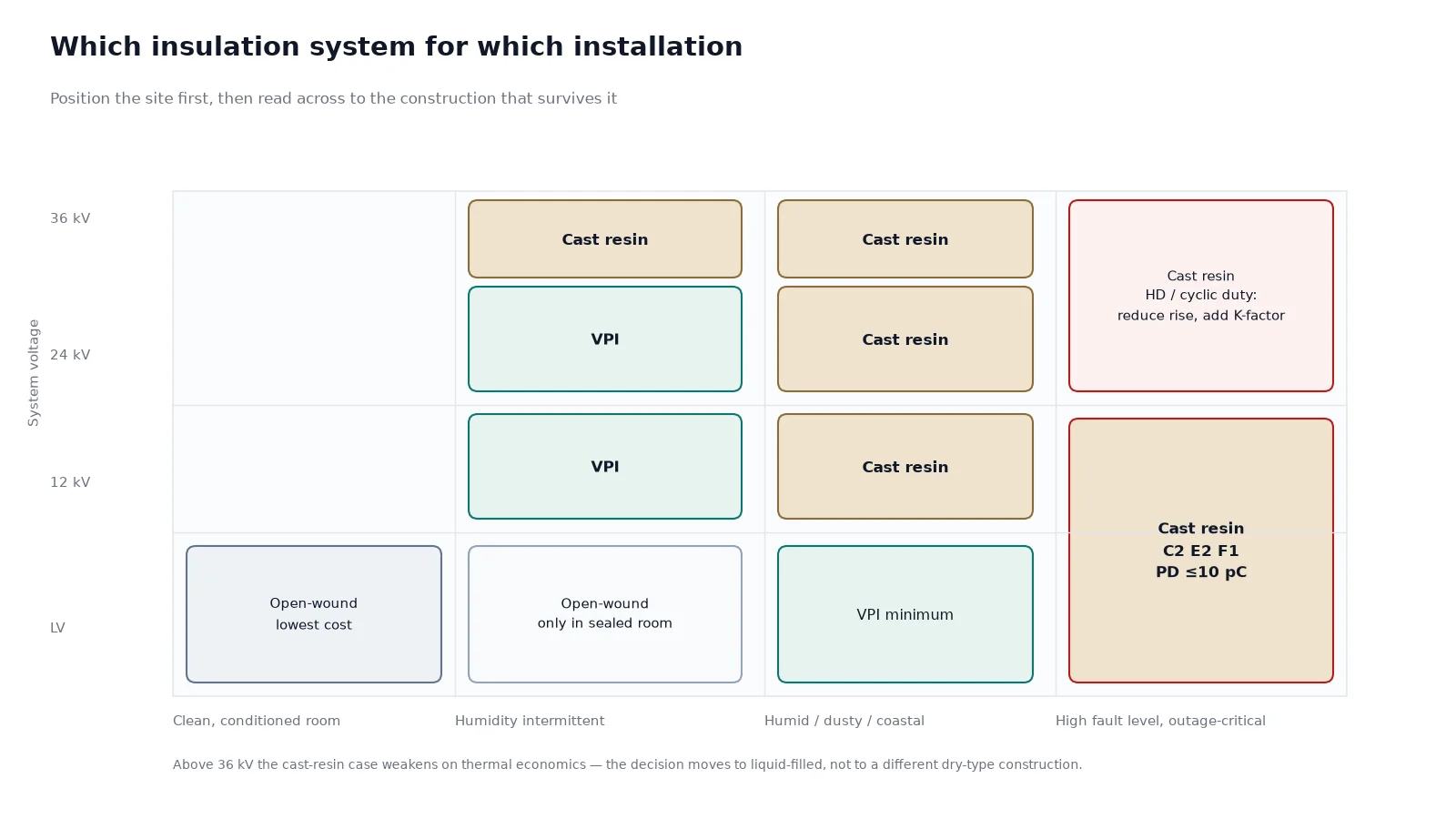
If the transformer sits in a coastal plant, a water-treatment works, a paper mill or an underground metro box, open-wound is the wrong answer regardless of price. Condensation on an unprotected coil is the single most common cause of premature dry-type failure in tropical installations, and it is entirely avoidable. VPI is the minimum sensible specification in an uncontrolled indoor space; cast resin is the default where humidity is chronic.
Harmonic and cyclic duty decides against rigid encapsulation in some cases
This is the argument VPI suppliers make, and it is a fair one up to a point. Loads dominated by rectifiers, VFDs or electric arc furnaces produce additional winding losses and hot spots, and the resulting thermal cycling works on every material interface. Cast resin has a lower thermal expansion coefficient than a varnish-impregnated coil and is mechanically restrained by the casting, so a poorly designed casting can crack at the coil ends under aggressive cycling. A well-designed casting — properly filled, with a compliant end-winding termination — handles the same duty without distress. The specification answer is not to reject cast resin but to demand the thermal cycling and impulse test evidence, plus a K-factor or harmonic-loss allowance in the design.
High fault level decides for cast resin
Through-fault forces scale with the square of the current, so a unit installed close to a large source sees electromagnetic loads that a varnished open coil resists only as well as its bracing allows. Cast resin wins here because the epoxy body shares the load with the conductor. Where the prospective fault current is high, or where the transformer will see frequent through-faults, the premium for casting buys mechanical margin that is difficult to retrofit.
Repairability decides against cast resin
VPI coils can be re-impregnated and, in many designs, rewound. A cast coil cannot: a fault inside the casting means a new winding. For a plant with an in-house maintenance team and long asset life, that difference matters. For a data centre with a service contract and a spare-unit policy, it does not.
Rating Range and What That Means in Practice
Open-wound units are essentially low-voltage products; specifying one at 11 kV or 33 kV usually means the design has migrated to VPI or casting anyway. VPI covers the medium-voltage range up to 36 kV and is common from a few hundred kVA to around 20 MVA. Cast resin is most economical in the 100 kVA to 10 MVA band at 12 kV and 24 kV, and remains available at 36 kV for projects where the environment demands it.
Above roughly 10 MVA, the thermal economics favour liquid-filled designs and the dry-type argument becomes a fire-and-site-constraints argument rather than an efficiency one. The dry-type specification guide sets out the full rating and loss envelope if you need to test a proposal against it.
Cooling, Overload and the Fan Question
All three constructions are air-cooled, and all three can be fitted with forced ventilation. The important point for a specification is that the AN (air natural) rating and the AF (air forced) rating are two different nameplate values, and only one of them is normally tested. Cross-flow fans typically add 33% to the continuous rating on an IEC-rated unit, and up to 40–50% where the design has thermal headroom. Do not accept a quotation that states the AF rating without the AN rating beside it.
Overload capability follows the same logic as the temperature class. A class F (155 °C) system with a 100 K average winding rise leaves little continuous margin above nameplate; a class H (180 °C) system with 125 K rise, or a design with an 80 K rise, can carry a sustained overload of around 30% without exceeding its insulation limits. If the load profile includes a predictable peak — EV charging, a shift-based plant, a solar inverter at midday — buy the margin at order stage rather than discovering it later. The comparison of cast resin efficiency grades shows how that margin is traded against no-load loss in the SCB family.
Decision Matrix by Installation
| Installation |
Recommended system |
Reason |
| Conditioned indoor electrical room, LV distribution |
Open-wound |
No environmental stress; lowest cost and weight |
| Indoor commercial or industrial, humidity intermittent |
VPI |
Moisture at the surface is the governing risk, not immersion |
| Data centre, hospital, airport terminal |
Cast resin |
Outage cost dominates; C2 E2 F1 and low PD are contractual |
| Metro, tunnel, underground substation |
Cast resin |
Humidity, dust, restricted maintenance access and fire load all point the same way |
| Coastal or offshore platform |
Cast resin |
Salt-laden air attacks any exposed conductor system |
| Harmonic-rich load, moderate environment |
VPI or cast resin with harmonic allowance |
Thermal duty governs; demand cycling test evidence from either |
| High prospective fault current |
Cast resin |
Through-fault mechanical margin |
| Phased buildout, energised months after delivery |
VPI or cast resin |
No drying cycle required before first energisation |
What to Write in the RFQ
Six lines in the enquiry remove most of the ambiguity that makes three dry-type bids impossible to compare:
- Rated power, voltage ratio, vector group, frequency and impedance, plus the tap range.
- Insulation system explicitly named — open-wound, VPI or cast resin — not “dry type”.
- IEC 60076-11 environmental, climatic and fire classes as C/E/F letters.
- Temperature class and average winding rise at rated load, with the AN rating stated separately from the AF rating.
- Partial discharge limit and the test voltage at which it applies.
- Enclosure IP rating, cable entry arrangement, and whether the unit must be withdrawable.
Add loss figures in watts for no-load and load loss at the reference temperature, because those two numbers drive the 25-year cost far more than the factory price does. Our technical data sheet walkthrough lists every field a supplier should return.
Frequently Asked Questions
Is cast resin always better than VPI?
No. It is better where the environment is hostile, the fault level is high, or fire and outage risk dominate. It is not better where budget and repairability dominate, where the plant has an in-house maintenance team, or where the unit is lightly loaded in a clean room. VPI is a legitimate engineering choice, not a downgrade.
Can a VPI transformer be installed outdoors?
Only inside an enclosure rated for the site, and preferably an IP23 or better enclosure with anti-condensation heaters. VPI in a ventilated canopy is a common arrangement in mild climates; it is not appropriate for monsoon or coastal exposure.
Does cast resin mean the transformer cannot be recycled?
The copper and the core are fully recoverable. The epoxy is not recyclable in the usual sense and must be disposed of as industrial waste. This is a real end-of-life consideration in markets with strict waste rules, and it is worth pricing at the procurement stage rather than at decommissioning.
Why does the same kVA cost more in cast resin?
Because the epoxy, the mould, the vacuum casting cycle, the curing time and the partial discharge testing all add cost, and because the sealed coil needs more conductor to hit the same temperature rise as a ventilated one. The premium is typically 15–30% over VPI at the same rating, and it buys environment class and fault strength rather than efficiency.
What insulation class should I specify for a tropical site?
Class H (180 °C) with a 125 K rise, or class F with a reduced rise, plus C2 climatic class. In ambient temperatures that stay above 40 °C for weeks, the extra thermal margin is cheaper than derating a class F unit.
Does the insulation system affect energy efficiency compliance?
Only indirectly. Efficiency is set by the core and the conductor cross-section, and any of the three systems can be built to a given loss target. But the cooling arrangement constrains how much loss a given frame can dissipate, so a VPI design may reach a low-loss target with a smaller core than a cast resin design of the same rating. Compare units at equal loss, not equal kVA.
The Decision in One Paragraph
Buy open-wound only for clean, conditioned, low-voltage rooms. Buy VPI when the environment is controlled but not guaranteed, when harmonics or cycling dominate the thermal duty, or when repairability and budget carry weight. Buy cast resin when moisture, pollution, fault level, fire load or the cost of an outage sets the requirement — and then insist on the C2 E2 F1 declaration and a partial discharge figure rather than accepting the words “cast resin” as a specification. The dry-type transformer range covers all three constructions, and we will quote the class letters on the datasheet rather than in the brochure.