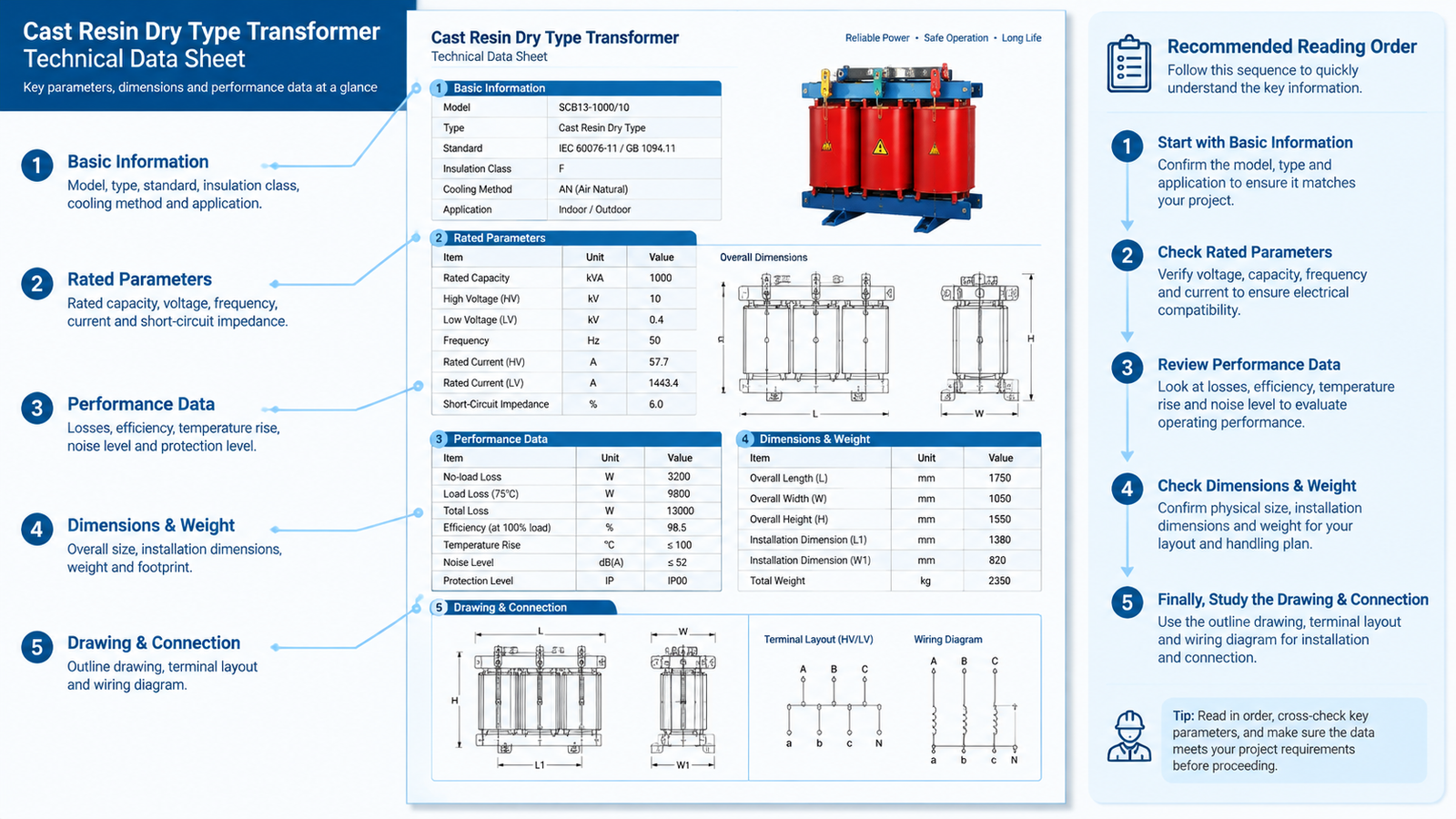
Dry Type Transformer Technical Data Sheet: Field by Field
Published: Author: Lisa
A dry type transformer technical data sheet is the document that decides whether the unit you receive matches the unit you priced. Quotations are short and optimistic; nameplates are short and fixed. The data sheet in between is where the engineering actually lives, and it is the only place where you can still change the outcome before the winding goes into the mould.
This guide walks a cast-resin dry-type data sheet field by field, in the order an experienced engineer reads it. The point is not to memorise a form. It is to know which eight fields move the price, which four are quietly assumed by the factory, and which three are the source of most acceptance disputes. If you can read a data sheet in ten minutes and spot those, you will stop paying for surprises.
Four documents that are not the same thing
Before the fields, the documents. Buyers routinely confuse them, then argue about which one governs.
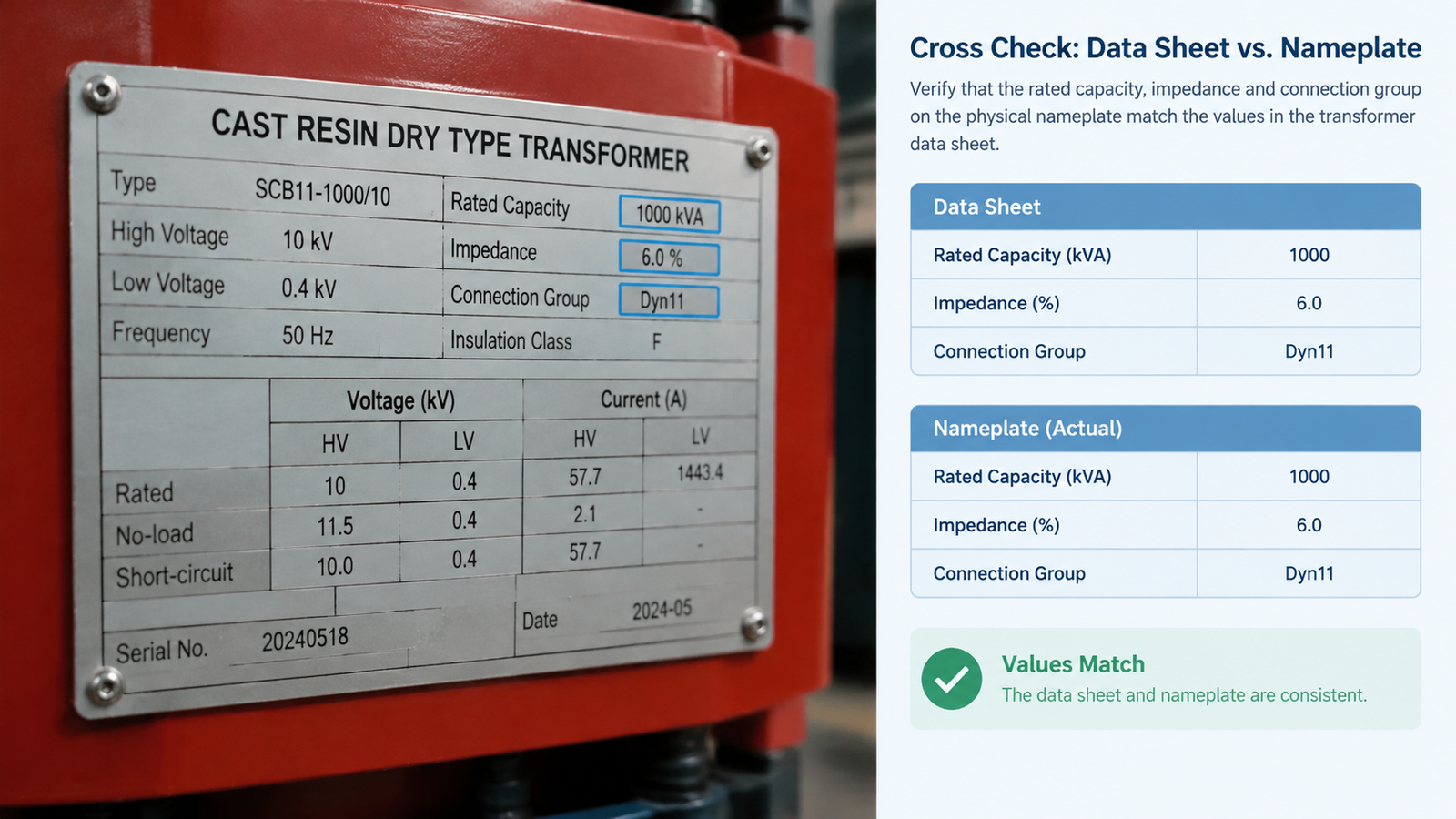
The chain that matters is quotation → approved data sheet → nameplate. If any link contains a value the others do not, you have an acceptance dispute waiting. The physical cross-check is described in the nameplate ratings guide.
Section 1: rating and voltage
Start at the top. The rating line looks simple and is where two of the four hidden assumptions appear.
Rated power in kVA, at a stated cooling condition. A unit rated 1,000 kVA AN and 1,250 kVA AF is two ratings, not one. If the sheet shows a single number and the unit has fans, ask which condition that number applies to.
Rated voltages — HV and LV, both written out, for example 10,000 V / 400 V. Never accept a ratio alone; 10/0.4 could mean 10,000/400 or 10,000/4,000 depending on the typist.
Tap range — positions, percentage per step, and whether it is off-circuit or on-load. The tap position at which losses and impedance are guaranteed should be named.
Frequency — 50 Hz or 60 Hz. A range is not a specification, because the core is designed for one.
Also confirm the vector group here, since it sits next to the voltage line on most forms: Dyn11 for the vast majority of distribution units, Yyn0 in some legacy Chinese networks, Yd11 on larger or generator-connected units. A wrong vector group makes parallel operation impossible and mis-sets the protection.
Section 2: impedance and its tolerance
Impedance, written uk%, is the percentage of rated voltage that produces rated current through the transformer with the secondary short-circuited. It sets the downstream fault level, so it interacts with every breaker and cable selection in the design.
Typical values for cast-resin distribution units: 4 percent at 630 kVA and below, 6 percent from 800 to 1,600 kVA, 8 percent at 2,000 kVA and above. These are conventions, not rules — a specification can require 6 percent at 1,000 kVA and you will get it, at the cost of a slightly different winding geometry.
Two conditions belong on the sheet with the number, and both are frequently missing:
Reference temperature. Impedance is quoted at a stated winding temperature, normally 120 °C for cast resin and 75 °C for oil-immersed. Comparing a 75 °C figure with a 120 °C figure makes a transformer look better or worse than it is.
Tolerance. Under IEC 60076-1, declared impedance carries a ±7.5 percent tolerance on the principal tapping, widening to ±10 percent for the first unit of a new design. That is a wide band. If your fault-level calculation has no margin for it, specify a tighter tolerance and expect to pay for it.
Section 3: losses and efficiency — the field that decides the price
No-load loss P0 and load loss Pk are the two numbers that most affect what you pay and what you pay forever. They also carry the loosest legal tolerances in the whole document.
Field
What to look for
Why it matters
P0 (no-load loss)
Watts, at rated voltage and frequency
Runs 8,760 hours a year regardless of load
Pk (load loss)
Watts, at rated current, with a stated reference temperature
Scales with the square of load; 120 °C for cast resin, 75 °C for oil
Total losses tolerance
+15% under IEC 60076-1
The guarantee value is a ceiling, not an expectation
Efficiency
Stated with the load point, e.g. 100% or 50%
A percentage without a load point is unreadable
That +15 percent tolerance deserves emphasis because it is legal and routinely used. If the sheet guarantees P0 at 1,350 W, a unit measuring 1,550 W on test can still pass. Specify the loss values you will test against, and check them at the same reference temperature the factory used — the difference between 75 °C and 120 °C on load loss alone can be 15 to 20 percent.
The load point question also decides which efficiency number is meaningful. Low-voltage dry-type units are assessed at 35 percent load under US DOE rules, medium-voltage dry-type and oil units at 50 percent under IEC-based schemes, and datasheets often quote 100 percent because it looks best. The three figures are not comparable; the efficiency class and loss evaluation guide explains the conversion, and the full specification context sits in the dry-type transformer specification guide.
Section 4: thermal design
Thermal fields come as a set. Reading one without the others is how a unit ends up rated for a duty it cannot sustain.
Insulation class — Class F (155 °C) or Class H (180 °C) for cast resin. The class is the material limit, not the operating temperature.
Temperature rise — 80 K, 100 K, or 125 K on the winding. A 100 K rise on Class F and a 125 K rise on Class H are both standard, and they produce different overload capability for the same losses.
Cooling class — AN (natural) or AF (forced). An AF rating only exists while the fans run, so fan failure drops capacity instantly.
Overload capability — declared as a percentage for a duration, or by reference to the standard’s loading guide. Units designed with an 80 K rise on Class H insulation can carry substantial continuous overload, but only if the sheet says so.
Hot-spot allowance — implied by the rise plus a gradient. Ask for the design hot-spot temperature if the load is cyclic.
The interaction is the point: two 1,000 kVA units with identical losses but different rise classes have different life expectancy at the same load. If your load profile has daily peaks, the lower rise with the higher insulation class is worth more than a small loss improvement.
Section 5: environment, enclosure, and derating
Factory standard conditions are 40 °C maximum ambient and 1,000 m altitude. Everything above those is a correction, and corrections are where quotations quietly diverge.
Ambient. Above 40 °C, capacity derates. A 45 °C plant room is common in the Gulf and in tropical industrial buildings.
Altitude. Above 1,000 m the air is thinner, so both cooling and external insulation weaken. The sheet must state the correction applied, not just the site altitude.
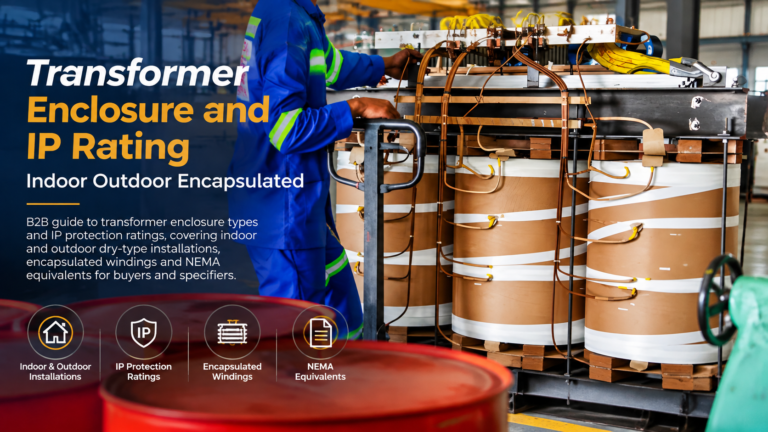
IP rating. IP20 is the indoor default, IP21 adds drip protection, IP23 allows better ventilation with finger-safe access, IP54 is an outdoor enclosure. An IP54 enclosure on an AN design usually forces a derating or an AF upgrade, because the enclosure restricts airflow.
Seismic and vibration. Not usually on a standard form, essential in some regions and on skid-mounted packages.
Pollution and humidity. Coastal and chemical sites need creepage and coating decisions that belong on the sheet, not in a site note.
Section 6: physical data
Dimensions, mass, and sound level look like logistics details until they arrive at a loading dock that cannot take the weight or a plant room that cannot take the height.
Overall dimensions for the bare unit and for the enclosure, since the enclosure adds 150 to 400 mm in each direction.
Mass with the enclosure and any fans, plus lifting point positions and the minimum crane capacity.
Sound level in dB(A) at 1 m, guaranteed. A 1,000 kVA cast-resin unit typically lands between 50 and 58 dB(A); a low-loss design is not automatically quieter, because the larger core can radiate more.
Clearances for ventilation and for cable termination, which drive the room layout more than the footprint does. The dimensional conventions are collected in the dry-type transformer sizes and dimensions chart.
Section 7: standards and tests
The last block tells you what the factory will prove. Two things must be named: the design standard and the routine test list.
Item
Common values
Check
Design standard
IEC 60076-11, GB 1094.11, EN 50588
Must match the project specification
North American listing
UL 1561 up to 600 V, UL 1562 above 600 V
480 V units are UL 1561, not 1562
Routine tests
Winding resistance, ratio, impedance and load loss, no-load loss and current, applied voltage, induced voltage with partial discharge
Ask for the test report, not just the certificate
Partial discharge
≤10 pC at 1.1 Um is a common requirement; premium specs ask ≤5 pC
PD is the best early indicator of cast quality
Type tests
Temperature rise, impulse, short-circuit
Type test reports must cover the specific model
Whether the routine tests are witnessed, and which documents come with them, is a separate commercial decision covered in the factory acceptance test guide.
The eight fields that move the price
If a quote looks inexplicably low or high, one of these eight has changed. Compare them before comparing totals.
Loss class — P0 and Pk together, not the model number.
Winding material — copper versus aluminium. The largest single cost lever, and often absent from the model code.
Impedance — 4 percent versus 8 percent at the same rating means a different winding.
Temperature rise and insulation class — 100 K on Class F versus 125 K on Class H.
Cooling — AN versus AF, and whether the AF rating is included in the quoted kVA.
Enclosure and IP rating — bare core versus IP54 outdoor enclosure with derating.
Tap changer — off-circuit five-position versus on-load with a controller.
Accessories — fans, PT100 sensors, thermostats, space heaters, and terminal arrangements.
Reading a data sheet in ten minutes
Order of attack, for a buyer under time pressure:
Rating, voltages, frequency, vector group — five lines, confirms it is the right machine.
Impedance with reference temperature and tolerance — confirms the fault-level study holds.
P0 and Pk with reference temperature — confirms the losses you are paying for.
Insulation class and temperature rise — confirms the duty cycle is supportable.
Ambient and altitude — confirms the derating is declared, not implied.
IP rating, mass, dimensions — confirms it fits the room and the crane.
Standard, routine tests, PD limit — confirms what will be proven.
Six data sheet errors that cause disputes
Watts versus kilowatts. A P0 of “1.8” without a unit has caused more arguments than any other typo.
Load loss at the wrong reference temperature. 75 °C values on a cast-resin unit flatter the design by a wide margin.
Efficiency without a load point. 99.1 percent at 35 percent load is a different claim from 99.1 percent at 100 percent.
No altitude correction. A 2,000 m site using a standard 1,000 m design runs hot from day one.
AF capacity quoted as continuous. The kVA only exists while the fans are healthy and powered.
Sound level without a distance or standard. dB(A) at 1 m to IEC 60076-10 is not the same as a sound power figure.
Conclusion
A dry-type technical data sheet is a short document with a long reach. Read it in a fixed order — rating, impedance, losses, thermal, environment, physical, tests — and check the four fields factories tend to leave implicit: the reference temperature for load loss, the tap position for guaranteed values, the derating for ambient and altitude, and the load point behind any efficiency figure.
If you have an approved sheet and want a second pair of eyes before the winding is released, the Kampa engineering team reviews customer datasheets against the cast-resin range and returns a marked comparison, including the losses at your actual load profile. The cast-resin product family and its standard ratings are listed on the epoxy resin 10 kV dry-type transformer page, and the wider range sits under dry-type power transformers.
FAQ
What must a dry type transformer technical data sheet include?
At minimum: rated kVA with cooling condition, HV and LV voltages, frequency, vector group, impedance with its reference temperature and tolerance, no-load and load losses, insulation class and temperature rise, ambient and altitude, IP rating, dimensions and mass, sound level, governing standard, and the routine test list.
What reference temperature is used for load loss?
120 °C for cast-resin dry-type units and 75 °C for oil-immersed units. Comparing values at different reference temperatures is the most common cause of misleading loss comparisons.
Is a 100 K temperature rise better than 80 K?
Not in itself. A 100 K rise allows a smaller, cheaper transformer with the same losses, and a 80 K rise gives more thermal margin and longer insulation life at the same load. Which is better depends on your duty cycle and how much margin the load profile needs.
What does IP23 mean on a dry type transformer?
IP23 means protection against fingers and tools plus protection against spraying water at up to 60 degrees from vertical. It is often used where better ventilation is needed than IP20 allows, and it usually needs a derating check against the open version.
How much does altitude reduce a transformer’s rating?
It depends on the design and the standard applied, but the effect is real above 1,000 m for both cooling and external insulation. The data sheet must state the site altitude and the correction applied rather than leaving it to be inferred.
Why is the +15% loss tolerance a problem?
Because IEC 60076-1 permits total losses up to 15 percent above the declared value on test. A unit can pass acceptance while costing more to run than the quotation implied. Specify the loss values you will test against and verify the reference temperature used.
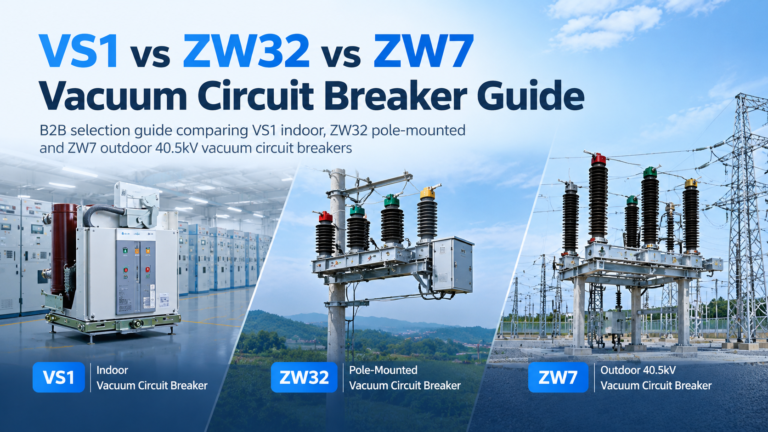
How to choose between VS1 indoor, ZW32 pole-mounted and ZW7 40.5 kV outdoor vacuum circuit breakers, including type codes and breaking capacity sizing.
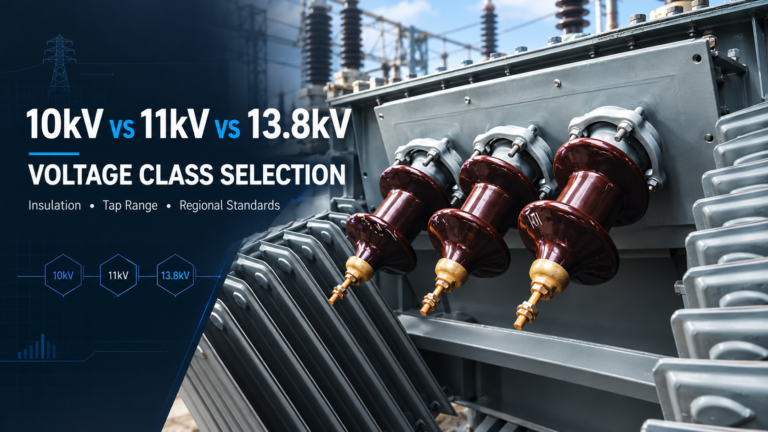
10 kV, 11 kV and 13.8 kV transformers differ in ratio, insulation level and tap range. Here is how to pick the right voltage class and avoid a costly mismatch.