Transformer Efficiency Class & Losses: EU ErP, DOE and GB 20052
Published: Author: Lisa
An efficiency class is the only transformer specification where the buyer is committing to a number they cannot see. Rated power, voltage ratio and impedance all show up immediately in operation. Losses do not — they show up as a line on the electricity bill for the next twenty-five years, and by then the purchase decision is long closed.
That is why tenders increasingly specify loss caps rather than asking for “good quality”. This guide explains what an efficiency class regulates, how the EU, US and Chinese frameworks differ, why three apparently comparable efficiency figures are often not comparable at all, and how to turn watts into money before you commit. Where the subject is a cast-resin unit, the same logic applies to dry type transformer efficiency as it does to oil-immersed designs — the arithmetic is identical, the loss values are not.
What an Efficiency Class Actually Regulates
Transformer losses come in two parts, and every regulation treats them separately:
No-load loss (P0) — core loss. It exists the moment the unit is energised, at any load, including zero. It runs 8,760 hours a year for the life of the installation.
Load loss (Pk) — winding loss. It rises with the square of the current, so at 50% load it is a quarter of the full-load figure.
An efficiency class sets maximum permissible values for both, at defined reference conditions and a defined load point. Because the two losses behave differently, the same total loss figure can describe two very different transformers — one with a cheap core and generous copper, one with an expensive core and thin windings. Which is better depends entirely on how the unit will be loaded.
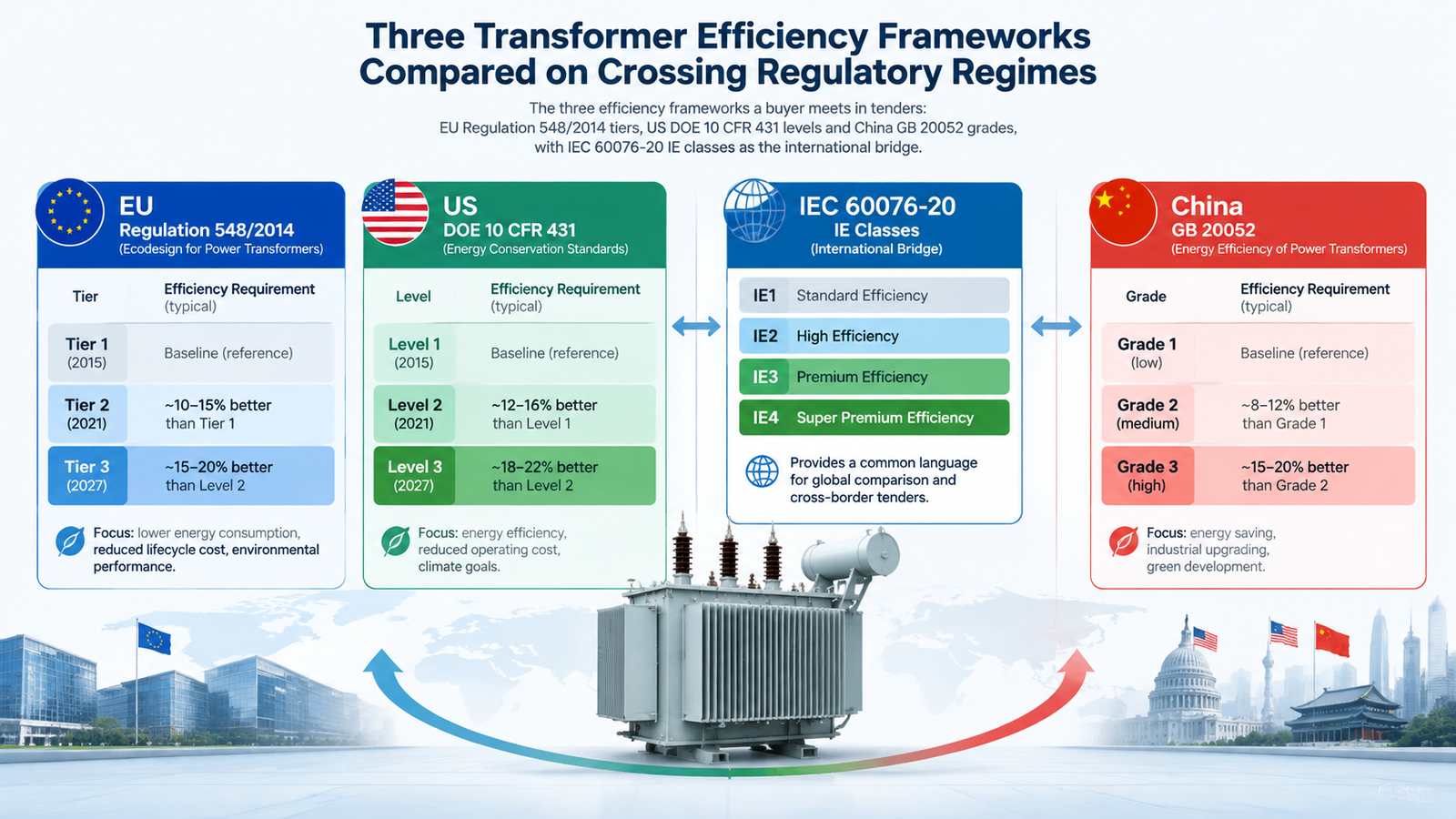
The Three Frameworks a Buyer Meets in Tenders
Framework
What it is
Current position
EU Regulation 548/2014 (Ecodesign)
Law, not a standard. Sets absolute maximum no-load and load loss by rating; EN 50588-1 supplies the harmonised loss tables
Tier 1 applied from 1 July 2015, Tier 2 from 1 July 2021. Tier 2 is the legal floor for any unit placed on the EU market — there is no opt-out tier above it
US DOE, 10 CFR 431
Federal minimum efficiency for distribution transformers, expressed as minimum efficiency at defined load points
The 2016 baseline is the current requirement. The 2024 revision took effect in July 2024 but compliance is required from 23 April 2029, so both levels will coexist in tenders for several years
China GB 20052-2020
National standard with three efficiency grades for oil-immersed and dry-type distribution transformers
Effective June 2021. Grade 3 is the legal minimum, Grade 2 is the level usually specified for new installations, Grade 1 is reached mainly with amorphous cores
IEC 60076-20
International energy performance framework with IE1–IE4 classes
The bridge between regimes. Tenders that cannot cite a national regulation often quote “minimum IE3” instead
The EU, US and Chinese rules have converged in direction but not in detail. Meeting Tier 2 does not automatically mean meeting the 2029 DOE level, and a Grade 2 unit is not necessarily IE3 unless the manufacturer has demonstrated it against the IEC tables. Ask for the specific declaration, not a general claim of “high efficiency”.
No-Load and Load Loss Are Not Interchangeable
Two transformers can meet the same total loss limit and behave completely differently in service. The split matters more than the sum, because the two components are weighted by different things.
Loss component
When it occurs
Who should care most
No-load loss P0
Continuously, 8,760 h/year, independent of load
Anyone running a lightly loaded or standby unit — the loss is paid even when the plant is idle
Load loss Pk
Scales with the square of loading; at 50% load it is 25% of the full-load value
Continuous high-load users: data halls, process plant, renewables export
This is why the same transformer is optimal for one duty and wasteful for another. A utility distribution unit that sits at 30% average load for its whole life is dominated by P0, and money spent on a better core pays back quickly while money spent on extra copper does not. A data centre transformer at 85% load is the reverse.
Why the Load Point Behind the Number Differs
This is the detail that most frequently makes two efficiency figures incomparable, and it is almost never stated in a quotation.
Where the number comes from
Load point used
What it means when you compare
US DOE efficiency tables, low-voltage dry-type
35% of rated load
Weighted heavily toward no-load loss, which is what a typical LV dry-type distribution duty looks like
US DOE efficiency tables, medium-voltage dry-type and liquid-immersed
50% of rated load
Assumes a higher average loading than the LV dry-type case
EU Ecodesign Tier 2
Absolute caps on P0 and Pk separately, plus the Peak Efficiency Index for larger units
There is no single “efficiency %” to compare — you compare two loss figures against the table
GB 20052 grades
Absolute loss limits at rated conditions
Grade 2 and IE3 are close in intent but not interchangeable without a demonstration
A 98.6% efficiency figure measured at 35% load and a 98.6% figure measured at 50% load describe different machines. When a supplier quotes a single efficiency percentage, ask at what load point and to which standard it was measured. If the answer is vague, treat the figure as marketing rather than specification.
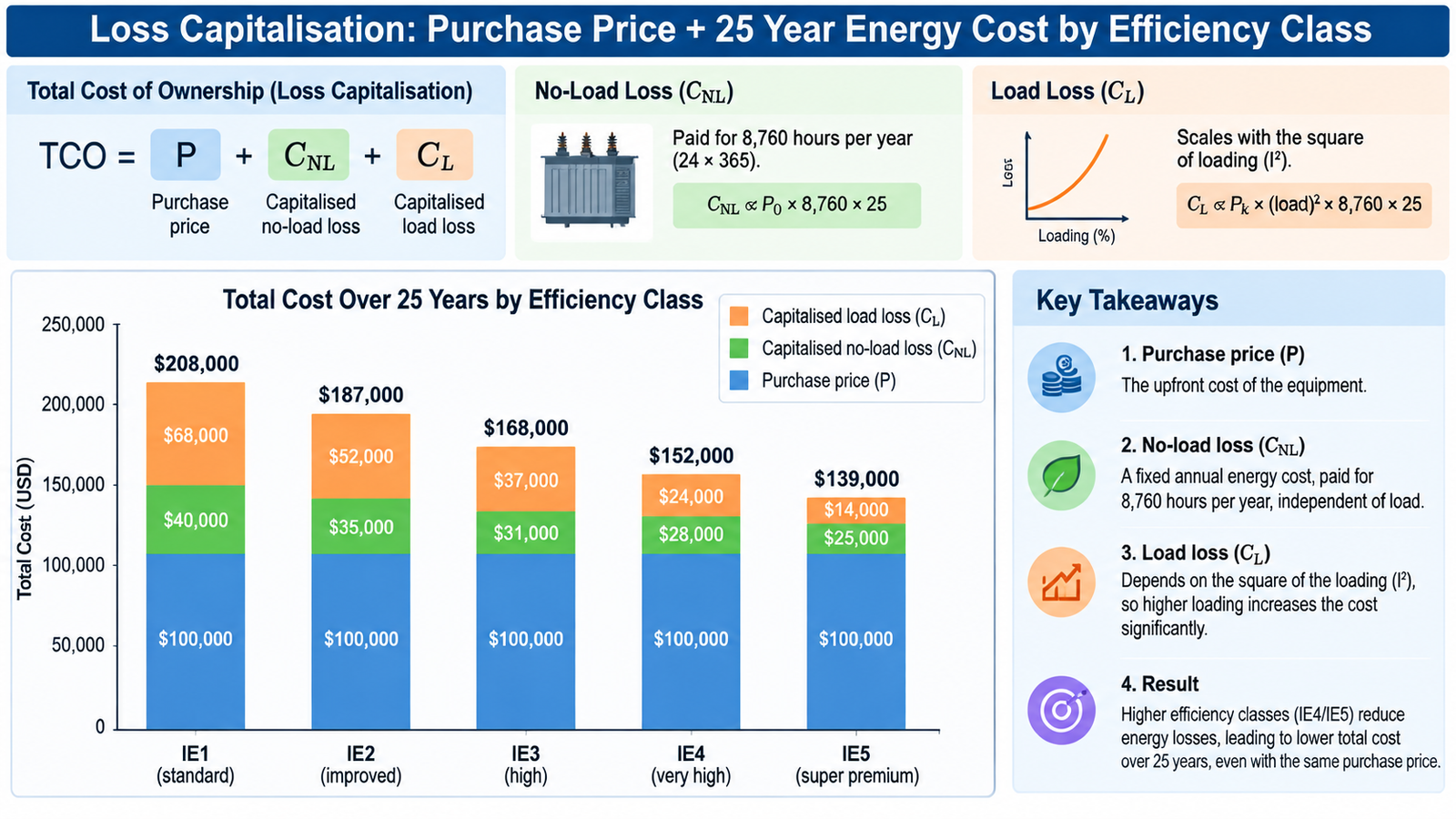
Turning Watts Into Money: Loss Capitalisation
The commercial question is not which unit has lower losses, but whether the lower-loss unit is worth its price premium. Loss capitalisation answers that with a single equation:
TCO = purchase price + (A × P0) + (B × Pk)
Where P0 and Pk are in watts, A capitalises one watt of continuous no-load loss over the evaluation period, and B capitalises one watt of load loss at the expected loading:
A = annuity factor × energy price × 8,760 hours B = A × (average loading fraction)²
At 8% discount rate, 25 years and US$0.12/kWh, the annuity factor is 10.675 and A works out at US$11.22 per watt. Every 100 W of no-load loss you remove is worth about US$1,120 of lifetime cost — a figure you can compare directly against the price difference on the quotation.
The loading fraction is where evaluations go wrong. Using B = A (full load) overstates the value of copper in a unit that will average 40% load. Use the load factor you actually expect, and if the project has a load study, use its numbers.
A Worked Comparison: Standard Core Versus Amorphous
Take a 630 kVA, 10 kV distribution transformer on a site with 60% average loading, 25-year life, 8% discount rate and US$0.12/kWh. Indicative loss values for three core grades:
Grade
P0
Pk
Indicative price premium
Capitalised loss (A×P0 + B×Pk)
Standard CRGO (S11 / Grade 3)
810 W
7,500 W
baseline
US$39,400
High-permeability CRGO (S13 / Grade 2)
720 W
7,000 W
+15–25%
US$36,400
Amorphous (S20 / Grade 1)
300 W
7,000 W
+25–40%
US$31,600
Amorphous saves about US$7,700 of capitalised loss against the baseline, and the price premium is typically in the region of US$2,000–3,500 on this rating. On a simple payback basis the premium returns in roughly four to seven years, which is comfortably inside a 25-year life.
Two honest caveats. First, at US$0.06/kWh the same premium takes twice as long to return, and in a low-tariff market with a short expected service life it may not return at all. Second, amorphous cores are physically larger and heavier, so check the footprint and floor loading before specifying — see the dimension and clearance reference for what that means per size.
Where Your Unit Actually Sits on the Efficiency Curve
Transformer efficiency is not flat across the load range. It rises steeply from no load, peaks where no-load loss equals load loss, then falls slowly as load loss takes over. The peak typically lands between 35% and 60% of rated kVA on distribution designs, which is exactly why the DOE low-voltage dry-type tables use a 35% load point.
The practical consequence: a unit sized with a large safety margin spends its life on the left-hand side of the curve, where efficiency is poor and the no-load loss is a fixed tax. This is the strongest argument against oversized transformers, and it is a sizing issue rather than an efficiency-class issue — no efficiency class fixes a unit that is twice the required size. The kVA sizing method covers how to avoid it.
Reading an Energy Label and a Test Report
A label is a declaration; a test report is evidence. Four documents matter at delivery:
The declaration of conformity for the market the unit is installed in — CE declaration for the EU, DOE compliance statement for the US.
The routine test report for the serial number you are receiving, with measured P0 and Pk against the guaranteed values. Not a type-test report from a different unit.
The guaranteed loss values in the contract, with a stated tolerance. IEC 60076-1 permits a positive tolerance on total losses, and a supplier quoting “typical” rather than “guaranteed” values is not giving you a specification.
The load point and reference temperature for the declared losses — load loss is normally corrected to a reference winding temperature, and figures at different temperatures are not comparable.
For a tender evaluation, put the guaranteed P0 and Pk of every bidder into the same capitalisation equation with your own energy price. The ranking often changes, and the difference is usually in the no-load loss column.
Choosing a Class for Your Market
Destination / requirement
Practical specification
European Union
Tier 2 as the legal floor; specify the exact EN 50588-1 loss class and require the declaration of conformity
United States, installed before 2029
DOE 2016 level as the minimum; if the unit will be replaced or recommissioned after 2029, evaluate the 2024 level now to avoid a stranded asset
United States, long-life critical installation
Specify the 2029 level deliberately — a transformer commissioned in 2028 will still be in service in 2055
China and many export tenders
GB 20052 Grade 2 as the practical baseline; Grade 1 where the tender rewards it or where energy is expensive
Tender quoting IE classes only
IE3 as the common minimum; ask for the IEC 60076-20 demonstration, not just a claim
Middle East, Africa, Southeast Asia, no stated requirement
Use the loss capitalisation calculation — the cheapest compliant unit is rarely the lowest lifetime cost when energy is expensive and load is high
If the destination has no mandatory class, the specification is yours to write, and writing it is worth the effort: a tender with no loss cap receives the cheapest compliant unit every time. The cost per kVA benchmarks show the price side of that trade-off, and the dry-type and cast-resin comparison covers how insulation system choice interacts with loss performance.
Three Specification Mistakes That Cost Real Money
Quoting an efficiency percentage without a load point. Three different standards, three different reference loads, one meaningless number.
Buying the lowest-loss class for a lightly loaded unit, then oversizing it. A large margin drops the operating point below the efficiency peak and gives back the savings the premium was meant to buy.
Accepting a type-test report as delivery evidence. Losses vary by build; only the routine test on your serial number confirms what you received. How that test is performed and what the acceptance tolerances are is covered in the factory test and FAT guide.
Finally, losses interact with temperature. A unit with lower losses runs cooler, which extends insulation life and may allow a lower temperature-rise design at the same rating. The cooling class guide explains how that thermal margin is declared, and the nameplate reference shows where loss, impedance and temperature rise appear on the plate you will actually receive.
Conclusion
Efficiency class is a commitment measured in watts, not a marketing adjective. Establish which framework your market requires, compare loss figures at the same load point and reference temperature, and put every bidder’s guaranteed P0 and Pk through the same capitalisation equation with your own energy price and load factor. That gives a defensible answer to the only question that matters: is the premium worth it on this duty, at this tariff, for this life?
If you have a rating, a load profile and a tariff, the engineering team can run that comparison against two or three core grades and tell you where the crossover sits — including the cases where the standard core is genuinely the better buy.
Frequently Asked Questions
What is an IE3 transformer?
IE3 is an efficiency class from IEC 60076-20, the international energy performance framework for power transformers. IE1 is the lowest class and IE4 the highest, normally requiring an amorphous core. Many tenders specify “minimum IE3” where they cannot cite a national regulation, which places it roughly alongside EU Tier 2 and GB 20052 Grade 2 — though the three are not formally interchangeable without a demonstration.
Is a higher efficiency class always worth the extra cost?
No. The premium is recovered through avoided losses, so it depends on energy price, expected loading and service life. A high-efficiency unit on a lightly loaded, low-tariff site may never pay back, while the same unit at 80% load on an expensive tariff can return its premium in a few years. Run the loss capitalisation calculation with your own figures before assuming either answer.
Why do two suppliers quote different efficiency percentages for the same kVA?
Most often because the figures were measured at different load points or against different standards, or because one is a “typical” value and the other a guaranteed value with a tolerance. Ask for the load point, the reference temperature and the standard before comparing. Comparing guaranteed no-load and load loss in watts is far more reliable than comparing a single percentage.
What is the difference between no-load loss and load loss?
No-load loss is the core loss, present whenever the transformer is energised and independent of the load — it runs 8,760 hours a year. Load loss is the winding loss, which rises with the square of the current and is therefore zero at no load and highest at full load. A transformer’s efficiency peak occurs where the two are equal, typically between 35% and 60% of rated load on distribution designs.
Does an efficiency class apply to dry-type transformers?
Yes. EU Tier 2 covers dry-type and oil-immersed units with separate loss tables, DOE sets separate levels for low-voltage and medium-voltage dry-type transformers, and GB 20052 defines grades for both. The load points differ — low-voltage dry-type is evaluated at 35% load under DOE — which is one reason efficiency figures for dry-type and oil-immersed units should never be compared directly.
How percentage impedance sets the fault level, the voltage drop and the parallel operating rules, with worked fault-current and regulation calculations.
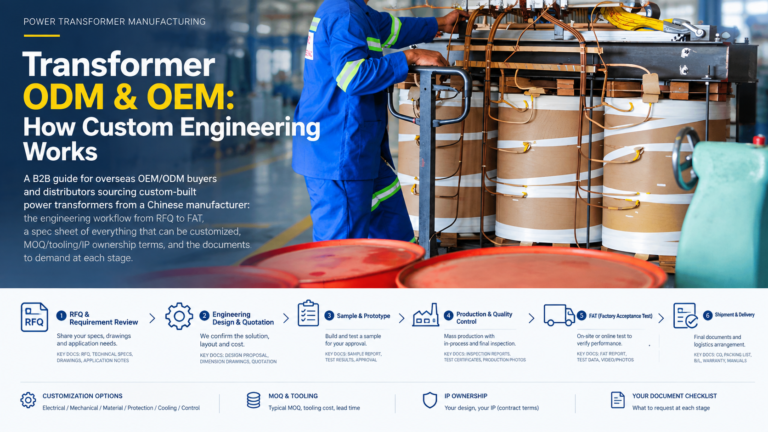
Transformer ODM and OEM programs explained: the custom engineering workflow from RFQ to FAT, the 15-field spec sheet, tooling and IP ownership, MOQ and lead-time terms.