Transformer Cooling Classes Explained: AN, AF, ONAN, ONAF
Published: Author: Lisa
Two transformers on the same 1,000 kVA duty can carry completely different thermal margins, occupy different footprints and cost different amounts to run — and the only place that difference appears on paper is the four-letter cooling code. Buyers who skip it usually discover the problem at commissioning, when the supplied unit delivers its 1,000 kVA only with fans running, and there is no auxiliary supply available for them.
This guide decodes the transformer cooling class system defined in IEC 60076-2, explains what each class actually buys you in capacity, noise and maintenance, and sets out how to specify the class so the quotation matches the duty you need.
Why the Cooling Code Matters More Than the kVA
A transformer’s rated power is not a property of its core and windings alone. It is the power at which the unit stays within its permitted temperature rise, in a defined cooling environment. Change the cooling, and the same active part carries a different rating.
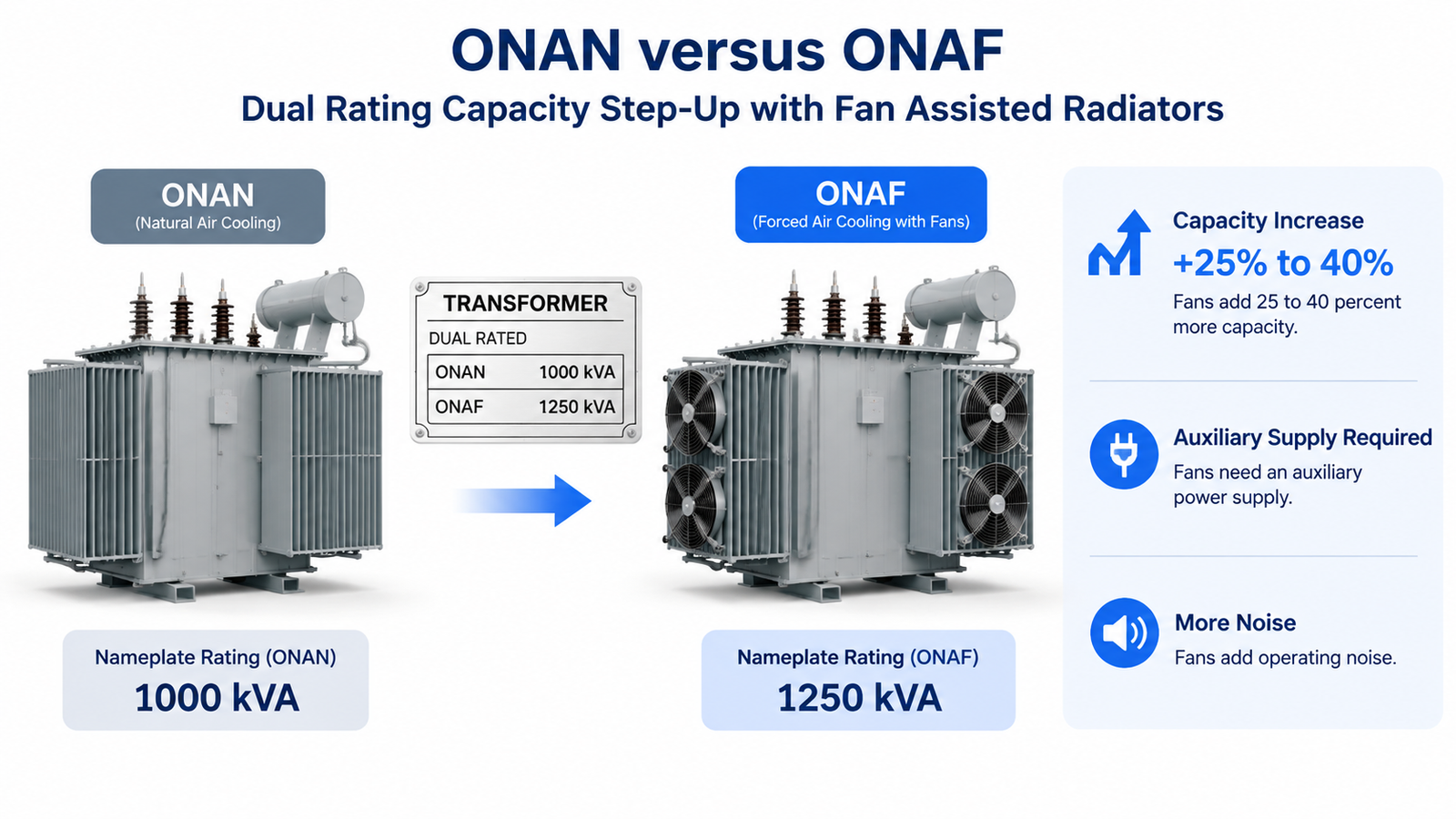
That is why a nameplate can read 1,600/2,000 kVA. The winding is one design; the second figure exists only because fans run. Lose the fans — a tripped auxiliary breaker, a failed controller, a fan motor bearing — and the permitted loading silently drops by a quarter. If nobody has written down that relationship, nothing trips and nothing alarms; the insulation simply ages faster until it fails years earlier than expected.
How to Read the Four-Letter Code
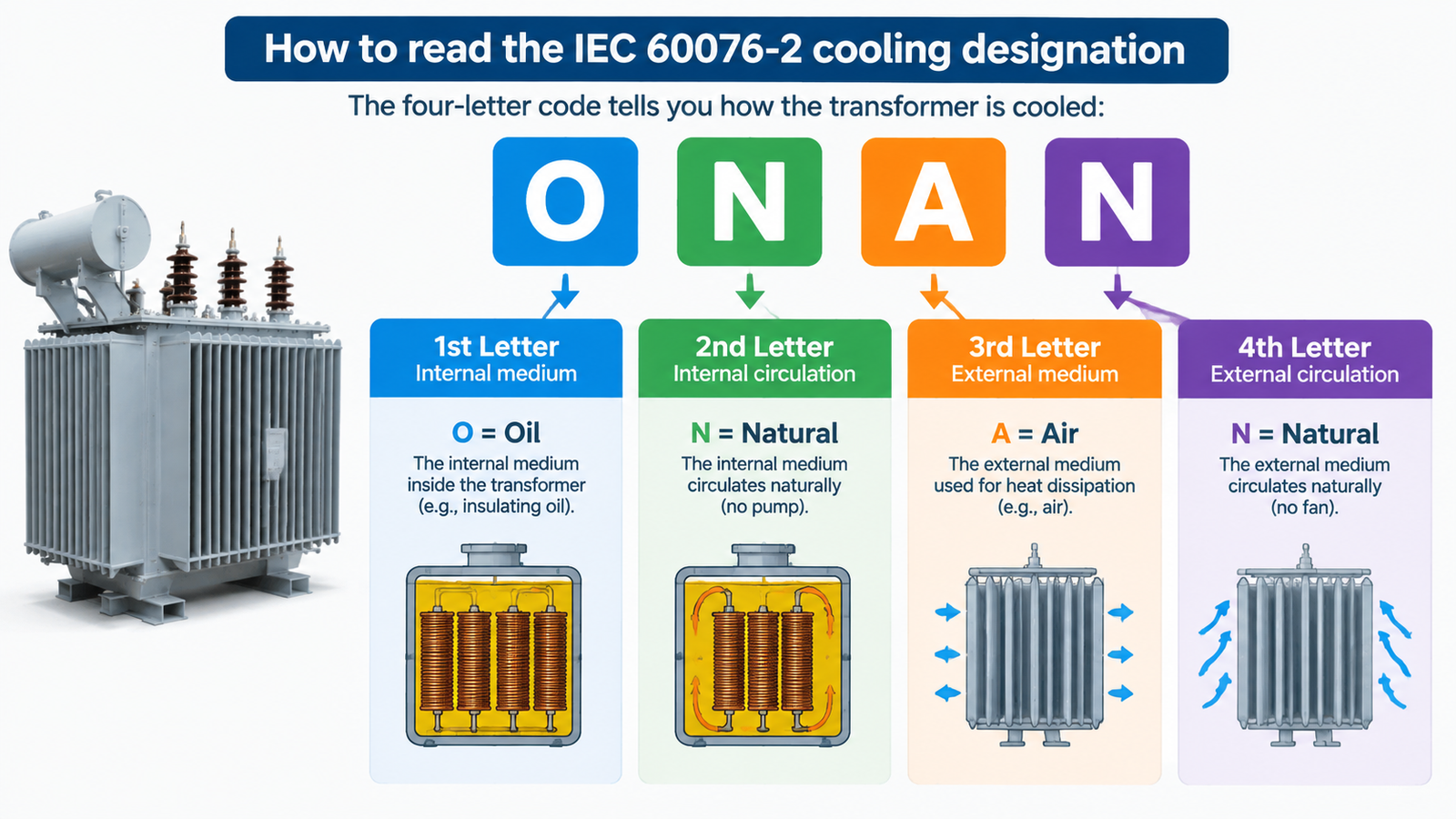
For liquid-immersed transformers, IEC 60076-2 identifies the cooling method with four letters in a fixed order: internal cooling medium, internal circulation, external cooling medium, external circulation.
Position
Meaning
Letters you will see
1st
Internal cooling medium
O mineral oil or synthetic liquid with fire point ≤300 °C · K liquid with fire point >300 °C (natural or synthetic ester) · L liquid with no measurable fire point (silicone)
2nd
Internal circulation
N natural thermosiphon · F forced by pump · D forced and directed into the windings
3rd
External cooling medium
A air · W water
4th
External circulation
N natural convection · F forced (fans or water pump)
Read left to right and the code becomes a sentence. ONAN is oil natural, air natural: no pump, no fan, nothing to power. ODAF is oil directed, air forced: a pump pushes oil through ducts straight onto the winding hotspots while fans blow air across the radiators.
The Liquid-Immersed Classes in Practice
Class
Auxiliaries
Where it is used
Practical notes
ONAN
None
Distribution transformers up to a few MVA; the default for pole-mounted and pad-mounted units
Silent, nothing to fail, lowest maintenance. The base rating for every other class
ONAF
Radiator fans
Dual-rated distribution and medium power units, typically 1,000–30,000 kVA
Adds 15–25% on oil units depending on size; fans are temperature-controlled and add noise
OFAF
Oil pump + fans
Large power transformers where natural oil flow can no longer reach the winding
Pump flow substantially raises the oil-side heat transfer coefficient
ODAF
Directed pump + fans
Large and extra-high-voltage power transformers
Oil is guided into winding cooling ducts; the most efficient air-cooled arrangement per kilogram of active part
OFWF / ODWF
Pump + water heat exchanger
Hydro, large industrial and where a cooling water circuit already exists
Compact and quiet, but oil pressure must always be kept above water pressure to prevent ingress
KNAN / KNAF
None / fans
Ester-filled units indoors, in tunnels, near water or in fire-sensitive buildings
Ester fire point is typically above 300 °C, so the fire load is materially lower than mineral oil
For most distribution projects the real choice is between ONAN and dual-rated ONAN/ONAF. OFAF and above belong to power transformers where natural circulation physically cannot move enough heat.
Dry-Type Classes: AN, AF and the Enclosure They Sit In
Dry-type transformers use a two-letter code because there is no internal liquid: AN (air natural) and AF (air forced). Some manufacturers also declare the enclosure class alongside — for example AN/AF in an IP20 ventilated casing, or an encapsulated unit rated for outdoor service.
Two things differ importantly from the oil side:
The capacity step is larger. Adding fans to a dry-type unit commonly delivers about 33% more rating (the increment is standardised in the substation-type range from 225 kVA upward), compared with 15–25% on oil-immersed units. Fans matter more because air is a poorer heat-transfer medium than oil.
The enclosure is part of the cooling system. A dry-type transformer in a sealed IP54 casing cannot dissipate heat the way the same unit does in an open IP20 casing, and the rating must be declared for the actual enclosure. This is the single most common dry-type specification error: a unit quoted as AN at nameplate rating, installed in a weatherproof box, running at 90% load in a hot room.
How the enclosure and protection level are declared, and what the options mean in practice, is covered in the enclosure and IP rating guide.
What a Dual Rating Actually Buys You
A dual-rated unit is written as two figures, for example 1,600/2,000 kVA ONAN/ONAF. The first is the rating with no auxiliaries running; the second applies while the fans are energised.
The economics are attractive: the core and windings for 2,000 kVA already exist in a 1,600 kVA ONAN design, so the incremental cost is fans, a controller and a fan-ready tank. You are buying future headroom at a fraction of the cost of a larger unit — and in many designs the fans can be retrofitted later if the tank was prepared for them.
The catch is that the second rating depends on equipment that can fail. Three specification points prevent that from becoming an operating risk:
Wire the fan supply to a circuit that is monitored, not a convenience socket.
Set protection so that loss of fans reduces the permitted load — typically by annunciating and, where the load cannot be shed, by tripping on winding temperature rather than waiting for the oil to boil.
Decide in advance whether the site can tolerate fan noise at night. In urban substations this is often the constraint that rules ONAF out entirely.
Temperature Rise Limits That Go With Each Class
A cooling class is meaningless without the temperature rise it is declared against. Two units with the same kVA and the same cooling code can carry different ratings if one is built to a 55 K rise and the other to 60 K.
Type
Parameter
Typical limit
Oil-immersed, class A insulation
Top-oil rise over ambient
60 K (55 K is a common cooler-running option)
Oil-immersed, class A insulation
Average winding rise
65 K
Dry-type, class 105 (A)
Average winding rise
60 K
Dry-type, class 120 (E)
Average winding rise
75 K
Dry-type, class 130 (B)
Average winding rise
80 K
Dry-type, class 155 (F)
Average winding rise
100 K
Dry-type, class 180 (H)
Average winding rise
125 K
The rise limit and the insulation class are two halves of one thermal design, which is why they are best specified together. The relationship between class, rise and expected life is set out in the insulation class and temperature rise guide; a lower rise on the same insulation class means a longer life at the cost of more material.
Ambient, Altitude and the Room Around the Unit
Ratings assume a maximum ambient of 40 °C, a daily average of 30 °C and a yearly average of 20 °C, at altitudes up to 1,000 m. Every one of those assumptions is a lever on the delivered rating.
Condition
Effect on the rating
What to do
Ambient above 40 °C
Rating must be reduced; a 50 °C room costs roughly 8–12% of nameplate kVA
Derate in the specification, or ventilate the room to bring the ambient down
Altitude above 1,000 m
Air density falls, so air cooling and external insulation both weaken
Apply the altitude correction factor from IEC 60076-1 and state the site altitude
Enclosed room with no free ventilation area
Hot exhaust air recirculates and the effective ambient climbs well above the room thermostat reading
Size louvres for the total loss in kW, and keep outlet and inlet separated
Radiators close to a wall
Restricted airflow cuts the effective cooling and invalidates the class
The room is not a site detail to be sorted out later. A cooling class is a promise about heat transfer, and it only holds if the installation lets the heat leave the building.
Noise, Auxiliary Power and Maintenance
Fans and pumps change three operating characteristics, and all three appear in the tender evaluation whether or not they are priced:
Noise. Fan operation raises the sound level by a few dB(A) at the measurement surface — modest in absolute terms, but perceptible where a substation sits against a residential boundary. ONAN units have no cooling-equipment noise at all.
Auxiliary power and control. Fans need a supply, a thermostat or winding-temperature controller, and usually alarm contacts into the building management system. That is extra cabling, extra commissioning and an extra failure mode.
Maintenance. Fan motors, bearings and contactors need periodic inspection; pumps need oil flow and pressure checks. ONAN needs neither, which is why it remains the default wherever the load allows.
Hydro and large industrial projects justify the complexity because the alternative is a physically larger transformer. A 1,600 kVA commercial substation rarely does.
Choosing a Cooling Class: A Decision Sequence
Start with ONAN. If the required continuous load fits an ONAN rating in the available footprint, stop there.
Check whether the peak is short and occasional. If it is, dual-rated ONAN/ONAF gives headroom without buying a bigger core — and confirm the overload duration against the thermal guide rather than assuming indefinite fan operation.
Confirm the room can carry the losses. Calculate total losses at the operating point and check the ventilation opening area. If the room cannot, no cooling class will fix it.
Check the noise limit. Compare the declared sound level in ONAF against the site boundary requirement before the design is frozen.
Only then consider OFAF or above. These belong to power transformers and large industrial units where natural circulation is physically insufficient.
If the transformer rating itself is still open, settle that first — the cooling class is a modifier on a rating, not a substitute for the load calculation. The kVA sizing method covers the five steps that produce the number.
What to Write in the Specification
A cooling specification that cannot be misread contains five items:
Item
Example wording
Cooling class and rating
1,600 kVA ONAN / 2,000 kVA ONAF, IEC 60076-2
Temperature rise
60 K top oil, 65 K average winding (or 55 K if a cooler-running design is required)
Reference conditions
40 °C maximum ambient, altitude 1,200 m, indoor ventilated substation
Auxiliary supply
Fans 400 V three-phase from a monitored circuit, controller with alarm contacts
Sound level
Declared dB(A) at 1 m in ONAN and in ONAF, measured to IEC 60076-10
Add the enclosure or protection level for dry-type units, and state whether the site is indoor or outdoor. For oil-immersed units, the liquid itself is worth naming: mineral oil versus ester changes the first letter of the code and the fire risk assessment, and the cost difference is real. The oil-immersed transformer overview covers what that choice changes in cost and installation.
Conclusion
The four letters are a contract about heat. ONAN means the unit delivers its rating with nothing running; ONAF means a quarter more capacity exists only while the fans do. Specify the class, the temperature rise, the reference ambient and the auxiliary supply together, and the quotation will match the duty. Specify a kVA rating alone and you are leaving the most consequential variable to the supplier’s default.
If you have a load profile and a room, the engineering team can confirm which cooling class actually delivers the required continuous rating in that space — including the case where dual rating is unnecessary and the simpler ONAN unit is the better buy.
Frequently Asked Questions
What does ONAN mean on a transformer nameplate?
ONAN stands for Oil Natural, Air Natural: the insulating oil circulates by natural convection and the radiators dissipate heat to ambient air without fans. It is the base rating of most distribution transformers, requires no auxiliary power and has no cooling equipment to maintain.
How much extra capacity does ONAF add?
On oil-immersed distribution and medium power transformers, fans typically add 15–25% to the ONAN rating depending on size and radiator design; larger units sit toward the higher end. On dry-type transformers the equivalent AN to AF step is larger, commonly around 33%. Always use the manufacturer’s declared figures rather than a rule of thumb, because the increment depends on the specific radiator and fan arrangement.
Can a transformer run continuously at its ONAF rating with the fans off?
No. The ONAF figure is valid only while the fans are running. With fans stopped, the unit reverts to its ONAN rating, and operating above it accelerates insulation ageing without necessarily tripping anything. Protection should reduce the permitted load, or alarm, when fan operation is lost.
Is AN or AF better for a dry-type transformer?
AN is simpler, quieter and has no auxiliary supply to maintain, so it is preferred wherever the rating fits. AF is worth specifying when the load peaks for limited periods and the additional capacity defers a larger unit, or where a compact footprint matters more than fan maintenance. In both cases the declared rating must correspond to the actual enclosure, because a sealed casing reduces heat rejection.
Does altitude affect the cooling class?
Yes. Above 1,000 m the lower air density reduces both the cooling capability and the external insulation strength, so the unit must be derated or the design adjusted. State the site altitude in the enquiry; a manufacturer quoting to nameplate at sea level is quoting a rating the site cannot use.
How percentage impedance sets the fault level, the voltage drop and the parallel operating rules, with worked fault-current and regulation calculations.
Transformer ODM and OEM programs explained: the custom engineering workflow from RFQ to FAT, the 15-field spec sheet, tooling and IP ownership, MOQ and lead-time terms.