


Description
VSG 12kV at a Glance
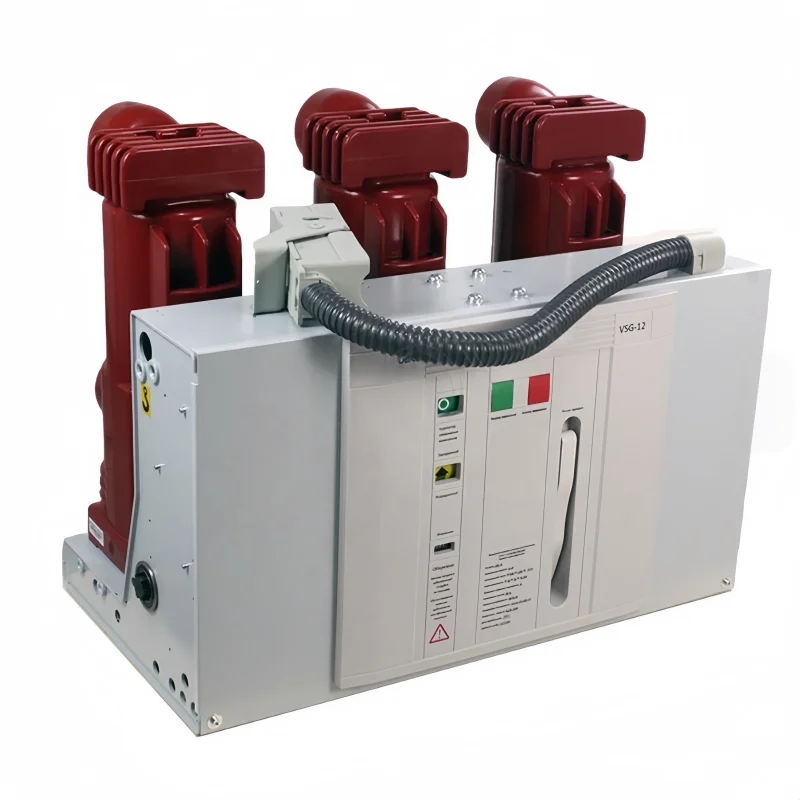
The VSG 12kV indoor vacuum circuit breaker is a three-phase unit for 12 kV metal-clad switchgear, available for fixed or withdrawable installation. On the VSG 12kV indoor vacuum circuit breaker, the distinguishing feature is the operating mechanism: an integrated modular spring unit rather than a mechanism assembled from separately serviceable parts.
That integration changes how the breaker is maintained. Where a conventional frame allows individual springs, cams and latches to be replaced in place, an integrated unit is exchanged as a module. For a panel builder standardising on one mechanism, it simplifies spares; for a maintenance team used to strip-and-rebuild, it changes the procedure.
Reading the VSG Designation
| Element | Meaning | What it decides |
|---|---|---|
| V | Vacuum interrupter | Sealed arc-quenching chamber |
| S | Design series | Frame family |
| G | Design variant | Distinguishes it from the VS1 and VBI frames |
| 12 | Voltage class in kV | 12 kV metal-clad switchgear |
Three 12 kV frames are in production — VS1, VBI and VSG — and they differ in mechanism design and in what they are rated to switch, not in voltage class. Choosing between them is a question of duty and maintenance strategy, covered below.
Published Configuration
| Parameter | Published value |
|---|---|
| Rated voltage | 12 kV |
| Rated frequency | 50 Hz |
| Installation form | Fixed or withdrawable |
| Operating mechanism | Integrated modular spring mechanism |
| Primary circuit | Sealed pole, optional |
| Functions | Switching and protection of normal load and fault current |
Rated current and short-circuit breaking current are not stated as a fixed table for this frame, so they are confirmed against the selected configuration rather than read off a generic list. Send the continuous current and the fault level at the installation point, and the pair is quoted against the frame.
Integrated Mechanism vs Modular Mechanism
The word “modular” appears in both the VSG 12kV indoor vacuum circuit breaker and the VS1, so the difference is worth being precise about.
- Integrated. The spring unit, the cam train and the latch are assembled as one sealed cartridge inside the mechanism housing. Servicing means exchanging the cartridge; individual spring or latch replacement is not intended in the field.
- Modular, separately serviceable. The mechanism is built from modules that can be removed and replaced individually, which allows a partial repair rather than a full exchange.
Which is better depends on the site. Where spares are held centrally and downtime is measured in hours, a cartridge exchange is faster and needs less skill. Where a workshop can rebuild a mechanism and spares logistics are slow, individually serviceable parts keep a unit in service that would otherwise be waiting for a cartridge.
State the maintenance strategy with the inquiry if it matters to the project, because it may point to a different frame in the same 12 kV range.
Sealed Pole Option
The primary circuit can be supplied as a sealed pole, where the vacuum interrupter is enclosed in a solidly insulated housing rather than mounted in open air inside the cubicle. The sealed arrangement removes the need to maintain insulation clearance around the interrupter and reduces the effect of dust and humidity inside the panel.
It changes the pole geometry, so it is specified at order. A unit built with an open pole arrangement cannot be converted to sealed afterwards.
Fixed or Withdrawable
Both arrangements are published. On a fixed installation the breaker is bolted into the cubicle with the primary connections made directly; on a withdrawable arrangement it sits on a chassis with isolating contacts and can be racked to a test position with the busbar live.
The withdrawable version adds the racking mechanism, the position indicator and part of the interlock chain to the panel. For a board where a breaker change has to happen without an outage, it pays for itself the first time it is used.
What This Frame Is For
The published duty is switching and protection of normal load current and fault current in 12 kV systems: incomer, outgoing feeder, busbar section and motor switching in plant and utility boards.
It is not published as a capacitor-switching device. For banks and back-to-back capacitor duty, the VBI 12 kV breaker carries the relevant ratings, and using a general-purpose frame on capacitor duty is how restrikes happen.
VSG in Switchgear Panels and Ring Main Applications
VSG is the 12 kV frame that goes into a switchgear panel where space and mechanism simplicity matter more than a racking truck. The integrated spring mechanism is built onto the frame rather than supplied as a separate modular unit, which shortens the panel depth and removes the coupling between mechanism and pole that has to be aligned on assembly.
In practice that suits ring main and secondary distribution panels: an indoor vacuum circuit breaker protecting a transformer bay or an outgoing feeder in a compact board, where the breaker is fixed and the panel is built around it. Where the same panel design has to accept a withdrawable truck for a main incoming bay, VS1 ZN63A is the frame for that bay, and mixing the two in one board is normal.
The panel builder’s own scope covers the enclosure, busbar, earthing and interlocking to the door. Our scope covers the breaker, its mechanism, the auxiliary contacts and the sealed pole option. State the panel type at enquiry, because the mounting footprint and the interlock interface differ between a VSG board and a VS1 board even though both are 12 kV indoor frames.
Service Conditions
Indoor installation at altitudes up to 1,000 m unless otherwise specified, ambient from -10 °C to +40 °C, daily average relative humidity up to 95 percent with a monthly average of 90 percent, and a maximum earthquake intensity of 8.
The saturated vapour pressure figures published for this frame — 2.2 kPa daily average and 1.8 kPa monthly average — describe a switchroom without dehumidification. Where condensation forms on the insulation the failure mode is surface tracking, and space heaters are the usual remedy rather than a different breaker.
When Another 12kV Frame Fits Better
- Higher current and breaking range. The VS1 ZN63A 12 kV breaker publishes 630 A to 4,000 A and 20 kA to 50 kA, with the operating sequence and interlock chain documented.
- Capacitor bank switching. The VBI 12 kV breaker is rated for single and back-to-back capacitor banks.
- 24 kV systems. The ZN63 VS1 24 kV breaker covers the higher class with a -25 °C ambient rating.
All frames sit under the vacuum circuit breaker category.
Standards and Tests
Routine tests cover power-frequency withstand, main-circuit resistance, contact travel and a mechanical operation sequence. Type test reports covering temperature rise, short-circuit making and breaking, and mechanical life are available for project documentation.
Because current and breaking ratings are confirmed per configuration, the type test report should be requested for the specific pair quoted rather than for the frame in general.
Manufacturer Supply, OEM and Wholesale
The VSG 12kV indoor vacuum circuit breaker is supplied direct. Panel builders order against a frozen current, breaking and mechanism configuration under OEM or private-label marking; distributors hold a standing specification for repeat supply; project buyers receive drawings and test reports for consultant approval.
Price, MOQ and Lead Time
- MOQ. Single units. Custom mechanism configuration and private-label marking carry a higher minimum.
- Price drivers. Current and breaking rating, fixed or withdrawable, sealed pole option, auxiliary contacts and quantity.
- Lead time. Confirmed against the production schedule at order.
- Payment. Deposit with balance against the bill of lading copy; letter of credit for project quantities.
What to Send With Your Inquiry
- System voltage and cubicle insulation class
- Continuous current required
- Fault level at the installation point
- Fixed or withdrawable arrangement
- Sealed pole required or not
- Maintenance strategy: cartridge exchange or component repair
- Auxiliary contacts and control voltage
- Quantity, destination port and required delivery date
Send those through the quote form on this page. Current and breaking are quoted as a pair against the frame, and the maintenance strategy may point to a different 12 kV model.
FAQ
What does integrated modular mechanism mean?
How does that differ from the VS1?
Are current and breaking ratings fixed?
Is it suitable for capacitor banks?
Can the sealed pole be added later?
What is the MOQ?
Request Quote
Tell us your specifications, quantity, or application scenario and we will reply with a tailored quote.