
If you are designing or maintaining a medium-voltage switchgear system, you have almost certainly come across both vacuum contactors and vacuum circuit breakers. On the surface, both devices interrupt current inside a vacuum bottle. Both handle medium-voltage AC circuits. Both are built to IEC standards. But using a vacuum contactor where a breaker is needed—or the other way around—can lead to equipment damage, arc flash hazards, and unnecessary cost.
The core difference is simple: a vacuum contactor is designed for frequent switching of normal load currents, while a vacuum circuit breaker is designed to interrupt both normal and fault currents under short-circuit conditions. Everything else—construction, ratings, endurance, cost, and application—flows from this fundamental distinction. This article breaks down all seven key differences and helps you choose the right device for your project.
What Is a Vacuum Contactor?
A vacuum contactor is an electrically operated switching device that uses a vacuum interrupter to make and break AC circuits under normal load conditions. It is designed primarily for high-frequency switching operations—tens of thousands or even hundreds of thousands of operations over its service life.
Vacuum contactors are typically rated for voltages from 1.14 kV up to 12 kV, with current ratings commonly ranging from 160 A to 800 A. Kampa Electric offers models such as the JCZ5 7.2 kV AC vacuum contactor, the CKG3 12 kV AC vacuum contactor, and the CKJ20 2 kV AC vacuum contactor, covering a broad range of industrial and utility applications.
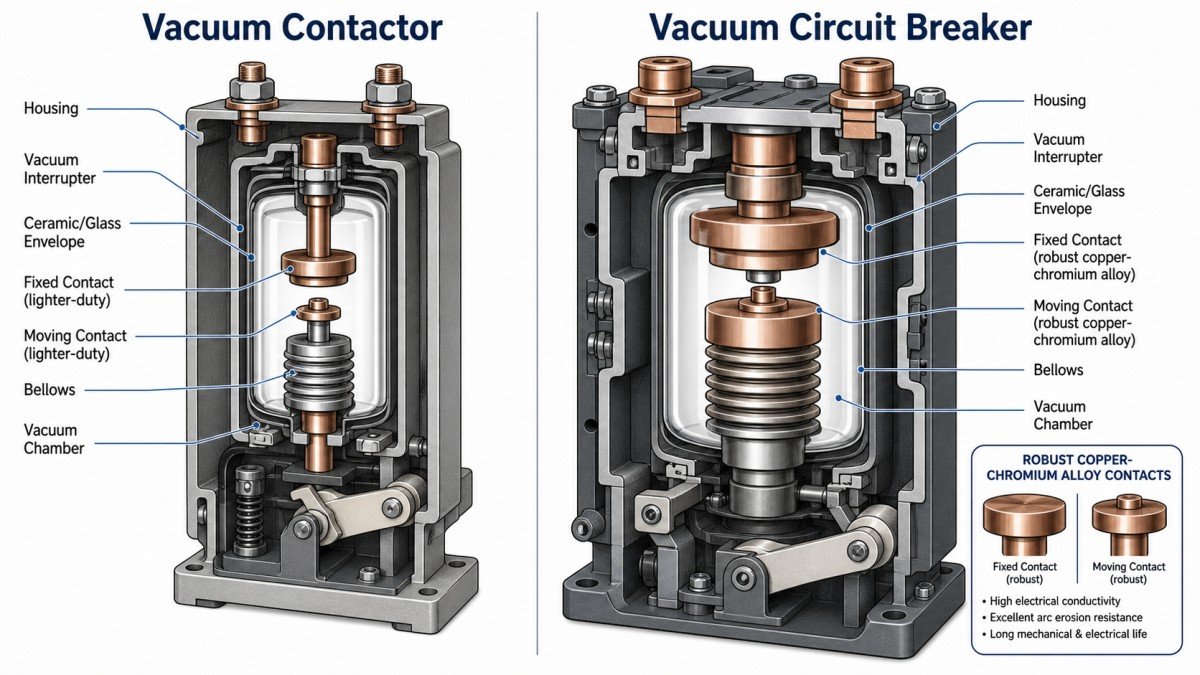
Inside the contactor housing, the vacuum interrupter contains a fixed contact and a moving contact sealed in a ceramic or glass envelope. When the operating coil is energized, an electromagnetic mechanism closes the contacts. When it is de-energized, a spring mechanism opens them. The vacuum environment extinguishes the arc almost instantly as the contacts separate, because there is almost no ionizable gas to sustain it.
Because contactors are optimized for mechanical endurance rather than fault interruption, they feature relatively light contact structures, simple arc extinguishing elements, and fast operating mechanisms. This makes them smaller, lighter, and more cost-effective than circuit breakers of equivalent voltage rating.
What Is a Vacuum Circuit Breaker?
A vacuum circuit breaker (VCB) is a protective switching device that uses a vacuum interrupter to make, carry, and break currents under both normal and abnormal circuit conditions—including short-circuit faults. It is designed primarily for protection, and its operating mechanism, contact structure, and trip system are built around that purpose.
Vacuum circuit breakers are available across a wide voltage range from 3.6 kV to 40.5 kV, with breaking capacities from 12.5 kA up to 40 kA or more depending on the model. Kampa Electric manufactures a complete line including the VS1 ZN63A indoor handcart VCB, the ZW32 40.5 kV outdoor VCB, and several other models for indoor and outdoor installations.
The vacuum interrupter in a circuit breaker uses a similar principle to the contactor—contacts sealed in vacuum—but the contacts themselves are much more robust. They are typically made from copper-chromium (CuCr) alloy and designed with special geometries that generate a magnetic field during arcing, forcing the arc to rotate and distribute thermal energy evenly. This prevents localized overheating and allows the breaker to interrupt high-magnitude fault currents safely.
A VCB also integrates a protection relay, current transformers, and a trip coil that work together to detect overcurrent, short-circuit, or earth-fault conditions and command the breaker to open. This protection chain is what fundamentally separates a circuit breaker from a contactor.
7 Key Differences Between a Vacuum Contactor and a Breaker
The table below summarizes the primary technical differences. Each point is explained in detail afterward.
| Feature | Vacuum Contactor | Vacuum Circuit Breaker |
|---|---|---|
| Primary Function | Frequent load switching | Load switching plus fault interruption |
| Breaking Capacity | Up to ~8 kA (load current only) | 12.5 kA to 40 kA (fault current) |
| Mechanical Endurance | 100,000 to 1,000,000 operations | 10,000 to 30,000 operations |
| Electrical Endurance | High at rated current | Moderate; rated for a limited number of fault interruptions |
| Protection Relay | Not built-in; requires external fuses | Integrated with protection relay and CTs |
| Operating Mechanism | Electromagnetic (latch or continuous duty) | Spring-charged or motor-operated, with trip coil |
| Typical Cost | Lower | 3 to 5 times higher |
1. Primary Function: Switching vs. Protection
A vacuum contactor is engineered to switch loads on and off frequently. Think of a motor starter panel in a pumping station: the contactor connects and disconnects the motor every time the pump cycles on and off, which may happen dozens or hundreds of times per day.
A vacuum circuit breaker is engineered to protect the circuit from damage. It stays closed for long periods carrying load current, and opens only when a fault is detected—perhaps once every few years. But when it does open, it must clear thousands of amperes at the point of the fault cycle. This is why the VCB is much heavier, more expensive, and subjected to completely different type-testing requirements under IEC 62271-100.
2. Breaking Capacity
This is the most important technical differentiator. A vacuum contactor typically has a rated short-circuit making capacity, but it does not have a rated short-circuit breaking capacity in the same sense as a breaker. Instead, contactors rely on series-connected HRC fuses to clear short circuits. The contactor opens the circuit under overload conditions up to its rated breaking current, and the fuse clears anything above that.
A vacuum circuit breaker, by contrast, is type-tested to interrupt its full rated short-circuit breaking current multiple times. For example, a VCB rated at 25 kA has been verified to break a 25 kA fault at the rated voltage. This proven fault-clearing capability is non-negotiable for transformer feeders, incoming switchgear incomers, and bus-tie circuits where a fuse alone is insufficient.
3. Mechanical and Electrical Endurance
Vacuum contactors are built for mechanical endurance classes that far exceed circuit breaker ratings. A typical JCZ5 or CKG3 vacuum contactor is rated for 250,000 to 500,000 mechanical operations and 50,000 to 250,000 electrical operations at rated current. This makes them ideal for processes with frequent starts and stops, such as conveyor systems, crushers, compressors, and capacitor banks.
Circuit breakers have a much lower mechanical endurance rating—typically 10,000 to 30,000 mechanical operations—because their design prioritizes fault-interruption robustness over switching frequency. Putting a VCB into a frequent-switching duty cycle will cause premature contact wear, mechanism fatigue, and ultimately failure.
4. Protection System Integration
When you buy a vacuum circuit breaker, you are effectively buying a complete protection and switching package. It includes or is supplied alongside a protection relay, current transformers (CTs), and tripping circuit. The relay monitors current in real time and issues a trip command within milliseconds when it detects a fault.
A vacuum contactor, in contrast, does not include a protection relay. It depends on external fuses and overload relays for short-circuit and overload protection. In a typical motor control centre (MCC) or capacitor bank panel, the contactor handles the switching duty while fuses handle fault interruption and an overload relay protects against thermal damage. This separation of switching and protection functions is a defining characteristic of contactor-based circuits.
5. Operating Mechanism
Vacuum contactors use an electromagnetic latch mechanism. When the closing coil is energized, it pulls the armature and closes the main contacts. In electrically held designs, the coil must remain energized to keep the contacts closed. In mechanically latched designs, a latch holds the contacts closed after the closing coil is de-energized, and a separate opening coil releases the latch.
Vacuum circuit breakers use a stored-energy mechanism, typically a spring-charged system. A motor charges a closing spring, which stores mechanical energy. When the close command is issued—manually or remotely—the spring releases, closing the contacts with the speed and force required to withstand the electromagnetic forces of a fault. An opening spring is charged during the closing stroke, ready to separate the contacts when a trip signal arrives.
6. Physical Size and Footprint
For the same voltage rating, a vacuum contactor is typically smaller, lighter, and more compact than a vacuum circuit breaker. A 12 kV vacuum contactor may be the size of a shoebox, while a 12 kV VCB on a handcart chassis can weigh several hundred kilograms and occupy a full switchgear panel.
This size difference matters when designing compact switchgear, containerized substations, or retrofit installations where space is limited. However, the smaller size of the contactor comes at the cost of lower breaking capacity and no integrated protection—factors that must be weighed carefully.
7. Cost
Vacuum contactors are significantly less expensive than vacuum circuit breakers, often by a factor of 3 to 5 for the same voltage class. This makes them attractive for applications where fault protection can be provided by fuses. However, the total installed cost must include the fuses, overload relay, contactor, and mounting hardware. Even with all these accessories, a contactor-based solution is usually more cost-effective than a VCB for switching-only applications.
When to Use a Vacuum Contactor
Choose a vacuum contactor when your primary requirement is frequent load switching and short-circuit protection can be provided by fuses. Common applications include:
- Motor control centres (MCCs) — starting, stopping, and reversing medium-voltage motors in pumping stations, compressors, crushers, mills, and conveyor drives
- Capacitor bank switching — connecting and disconnecting power-factor-correction capacitors, where inrush currents are managed by detuning reactors and fault clearing is handled by fuses
- Transformer switching — energizing and de-energizing transformers up to about 2,000 kVA, where inrush is within the contactor’s making capacity and faults are cleared by transformer primary fuses
- Heater and furnace control — cycling resistive heating elements in industrial processes
- Lighting and auxiliary circuits — switching non-critical loads where protection requirements are modest
In all of these applications, the contactor is always paired with suitable HRC fuses or a circuit breaker upstream. The contactor handles the operational duty; the fuses or upstream breaker handle the protection duty. For an overview of available contactor options, see the Kampa vacuum contactor series.
When to Use a Vacuum Circuit Breaker
Choose a vacuum circuit breaker when your primary requirement is fault protection or when the application requires breaking high short-circuit currents. Typical applications include:
- Incoming feeders — the main incoming switchgear panel connecting to the utility supply, where fault levels are highest
- Transformer feeders — protecting transformers by interrupting both inrush and fault currents without depending on fuses alone
- Bus-tie and bus-section circuits — connecting or isolating two busbar sections under load and fault conditions
- Generator circuit breakers — protecting generators against internal and external faults
- Distribution feeders — outgoing circuits in substations where selectivity and coordinated protection are required
- Any circuit where fault current exceeds ~8 kA — contactors with fuses are typically limited to fault clearing below 8–10 kA; above that, a VCB is mandatory
VCBs are also preferred where selectivity and coordination with other protective devices is critical. The precise time-current curves of a protection relay allow an engineer to tune trip settings so that only the closest upstream breaker trips for a downstream fault, keeping the rest of the system energized. Fuse-based protection cannot offer this level of coordination. Browse the Kampa vacuum circuit breaker range for specifications and model options.
Contactor-Fuse Combinations: A Practical Middle Ground
In many industrial MV switchgear panels, engineers combine a vacuum contactor with HRC fuses to get the best of both devices. The contactor provides the high switching endurance; the fuses provide the high breaking capacity. This arrangement, defined in IEC 62271-106, is known as a contactor-fuse combination starter.
The fuse and contactor must be properly coordinated. The fuse must clear any current above the contactor’s breaking capacity before the contactor attempts to open. If the coordination is wrong—if the contactor tries to break a current above its rating—it can fail destructively. The typical coordination point is set so that for currents up to the contactor’s maximum breaking current, the contactor opens under overload relay command; for higher currents, the fuse clears the fault and the contactor opens on loss of voltage or via a striker pin.
| Protection Element | Handles | Fails If Asked To Handle |
|---|---|---|
| Contactor | Load switching, overload interruption (up to ~8 × rated current) | Short-circuit current above its rated breaking capacity |
| HRC Fuse | Short-circuit interruption (up to 40–50 kA) | Repeated overload conditions; fuses are single-shot devices |
| Overload Relay | Thermal overload detection (1.05–10 × rated current) | Short-circuit current; it responds too slowly for fault protection |
When properly coordinated, contactor-fuse combinations are a cost-effective solution for motor starters, capacitor bank switching, and transformer feeders up to about 12 kV. The Kampa CKG3 12 kV vacuum contactor is frequently supplied into these exact configurations.
Common Mistakes When Choosing Between a Contactor and a Breaker
Even experienced engineers sometimes select the wrong device. Here are the most common mistakes and how to avoid them:
- Using a contactor on a circuit with high fault current and no fuse coordination. If the fault level at the contactor’s terminals exceeds its breaking capacity and proper fuse coordination is not in place, a fault can destroy the contactor and create an arc flash hazard. Always verify the prospective short-circuit current at the installation point.
- Using a VCB for frequent switching duty. Circuit breakers are not designed for daily on/off cycles. Using one to start and stop a motor hundreds of times per week will cause premature wear on the mechanism and contacts, leading to maintenance headaches and reduced reliability.
- Assuming a contactor provides short-circuit protection. A contactor alone cannot clear a short circuit. The circuit must include fuses or an upstream breaker for fault protection. This is the #1 misconception among engineers new to MV switchgear design.
- Ignoring mechanical endurance ratings in the specification. Not all contactors are equal. Some are rated for 100,000 operations; others for 1,000,000. Know your duty cycle before you specify.
- Oversizing a VCB for a simple switching application. Using a full circuit breaker panel for a capacitor bank that could be switched by a contactor-fuse combination wastes capital, panel space, and auxiliary power. Match the device to the actual duty.
Selection Flowchart: Contactor or Breaker?
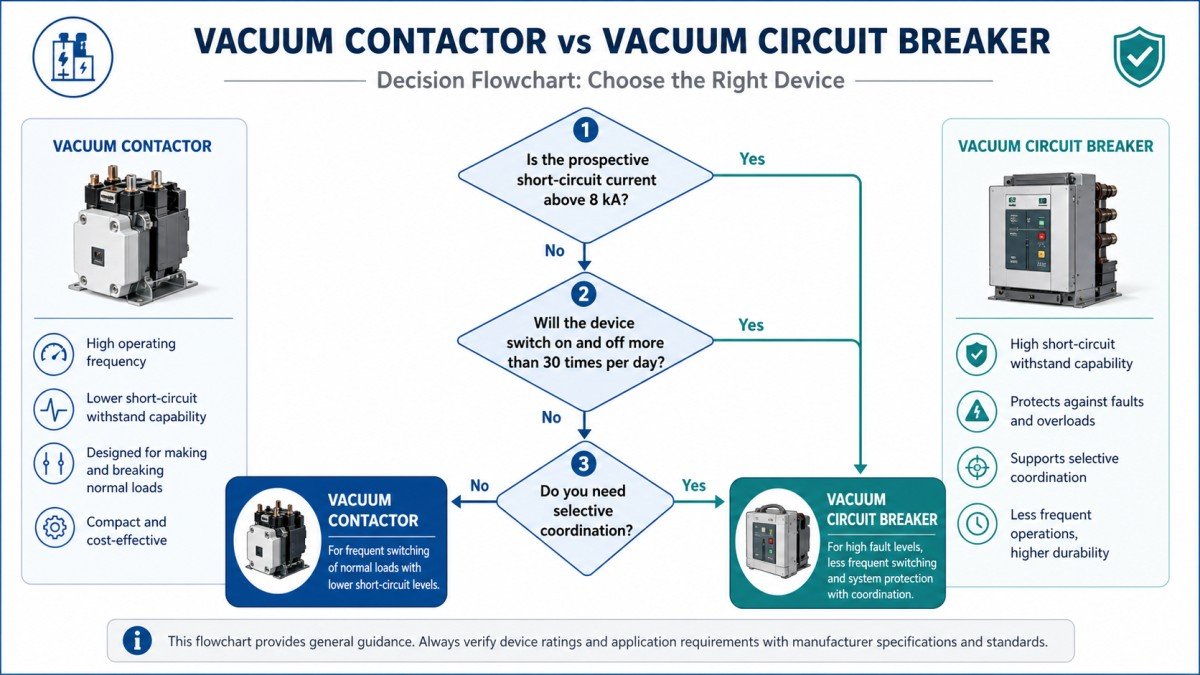
If you are evaluating a specific circuit, walk through these questions to decide which device you need:
- Is the prospective short-circuit current above 8 kA at the installation point? If yes, you need a vacuum circuit breaker or a properly coordinated contactor-fuse combination.
- Will the device switch on and off more than 30 times per day? If yes, a vacuum contactor is almost always the right choice for switching duty.
- Do you need selective coordination with other protective devices? If yes, a VCB with an adjustable protection relay is required. Fuses cannot provide time-graded coordination.
- Is the load a motor, capacitor bank, or frequently cycled process equipment? If yes, start with a contactor-based solution.
- Is the circuit an incoming feeder, transformer feeder, or bus-tie? If yes, a VCB is standard.
Vacuum Contactor vs. Breaker: Quick Reference
| Application | Recommended Device | Notes |
|---|---|---|
| Motor starter (frequent starts) | Vacuum Contactor + Fuse | Contactor handles switching; fuse handles faults |
| Capacitor bank switching | Vacuum Contactor + Fuse | Ensure contactor is rated for capacitive switching duty |
| Incoming switchgear feeder | Vacuum Circuit Breaker | Highest fault level; VCB mandatory |
| Transformer feeder (>2,000 kVA) | Vacuum Circuit Breaker | Fault current and inrush exceed contactor-fuse capability |
| Transformer feeder (≤2,000 kVA) | Contactor + Fuse | Cost-effective if properly coordinated |
| Bus-tie / bus-section | Vacuum Circuit Breaker | Must handle load transfer and bus faults |
| Pump / fan / compressor control | Vacuum Contactor + Fuse | High switching frequency suits contactor endurance |
| Generator protection | Vacuum Circuit Breaker | Requires fault-clearing and synchronizing capability |
How Kampa Electric Supports Your Equipment Selection
Choosing between a vacuum contactor and a vacuum circuit breaker is not always a one-or-the-other decision. Many projects use both: a VCB at the incomer for system protection, and contactor-fuse starters on outgoing feeders for motor and capacitor bank switching. Getting the mix right requires a clear understanding of your fault levels, load profiles, and operational requirements.
Kampa Electric manufactures both product lines in-house—vacuum contactors from 1.14 kV to 12 kV and vacuum circuit breakers from 3.6 kV to 40.5 kV—with full IEC compliance and customized OEM/ODM configurations. Our engineering team can review your single-line diagram, calculate fault levels, and recommend the right combination of contactors, breakers, and fuses for your specific project.
For larger applications, also review our switchgear and substation solutions and industrial power distribution protection pages, or contact us directly with your specifications.
FAQ
Can a vacuum contactor be used without a fuse?
Only if there is an upstream circuit breaker providing short-circuit protection, and only if the prospective fault current at the contactor does not exceed its rated short-time withstand current. In practice, most medium-voltage contactors are installed with series fuses because this is the most reliable and cost-effective protection method.
What happens if a vacuum contactor tries to interrupt a short circuit?
The contactor’s vacuum interrupter is not designed to extinguish an arc at fault-current magnitudes. Attempting to interrupt a short circuit above the rated breaking capacity can cause contact welding, vacuum bottle rupture, or arc flash. This is why fuses or an upstream breaker must clear faults before the contactor opens.
What is the typical life expectancy of a vacuum circuit breaker?
Under normal operating conditions—infrequent fault interruptions and regular preventive maintenance—a vacuum circuit breaker typically serves 20 to 30 years. The vacuum interrupter bottle is a sealed-for-life component and rarely needs replacement. However, the operating mechanism, auxiliary contacts, and trip circuit components require periodic inspection and servicing.
Are vacuum contactors maintenance-free?
No device is truly maintenance-free, but vacuum contactors come close. The vacuum bottle requires no servicing. The electromagnetic operating mechanism and auxiliary contacts should be inspected periodically based on the switching frequency. For contactors approaching their rated mechanical endurance limit, replacement is more cost-effective than overhaul.
Why are vacuum interrupters used in both contactors and breakers?
Vacuum is the ideal arc-quenching medium for medium-voltage applications because it provides excellent dielectric recovery, is environmentally safe (no SF6 or oil), requires minimal maintenance, and is suitable for frequent operations. The same vacuum interrupter technology is scaled differently—lighter for contactors, heavier for breakers—based on the required interrupting duty.
How does a vacuum contactor compare to an air-break contactor?
Vacuum contactors are preferred for medium-voltage applications (above 1 kV) because vacuum provides superior arc quenching and longer contact life compared with air at higher voltages. Air-break contactors are more common at low voltages (below 1 kV) where the arc voltage is lower and the cost advantage of air outweighs the performance benefit of vacuum.