Transformer Enclosure & IP Rating: Indoor, Outdoor & NEMA
Published: Author: Lisa
Two quotations for the same 1,000 kVA transformer can differ by 20% and the difference is often not in the core, the copper or the brand. It is in the box around it. The enclosure decides whether the unit survives its first humid season, whether the room needs fire separation, whether maintenance is possible without a shutdown, and — because a sealed box traps heat — how much of the nameplate rating you can actually use.
This guide explains how to read an IP code, where IP and NEMA diverge (and why they are not interchangeable), what “encapsulated” really means at winding level, and how to specify an encapsulated dry type transformer whose declared rating matches the environment it will live in.
Why the Enclosure Is Part of the Electrical Specification
A transformer’s rating is a thermal statement: this much current, at this temperature rise, in this cooling environment. The enclosure is part of that environment. Put a unit designed for open indoor air into a sealed weatherproof box and the heat it generates has nowhere to go — the rating falls, the winding runs hotter, and the insulation ages faster. Nothing on the nameplate changes, which is exactly what makes the mistake expensive.
Three properties are being specified at once, and they are often confused:
Ingress protection — resistance to solids and water, expressed as an IP code.
Mechanical construction — material, corrosion resistance, impact strength, icing, door hardware, cable entry.
Thermal behaviour — how much heat the enclosure lets out, which sets the usable rating.
An IP code describes only the first. It says nothing about whether the enclosure will rust through in a coastal plant or whether the rating plate is still valid at 90% load.
Reading an IP Code
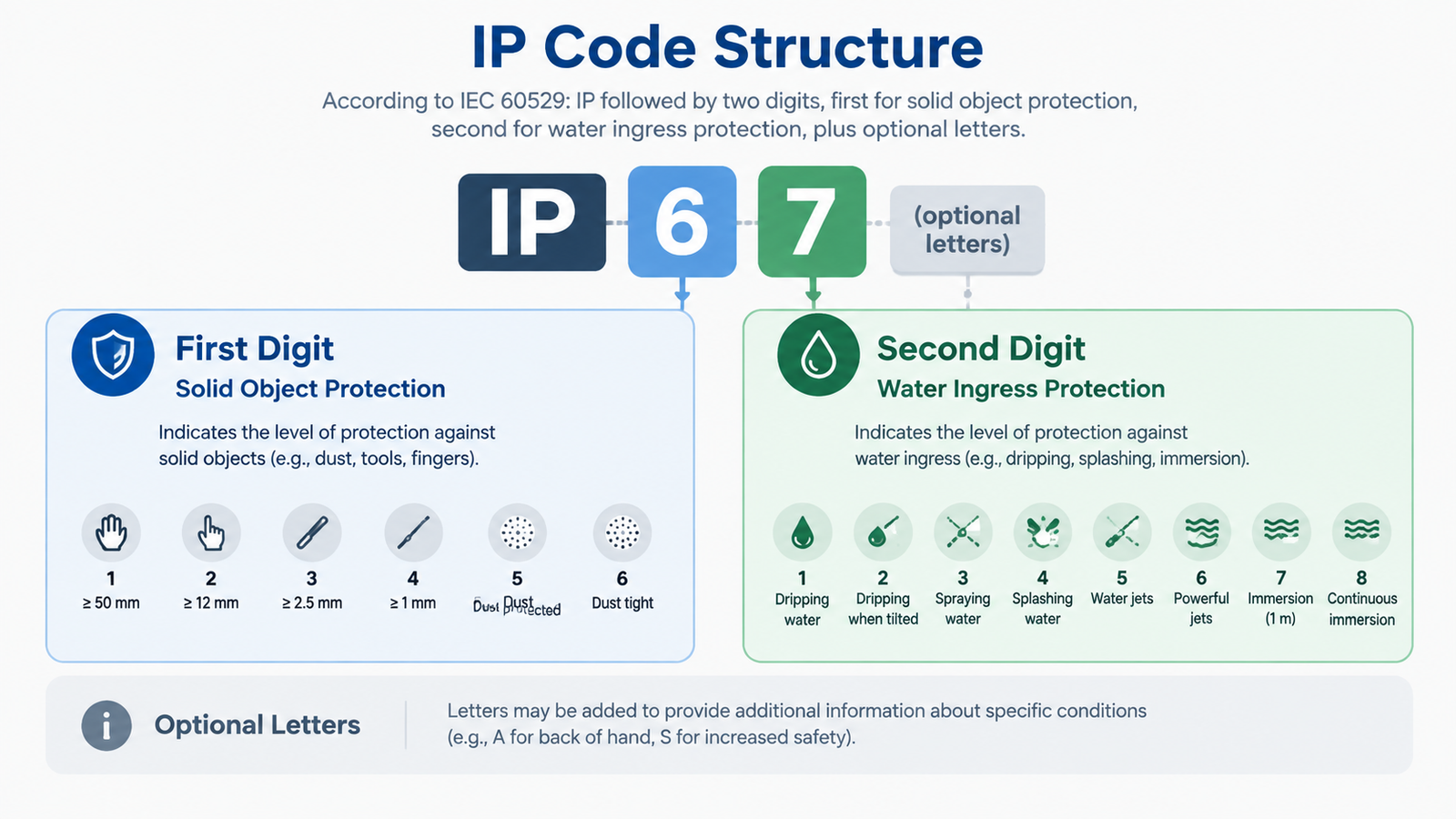
IP codes follow IEC 60529: the letters IP, then two digits, optionally followed by letters for special conditions.
First digit
Protection against solid objects
Second digit
Protection against water
0
None
0
None
1
Solid objects > 50 mm
1
Dripping water (vertical)
2
Solid objects > 12.5 mm (fingers)
2
Dripping water, enclosure tilted 15°
3
Solid objects > 2.5 mm (tools, wires)
3
Spraying water up to 60° from vertical
4
Solid objects > 1 mm
4
Splashing water from any direction
5
Dust protected (limited ingress, no harmful effect)
5
Water jets from any direction
6
Dust tight
6
Powerful water jets
—
—
7 / 8
Temporary / continuous immersion
Two conventions matter in practice. First, IP2X means the first digit is 2 but the second is unspecified — a common shortcut in switchgear specifications that tells you nothing about water. Second, a higher second digit does not imply a higher first digit; IP54 and IP65 differ in both.
The IP Ratings You Actually Meet on Transformers
Rating
What it means
Where it is used
IP00
No enclosure — bare active part
Inside a customer’s own switchgear, PDU or enclosure; never accessible to people
IP20
Finger-safe, no water protection
Standard indoor dry-type in a clean, dry electrical room
IP21 / IP23
IP23 adds protection against spraying water at up to 60°
Indoor units near washdown areas; IP23 is the usual minimum for a weatherproof hood outdoors
IP31 / IP41
Tool-proof, dripping or splashing water
Industrial halls with condensation risk
IP54
Dust protected, splashing water from any direction
Sheltered outdoor positions, humid or dusty plant rooms
IP55 / IP65
Dust protected / dust tight with water jets
Coastal, mining, food processing, washdown and other harsh environments
The jump from IP23 to IP54 is where most cost and most thermal penalty appear. IP23 gives you rain protection with free air movement — the enclosure is essentially a hood with louvres. IP54 requires the louvres to be filtered or the heat path redesigned, and the unit inside must be able to reject its losses through a much more restricted surface.
NEMA Types and the IP Equivalence Trap
North American projects usually specify NEMA enclosure types instead of IP codes, and the two systems overlap without being equivalent.
NEMA type
Typical use
Closest IP, and why it is not equal
Type 1
Indoor, general purpose, protection against dust and light indirect splashing
Roughly IP20 — but NEMA adds construction and door hardware requirements
Type 2
Indoor, dripping and light splashing water
Roughly IP21/22
Type 3R
Outdoor, rain, sleet, snow and external ice formation
Often quoted as IP24/54 — but icing resistance has no IP equivalent at all
Type 4
Indoor or outdoor, windblown dust and rain, splashing and hose-directed water
Roughly IP55/56
Type 4X
As Type 4 plus corrosion resistance (usually stainless or non-metallic)
Corrosion performance is a NEMA requirement, not an IP one
Type 12
Indoor, dust, falling dirt and dripping non-corrosive liquids
Roughly IP52 — no outdoor water rating
The trap: NEMA 3R is routinely described as “equivalent to IP54”, but the NEMA test includes ice formation on the enclosure and a specific rain-intrusion test that IP54 does not perform. Conversely, an IP65 enclosure may not satisfy NEMA 3R’s mechanical requirements. If your project specifies NEMA, ask for a NEMA-rated enclosure and a declaration against that standard — do not accept an IP rating as a substitute, and do not let a supplier convert one to the other on a datasheet.
Encapsulated vs Ventilated: What “Encapsulated” Actually Means
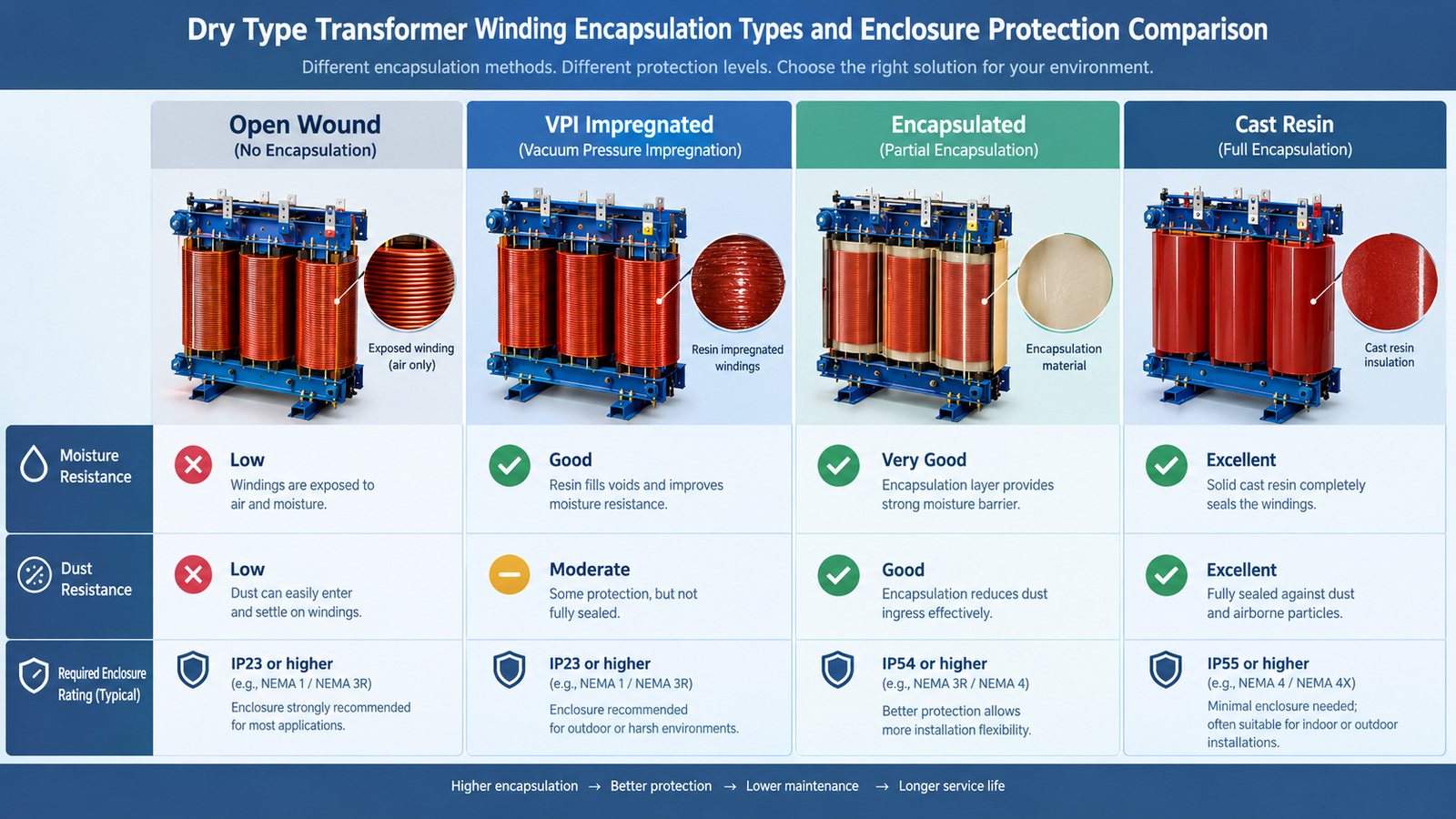
“Encapsulated” is used loosely in the market. At winding level there are four distinct constructions, and they behave very differently in a humid or dusty site.
Construction
How the winding is protected
Typical enclosure need
Best for
Open wound
None — varnish only
Must be enclosed; IP20 minimum, dry clean room
Low-cost indoor distribution in controlled environments
VPI (vacuum pressure impregnated)
Full vacuum/pressure resin impregnation of the whole winding, thin surface film
IP20–IP23 typical; outdoor needs a weatherproof enclosure
General industrial, good overload tolerance, lower cost than cast
VPE (vacuum pressure encapsulated)
Multi-layer resin encapsulation over the winding, thicker than VPI
Can reach IP54 with a matched enclosure
Humid, dusty, mildly corrosive sites; basements
Cast resin
Winding cast solid in epoxy under vacuum
IP00 to IP65 depending on casing; outdoor with correct enclosure
Coastal, chemical, tunnel, high-rise and data centre installations
The point that buyers miss: encapsulation protects the winding, not the transformer. Terminals, tap links, temperature sensors and cable boxes remain exposed unless the enclosure protects them too. A cast-resin unit in an IP00 arrangement is still an IP00 installation. How the insulation system itself is classified, and what temperature class goes with it, is covered in the dry-type insulation guide and the insulation class and temperature rise reference.
How the Enclosure Changes the Rating
Every degree of sealing costs cooling. The mechanism is simple: heat leaves the transformer by convection and radiation from its surfaces, and an enclosure interrupts both.
Enclosure situation
Effect on usable rating
Mitigation
Open IP00 in a ventilated room
Full nameplate rating
None needed; respect clearances
IP20/IP21 casing with louvres
Close to nameplate if the room ventilates
Keep louvre area unobstructed; clean periodically
IP54 sealed casing
Typically 5–10% derating unless the unit is designed for it
Declare the rating for the enclosure, or specify AF fans
Enclosed room with no dedicated ventilation
Can cost 8–12% at 50 °C room temperature
Size louvres for total loss in kW; separate inlet and outlet
Outdoor enclosure in direct sun
Solar gain raises the internal ambient well above air temperature
Double-skin roof, shade, or specify for the higher ambient
This is why the enclosure and the cooling class have to be specified together. A unit quoted as AN at nameplate, installed in a sealed outdoor box, may not deliver that rating — and the fans that would recover it need an enclosure that can still breathe. The cooling class guide covers how AN and AF ratings are declared and what an enclosure does to them.
Indoor vs Outdoor: What Outdoor Actually Requires
An outdoor dry-type installation is not simply an indoor unit placed outside. Five requirements come with the move:
Rain and snow protection with drainage. IP23 with a hood is the minimum; IP54 or NEMA 3R is the norm for exposed positions.
UV resistance. Paint systems and non-metallic components must be rated for continuous sunlight.
Corrosion class. Coastal and industrial atmospheres need a defined paint system or stainless hardware — IP says nothing about this.
Condensation control. A sealed enclosure that cools at night draws moisture in; anti-condensation heaters are usually necessary.
Vermin and insect ingress. Cable entries and louvres need screens; this is a construction detail, not an IP number.
For genuinely harsh positions — mining, coastal chemical plant, offshore — the enclosure specification carries more weight than the transformer’s electrical design, because the failure mode is corrosion and moisture rather than thermal. The mining transformer guide covers what that environment demands in practice.
Clearance, Access and Maintenance Inside the Box
An enclosure that protects the transformer but cannot be maintained is a liability. Three dimensional requirements appear repeatedly in site problems:
Front access for inspection — typically 800–1,000 mm clear in front of the doors, more where cables enter from the front.
Louvre clearance to walls — the manufacturer’s figure is a cooling requirement, not a suggestion; blocking it silently derates the unit.
Cable bending radius and entry space — large LV cables need considerably more room than the terminal position suggests.
The dimensional envelope for each rating, including the clearance needed around the unit, is tabulated in the dry-type dimension and clearance chart. Check the enclosure dimensions against the room before the order, not after delivery.
One fire-safety point deserves mention for indoor installations. Under NEC 450.21(B), a dry-type transformer above 112.5 kVA installed indoors generally requires a fire-resistant transformer room — but Exception 2 removes that requirement where the unit uses Class 155 insulation or higher and is fully enclosed except for ventilation openings. Enclosure class and insulation class together can therefore change the building works, which is a construction-cost decision, not an electrical one.
Specifying the Enclosure: A Checklist
Item
What to state
Ingress protection
IP code to IEC 60529, or NEMA type — state which standard governs, not both converted
Insulation class and “fully enclosed except ventilation openings” if NEC Exception 2 is being used
A quotation that states an IP rating but not the thermal basis for the rating is incomplete. Ask the question directly: is the kVA figure quoted with this enclosure fitted, or is it the bare-unit rating?
Conclusion
The enclosure is not an accessory added after the electrical design. It sets ingress protection, corrosion life, maintenance access, fire-separation requirements and — through thermal behaviour — how much of the nameplate rating you can actually use. Match the IP or NEMA rating to the real environment, confirm the kVA is declared with that enclosure fitted, and specify the corrosion class separately, because no IP number covers it.
If you can describe the room or the outdoor position — humidity, dust, salt, ambient maximum and available footprint — the engineering team can propose an enclosure and insulation combination that holds its rating in that specific place, rather than a standard casing that only works in a laboratory.
Frequently Asked Questions
What does IP54 mean on a transformer enclosure?
IP54 means the enclosure is dust protected — limited dust ingress is allowed but must not interfere with operation — and protected against splashing water from any direction. It is a common choice for humid plant rooms and sheltered outdoor positions, but it is not rated for water jets (IP55) or for immersion, and it says nothing about corrosion resistance.
Is NEMA 3R the same as IP54?
No. NEMA 3R and IP54 are often treated as equivalents on datasheets, but the NEMA test includes external ice formation and a specific rain-intrusion procedure that the IP test does not perform, along with construction requirements for doors, hinges and hardware. If a project specifies NEMA 3R, require a NEMA-rated enclosure and declaration; an IP rating is not a substitute.
Do I need an enclosure around a cast resin transformer?
It depends on where it sits. Cast resin protects the winding, but terminals, tap links and sensors remain exposed, so an IP00 cast-resin unit is only appropriate inside your own switchgear or a secure electrical room. For indoor public areas IP20 is the usual minimum, and for outdoor positions IP23 with a hood or IP54/NEMA 3R is standard.
Does an enclosure reduce the transformer’s kVA rating?
Yes, unless the unit was designed for that enclosure. A sealed casing restricts heat rejection, and the rating must be declared with the enclosure fitted. The reduction is typically 5–10% for a sealed IP54 box, and more where the room itself is poorly ventilated or the ambient is high. Always confirm the rating basis in the quotation.
What IP rating is needed for an outdoor transformer?
IP23 with a weatherproof hood is the practical minimum for a sheltered outdoor position, and IP54 or NEMA 3R is normal for fully exposed sites. Beyond the IP number, outdoor installations need UV-resistant finishes, a defined corrosion class, anti-condensation heaters and screened cable entries — none of which the IP code covers.
How percentage impedance sets the fault level, the voltage drop and the parallel operating rules, with worked fault-current and regulation calculations.
Transformer ODM and OEM programs explained: the custom engineering workflow from RFQ to FAT, the 15-field spec sheet, tooling and IP ownership, MOQ and lead-time terms.
What an efficiency class regulates, how EU ErP, DOE and GB 20052 differ, why load points are not comparable, and how to capitalise losses into a 25-year cost.