


Description
JDZ(F)8-10R at a Glance
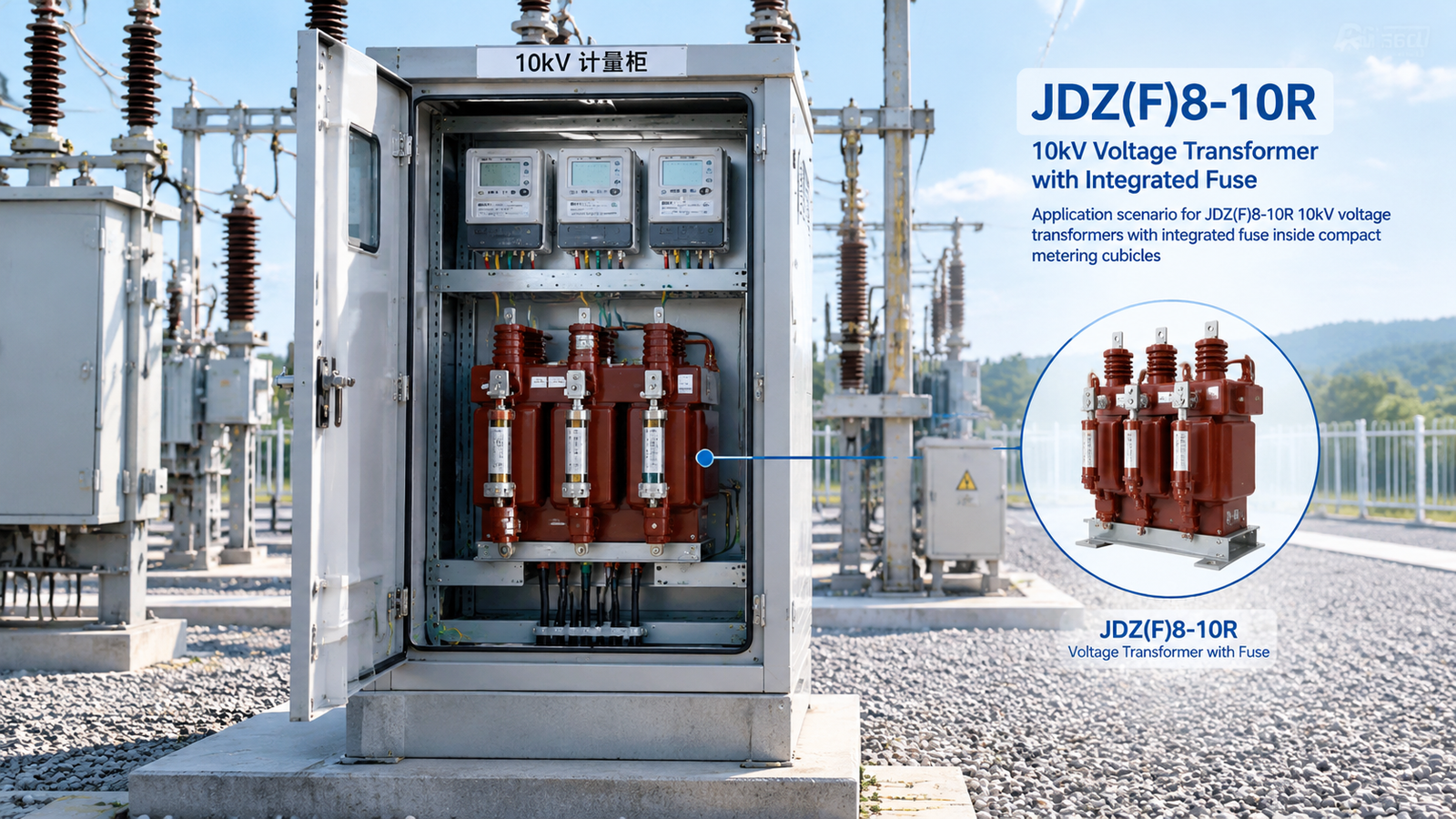
The JDZ(F)8-10R voltage transformer with fuse is a single-phase, epoxy-resin cast unit for indoor 6 kV and 10 kV systems, with the primary fuse built into the cast body. The F in the code marks the dual-winding version, which delivers two independent secondary circuits from one primary winding: one for metering, one for protection or a second metering point.
Four builds make up the series: JDZ8-6R and JDZ8-10R with a single secondary winding, and JDZF8-6R and JDZF8-10R with two. All four are rated for 50 Hz and install directly inside a switchgear cubicle.
Reading the Type Designation
| Element | Chinese designation | Meaning |
|---|---|---|
| J | 电压互感器 | Voltage transformer |
| D | 单相 | Single-phase |
| Z | 浇注绝缘 | Cast-resin insulation |
| (F) | 有分开的两个二次绕组 | Two separated secondary windings |
| 8 | 设计序号 | Design sequence |
| 6 / 10 | 电压等级 | Voltage class in kV |
| R | 带熔断器 | Integrated primary fuse |
Two letters decide what arrives: the F on the dual-winding build, and the R on every unit in this series. A JDZ8-10R without the F has one secondary circuit and a 400 VA limit output; the JDZF8-10R has two circuits and a 300 VA limit. The reduction is not a concession, it reflects the split of the thermal capacity across two windings.
Ratings: Single Winding and Dual Winding
Each rated output is valid at the accuracy class printed in the same column, and the pairing is fixed by the winding design.
| Type | Ratio (kV) | 0.2 | 0.5 | 1.0 | 0.2/0.2 | 0.2/0.5 | 0.5/0.5 | Limit output | Insulation (kV) |
|---|---|---|---|---|---|---|---|---|---|
| JDZ8-6R | 6 / 0.1 | 20 VA | 60 VA | 120 VA | — | — | — | 400 VA | 7.2 / 30 / 60 |
| JDZ8-10R | 10 / 0.1 | 30 VA | 80 VA | 150 VA | — | — | — | 400 VA | 12 / 42 / 75 |
| JDZF8-6R | 6 / 0.1 / 0.1 | — | — | — | 15/15 VA | 15/20 VA | 30/50 VA | 300 VA | 7.2 / 30 / 60 |
| JDZF8-10R | 10 / 0.1 / 0.1 | — | — | — | 20/20 VA | 20/40 VA | 40/40 VA | 300 VA | 12 / 42 / 75 |
The insulation level is stated as highest voltage for equipment / power-frequency withstand / lightning impulse. A 10 kV build carries 12 / 42 / 75 kV, which is the 12 kV class, not the 10 kV nominal figure.
Two Windings From One Primary
On the dual-winding build the secondary box carries four terminals marked a1, b1, a2 and b2: two independent circuits from a single primary winding.
Why that matters in practice:
- Metering and protection stay electrically separate. A fault or a short in the protection circuit does not disturb the metering signal, and the two circuits can be earthed independently.
- The protection core can be specified for fault behaviour. Where the metering core holds 0.2 or 0.5 class at normal voltage, the second core can be set for residual voltage performance during an earth fault.
- One cubicle, one primary connection. Two separate PTs would need two primary taps and twice the clearance.
The trade is output. The dual build carries 20/20 VA or 20/40 VA where the single-winding 10 kV unit carries 30 VA at 0.2 class. If the metering burden alone exceeds 40 VA, the dual build is the wrong answer and two single units, or a different frame, is the correct one.
What the Built-In Fuse Actually Saves
The reason the JDZ(F)8-10R voltage transformer with fuse exists in this form is the fuse being inside the casting rather than beside it. Three things follow.
- Cubicle space. A separate fuse holder needs its own clearances and its own air gap. Wrapping the fuse into the cast body removes that volume from the panel layout, which matters most in a narrow metering compartment.
- Switchgear cost. Fewer components, less wiring and less assembly time in the panel. For a builder producing repeated cubicles, the saving is per bay rather than per unit.
- Fuse replacement access. Replacing a fuse in a separate holder means working in the primary compartment. With the fuse in the cast body, the replacement procedure is defined by the unit rather than by the panel layout.
The unit mounts directly inside the cubicle with no additional primary isolation hardware, which is what the original design intent describes.
Matching Fuse Current to the Transformer
This is the step that determines whether the fuse protects anything at all, and it is skipped in most purchase orders.
The fuse is there to clear a fault inside the voltage transformer before it becomes a busbar fault. Two failure modes follow from a wrong rating:
- Fuse rated too high. A fault in the primary winding draws current below the fuse’s clearing threshold, so the fuse does not operate. The transformer fails and the fault spreads to the busbar, which is the exact outcome the fuse was meant to prevent.
- Fuse rated too low. Inrush at energisation, or a high secondary burden, trips the fuse during normal operation and the PT goes dead without a genuine fault.
The correct rating sits between the transformer’s short-circuit withstand and the minimum fault current the primary winding can produce. Send the system fault level at the tap point, or state the ratio and class and let us size it, because the fuse value is fixed at order together with the winding and cannot be revised on site.
Single Winding or Dual Winding
| Your requirement | Choose |
|---|---|
| Metering only, burden under 150 VA | JDZ8-10R, 1.0 class at 150 VA |
| Revenue metering at 0.2 class with light burden | JDZ8-10R, 0.2 class at 30 VA |
| Metering plus a protection relay from one unit | JDZF8-10R, 20/40 VA |
| Two independent metering points | JDZF8-10R, 20/20 VA |
| Burden above 40 VA on each circuit | Two single-winding units, not the dual build |

Installation and Dimensions
The JDZ(F)8-10R voltage transformer with fuse is 290 mm wide and 296 mm high, with the primary terminals 145 ± 0.5 mm apart on 2-M10 studs and the base 230 ± 0.5 mm between mounting centres on 4-M10 holes. The secondary terminals are arranged as two pairs, a1/b1 and a2/b2, which is the physical difference between the single and dual builds.

When a Different PT Fits Better
- No fuse needed, indoor 3 kV to 10 kV. The JDZ10 cast voltage transformer covers that duty without paying for a fuse you will not use.
- Semi-insulated construction with a fuse. The JDZX18 voltage transformer with fuse suits grounded-neutral systems where one primary end sits at ground potential.
- 35 kV class. The JDZ9-35 voltage transformer covers 35 kV indoor duty, including railway traction.
Service Conditions
The JDZ(F)8-10R voltage transformer with fuse is rated for indoor installation at 50 Hz, with a cast body resistant to moisture and surface contamination. Pollution level and site altitude belong in the inquiry: the creepage is set during casting, and altitude correction above 1,000 m is a different build rather than an adjustment made on site.
Standards and Routine Tests
Routine tests on every JDZ(F)8-10R voltage transformer with fuse cover power-frequency withstand at 42 kV for the 10 kV build and 30 kV for the 6 kV build, insulation resistance, ratio and polarity, and ratio error and phase displacement at the rated output for the declared accuracy class. Type test reports for temperature rise and impulse withstand are available for documentation packages.
Manufacturer Supply, OEM and Wholesale
The four builds are supplied direct. Switchgear builders order against a frozen ratio, class and fuse specification under OEM or private-label marking; distributors hold a standing specification for repeat supply; project buyers receive drawings and test reports for consultant approval.
Because the winding and fuse rating are fixed per order, non-standard ratios are quoted rather than declined.
Price, MOQ and Lead Time
- MOQ. Single units for standard configurations. Custom ratios and private-label marking carry a higher minimum.
- Price drivers. Voltage class, single or dual winding, accuracy class, rated output, fuse rating and quantity.
- Lead time. Confirmed against the production schedule at order.
- Payment. Deposit with balance against the bill of lading copy; letter of credit for project quantities.
What to Send With Your Inquiry
- System voltage: 6 kV or 10 kV
- Single winding or dual winding requirement
- Voltage ratio, primary and secondary
- Accuracy class and burden for each circuit
- Fuse rating, or the system fault level so we can size it
- Indoor panel type and mounting orientation
- Quantity, destination port and required delivery date
Send those through the quote form on this page. The fuse rating and the burden per circuit are the two items that turn a price into a quote, so including them avoids a second round.
FAQ
What does the F in JDZ(F)8-10R mean?
What is the difference in output between the single and dual builds?
Why must the fuse rating match the transformer?
What does the built-in fuse save?
Which voltage classes are available?
What is the MOQ?
Request Quote
Tell us your specifications, quantity, or application scenario and we will reply with a tailored quote.