
Description
JDZW(X) at a Glance
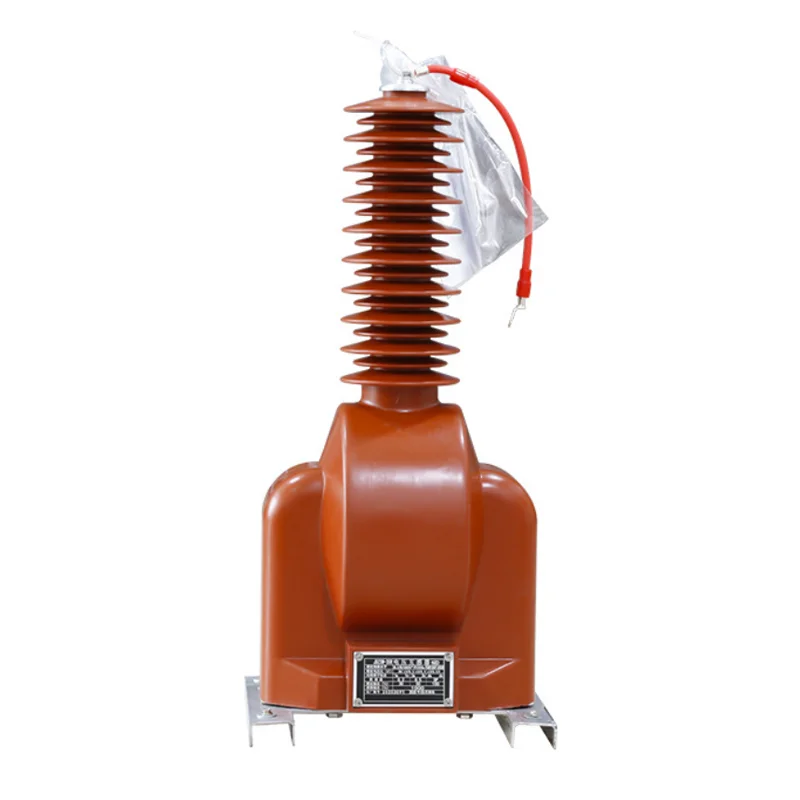
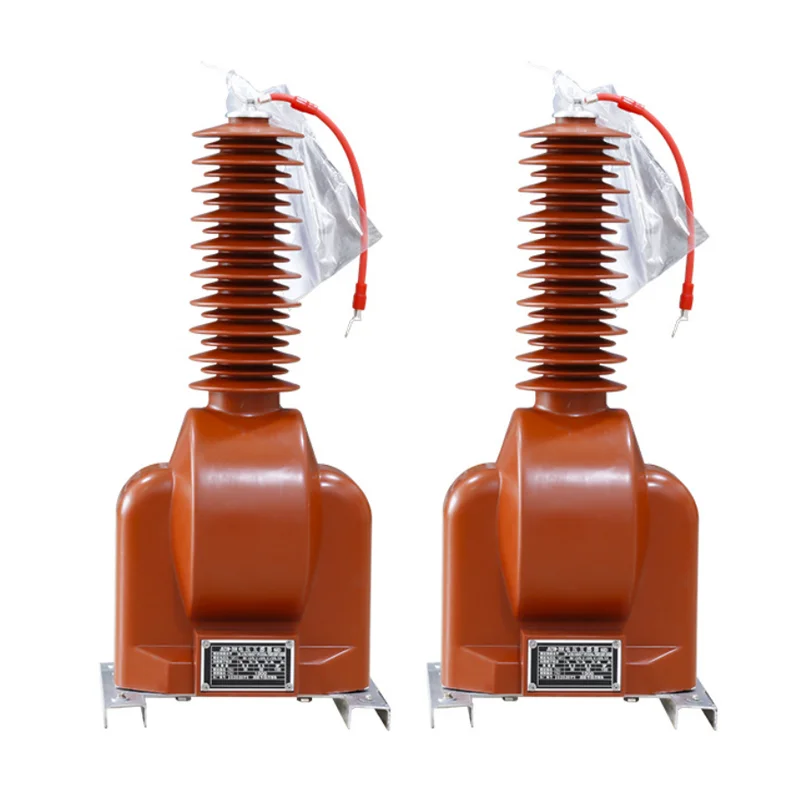
The JDZW(X) outdoor voltage transformer is a single-phase, fully enclosed cast-resin unit for 3 kV, 6 kV and 10 kV overhead distribution. It steps line voltage down to a standard secondary level for meters, remote terminal units and protection relays mounted on a pole or in an outdoor enclosure.
The construction of the JDZW(X) outdoor voltage transformer is aimed at the outdoor problem rather than the electrical one: the casting is formulated for ultraviolet exposure and ageing, and the unit is sealed so there is nothing to top up, dry out or re-test over its service life.
Reading the Designation
| Element | Meaning | What it decides |
|---|---|---|
| J | Voltage transformer (电压互感器) | PT, not a current transformer |
| D | Single-phase (单相) | One unit per phase |
| Z | Cast insulation (浇注绝缘) | Epoxy body, no oil |
| W | Outdoor (户外) | UV-stabilised casting, weatherproof |
| (X) | Frame variant | A derivation of the base JDZW frame |
The letter W is the one that matters most in selection. It denotes an outdoor-rated casting, not simply a unit that can be installed outside. An indoor PT put on a pole will fail at the surface, where UV and pollution attack the resin rather than the winding.
The bracketed X marks a variant of the base frame. The specific configuration is confirmed against the outline drawing at order rather than inferred from the code, because the derivation can cover more than one arrangement.
Voltage Classes
Three classes share the frame: 3 kV, 6 kV and 10 kV, all single-phase, for 50 Hz or 60 Hz systems.
| Class | Typical application |
|---|---|
| 3 kV | Small industrial and mining distribution, legacy 3.3 kV networks |
| 6 kV | Plant distribution, older utility feeders, mining networks |
| 10 kV | The common overhead distribution class for utility and rural networks |
Choosing the class follows the highest voltage for equipment, not the nominal system voltage. A 10 kV nominal feeder usually needs a 12 kV class device where the installation is at the upper tolerance, so confirm the insulation level your network standard requires rather than matching the number on the feeder nameplate.
Outdoor Construction
The JDZW(X) outdoor voltage transformer faces a different set of degradation mechanisms from an indoor one, and the casting is what addresses them.
- Ultraviolet exposure. Sunlight degrades ordinary epoxy at the surface, producing chalking and then tracking. The outdoor casting uses a formulation and a surface finish that resist UV ageing, which is what the published anti-ageing claim refers to.
- Pollution and moisture. Contamination settles on the surface and is wetted by rain, fog or condensation. The shed profile and the creepage distance determine whether that film becomes conductive enough to track.
- Thermal cycling. Day and night temperature swings, plus load cycling, stress the interface between the casting and the embedded winding. A fully enclosed body distributes that stress more evenly than a partially filled housing.
Maintenance is limited to cleaning the surface on a schedule that suits the site. There is no oil level, no gas pressure and no desiccant to replace, which is the basis of the maintenance-free claim.
Where an Outdoor PT Is Used
- Pole-mounted switchgear where a recloser or a load break switch needs a voltage signal for its controller.
- Pole-mounted transformer metering, providing the voltage reference for a meter in a roadside cabinet.
- Rural distribution where the switching point is on the line rather than in a substation building.
- Drop-out fuse protection schemes, where the PT supplies both the measurement and the control supply for the switching device.
In all four cases the alternative is to build an enclosure and install indoor equipment. The outdoor unit exists precisely so that a switching or measurement point can be created on the line without a building.
Installation and Mounting
The JDZW(X) outdoor voltage transformer mounts on a bracket or a cross-arm, with the primary connected to the line conductor and the secondary run down to the meter or controller cabinet through a protected cable.
Three installation items belong in the inquiry rather than on the drawing:
- Pollution level at the site, because the creepage is cast into the body and cannot be increased later.
- Altitude, because external insulation needs correction above 1,000 m.
- Mounting orientation, if the bracket constrains it, because the terminal box position determines where the secondary cable can leave.
Selection Inputs
Because the frame covers three voltage classes and more than one ratio, selection is driven by the project data.
| Input | What it decides |
|---|---|
| System voltage and insulation level | Voltage class of the unit |
| Voltage ratio, primary and secondary | Winding design |
| Accuracy class and burden | Core design and rated output |
| Number of units | One per phase for a three-phase measurement |
| Pollution level | Creepage distance, fixed at casting |
| Site altitude | External insulation correction |
Send those six items and the ratio, class and output come back confirmed together rather than as three separate questions.
Pollution Level and Creepage
For an outdoor unit this is the specification item that most often gets omitted, and it is the one that cannot be corrected after manufacture.
A unit built for a clean rural site has a shorter creepage distance than one built for a coastal or industrial site. On a polluted site the shorter unit tracks across the surface within a few wet seasons, and the failure looks like an insulation fault rather than a specification error.
State the level explicitly. Where the site is coastal, near a cement works, or downwind of heavy industry, specify the higher class even if the network standard does not demand it.
When an Indoor PT Fits Better
- A switchroom exists or is being built. Indoor cast PTs are cheaper for the same class, and the JDZ10 voltage transformer covers 3 kV to 10 kV for cubicle installation.
- Earth-fault protection is required. The JDZX18 fused voltage transformer carries an integrated primary fuse for cabinet duty.
- 35 kV class. The JDZ9-35 voltage transformer covers 35 kV indoor applications including railway traction.
The full range sits under voltage transformers.
Standards and Tests
Units are built and tested to the instrument transformer standards for this class. Routine tests cover power-frequency withstand, insulation resistance, ratio and polarity, and ratio error and phase displacement at the rated output for the declared accuracy class.
Type test reports covering temperature rise and impulse withstand are available for project documentation. Ask for the report behind the outdoor ageing claim if the site is in a high-UV region.
Manufacturer Supply, OEM and Wholesale
The JDZW(X) outdoor voltage transformer is supplied direct. Utility and EPC buyers receive drawings and test reports for approval; distributors hold a standing specification for repeat supply; OEM arrangements cover private-label marking and non-standard ratios.
Price, MOQ and Lead Time
- MOQ. Single units for standard ratios. Non-standard ratios and private-label marking carry a higher minimum.
- Price drivers. Voltage class, ratio, accuracy class, rated output, pollution class and quantity.
- Lead time. Confirmed against the production schedule at order.
- Payment. Deposit with balance against the bill of lading copy; letter of credit for project quantities.
What to Send With Your Inquiry
- System voltage and required insulation level
- Voltage ratio, primary and secondary
- Accuracy class and the connected burden
- Number of units and whether a three-phase set is required
- Pollution level at the site
- Altitude and ambient temperature range
- Mounting arrangement and bracket type
- Quantity, destination port and required delivery date
Send those through the quote form on this page. The pollution level and the altitude are the two items that most often need a second round, because neither can be changed once the body is cast.
FAQ
What does the W in JDZW mean?
Which voltage classes are available?
Can an indoor PT be used outdoors?
What maintenance does it need?
Why does pollution level matter so much outdoors?
What is the MOQ?
Request Quote
Tell us your specifications, quantity, or application scenario and we will reply with a tailored quote.