Dry Type Transformer for Mining: Overload, Dust & Flameproof
Published: Author: Lisa
A dry type transformer for mining is not selected from a distribution catalogue. It is an engineered assembly that has to survive a potentially explosive atmosphere, a temperature that can sit above 40 °C for weeks, abrasive dust, and repeated direct-on-line starting of large motors — often while mounted on a skid that is towed along a gallery. Each of those requirements pulls the design in a different direction, and the certification is what makes the result legal to install.
This guide covers the difference between surface and underground duty, what flameproof protection actually requires, why overload capability matters more in a mine than anywhere else, and how to build a specification that a certification body will accept.
Why mining duty breaks ordinary assumptions
The atmosphere can be explosive. Underground coal mines contain methane and coal dust. The transformer is part of the ignition risk, so it is regulated as hazardous-area equipment rather than as ordinary electrical apparatus.
The load is motor-heavy and switch-heavy. Conveyors, shearers, pumps and fans are started direct-on-line, repeatedly, with high inrush current and the voltage dip that comes with it.
Space is a corridor, not a room. Underground clearances follow the gallery, and equipment is frequently moved as the face advances.
Dust is a material, not a nuisance. Coal dust accumulates, insulates, and in high enough concentration becomes an explosion hazard in its own right.
Underground and surface: two different specifications
The single most useful split in mining transformer selection is between the fixed surface installation and the underground or mobile one. They share a kVA figure and almost nothing else.
Requirement
Surface substation
Underground / mobile
Hazardous area certification
Usually not required
Required — flameproof equipment certified for the zone
Technology
Liquid-immersed or dry type, outdoor rated
Dry type in a flameproof steel enclosure; liquid-filled units are generally unsuitable
Mounting
Concrete pad, fixed
Rail-mounted trolley or skid, towed with the face
Voltage
Utility class, stepped down to distribution level
Typically 6 kV or 10 kV down to 400/690/1,200/3,450 V class machine voltages
Dominant design driver
Efficiency, fault level, protection coordination
Explosion protection, overload capability, enclosure strength, weight and envelope
On the surface side, the protection and coordination work is mainstream distribution engineering, and the interfaces are described in our overview of industrial power distribution and protection. Underground, the certification and enclosure requirements come first and everything else is fitted around them.
Flameproof and explosion protection
Group I versus Group II
Hazardous-area equipment is classified into groups, and mining sits in the one with the strictest requirements.
Group
Environment
Categories
What the categories mean
Group I
Underground mining, including firedamp and coal dust
M1, M2
M1 equipment must remain operational even in the presence of an explosive atmosphere. M2 equipment must be de-energised when an explosive atmosphere is detected.
Group II
Surface industry with flammable gas, vapour or mist
Zones 0, 1, 2
The familiar surface classification, less demanding than Group I for the same gas
Group I is deliberately more demanding than Group II, so equipment certified only for surface use cannot simply be relocated underground. A typical mining transformer marking combines the protection concept, the group and the category — for example Ex d I Mb, where “d” denotes flameproof enclosure. The applicable protection standard is EN 60079-1, with EN 60079-0 covering general requirements, and certification is issued under ATEX for Europe or IECEx for international projects.
Surface temperature and T-class limits
Flameproof construction alone does not make a transformer safe underground. The external surface must also stay below the temperature that would ignite the surrounding atmosphere, which is expressed as a temperature class limit. For coal mining this is a design constraint on the enclosure, not just on the winding: the heat generated inside has to reach the surface and dissipate without any local hot spot exceeding the limit, and the result has to be demonstrated by thermal testing rather than calculated and asserted.
What a flameproof enclosure actually does
An Ex d enclosure does not prevent an internal explosion. It contains one. The enclosure is built to withstand the internal pressure of an explosion without rupturing, and the flame paths — the machined gaps between the enclosure and its covers — are dimensioned so that hot gases escaping through them are cooled below ignition temperature before they reach the outside atmosphere. In practice this means heavy steel construction, certified flamepath surfaces, and pressure testing of the assembly.
That construction is also what produces the weight and the cost. A flameproof enclosure for a mining transformer is a structural item, and its mass affects transport, lifting and the skid design as much as the transformer itself.
Overload: the requirement mines really specify
Underground mining specifications are unusually explicit about overload and short-circuit withstand, and for good reason. The transformer has to absorb repeated direct-on-line starts of large motors, and the combined effect is a duty cycle that a standard distribution unit was never asked to survive.
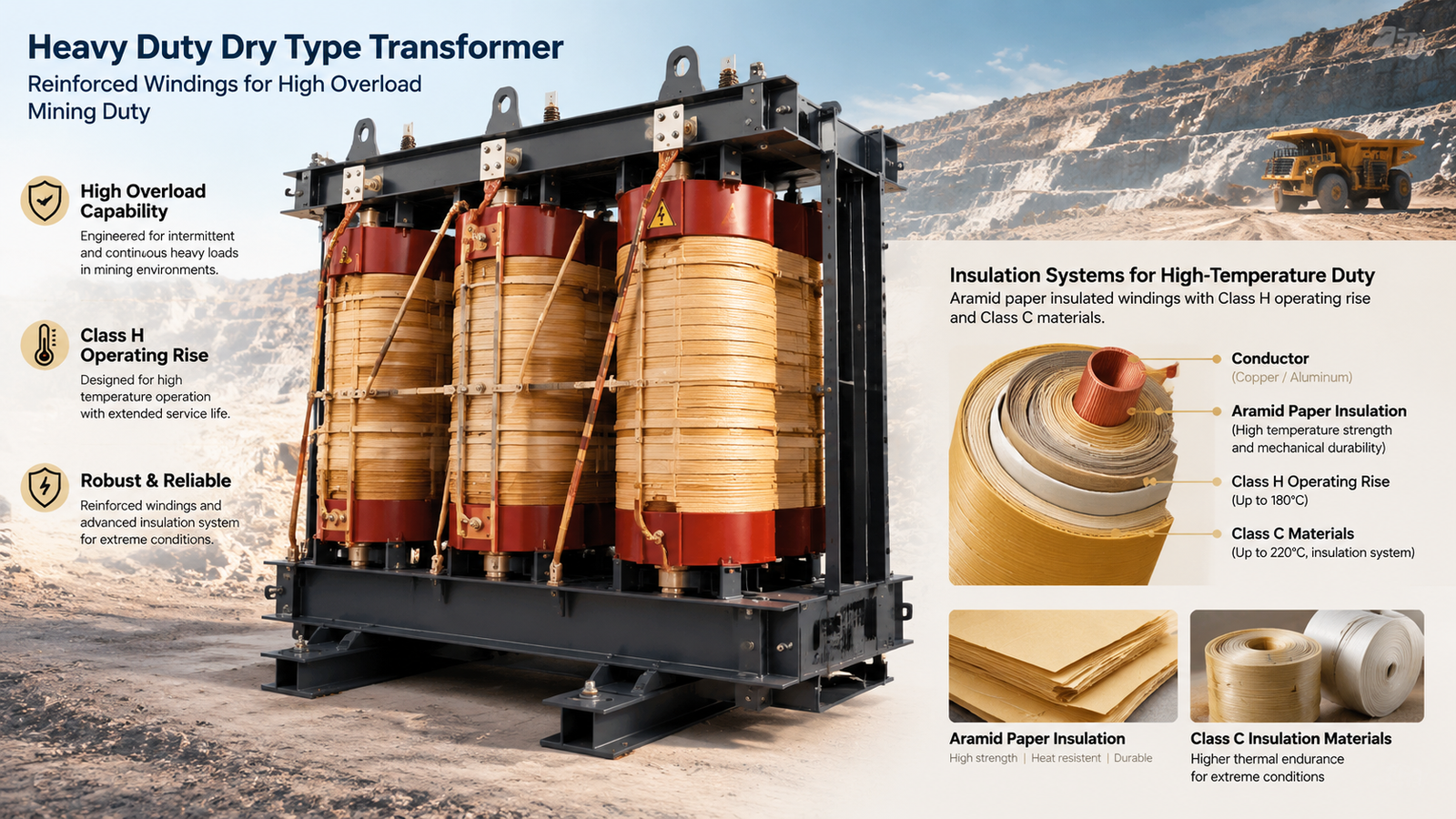
Two design measures are normally used together. The first is an insulation system with genuine thermal headroom: mining transformers commonly use aramid paper insulation such as Nomex with copper conductors, with the normal operating temperature rise controlled at Class H (180 °C) level while the insulation materials themselves are rated to Class C (220 °C) so that short-term overload does not consume the design margin. The second is mechanical: the winding construction is built for the electromagnetic forces of motor starting and through-faults, and the enclosure provides the required mechanical protection.
Practical consequences to state in the specification:
Required overload capability, expressed as a multiple of rated current for a defined duration rather than as a claim.
Required short-circuit withstand, expressed as a current and duration consistent with the mine’s protection settings.
The largest direct-on-line motor start the transformer must support, including the voltage dip at the motor terminals.
Direct motor starting and voltage dip
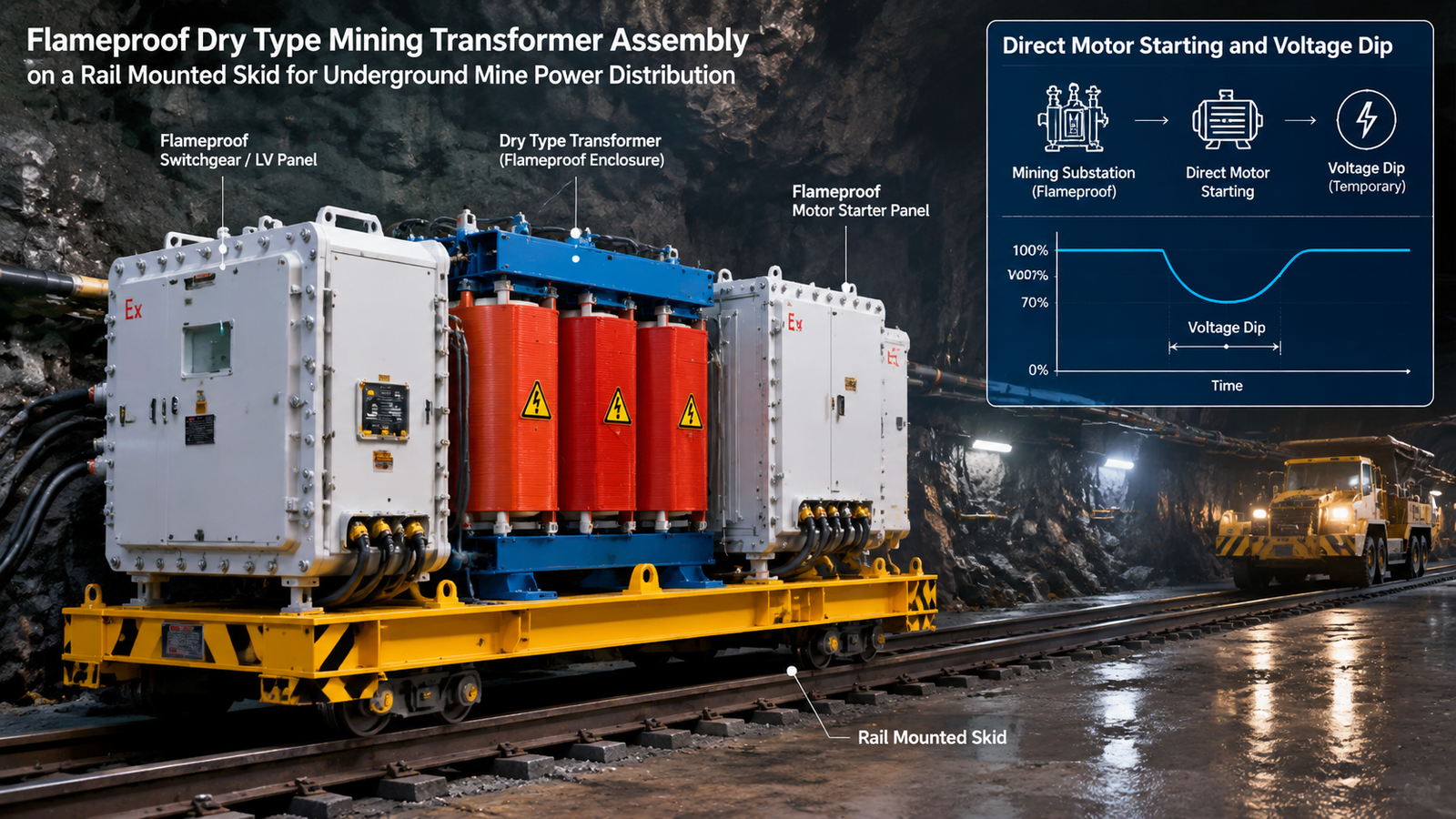
Starting a large motor direct-on-line draws several times its rated current, and the resulting dip at the motor terminals depends on the transformer impedance and the cable run. Underground cable runs are long and deliberately so, which makes the dip worse. Low impedance improves the starting voltage but raises the through-fault current the transformer must withstand, so impedance becomes a coordination decision between the transformer, the motor starter and the protection settings — not a value to be copied from a previous project.
Dust, moisture and thermal design
Coal dust is both an explosion risk and a thermal insulator, so mining transformers are designed so that dust cannot accumulate where it matters. Curved or domed enclosure tops, open sides where protection concept allows, and the absence of horizontal ledges are all deliberate — a flat top collects a layer that insulates the enclosure and raises the surface temperature.
Enclosure protection for mining duty typically runs from IP54 to IP65, which also addresses the water used for dust suppression. Where the design uses a sealed construction rather than open air circulation, the internal atmosphere is controlled to keep moisture and dust out of the winding assembly entirely. In all cases, insulation and partial discharge behaviour should be specified so that the unit is not sensitive to the humidity cycling it will actually see.
Ambient temperature matters as much as dust. Deep and tropical mines run hot, and an air-cooled unit rated at a 40 °C reference ambient is not delivering its nameplate in a 50 °C gallery. State the design ambient and require derating to be shown, exactly as you would for a high-altitude installation. The class system behind both thermal and environmental ratings is covered in our guide to transformer insulation class and temperature rise.
Insulation systems for high-temperature duty
The material choice is what makes the overload claim credible. Aramid paper insulated conductors, vacuum pressure impregnated windings and Class C insulation materials are the standard combination for mining duty, and the reason is not only temperature: aramid paper has a dielectric constant close to that of air, which produces a more uniform electric field around the winding, lower partial discharge, and less sensitivity to temperature and humidity than a conventional paper system. Mine-grade units are commonly required to demonstrate partial discharge below about 5 pC, which is tighter than the general dry-type expectation.
Mechanical robustness is specified alongside the electrical data: an anti-loosening structure that survives transport over rough ground, vertical lifting provisions, and a body designed to resist impact and vibration. Because the unit will be towed, every connection that can work loose eventually does.
Mobile and skid-mounted substations
The mining mobile substation is a packaged assembly rather than a bare transformer, and the integration is what makes it usable underground.
Flameproof high-voltage switch — an incomer or load-break switch in its own flameproof enclosure, with cable entry glands.
Flameproof dry-type transformer — the main unit, bolted to the switch enclosures.
Low-voltage distribution and protection — outgoing feeders with the overload, short-circuit, earth-fault, undervoltage and overtemperature protection the mine requires, plus electrical interlocking between the high- and low-voltage sides.
Rail trolley or skid base — the mounting that allows the assembly to be towed along the gallery and locked in position.
Typical ratings for this class of equipment run from 100 kVA to several MVA, at primary voltages up to 10 or 11 kV and secondary voltages of 400, 690, 1,200 and 3,450 V class, which correspond to the machine voltages used underground. Vector group options include Yyn0 and Dyn11, and impedance is usually around 5% with a ±5% tapping range on the high-voltage side. Enclosure protection of IP54 or better is normal. Because the assembly is transportable, the outline drawing and the mass matter as much as the electrical data, and the envelope should be checked against the gallery and the transport route.
Standards and certification map
Standard or scheme
What it covers
EN 60079-0 / IEC 60079-0
General requirements for equipment in explosive atmospheres
EN 60079-1 / IEC 60079-1
Flameproof enclosure protection concept, including flamepath requirements and testing
ATEX 2014/34/EU
European certification route, with Group I covering mining
IECEx
International certification scheme, widely accepted outside Europe
IEC 60076 series
Transformer design, testing and thermal requirements, including dry-type specifics in IEC 60076-11
National mining standards
Country-specific rules for mine electrical equipment and mobile substations
Certification is not a formality to be resolved at delivery. The protection concept, the group and category, and the surface temperature limit all have to be fixed before the design is frozen, because changing them afterwards means redesigning the enclosure. The construction and testing side of the transformer itself is covered in our dry type transformer specification guide.
Specification checklist
State the hazardous-area zone and the required group and category — Group I M1 or M2 for coal mines.
State the protection concept and marking, for example Ex d I Mb, and require the certification documents.
State the surface temperature class limit, and require thermal test evidence.
State the design ambient temperature and require the derating calculation.
Specify overload capability as a multiple and duration, and short-circuit withstand as current and time.
Give the largest direct-on-line motor start, so impedance can be coordinated.
State the enclosure protection rating and the dust-management requirements.
Require partial discharge as a routine test with recorded values.
Confirm envelope, mass and rail gauge against the transport route and the gallery.
Confirm the low-voltage protection functions and the interlocking arrangement.
For any mine project that also has a fixed surface substation, the surface transformer is a mainstream distribution selection, and the comparison in our guide to selecting an oil-immersed transformer type covers the voltage class and cooling choices for that side. Where the underground unit is flameproof dry type, the dimensional and clearance considerations in the dry type transformer sizes and dimensions chart apply to the enclosure assembly rather than to the bare transformer.
Conclusion
Mining transformer selection runs in a fixed order: certification first, then overload, then environment, then price. Fix the group, category, protection concept and surface temperature limit before design starts. Specify overload as a multiple of rated current for a stated duration, and short-circuit withstand as a current and time, so that the claim can be verified rather than assumed. Choose an insulation system with real thermal headroom, insist on a low partial discharge figure, and design the enclosure so that dust cannot settle on it. Then, and only then, compare envelopes, masses and quotations. For units built to these classes, the cast resin data in our SCB series dry type transformer range provides a baseline for the electrical characteristics, and our engineering team can work through the flameproof packaging with your certification body.
FAQ
What is a dry type transformer for mining?
It is a dry-type transformer built into an explosion-protected enclosure for use in hazardous mining atmospheres, typically flameproof (Ex d) and certified to Group I for underground coal mining. It powers conveyors, pumps, fans and face machinery, and is often supplied as a mobile substation on a rail trolley or skid.
What is the difference between ATEX Group I and Group II?
Group I covers underground mining and is subject to stricter requirements than Group II, which covers surface industry. Group I is further divided into M1, where equipment must remain operational in the presence of an explosive atmosphere, and M2, where it must be de-energised when one is detected.
What does Ex d mean on a mining transformer?
It denotes flameproof enclosure protection: the enclosure withstands an internal explosion without rupturing, and its flame paths cool escaping hot gases below ignition temperature before they reach the surrounding atmosphere. The applicable standard is IEC or EN 60079-1.
Why do mining transformers have such high overload requirements?
Because the load is dominated by large motors started direct-on-line, repeatedly. The transformer has to absorb that inrush and the resulting temperature rise without losing insulation life, which is why mining specifications state overload as a multiple of rated current for a defined duration and use insulation systems with substantial thermal headroom.
Can an oil-filled transformer be used underground?
Generally not. A flammable liquid in a confined, potentially explosive atmosphere is a fire and containment risk that cannot be managed, which is why mining installations use dry-type transformers inside flameproof enclosures.
How is dust handled in a mining transformer design?
By designing so that dust cannot accumulate: domed or curved enclosure tops instead of flat surfaces, open sides where the protection concept allows, and enclosure ratings of IP54 to IP65 to resist dust ingress and washdown.
What is a mining mobile substation?
A packaged assembly of flameproof high-voltage switchgear, a flameproof dry-type transformer and low-voltage distribution and protection, mounted on a rail trolley or skid so it can be towed along the gallery as the working face advances.
What partial discharge limit applies to mining transformers?
Mine-grade units are commonly specified below about 5 pC, which is tighter than the general dry-type expectation. Low partial discharge indicates void-free casting and is one of the strongest predictors of long-term reliability in high-humidity conditions.
How to size and specify a transformer for EV charging stations and hubs: AC input kVA, continuous load rules, demand factors, K-factor selection and site matching.
How to specify a dry type transformer for metro and tunnel duty: F1 fire behaviour, C2 E2 environmental classes, IEC 61936-1 separation and partial discharge limits.
How to specify a dry type transformer for solar plant and BESS duty: IEEE C57.159 guidance, inverter harmonic losses, derating, thermal cycling and energy storage selection.