Dry Type Transformer for Metro and Tunnel Applications
Published: Author: Lisa
A dry type transformer for metro and tunnel applications is specified by its environment before its rating. An underground equipment room has no ventilation to spare, no space for oil containment, no easy route for a fire brigade, and no tolerance for a leak. That combination removes liquid-filled units from consideration almost everywhere below grade, and it turns fire behaviour, condensation resistance and noise into primary design criteria rather than footnotes.
This guide covers where transformers sit in a metro power system, why the fire behaviour class does more work than the kVA rating, and how to specify an underground substation transformer that survives a humid, dusty, confined equipment room for thirty years.
Why underground installations change the specification
Four constraints do most of the work.
Fire. A tunnel or station equipment room is a confined space with limited egress. Any insulating liquid becomes a fire load that cannot be contained, which is why most transit authorities require non-liquid construction for indoor installations.
Air. Heat has to leave the room by ventilation, and the room is often carved out of the structure rather than designed around the transformer. Poor ventilation is the single most common cause of premature dry-type failure indoors.
Humidity and pollution. Tunnel atmospheres combine moisture, brake and wheel wear particles, and temperature cycling that drives condensation. Insulation that is not sealed against moisture will degrade.
Access. Delivery, positioning and future replacement all happen through openings that already existed for other purposes.
Where transformers sit in a metro power system
Two very different duties share the same tunnels, and they should not be specified from the same template.
Duty
Function
Typical arrangement
What drives the design
Traction rectifier transformer
Steps medium voltage down to the rectifier that produces 750 V or 1,500 V DC for the running rails
Dry type or liquid-filled in a dedicated traction substation, with 12-pulse or 24-pulse rectifier groups
Harmonic duty, cyclic loading under train acceleration, ripple and impedance matching
Auxiliary / station transformer
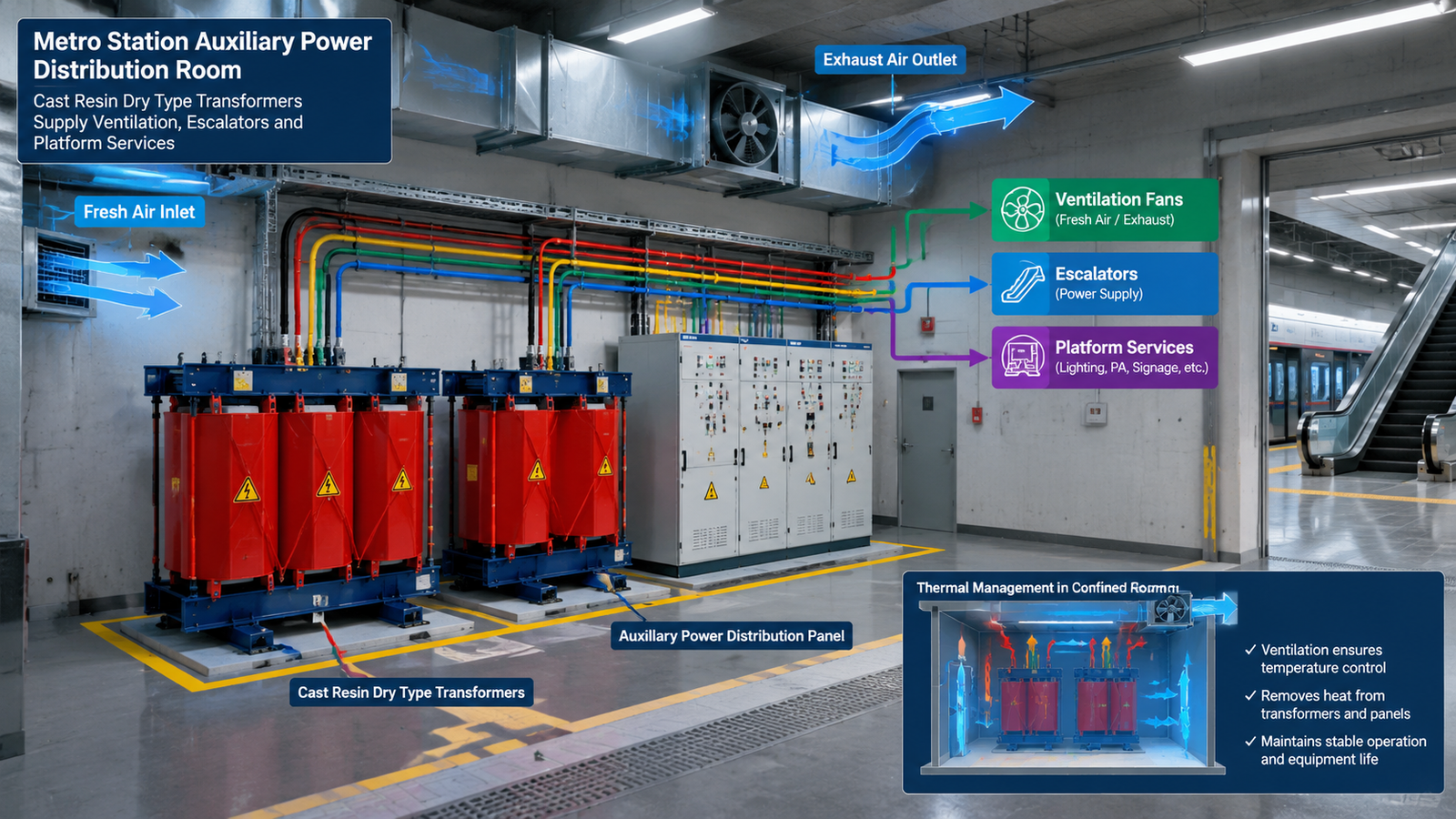
Supplies ventilation fans, escalators, lifts, lighting, signalling and platform services
Cast resin dry type, installed in station or tunnel equipment rooms
Fire behaviour, noise, condensation resistance, thermal margin for cyclic loads
The switchgear and substation solution package is where these two paths usually meet the protection scheme, and it is worth agreeing the transformer scope against the traction interface early — impedance and harmonic cancellation are shared decisions.
Traction rectifier transformers
Rectifier duty is a converter application, not a plain step-down. The transformer sees the harmonic spectrum of the rectifier group on its secondary and is normally designed with that spectrum stated in the specification rather than assumed. Multi-pulse arrangements are chosen for their harmonic cancellation on the primary side, and the transformer’s winding design has to suit the resulting current waveform. Impedance is also part of the traction protection story, because it influences DC fault levels and the coordination with the rectifier and DC switchgear.
Auxiliary and station transformers
Station duty looks more like a building load, but with sharper cycling: ventilation ramps with tunnel temperature, escalators start and stop, and lifts follow passenger flow. Load peaks are short and repetitive rather than sustained, which is why a temperature rise with genuine margin matters more here than in an office building. Foil-wound low-voltage windings are commonly chosen because they handle these short peaks and the mechanical forces involved.
Fire behaviour: the requirement that rules out oil
Fire behaviour class is the first line of the specification, and it is where the code requirement enters the design.
IEC 61936-1 separation distances for indoor units
IEC 61936-1 sets out how much separation an indoor transformer installation requires, and the answer depends entirely on the technology and the fire class. The pattern in the standard is that a properly rated dry-type unit needs clear distance from a non-combustible wall, while liquid-filled units need a rated fire-resisting enclosure or automatic protection.
Transformer type
Safeguard required
Separation from non-combustible wall
Dry type, fire class F0
No special fire risk assumed
About 0.9 m horizontally, 1.5 m vertically
Dry type, fire class F1 or F2
Non-combustible walls
Per the standard’s arrangement rules
Liquid-filled, up to about 1,000 L of liquid
Fire-resisting enclosure, typically EI 60 / REI 60
Enclosure rating governs
Liquid-filled, above about 1,000 L of liquid
Higher fire-resisting rating, or EI 60 plus automatic sprinkler protection
Enclosure rating governs
Read the table as a comparison of obligations, not as a substitute for the standard. The practical conclusion for an underground room is straightforward: an F1 dry-type unit removes the fire-resisting construction, the containment and the sprinkler question from the civil and fire scopes, which in a tunnel is worth considerably more than the equipment price difference.
What F1 actually means, and what to verify
Under IEC 60076-11, F1 describes limited flammability, self-extinguishing behaviour and the absence of burning droplets, with low toxic emission. F0 means the unit is not tested against those criteria. For a station or tunnel equipment room, F0 is not an acceptable substitution, and a manufacturer’s claim is not evidence — ask for the fire test report. The epoxy formulation, its wall thickness and its filler content all contribute to the classification, so two visually identical castings can carry different results.
The material point behind the class is smoke. In a confined underground space, the toxic emission and smoke density of the insulation system matter as much as flame spread, because they determine whether evacuation and intervention are possible at all.
Environmental classes for tunnels and underground rooms
The climate and pollution classes in IEC 60076-11 are what separate a unit that survives a tunnel from one that does not. The combination most commonly specified for underground transit work is C2 E2 F1: rated to a minimum ambient of −25 °C, suited to frequent condensation and heavy pollution, and fire behaviour class F1.
The E2 part is the one worth dwelling on. Cast resin encapsulation seals the high-voltage winding against moisture ingress, which allows operation at high relative humidity and, importantly, restart after a long shutdown without pre-drying. A VPI design that relies on surface protection rather than encapsulation is more sensitive to the same conditions, which is why the winding construction and the environmental class should be specified together. The full class system is set out in our guide to transformer insulation class and IEC 60076-11 classes.
Enclosure protection follows the room. IP20 is adequate in a clean, dry station equipment room. For a tunnel equipment room with dust, humidity and the occasional washdown, IP23 stainless steel is the usual minimum, with higher ratings and anti-corrosion treatment where conditions are severe.
Noise: the constraint nobody puts in the tender
Transformer noise is core magnetostriction, which appears as a hum at twice the supply frequency — 100 Hz on a 50 Hz system — plus its harmonics. In a station, that hum travels through the structure as much as through the air, and an equipment room adjacent to a platform or a commercial tenancy turns it into a complaint rather than an engineering problem.
Well-designed cast resin units in this class sit around 50–55 dB(A) at one metre, with general-purpose units in the 55–65 dB(A) range. Lower figures come from reduced core flux density, step-lap core joints to limit local flux concentration, and anti-vibration pads between core and enclosure that interrupt the structure-borne path. Where the room abuts a noise-sensitive space, these are specification items, not options — state a maximum sound pressure level and require the test method.
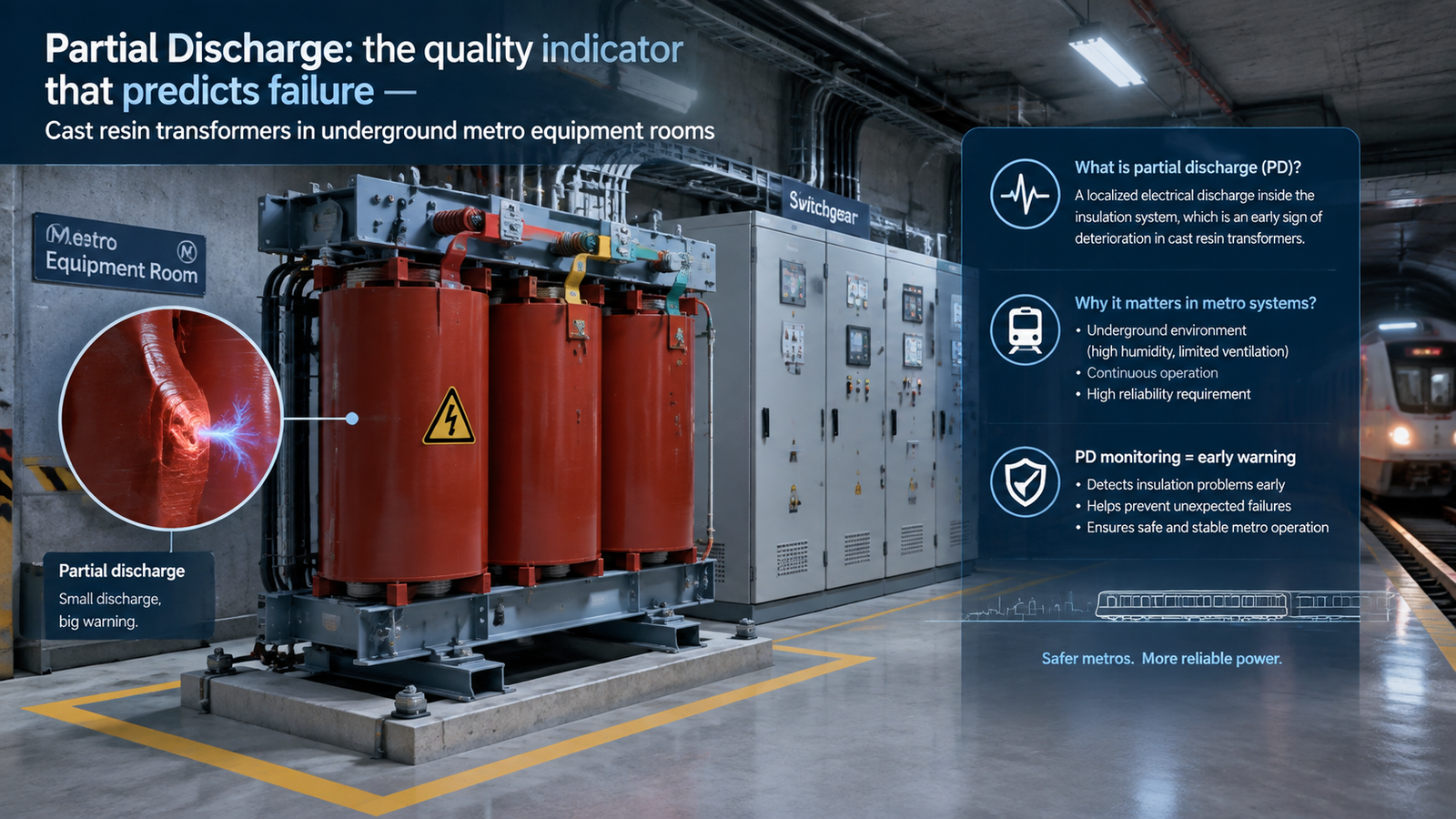
Partial discharge: the quality indicator that predicts failure
Partial discharge is the most useful single indicator of cast resin winding quality. It measures small discharges occurring inside voids or defects in the casting, and because those voids progressively erode the insulation, a unit with high partial discharge will fail early regardless of how good its nameplate looks.
Good cast resin practice is below 10 pC measured at an elevated voltage, tested to IEC 60270. Values above roughly 20 pC point to voids or poor vacuum casting control. Since the defect is invisible from outside, the test is the only practical defence — require it as a routine test with the recorded value on the certificate, not as a type test on a sample.
Ventilation and thermal design in a confined room
A dry-type transformer rejects heat by convection, so the room is part of the thermal design. As a working figure, a naturally cooled unit in the 1,600 kVA class needs several square metres of net inlet and outlet opening to maintain its rating, with the outlet placed high so hot air leaves rather than recirculating. Where the structural opening cannot be that large, the honest alternatives are forced ventilation or a forced-air-cooled unit — not an assumption that it will be fine.
Metro equipment rooms commonly run at 30–40 °C ambient. A unit designed to a 40 °C reference ambient and installed in a 45 °C room is not delivering its rated capacity, and the derating should be calculated rather than discovered. Clearance planning and the room-sizing arithmetic are set out in our dry type transformer sizes and dimensions chart, and the envelope should be checked against the actual access route as well as the room.
Seismic and vibration
Rail infrastructure carries seismic and vibration requirements that a normal building does not. Seismic qualification for substation equipment is commonly demonstrated against IEEE 693, using a reinforced frame and anti-vibration mounts, and structural calculations or shake-table reports are usually required at submittal. Vibration isolation also serves the acoustic requirement, so the two are worth resolving together rather than as separate line items.
Standards map for rail transit projects
Standard
What it covers
Where it applies
IEC 60076-11
Dry-type transformers: thermal classes, fire behaviour classes F0 and F1, environmental classes, partial discharge and short-circuit withstand
Fixed guideway transit and passenger rail system fire safety, including indoor transformer installations
North American transit projects
GB 1094.11
Chinese national dry-type transformer standard, technically aligned with IEC 60076-11
Chinese domestic and Chinese-standard export projects
IEEE 693
Seismic design recommendations for substation equipment
Seismically active regions
Several of these apply at once, and the tender usually names the transformer standard while leaving the installation standard to the civil designer. The dry type transformer specification guide covers the construction and testing side, and the wider plant interfaces are described in our industrial power network solutions overview.
Specification checklist
State fire behaviour class F1, and require the fire test report — not a manufacturer statement.
State climatic, environmental and enclosure classes together: typically C2, E2, IP23 for tunnel rooms.
Set the design ambient and the actual room ambient, and require the derating to be calculated.
Specify a maximum sound pressure level and the measurement standard if the room is near occupied space.
Require partial discharge as a routine test with the recorded value, per IEC 60270.
For traction duty, state the rectifier pulse number and the harmonic spectrum rather than only the kVA.
Confirm the delivery envelope and access route against the manufacturer’s outline drawing.
Add seismic and vibration isolation requirements where the region or the structure demands them.
Conclusion
Underground transit duty is a specification problem before it is a rating problem. A cast resin unit with fire behaviour class F1, environmental class E2 and an IP23 enclosure removes the fire-resisting construction, containment and sprinkler obligations that a liquid-filled unit would impose on a tunnel. After that, the design work is thermal and acoustic: real ventilation for the room, an ambient figure you are willing to defend, a declared temperature rise with margin for cyclic station load, and a sound level that does not reach the platform. Verify partial discharge on every unit, because it is the one number that predicts whether the transformer will still be there in twenty years. For units built to these classes, the cast resin data in our SCB series dry type transformer range is a practical reference point.
FAQ
Why can’t oil-filled transformers be used in metro tunnels?
Because a confined underground space cannot contain an insulating-liquid fire or provide the rated fire-resisting enclosure, containment and sprinkler protection that a liquid-filled installation requires. Most transit authorities therefore specify non-liquid dry-type construction for indoor and underground installations.
What fire class is required for a metro transformer?
Fire behaviour class F1 under IEC 60076-11 — limited flammability, self-extinguishing, no burning droplets and low toxic emission. Class F0, which means the unit is not tested against those criteria, is not an acceptable substitution for a station or tunnel equipment room.
What does the C2 E2 F1 designation mean?
It is the IEC 60076-11 class combination: C2 climatic class rated to a minimum ambient of −25 °C, E2 environmental class for frequent condensation and heavy pollution, and F1 fire behaviour class. It is the combination most often specified for underground transit installations.
What is a metro traction transformer?
It is a rectifier transformer that steps medium voltage down to the rectifier producing the 750 V or 1,500 V DC traction supply. Its design is driven by the rectifier pulse number and harmonic spectrum rather than by kVA alone.
What partial discharge limit should be specified?
Below 10 pC at 1.5 times rated voltage, measured to IEC 60270, as a routine test on every unit. Values above about 20 pC indicate voids in the casting and correlate with premature insulation failure.
What noise level can a cast resin transformer achieve in a station?
Well-designed units in this class reach roughly 50–55 dB(A) at one metre, with general-purpose units typically 55–65 dB(A). Reduced flux density cores, step-lap joints and anti-vibration mounts are the design measures that get you to the lower figure.
How much ventilation does an underground transformer room need?
Enough net opening — inlet low and outlet high — to carry away the total losses by convection, which for a naturally cooled unit in the 1,600 kVA class commonly means several square metres of net opening. Where that is impossible, forced ventilation or a forced-air-cooled unit is the correct answer.
How percentage impedance sets the fault level, the voltage drop and the parallel operating rules, with worked fault-current and regulation calculations.
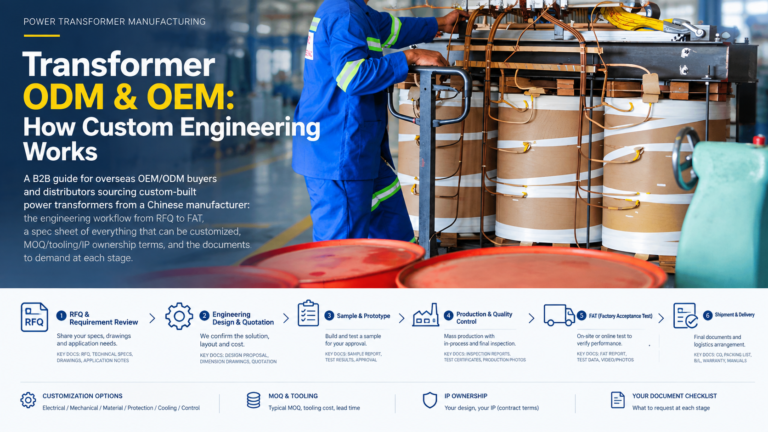
Transformer ODM and OEM programs explained: the custom engineering workflow from RFQ to FAT, the 15-field spec sheet, tooling and IP ownership, MOQ and lead-time terms.