How to Choose a Power Transformer Manufacturer in China
Published: Author: Lisa
If you need to choose a power transformer manufacturer in China, the real work is not finding suppliers — it is qualifying them. China builds roughly 60% of the world’s transformers and can deliver a standard unit in 10–12 months against 18–24 months for most Western plants, but manufacturing depth, testing capability and documentation vary just as widely as price. A short, disciplined qualification process decides whether you receive a compliant transformer on schedule or inherit a two-year delay.
This guide is a working audit checklist for procurement managers, EPC contractors, MEP consultants and distributors placing a first or second order with a Chinese factory. Every point below can be checked from documents, a live video tour or a witnessed test, so you can qualify a supplier without travelling to China.
Why supplier selection decides the outcome of a transformer project
The 2026 market is in a structural shortage, which shifts leverage to suppliers and makes qualification more important, not less. Customs data cited by industry research puts China’s transformer exports at about RMB 21.77 billion for January–April 2026 alone, up 27% year on year, with large transformer exports up 53%. Many Chinese factories report order books extending into 2027.
Elsewhere lead times are far longer. Large power transformers in North America commonly run 36–48 months, and domestic production covers only around 20% of US demand. That gap is why so many projects now source from China — and why a weak supplier can promise a date it cannot hold.
The cost of choosing badly is rarely the invoice price. It is the delay penalty, the re-test, the failed energization and the warranty dispute.
Failure mode
What it typically costs
How to prevent it
Late delivery
Milestone penalties, idle crews and delayed energization
Verify capacity and backlog; write delay penalties into the contract
Non-compliant unit
Rejected at site inspection; rework or replacement
Match certification scope to your rating and market before ordering
Higher losses than quoted
Years of avoidable energy cost
Sign a loss guarantee with a stated tolerance
Missing documents
Customs delays and grid-approval rejection
Agree the document set in the purchase order
No after-sales support
Long outages and unbudgeted spares
Confirm warranty, spares and response times in writing
Factory or trading company? Confirm you are buying from the actual maker
Before any technical review, establish what kind of company you are dealing with. Many suppliers presenting themselves as manufacturers are traders reselling factory output. That is not automatically wrong, but if you believe you are buying from a factory and you are not, you lose visibility of the things that actually determine reliability: core steel grade, winding material and insulation system.
Business licence scope. Ask for the Chinese original. The registered scope should include manufacturing, not only sales or trading.
Factory address. It should match the licence and the address shown on the test reports.
Live video tour. Request a walkthrough of the winding shop, the casting or VPI area and the test bay during working hours. A real factory can arrange this within a day.
Production evidence. Ask for dated photos or video of your product type in production, not catalogue renders.
Export record. Ask which markets they shipped to in the last 24 months and request anonymised test reports and packing lists.
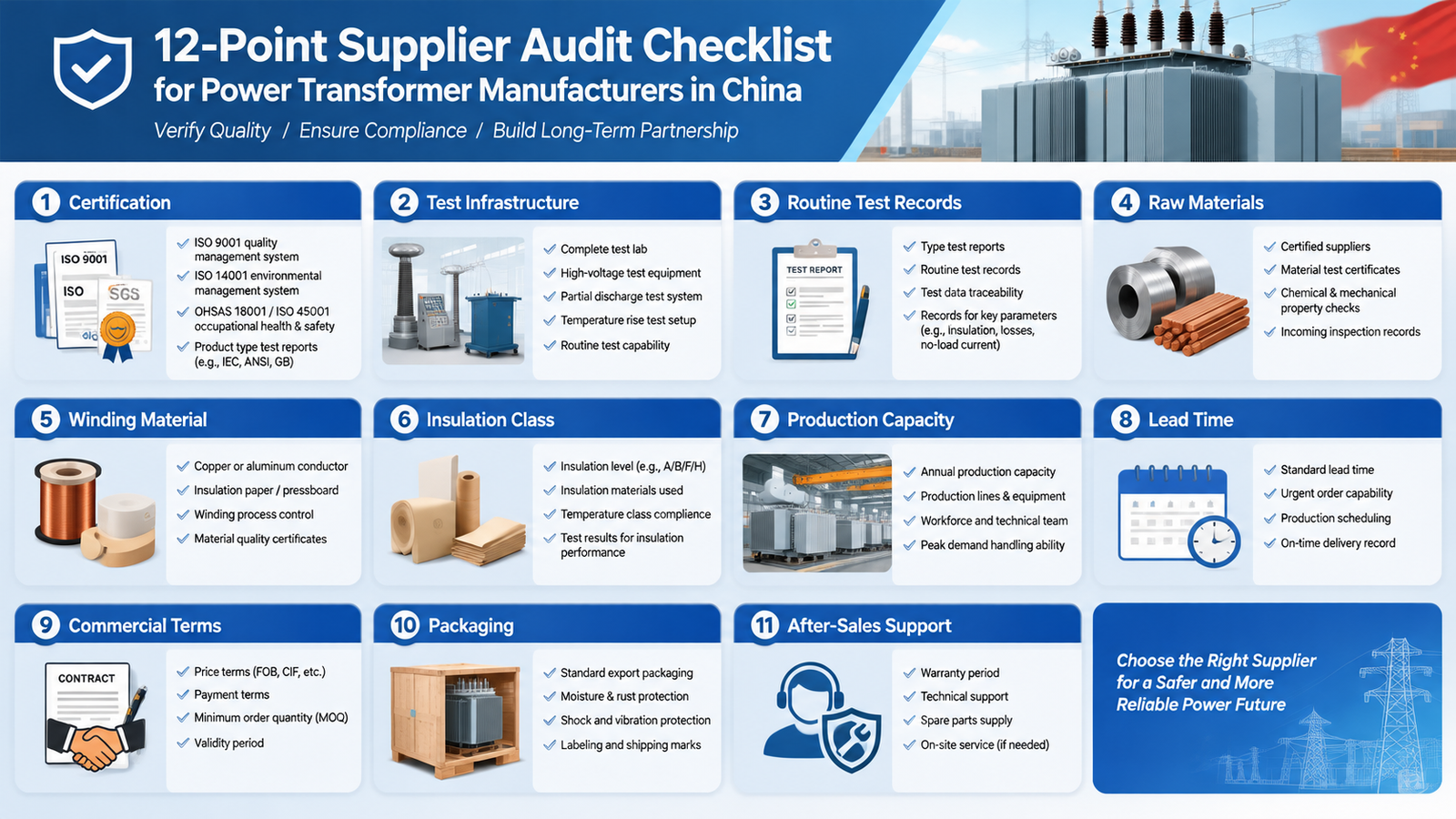
The 12-point power transformer manufacturer audit checklist
Use the table below as a scoring sheet. Weight the points by project risk: for utility or infrastructure work, certification, testing and materials carry the most weight; for a clean indoor installation with a short lead time, capacity and commercial terms may matter more.
#
Checkpoint
What to verify
Evidence to request
1
Certification and standards
ISO 9001 plus IEC 60076 type test; market-specific marks
Certificate numbers for online verification; full report
2
In-house test infrastructure
Impulse generator, partial discharge room, heat-run platform, loss bridge
Equipment list and calibration certificates
3
Routine test records
Evidence that every unit is tested before shipment
Dated reports from the last six months
4
Type and special tests
Design proven for temperature rise, impulse and short-circuit
Accredited lab report matching your rating class
5
Raw material control
Grain-oriented electrical steel and insulation traceability
Incoming inspection records and supplier certificates
6
Winding material
Copper or aluminium, declared and consistent
Conductor purity report (copper above 99.9%)
7
Insulation and thermal class
System matches the specified temperature class and standard
Design sheet for your exact model
8
Production capacity
Output realistic for your order size and schedule
Factory layout, shifts and work-in-progress evidence
9
Lead time and backlog
Date is achievable, with contingency
Current order book and component lead times
10
Commercial terms
Loss guarantee, tolerance, payment and warranty
Signed technical specification and contract clauses
11
Packaging and logistics
Sea-freight protection for long voyages
Packing specification, shock indicators, lifting marks
12
After-sales support
Warranty, spares and response times
Written after-sales policy and reference cases
Certifications must match your destination market
A certificate is only as useful as its scope. Check that it covers your transformer type, voltage class and capacity range, and verify the number with the issuing body — a PDF on its own proves nothing.
Market
Required or expected
What to verify
Global baseline
ISO 9001 and IEC 60076 type test report
Validity via IAF CertSearch; complete report, not the cover page
European Union / EEA
CE marking, EN 60076, Ecodesign
Technical file controlled by the manufacturer
USA / Canada
UL 1561 (up to 600 V) or UL 1562 (above 600 V), CSA, DOE efficiency
Model-specific listing in the UL online database
Middle East
SASO, G-Mark
Certified models exactly match the ordered product
Southeast Asia
SIRIM and local equipment registration
Registration per destination country
Russia / CIS
EAC, GOST
Certificate valid for the voltage class
India
BIS and IS 11171 for dry type
Licence issued against the exact standard
Two details catch buyers out. First, UL 1561 covers dry-type transformers up to 600 V and UL 1562 covers those above 600 V, so a 480 V unit quoted against UL 1562 is a common specification error. Second, CE marking for transformers is largely self-declared, so it carries less weight than an accredited witnessed test report.
Standards also differ by design. IEC 60076-11 governs dry-type transformers and IEC 60076-12 governs oil-immersed units; GB 1094 and GB/T 6451 are the Chinese equivalents; and GB 20052 defines the S11, S13 and S15 efficiency grades you will see quoted by Chinese factories.
In-house testing separates a manufacturer from an assembler
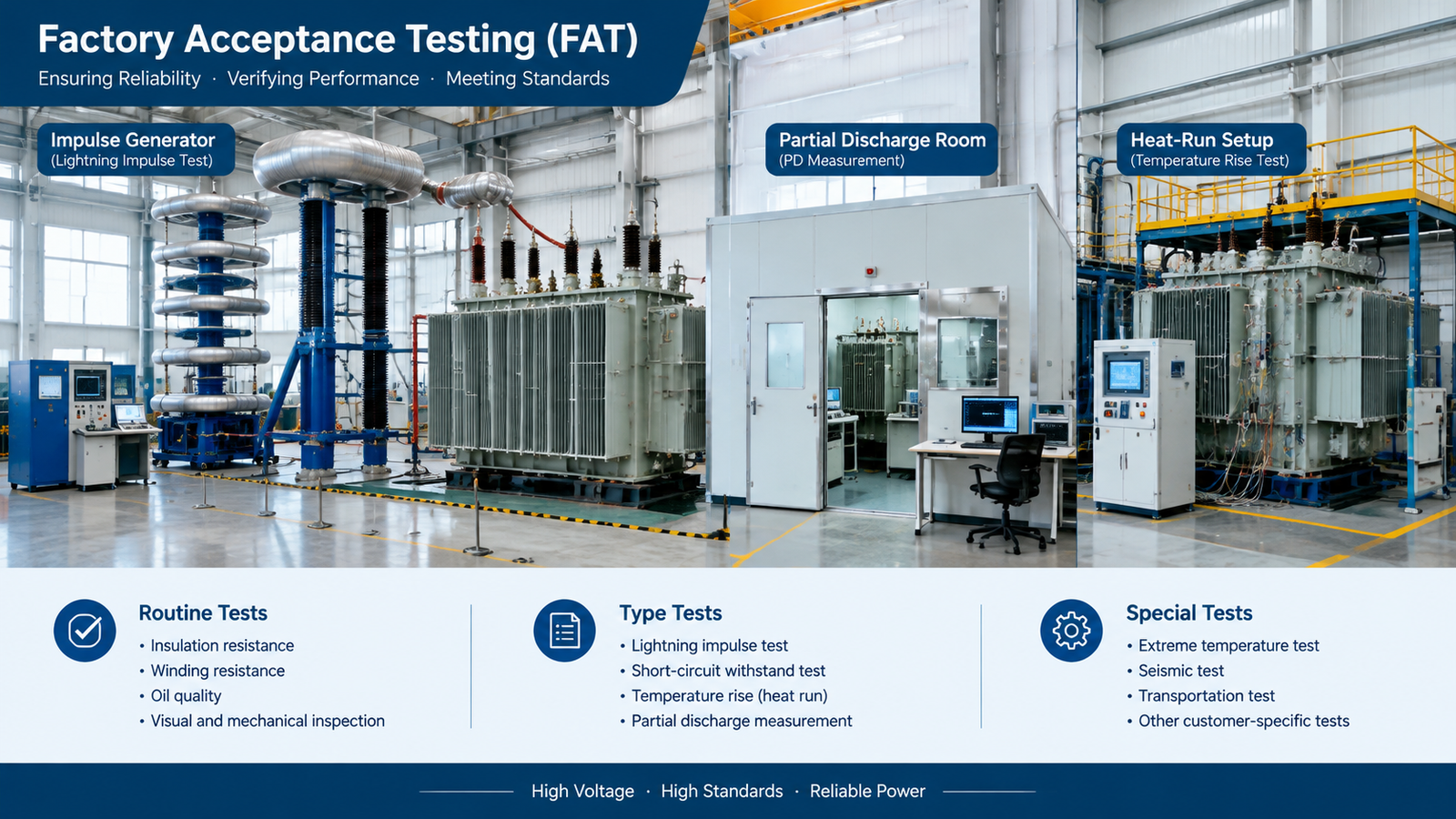
Ask for the equipment list and current calibration certificates. A serious power transformer factory owns its impulse generator, partial discharge test room, temperature-rise (heat-run) platform and loss-measurement bridge. A factory that outsources every type test has limited control over design quality.
Raw materials and winding material
Request incoming-inspection records for grain-oriented electrical steel and copper conductor purity reports — copper should normally exceed 99.9% purity. Insulation should be traceable to named suppliers where your specification requires it. Aluminium windings sold as copper remain one of the oldest problems in the market, and they change losses, physical size and service life.
If your specification calls for a particular insulation system or temperature class, confirm it is designed in rather than added as a marketing claim. Our dry-type transformer specification reference explains the ratings, insulation classes and clearances a compliant unit should state.
Capacity, backlog and a delivery date you can hold
Compare claimed monthly output against facility size, shift pattern and work in progress. Inflated capacity claims are the single best predictor of a missed delivery date.
Type
Typical China lead time (2026)
Notes
Standard dry-type
20–32 weeks
Cast-resin or VPI designs
Oil-immersed distribution
30–45 weeks
Depends on rating and accessories
Large or custom power
10–12 months (emergency under 8)
Against 18–24 months for Western plants
North America large power
36–48 months
Domestic capacity covers only about 20% of demand
Factory acceptance testing: routine, type and special tests
Brochures describe what a factory intends to build; test reports document what it actually built. Put the testing plan in the contract, and insist on a witnessed factory acceptance test (FAT) for anything above a routine order.
Test group
Tests
Applies to
Routine (every unit)
Winding resistance; ratio and vector group; no-load loss and current; load loss and impedance; insulation resistance; applied and induced voltage withstand
All units
Type (design proof)
Temperature rise (heat run); lightning impulse; short-circuit withstand
A representative design
Special
Partial discharge; sweep frequency response analysis; sound level; dissolved gas analysis
On request
For oil-immersed units, ask for the oil breakdown voltage (BDV), commonly required above 60 kV per 2.5 mm gap. For medium-voltage dry-type units, partial discharge at or below 5 pC is a standard acceptance point.
You do not have to travel to China to witness testing. A live video FAT, or a third-party inspector from SGS, Bureau Veritas or TUV, is accepted practice. A supplier that welcomes witnessed testing is telling you something; one that resists is telling you more. For the full test sequence and how it maps onto procurement documents, see our power transformer selection and procurement guide.
Commercial terms that protect the buyer
Price is the easiest number to compare and the least reliable. Three terms matter more.
Loss guarantee. Write no-load and load losses into the contract at the reference temperature (75 °C for oil-immersed), with a stated tolerance, normally +15% per IEC 60076-1.
Total cost of ownership. Capitalised losses over 25 years often exceed the purchase price. At an 8% discount rate, a 25-year life and $0.12/kWh, every watt of loss is worth roughly $11.22, so a slightly cheaper unit with higher losses can be the more expensive choice.
Payment, warranty and spares. Agree milestones tied to the FAT, a warranty period, spare-parts availability and after-sales response times before signing.
Define the specification precisely: kVA or MVA, primary and secondary voltage, vector group, impedance, cooling (ONAN/ONAF), BIL, loss limits, altitude, ambient temperature and enclosure or IP rating.
Shortlist three to five factories rather than traders.
Send the same specification sheet to all of them and compare like for like.
Verify certifications online and match their scope to your rating.
Request test-infrastructure evidence and recent routine test reports.
Arrange a live video audit or a third-party on-site audit.
Place a one-unit pilot order with a full witnessed FAT before committing to volume.
Only after the pilot passes, negotiate the volume contract with loss guarantees and delivery penalties.
The pilot order is the highest-value step in the list. One compliant unit with a witnessed test costs a fraction of a failed batch and confirms everything the paperwork promised.
Choosing a manufacturer you can hold to the specification
Selecting a power transformer manufacturer in China comes down to evidence, not adjectives. Confirm you are dealing with a real factory, match certifications to your market, demand the test reports, lock losses into the contract, and run a pilot unit before you scale up. A supplier that supports every one of those steps is the one worth signing with.
Kampa Electric manufactures oil-immersed and dry-type transformers from 11 kV to 35 kV for industrial, utility and commercial projects, with IEC 60076 testing and support for third-party inspection. If you have a specification sheet ready, contact our engineering team for a factory-direct quotation and a proposed test plan.
Frequently asked questions
How do I know if a Chinese transformer supplier is a real factory?
Check the business-licence scope for manufacturing, confirm the factory address matches the test reports, ask for a live video tour of the winding, casting and test areas, and request dated production photos. A third-party audit from SGS or Bureau Veritas settles the question definitively.
What certifications should a power transformer manufacturer have?
As a baseline, ISO 9001 and an IEC 60076 type test report. Then match your destination market: CE and EN 60076 for the EU, UL 1561 or UL 1562 plus DOE efficiency for North America, SASO or G-Mark for the Middle East, SIRIM for Malaysia, EAC for Russia and the CIS, and BIS with IS 11171 for India.
Can I witness the factory acceptance test without travelling to China?
Yes. Most established factories accept a live video FAT, and many buyers appoint an independent inspector to witness testing on site. Both are common for first orders and cost far less than a failed shipment.
How long does a power transformer take to manufacture in China?
Standard dry-type units typically take about 20–32 weeks, oil-immersed distribution transformers 30–45 weeks, and large or custom power transformers about 10–12 months, with emergency slots sometimes under eight months. Western factories commonly quote 18–24 months for comparable units.
Should I worry about copper versus aluminium windings?
Yes. Aluminium windings are legitimate for some ratings, but they are larger, less conductive and less thermally robust, and they must be declared. If your specification requires copper, ask for conductor purity reports; copper should exceed 99.9% purity.
What is the biggest mistake buyers make when sourcing from China?
Choosing on unit price alone and skipping factory verification. Most failures trace back to an unverified supplier, an unverified certification scope or a skipped witnessed test — all of which are avoidable before the order is placed.
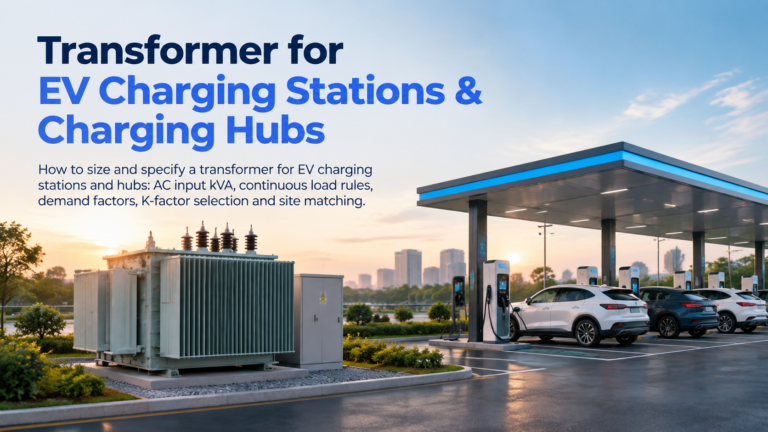
How to size and specify a transformer for EV charging stations and hubs: AC input kVA, continuous load rules, demand factors, K-factor selection and site matching.
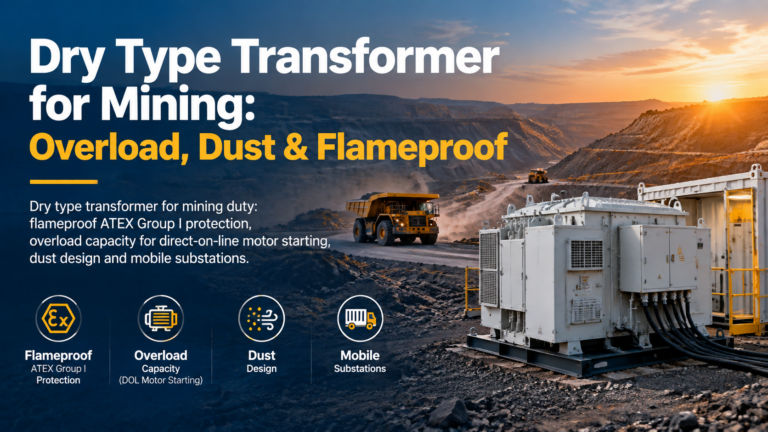
How to specify a dry type transformer for mining: flameproof Group I protection, overload for direct-on-line motor starting, dust design and mobile substations.
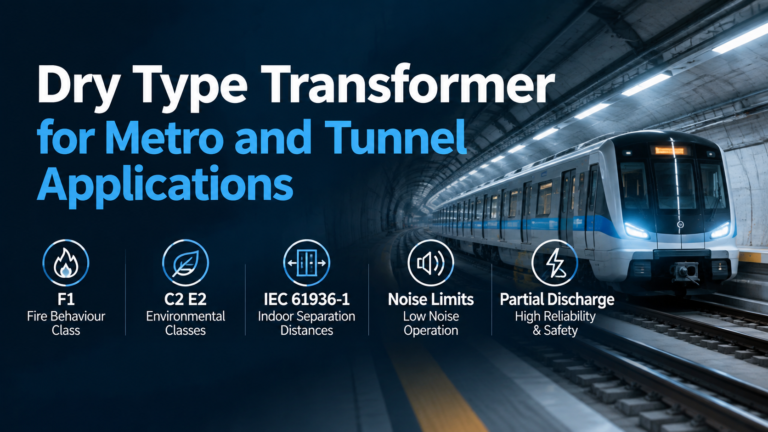
How to specify a dry type transformer for metro and tunnel duty: F1 fire behaviour, C2 E2 environmental classes, IEC 61936-1 separation and partial discharge limits.