Transformer ODM & OEM: How Custom Engineering Works (Spec Sheet)
Published: Author: Lisa
Most overseas buyers who ask for a transformer ODM or OEM program are not trying to invent a new product. They need a unit that fits a real switchroom — a voltage pair the local grid actually delivers, an enclosure that clears the cable trench, a nameplate carrying their own brand instead of the factory’s. The factory’s job is to turn that requirement into a drawing, a tested unit and a repeatable production process.
The gap is usually not capability, it is information. A vague enquiry such as “we need a 1000 kVA transformer” forces the engineering team to guess at six or seven parameters, and every guess becomes a change order later. A complete specification sheet removes that guesswork and typically shortens the whole cycle by weeks.
This guide walks through what ODM and OEM cooperation really involve, compares them with standard catalogue supply, and gives you the specification fields, engineering stages, test scope, tooling terms and document checklist that a custom power transformer order runs on.
What “Transformer ODM” and “OEM” Actually Mean
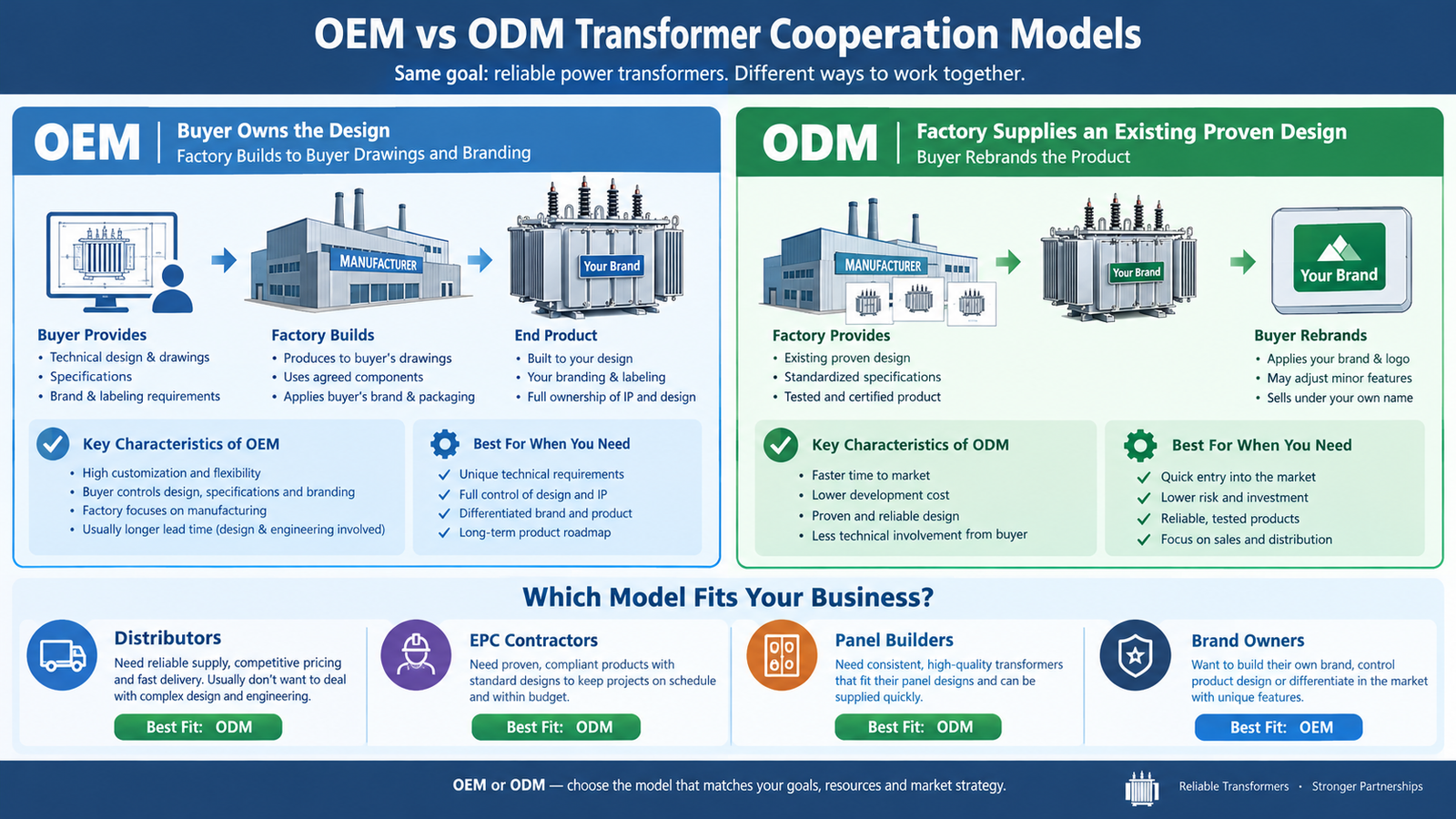
In the transformer industry the two terms describe who owns the design, not who owns the factory:
OEM (original equipment manufacturing) — you own the design. You supply drawings, specifications, brand assets and quality requirements; the factory manufactures to your documents, applies your nameplate and packaging, and does not sell that design under its own name.
ODM (original design manufacturing) — the factory owns an existing, already type-tested design. You select it, request minor variations, apply your own brand and sell it as your product line.
The practical difference shows up in three places: who carries the design risk, who pays for engineering and tooling, and how long the first unit takes. Everything else — the winding shop, the test bay, the impregnation plant — is the same building.
OEM vs ODM vs Standard Supply: Which Model Fits Your Business
Before requesting a quotation, decide which cooperation model your project actually needs. Choosing ODM when you need OEM (or the reverse) is the most expensive mistake in a custom transformer programme, because it is discovered late.
Factor
Standard / catalogue
OEM
ODM
Who owns the design
Factory
You (buyer)
Factory
Engineering effort carried by you
Selection only
Full design package, drawings, tolerances
Review and approval of an existing design
Typical unit cost
Lowest
Higher — NRE, tooling, inspection
Moderate — amortised across the factory’s customer base
Distributors, resellers, EPC contractors, new market entrants
The same factory can serve all three models at once, but not with the same lead time. If your business plan depends on a two-year product roadmap with your own drawings, an ODM platform will feel restrictive. If your plan depends on launching a private-label range in one season, OEM engineering will simply be too slow. An experienced OEM and ODM transformer manufacturing partner will tell you which model its existing platforms support before quoting.
The Custom Engineering Workflow, Stage by Stage
A disciplined custom transformer programme moves through eight stages. Each stage has an output you approve, and skipping an approval is how projects end up with units that fit the electrical drawing but not the switchroom door.
#
Stage
What happens
What you approve or receive
1
RFQ and requirement review
Engineering reviews your specification sheet, one-line diagram and installation constraints. Missing parameters are flagged as questions, not assumptions.
Two stages deserve extra attention. Stage 3 is where tooling ownership is fixed — if you pay for a winding mould or enclosure tool, the agreement should say that you own it and that it cannot be used for a competing product without your written consent. Stage 6 is optional for small programmes but essential when a new design will be produced for years: it is the only cheap opportunity to find a repeatability problem.
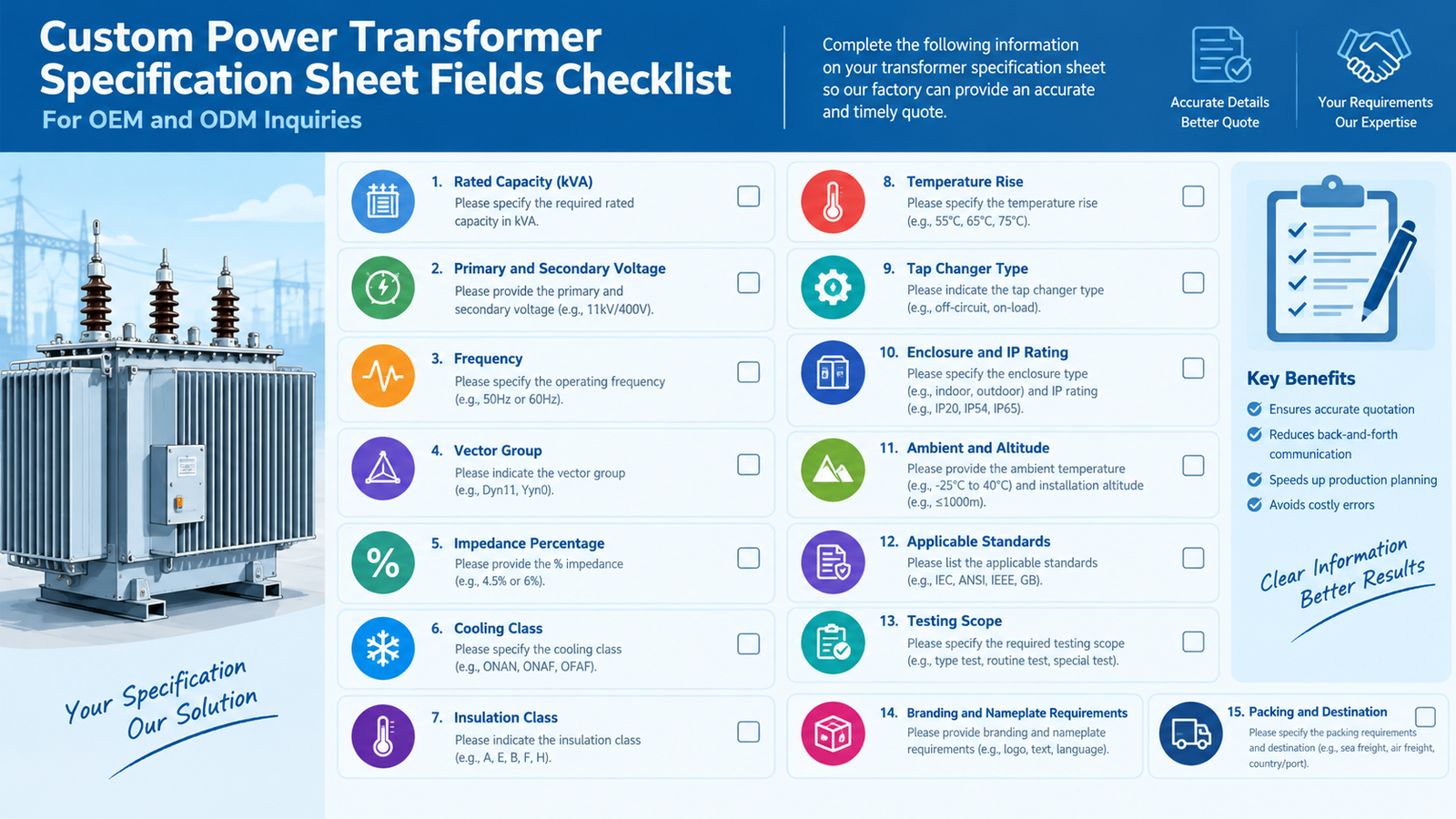
The Specification Sheet: 15 Fields to Complete Before You Request a Quote
This is the single highest-leverage document in the whole programme. Fill it in completely and the engineering review becomes a confirmation exercise; leave gaps and the factory will fill them with assumptions that may not match your site.
Field
What to state
Why it matters
1. Rated capacity
kVA (or MVA), based on maximum demand — not on the generator nameplate
Drives core and copper mass, weight, price and transport limits
2. Primary and secondary voltage
Both voltages, plus the highest system voltage
Sets turns ratio and insulation coordination
3. Frequency
50 Hz, 60 Hz, or dual-frequency
Core flux density and loss design change with frequency
4. Vector group
e.g. Dyn11, Yyn0, YNd11, Dyn5
Determines parallel-operation compatibility and harmonic behaviour
5. Impedance
Guaranteed %Z, typically 4–6% for distribution sizes
Controls fault level and voltage regulation
6. Cooling class
AN, AF, ONAN, ONAF, OFAF
Sets continuous rating and permissible overload margin
7. Insulation class
A, E, B, F or H
Fixes permissible temperature rise and enclosure requirements
8. Temperature rise
e.g. 55 K, 65 K, 75 K, 80 K
Service life and overload capability trade directly against size
9. Tap changer
Off-circuit (DETC) or on-load (OLTC); tap range and step
Affects cost, size and maintenance regime
10. Enclosure and IP rating
Indoor or outdoor, IP20 to IP55, NEMA equivalent
Cooling airflow, ingress protection and footprint
11. Ambient and altitude
Maximum ambient temperature and site elevation
Both require derating above standard reference conditions
12. Applicable standards
IEC 60076, IEEE C57, GB 1094, IS 11171, ANSI, CSA — whichever your market requires
Determines test scope, tolerances and certification route
13. Testing scope
Routine, type and special tests; third-party witness or not
Must be inside the quotation, not added after production
14. Branding and nameplate
Logo, model designation, label language, serial-numbering rule
Affects nameplate artwork, packing labels and lead time
15. Packing and destination
Sea, air or road; port or site; any inland transit restrictions
Determines crate design, gross weight and documentation
Two fields are routinely left out and cause the most rework: the load profile (continuous, intermittent, motor-starting, harmonic-rich) and the mechanical envelope (available space, mounting orientation, cable entry direction, lifting access). A transformer that is electrically perfect but 40 mm too tall still fails its fit-and-function review.
What Can Actually Be Customised
Customisation is not unlimited, but it covers far more than most buyers expect. The realistic scope breaks into four groups.
Group
Customisable
Notes and limits
Electrical
Voltage pair, kVA rating, frequency, vector group, impedance, tap configuration, dual-voltage windings, winding material (copper or aluminium), losses and efficiency level
Loss targets below the applicable efficiency regulation usually force a larger core or a better steel grade
Mechanical
Dimensions, enclosure type, mounting, terminal arrangement and position, weight reduction, colour and finish
A fixed footprint agreed before thermal calculations can restrict the available design margin
Environmental
IP rating, cooling configuration, corrosion protection for coastal or offshore sites, seismic bracing, acoustic treatment
Altitude and high ambient both reduce the permissible continuous load
Branding requirements must be supplied before nameplate artwork is released
For dry-type projects the mechanical and insulation choices usually matter more than the electrical ones, which is why the range of dry-type power transformers starts with the insulation system rather than the kVA figure. A cast-resin unit such as an epoxy resin cast dry-type transformer tolerates dust, humidity and condensation far better than an open-wound design, at the cost of a heavier, more expensive build. For outdoor and substation work, enclosures and tank construction dominate: an oil-immersed distribution transformer can be delivered hermetically sealed, with conservator, or pad-mounted, and a 35 kV oil-immersed power distribution transformer for a substation project will normally be specified with tap changer, protection accessories and a documentation pack agreed in advance.
Design Review: The Trade-Offs the Factory Should Flag
A competent engineering team raises conflicts during the design review rather than after the prototype fails. Expect questions in these areas, and treat a supplier who never raises them as a risk:
Low loss versus size. Meeting a tight no-load loss target usually means a larger core or a higher grade of grain-oriented steel, which increases weight, footprint and cost.
Compact enclosure versus cooling. Shrinking the enclosure restricts natural convection and can force a temperature-rise problem or a fan-cooled design with more moving parts.
Altitude and high ambient. Both reduce air density and heat transfer, so the permissible continuous rating drops unless the design is enlarged.
Non-standard vector groups. A vector group outside the common families is achievable but affects winding layout, cost and the type-test evidence you can rely on.
Harmonic-rich loads. Rectifiers, drives and UPS-fed loads need derating or a different winding arrangement; a standard distribution unit will run hot.
Fixed dimensions requested early. Locking the footprint before the thermal and electrical work is finished removes design margin and is a common cause of redesign.
None of these are reasons to refuse a requirement. They are the reasons the design stage exists.
Prototype, First Article and FAT: What You Approve and What You Test
For a custom design, approval is not a formality. The prototype is built on the production line so that the tooling, winding process and impregnation cycle are all validated together, and the test results become the reference for every unit that follows.
Testing scope falls into three groups under IEC 60076. Routine tests are performed on every unit and form the core of your factory acceptance testing; type tests qualify the design once and should be traceable to the exact design you are buying; special tests are ordered when the application demands them.
Group
Typical items
When it applies
Routine
Winding resistance, turns ratio, vector group check, no-load loss and excitation current, load loss and impedance, insulation resistance, applied and induced voltage withstand
Once per design; the report must reference the design being supplied
Special
Partial discharge measurement, harmonics and no-load current waveform, zero-sequence impedance, audible noise at specified load
When the contract or the site conditions require it
If a sample fails a critical parameter, reject it and require a documented corrective action before releasing production. Approving a non-conforming prototype is the single most expensive decision available in a custom programme, because it converts a contained problem into a repeat-order problem.
Commercial Terms for Custom Programmes: MOQ, Tooling, IP and Lead Time
Custom work changes the commercial structure, not just the product. A standard distribution transformer has a minimum order quantity of one unit, because it is built from the factory’s own drawings. A custom or private-label programme is a different animal.
Item
Standard supply
Custom OEM / ODM programme
MOQ
1 unit
Rises with tooling, unique parts and dedicated production runs — a pilot batch plus a production batch is typical
Tooling
None
Winding moulds, dies, fixtures or enclosure tooling invoiced as NRE, with ownership defined in the contract
Design ownership
Factory
OEM — yours; ODM — factory’s, with branding rights licensed to you
Payment structure
30% deposit with order, 70% against bill of lading copy
Milestone-based: deposit, design approval, prototype or FAT, then balance before shipment; larger programmes often use a documentary credit
Lead time
Dry type roughly 20–32 weeks; pad-mounted liquid units 40–65 weeks
Add engineering and prototype time to the production figure; slot reservations under a framework agreement protect capacity
Repeat orders
Re-quote at prevailing material cost
Price validity and change-order control should be written into the agreement instead of left to email
Two clauses are worth negotiating before the first purchase order. First, price validity and material escalation: a custom programme runs for years, and core steel and copper move faster than annual quotations. Second, change control for repeat orders — once drawings are frozen, any variation should go through a written change note with its own price and lead-time impact. The wider MOQ, lead time and payment terms behind these programmes are worth confirming during the enquiry stage, not after the drawings are approved.
Common Mistakes That Delay a Custom Transformer Order
Specifying only input and output voltage. Capacity, load type, duty cycle and starting current are just as important.
Sending a dimensional requirement without terminal positions. The unit fits the space but not the cable.
Leaving the test scope out of the quotation. Witness testing, third-party inspection and special tests cost money and time; discovering them at shipment stage is expensive.
Assuming a type-test report transfers to a modified design. A report for a different winding arrangement or rating does not qualify your design.
Not clarifying tooling ownership. Paying for tooling and not owning it removes your protection against a competitor receiving the same product.
Approving a non-conforming prototype. It sets the reference for every unit that follows.
No change-control process for repeat orders. Undocumented variations destroy traceability and warranty position.
Turning a Requirement into a Repeatable Product
Transformer ODM and OEM programmes succeed on documentation, not on goodwill. Decide who owns the design, complete the specification sheet, approve the drawings and tooling plan in writing, verify the prototype against the agreed test scope, and lock the commercial terms before volume production starts. Done in that order, a custom transformer becomes a repeatable catalogue item that your own brand can sell for years.
If you are working from a one-line diagram, a photograph of the existing installation or a competitor’s nameplate, that is enough to start. Send us your specification and our engineering team will return a clarification list, a technical proposal and a firm quotation for the cooperation model that fits your project.
Frequently Asked Questions
What is the difference between transformer OEM and ODM?
In an OEM programme you own the design and supply drawings and specifications for the factory to manufacture under your brand. In an ODM programme the factory owns an existing, type-tested design that you rebrand and sell. OEM offers full differentiation at higher cost and longer lead time; ODM gets you to market faster with proven hardware.
Is there a minimum order quantity for a custom transformer?
Standard distribution transformers normally ship from one unit. Once a design needs dedicated tooling, unique parts or a reserved production slot, the minimum rises — usually a pilot batch to validate the design plus a production batch. Framework agreements with a non-refundable deposit can reserve capacity for repeat programmes.
How long does a custom power transformer take to build?
Add engineering and prototype time to the standard production figure. Dry-type distribution units currently run roughly 20–32 weeks, and pad-mounted liquid-filled units 40–65 weeks in normal market conditions. A straightforward variation on an existing ODM platform is considerably faster than a new OEM design.
Who owns the drawings and tooling in a custom transformer project?
That is a contractual matter, and it should be settled before tooling is ordered. If you pay for the engineering and tooling, you should own them, and the agreement should state that the tooling and drawings cannot be used for a competing product without your written consent.
Should the type-test report apply to my exact design?
Yes. Type tests qualify a design, not a brand or a factory. If the winding arrangement, insulation system, rating or cooling class changes, ask for the report that references the configuration you are actually buying — otherwise your qualification evidence is not valid for that unit.
Can a custom transformer be certified for my export market?
Usually yes, but certification must be decided at the design stage, not after production. UL or cUL listing, CE marking, SASO, TIS, EAC and other market approvals each carry their own documentation and testing requirements, and some of them cannot be added retroactively to a finished unit.
In 2026 large power transformers average about 128 weeks while distribution units run 12-30 months. Here is what MOQ, lead time, payment terms and Incoterms really look like for buyers.
How transformers are classified under HS 8504, what the 2026 duty treatment looks like, and how to pack, containerise and document an export shipment so customs clears it without delays.
Routine, type and special power transformer tests under IEC 60076 explained for buyers — acceptance limits, what a FAT dossier must contain, red-flag readings and how to witness testing.