VS1 vs ZW32 vs ZW7: Vacuum Circuit Breaker Selection
Published: Author: Lisa
Three vacuum circuit breakers, three different jobs. The VS1 is an indoor switchgear breaker, the ZW32 is a pole-mounted outdoor unit for 12–24 kV overhead lines, and the ZW7 is a 40.5 kV outdoor breaker for substation feeders. They overlap in one place only — all three interrupt fault current in a vacuum bottle — and choosing between them is decided long before the electrical calculation, by where the breaker has to sit and what it has to protect.
This guide sets out the decision in the order it actually happens: indoor or outdoor, then voltage class, then breaking capacity, then mechanism and mounting detail. It closes with a type-code decoder and the specification fields that prevent a wrong order. If you need the general principles first, the vacuum circuit breaker overview covers the interrupting principle and the switching duty.
Three Families, Two Decisions
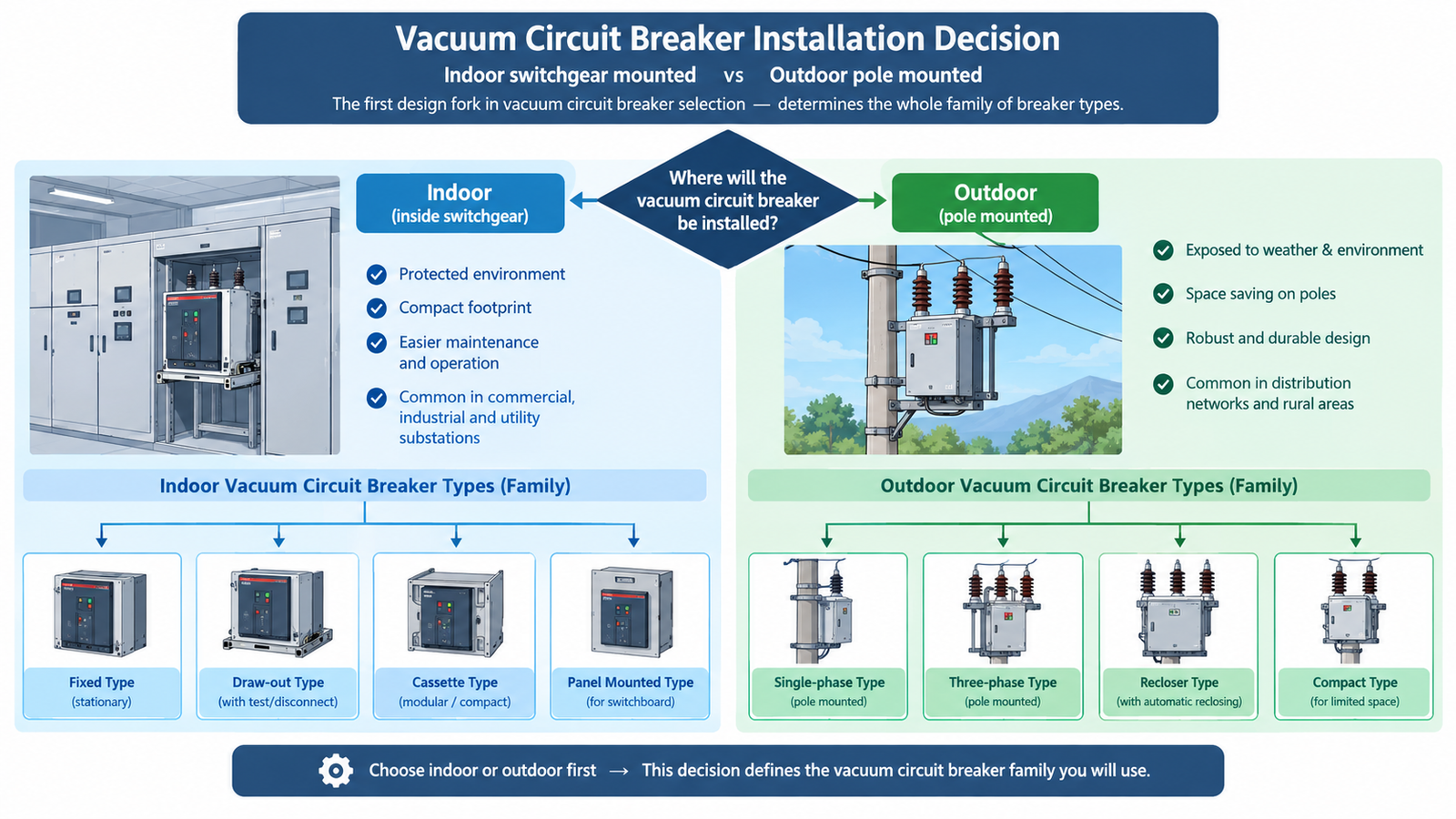
The first decision is environmental, and it eliminates two thirds of the options immediately:
Indoor, inside a switchgear cubicle — VS1 (and its handcart variants), mounted in KYN28-type metal-clad switchgear.
Outdoor, on a pole or a frame, exposed to weather — ZW32 at 12–24 kV, ZW7 at 40.5 kV.
The second decision is voltage class. ZW32 tops out around 24 kV; 35 kV systems need ZW7 or its equivalents. Between them they cover the medium-voltage distribution range that most export projects actually buy.
Decision 1: Indoor or Outdoor Governs Everything Else
An indoor breaker lives in a controlled environment and can rely on the cubicle for insulation clearance, cable termination and personnel protection. An outdoor breaker must carry all of that itself: its own insulation housing, its own terminal arrangements, its own operating mechanism enclosure, and a design that tolerates rain, dust, UV and condensation.
That difference explains the physical shape of the two families. The VS1 is a rectangular chassis designed to slide into a cubicle, with the primary contacts presented at the rear. The ZW32 is a sealed epoxy pole assembly on a frame, with bushings that accept overhead conductors, because nothing else is going to protect it.
Practical consequences:
Consideration
Indoor (VS1)
Outdoor (ZW32 / ZW7)
Insulation coordination
Provided by the cubicle and the breaker together
Entirely the breaker’s responsibility
Maintenance access
Through cubicle doors, with the truck withdrawn
Requires a ladder, a platform or a lift
Environmental rating
Assumes a dry, ventilated switchroom
Rated for pollution level III and 2,000 m altitude as standard
Typical buyer
Building, plant and substation switchgear packages
Utility distribution, rural electrification, overhead line projects
VS1: The Indoor Workhorse
The VS1 is the most widely copied indoor vacuum breaker pattern in the 12 kV class, and for good reason: it is simple, well understood and supported by a large switchgear ecosystem.
Voltage — 12 kV nominal, with 7.2 kV variants for lower-voltage systems.
Current — typically 630 A to 3,150 A depending on frame.
Breaking capacity — 20 kA to 40 kA, with 25 kA and 31.5 kA the common commercial points.
Mechanical life — around 30,000 operations on the better frames; rated short-circuit current can be broken on the order of 50 times.
Mounting — fixed type, or withdrawable on a handcart for cubicles with a truck.
The fixed-versus-withdrawable choice is its own decision and worth separating from the model choice: a withdrawable truck lets you rack the breaker out for maintenance and replace it with a spare in minutes, at the cost of a more complex cubicle and more mechanical parts to maintain.
The current range available in this family is listed on the VS1 series page; the withdrawable variant is described separately under the handcart version.
ZW32: Pole-Mounted, 12–24 kV
The ZW32 is the breaker you see on overhead distribution lines: a compact outdoor unit mounted on a pole bracket or a frame, usually with a current transformer set and a controller for automatic reclosing.
Voltage — 12 kV and 24 kV versions.
Current — 400 A and 630 A are the standard ratings.
Breaking capacity — 12.5 kA, 16 kA or 20 kA depending on the variant.
Mechanical life — around 10,000 operations; rated short-circuit current broken about 30 times.
Mechanism — spring operating mechanism, or a permanent-magnet actuator on the ZW32M variant.
The permanent-magnet actuator is the detail worth understanding before ordering. It replaces the spring-charging mechanism with a magnetic holding force and a capacitor-driven trip, which reduces the part count in the mechanism and makes the unit quieter and more consistent in operation. The trade-off is that the actuator needs a reliable DC supply and a controller that manages the capacitor charging — a failure mode that does not exist on a spring mechanism.
Note also the “-12G” suffix: it adds a visible isolation gap in series with the breaker, so the line can be isolated for work without a separate isolator. That single feature often decides between two otherwise identical offers. Both arrangements are shown on the ZW32 outdoor breaker page and the ZW8-12G page for the earlier pattern.
ZW7: 40.5 kV Outdoor Feeder Breaker
At 35 kV system voltage the breaker is a different animal. The ZW7 is a 40.5 kV outdoor unit mounted on a frame or a structure, with three separate pole assemblies and a common mechanism, and it is typically used as the incoming or outgoing breaker in a 35 kV outdoor substation.
Parameter
VS1 (12 kV)
ZW32 (12–24 kV)
ZW7 (40.5 kV)
Application
Indoor metal-clad switchgear
Pole-mounted overhead line
Outdoor substation feeder
Rated current
630–3,150 A
400–630 A
1,250–2,000 A
Breaking capacity
20–40 kA
12.5–20 kA
25–31.5 kA
Mechanical life
~30,000 operations
~10,000 operations
~10,000 operations
Mechanism
Spring, fixed or handcart
Spring or permanent magnet
Spring, frame mounted
Typical add-on
CT/PT, protection relay in the cubicle
Recloser controller, sectionaliser function
External CTs, protection panel
The pattern in that table is worth reading twice: the pole-mounted ZW32 has the lowest current and breaking ratings of the three, and that is not a limitation of design effort — it is what an overhead distribution line needs. A 630 A, 20 kA breaker is ample for a 12 kV feeder at the end of a rural network. Specifying more there buys nothing.
The 40.5 kV unit is available as a frame-mounted outdoor breaker; details are on the ZW7-40.5 page. The full product range is indexed under the vacuum circuit breaker category.
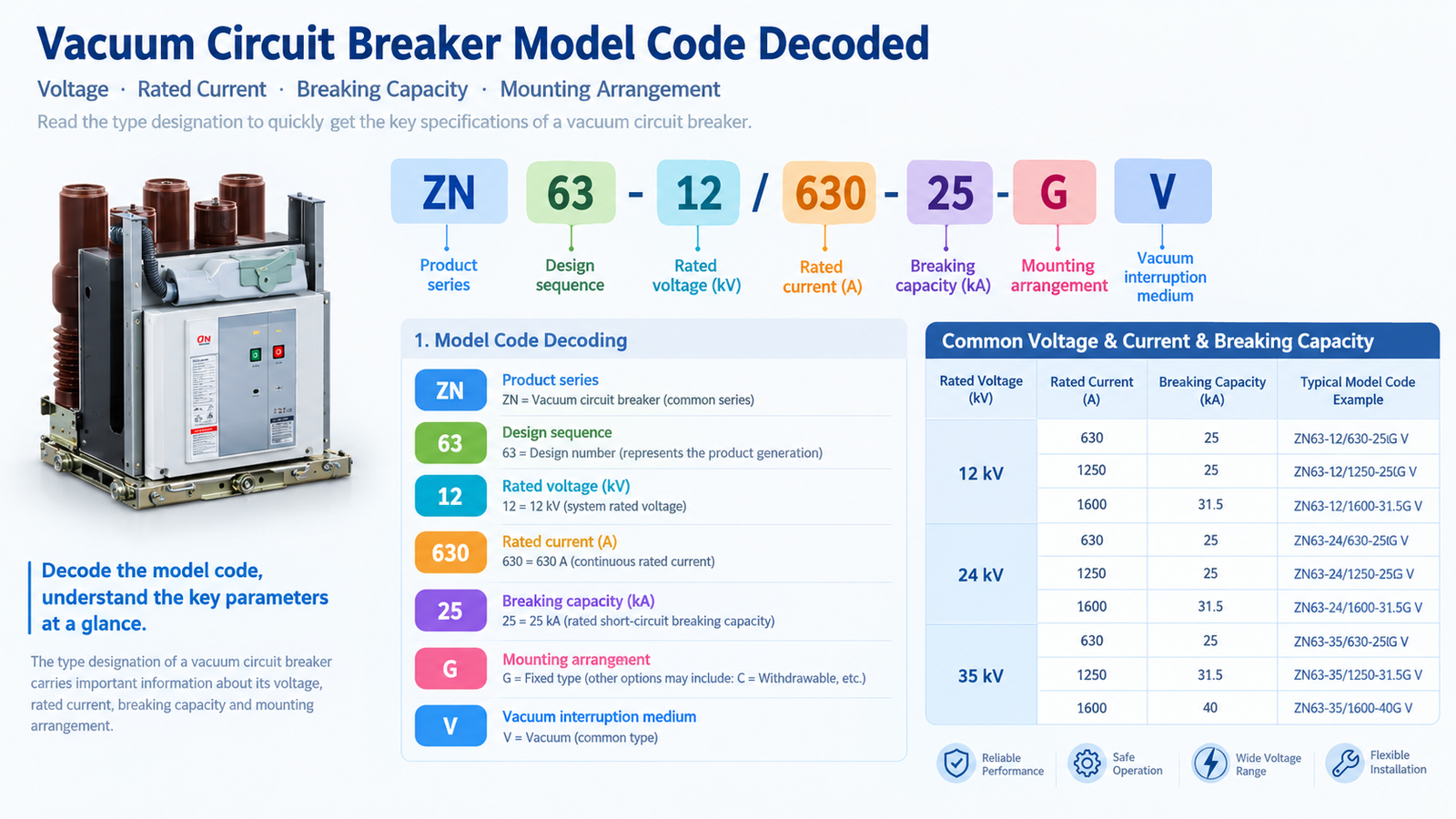
Reading the Type Code
Chinese-manufactured breakers follow a type designation that encodes the rating in the model number. Once you can read it, comparing two offers takes seconds.
Segment
Meaning
Example: VS1-12/630-20
VS1 / ZW32 / ZW7
Product family code
VS1 = indoor vacuum breaker family
First number
Rated voltage in kV
12 = 12 kV
Second number
Rated current in A
630 = 630 A
Third number
Rated short-circuit breaking current in kA
20 = 20 kA
Suffix letters carry the mechanical detail: T or M for spring versus permanent-magnet mechanism, W for withdrawable and F for fixed, and a pole-distance figure for the phase spacing. A model number missing the breaking capacity tells you the offer is incomplete — that value cannot be assumed from the family.
Matching the Breaker to the Fault Level
The breaking capacity is not a quality indicator, it is a number that must exceed the prospective fault current at the installation point — with margin, but not indefinitely more. Two inputs set it:
The transformer’s contribution, calculated from its rating and percentage impedance: a 1,000 kVA transformer at 6% impedance delivers roughly 24 kA into a bolted fault at its terminals at 400 V, and proportionally less at 12 kV.
Motor and network contribution, which adds to the transformer figure and must be included for industrial systems with large drives.
Selecting a 31.5 kA breaker where 20 kA would do is money spent on a number that never gets used. Selecting 20 kA where the fault level is 24 kA is a safety failure. The calculation method, including the tolerance assumptions, is set out in the impedance and fault level guide.
Breaker or Contactor? A Separate Question
Projects with frequent switching duty — capacitor banks, motor starters, arc furnaces — sometimes reach for a circuit breaker when a vacuum contactor is the correct device. The two interrupt current in the same way but are built for different operating lives: a breaker is designed for occasional fault interruption, a contactor for hundreds of thousands of load operations. The distinction, and when the overlap causes trouble, is covered in the contactor versus breaker comparison.
What to Specify
Item
Value to state
Family and mounting
Indoor cubicle (VS1, fixed or withdrawable) or outdoor (ZW32 / ZW7)
Rated voltage
12 kV, 24 kV or 40.5 kV — and the system’s highest voltage, not just the nominal
Rated current
From the load calculation, with the ambient correction applied
Breaking capacity
kA, from the fault level study at the installation point
Mechanism
Spring or permanent magnet; manual trip or motor charged
Control voltage
DC110, DC220 or AC220 for the closing and trip coils
Integration
Cubicle type (e.g. KYN28), CT ratio, protection relay, interlocks
The control voltage is the field that most often arrives wrong on a purchase order. It is set by the station battery, not by the breaker, and a mismatch means the breaker cannot be commissioned until the coil is replaced.
Conclusion
Choose the family by environment and voltage first — indoor VS1 for cubicles, ZW32 for pole-mounted overhead lines up to 24 kV, ZW7 for 40.5 kV outdoor substations — then size the breaking capacity from the fault level, then settle the mechanism and accessories. Reading the type code correctly at the quotation stage prevents most of the mismatches that only surface at commissioning.
If you can confirm the system voltage, the fault level at the point of installation and whether the breaker sits indoors or on a pole, the engineering team can match a specific frame and confirm the accessory set against your cubicle or pole arrangement.
Frequently Asked Questions
What is the difference between VS1 and ZW32?
The VS1 is an indoor vacuum circuit breaker designed to be mounted inside metal-clad switchgear, available up to about 3,150 A and 40 kA. The ZW32 is an outdoor pole-mounted breaker for 12–24 kV overhead lines, typically 400–630 A and 12.5–20 kA, often supplied with a recloser controller. They serve different installation environments, not different performance tiers.
Which vacuum circuit breaker is used for 35 kV?
The ZW7-40.5 family, rated 40.5 kV for a 35 kV system, with typical ratings of 1,250–2,000 A and 25–31.5 kA. It is an outdoor frame-mounted breaker used as incoming or outgoing protection in 35 kV substations. Indoor 35 kV applications use cubicle-mounted breakers of a different family with the same 40.5 kV rating.
How do I choose the breaking capacity of a circuit breaker?
Calculate the prospective short-circuit current at the breaker’s installation point — transformer contribution plus motor and network contribution — and select the next standard breaking capacity above it. Standard values in medium voltage are 20, 25, 31.5 and 40 kA. Oversizing is safe but costly; undersizing is a safety failure, so the calculation should be documented rather than estimated.
What is the difference between a spring and a permanent-magnet mechanism?
A spring mechanism charges a spring with a motor and releases it to close the contacts; it is mechanical, well understood and needs no special supply beyond the charging motor. A permanent-magnet actuator holds the closed position magnetically and trips by discharging a capacitor, which reduces moving parts and noise but depends on a reliable DC supply and a controller managing capacitor charge.
Can a ZW32 be used indoors?
It can be installed indoors in a suitable enclosure, but it is designed as an outdoor device and that is where its cost advantage lies. Installing an outdoor breaker indoors usually means paying for weather protection you do not need, while losing the cubicle integration, interlocks and cable termination arrangements that an indoor breaker provides.
A field-by-field walkthrough of the dry type transformer technical data sheet, including the eight fields that move the price and the errors that cause disputes.
10 kV, 11 kV and 13.8 kV transformers differ in ratio, insulation level and tap range. Here is how to pick the right voltage class and avoid a costly mismatch.