
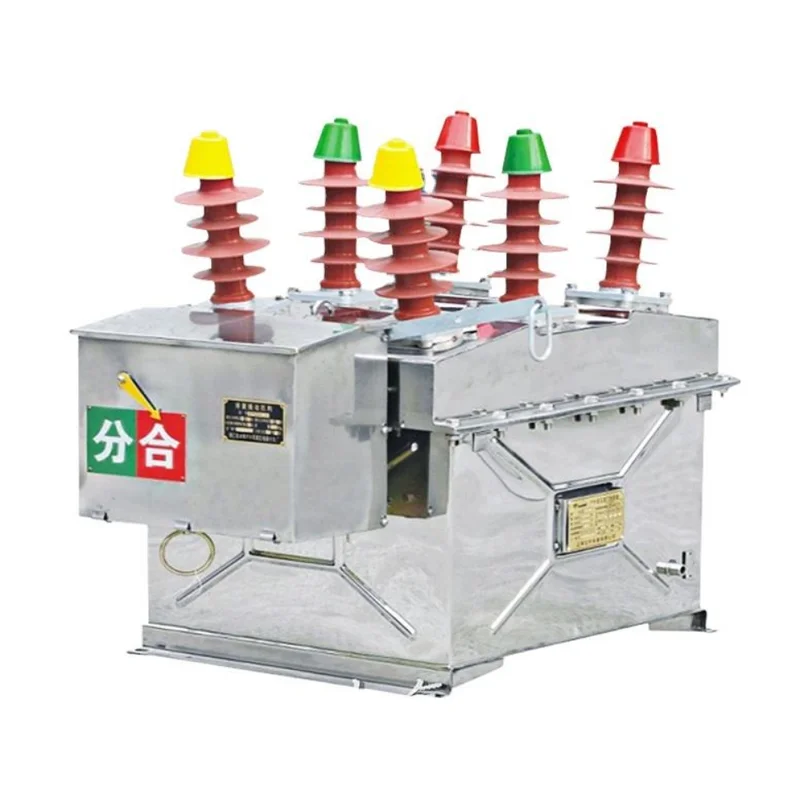
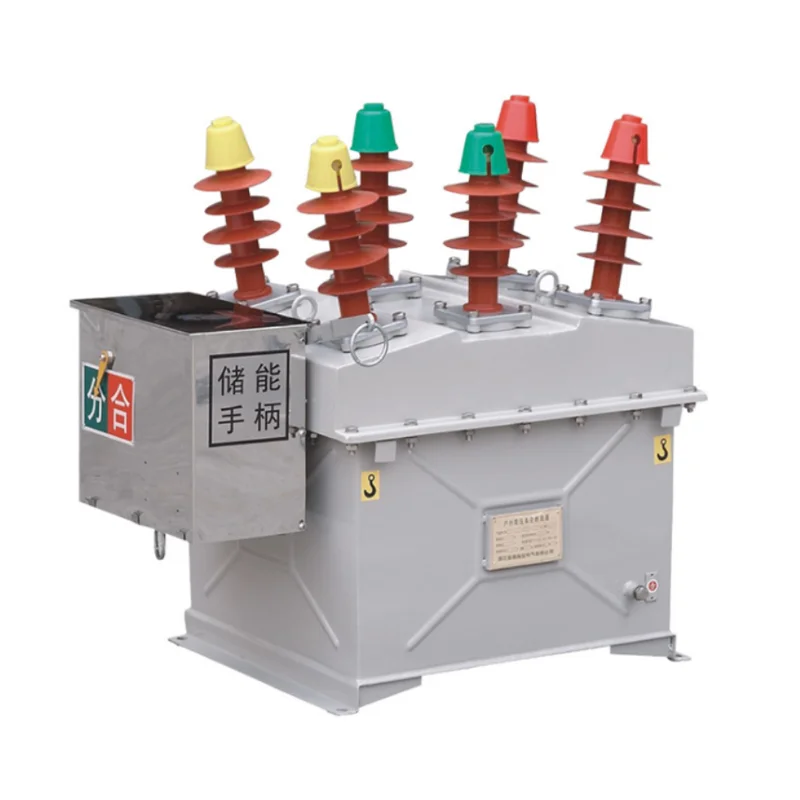
Description
ZW8 12kV at a Glance
The ZW8 12kV outdoor vacuum circuit breaker is a three-phase pole-mounted unit for 12 kV overhead distribution, rated 630 A and built for environments that would defeat an indoor breaker. Its published envelope runs from -40 °C to +45 °C, at altitudes up to 2,000 m, with 10 mm of ice loading and pollution class IV.
The ZW8 12kV outdoor vacuum circuit breaker switches load, overload and short-circuit current, and can be supplied with a controller for reclosing. The frame is used where an overhead line needs a switching and protection point without a substation building: rural feeders, coastal networks and installations in cold or contaminated regions.
Reading the Designation
| Element | Meaning | What it decides |
|---|---|---|
| Z | Vacuum (真空) | Vacuum interrupter |
| W | Outdoor (户外) | Weatherproof housing, pole or frame mounted |
| 8 | Design sequence | Frame family |
| 12 | Voltage class in kV | 12 kV overhead distribution |
Published Ratings
| Parameter | Published value |
|---|---|
| Rated voltage | 12 kV |
| Rated frequency | 50 Hz |
| Rated current | 630 A |
| Opening time | 5 ms |
| Maximum altitude | 2,000 m |
| Ambient temperature | -40 °C to +45 °C |
| Maximum wind speed | 34 m/s |
| Maximum ice thickness | 10 mm |
| Pollution degree | Class IV |
| Maximum earthquake intensity | 8 |
| Maximum daily average relative humidity | 95% |
| Maximum monthly average relative humidity | 90% |
Rated current and short-circuit configuration beyond the 630 A figure are confirmed per project, so state the fault level at the installation point with the inquiry.
The Environmental Envelope
Every figure in that table is a test the ZW8 12kV outdoor vacuum circuit breaker has to pass, and each one eliminates a different class of competitor. Taken together they describe where this frame is meant to be installed.
- -40 °C to +45 °C. The low end is a cold-climate rating, not a storage figure. At -40 °C, ordinary lubricants in the mechanism stiffen, seals harden and the closing time extends beyond its rating. The frame uses low-temperature lubricant and elastomers specified for that range.
- 2,000 m altitude. Above 1,000 m the reduced air density lowers external insulation withstand. A 2,000 m rating means the creepage and clearances are corrected for that altitude rather than the unit simply being labelled for it.
- 34 m/s wind and 10 mm ice. These set the mechanical strength of the mounting and the column, not the electrical ratings. Ice loading adds both weight and wind area, and a unit rated for 10 mm of ice is built for overhead lines in freezing-rain regions.
- Pollution class IV. The most demanding of the standard pollution bands, and the subject of the next section.
The combination matters more than any single figure. A breaker rated for -40 °C but only pollution class II is not usable on a coastal site in a cold climate, which is exactly the combination that defeats equipment specified one parameter at a time.
Pollution Class IV and Creepage
Pollution class determines how much creepage distance the external insulation needs, because contamination on the surface plus moisture produces a conductive film that can track across the insulation.
Class IV is the heavy band. It covers coastal sites with salt fog, industrial areas with conductive dust, and regions where both deposit on the insulation and are then wetted by fog or drizzle. At that level the creepage per unit of line voltage is roughly double what a clean rural site requires, and the shed profile of the bushings changes to suit.
Two practical consequences: a unit built for class IV will work on a cleaner site without penalty, so specifying up is safe; and a unit built for class II cannot be upgraded after manufacture, because the creepage is cast into the housing.
Opening Time and Reclosing
The published opening time of 5 ms should be read as the interval from the trip signal to contact separation, not as the total fault clearing time. Clearing also includes the relay operating time and the arc extinction, so the figure that matters at system level is the sum of all three.
A fast opening time is useful on a reclosing scheme because it shortens the dead time the controller has to work with, and a shorter dead time means less disturbance to consumers on the feeder.
Where a controller is fitted for reclosing, three things need to be settled at order: the protection functions it implements, the reclosing sequence including dead times and the number of shots, and the auxiliary supply with its battery backup. A reclosing breaker without a defined sequence arrives capable of the function but not configured for it.
Pole Mounting
The unit mounts on a pole bracket or a frame, with the primary connections taken to overhead conductors or cable terminations. Phase spacing and clearance to earth follow the outdoor insulation requirement at 12 kV, which is set by the pollution class rather than by the panel layout, and the same clearances serve an 11 kV outdoor line because the equipment maximum voltage already covers that system.
The mechanical loading on the mounting comes from wind plus ice, so the pole design needs the 34 m/s and 10 mm figures rather than a generic assumption. Where the line runs through terrain with a higher wind zone, state it: the frame’s rating is the maximum it is tested to, not a guarantee for any site.
ZW8 on 11 kV Outdoor Overhead Distribution
Most ZW8 units leave for 11 kV outdoor overhead duty rather than for a nominal 12 kV line. The 12 kV equipment maximum voltage covers an 11 kV system with margin, so an 11 kV outdoor vacuum circuit breaker enquiry is quoted on this frame without a change of hardware. The nameplate and the test documentation carry the system voltage; the frame stays the same.
What actually distinguishes the 11 kV outdoor order is the environment rather than the voltage. The frame is rated for -40 °C to +45 °C, 2,000 m altitude, 10 mm ice and pollution class IV, and those figures are what matter on an 11 kV rural feeder crossing exposed terrain. A coastal or industrial 11 kV line needs the class IV creepage; a line through a valley does not, and the lighter build is the cheaper one.
Where the 11 kV feeder also carries a reclosing requirement, the controller option matters more than the breaker rating: automatic reclosing is set in the controller, and the same frame serves both switched and reclosing duty.
When a Different Breaker Fits Better
- Pollution class II or III sites with a milder climate. A lighter outdoor frame is cheaper and adequate; specifying class IV where it is not needed buys creepage you will never use.
- 35 kV overhead lines. The ZW32 40.5 kV outdoor breaker covers that class with integrated current transformers and intelligent control.
- Indoor 12 kV switchgear. The VS1 ZN63A indoor breaker is the appropriate frame once the cubicle exists.
Standards and Tests
Routine tests on every unit cover power-frequency withstand, main-circuit resistance, contact travel and a mechanical operation sequence. Type test reports covering temperature rise, short-circuit making and breaking, and the environmental tests behind the ratings above are available for project documentation.
Ask specifically for the low-temperature and pollution-class type test reports if the site depends on those figures. They are the ones that distinguish this frame from a standard outdoor breaker, and they should be in the documentation pack.
Manufacturer Supply, OEM and Wholesale
The ZW8 12kV outdoor vacuum circuit breaker is supplied direct, with controller configuration fixed per order. Utility buyers receive drawings, controller settings and test reports for approval; distributors hold a standing specification for repeat supply; OEM arrangements cover private-label marking and controller configuration to your protection scheme.
Price, MOQ and Lead Time
- MOQ. Single units. Controller configuration and private-label marking carry a higher minimum.
- Price drivers. Current and breaking configuration, controller type, mounting arrangement and quantity.
- Lead time. Confirmed against the production schedule. Controller configuration extends it beyond a bare breaker.
- Payment. Deposit with balance against the bill of lading copy; letter of credit for utility quantities.
What to Send With Your Inquiry
- System voltage and fault level at the installation point
- Continuous current required
- Site ambient temperature range, particularly the winter minimum
- Altitude and pollution class
- Wind zone and expected ice loading
- Controller functions and reclosing sequence required
- Auxiliary supply arrangement and battery backup
- Pole or frame mounting arrangement
- Quantity, destination port and required delivery date
Send those through the quote form on this page. The winter minimum and the pollution class are the two items that decide whether this frame or a lighter one is correct.
FAQ
Why is the -40 °C rating significant?
What does pollution class IV mean?
Can a class II unit be upgraded to class IV?
What is the 10 mm ice rating for?
How should the 5 ms opening time be read?
What is the MOQ?
Request Quote
Tell us your specifications, quantity, or application scenario and we will reply with a tailored quote.