


Description
CKG3 7.2kV Series at a Glance
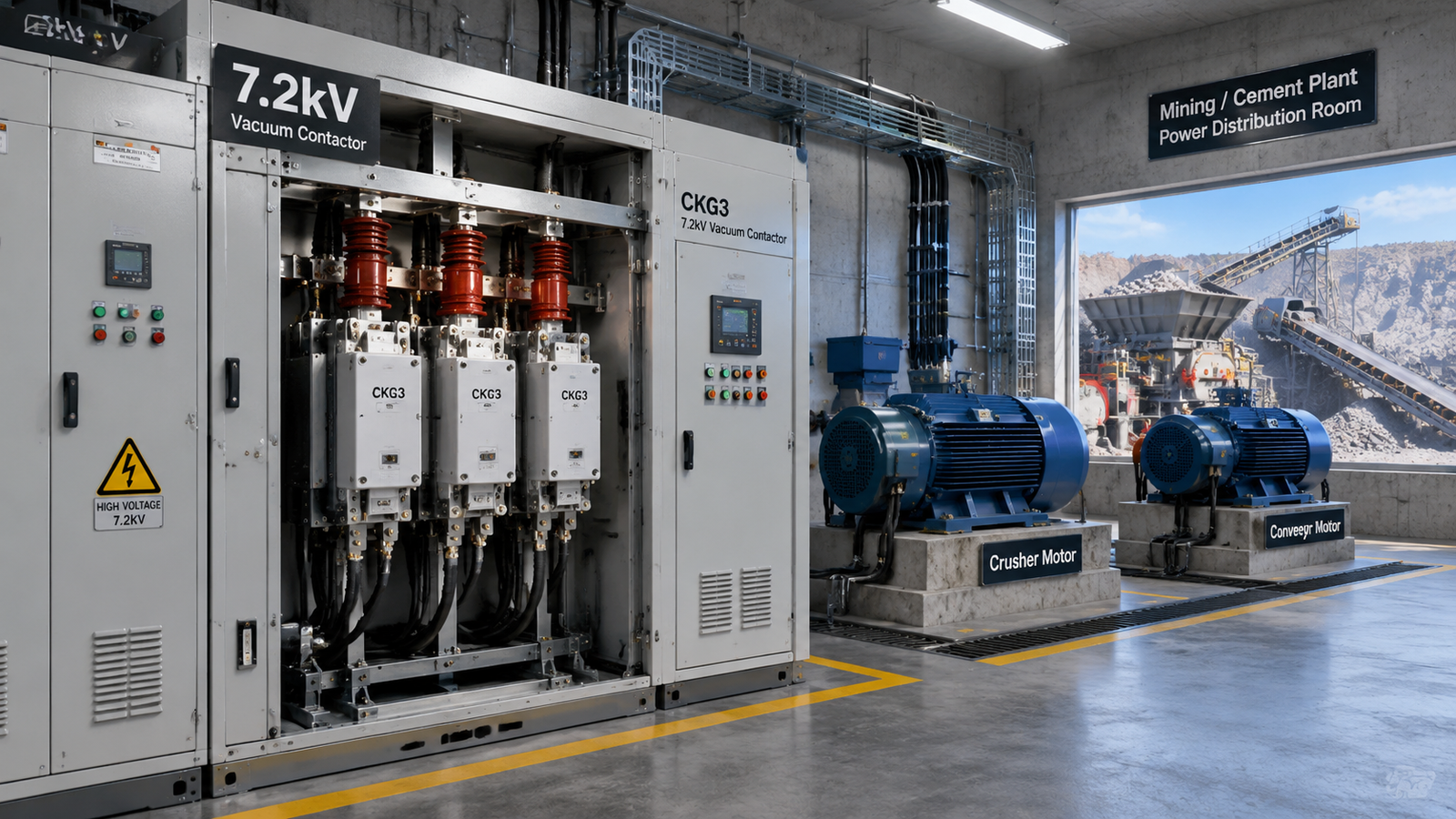
The CKG3 7.2kV AC vacuum contactor is an indoor switching unit for three-phase systems up to 7.2 kV, built for duties where the circuit operates often. The range covers 160 A, 250 A, 400 A and 630 A primary ratings, with a mechanical life of one million operations and a making capacity of up to 6,300 A on the largest frame.
Two build types of the CKG3 7.2kV AC vacuum contactor are available: an ordinary type for installations up to 1,000 m and a plateau type rated to 4,000 m. That second option is unusual in this frame class and matters for projects in highland or Andean sites.
Reading the CKG3 Type Designation
| Element | Meaning | What it tells you |
|---|---|---|
| C | Contactor (接触器) | Frequent switching device, not a fault-clearing breaker |
| K | Vacuum arc-quenching | Sealed vacuum interrupter chamber |
| G | High-voltage frame | Distinguishes it from low-voltage CJ series frames |
| 3 | Design sequence | Third-generation frame in this family |
| 160 / 250 / 400 / 630 | Rated current in amps | Sets the load you can switch continuously |
| 7.2 / 12 | Rated voltage class in kV | This page covers the 7.2 kV build; the 12 kV build is a separate frame |
Ratings by Current Variant
The four current options of the CKG3 7.2kV AC vacuum contactor share the same voltage class and service data. What separates them is switching capability, and the gaps are not proportional to the current rating, so the choice deserves a calculation rather than a guess.
| Parameter | 160 A | 250 A | 400 A | 630 A |
|---|---|---|---|---|
| Main-circuit rated voltage | 7.2 kV | |||
| Making capacity, 100 operations | 1,600 A | 2,500 A | 4,000 A | 6,300 A |
| Breaking capacity, 10 operations | 1,280 A | 2,000 A | 3,200 A | 5,000 A |
| Ultimate breaking capacity, 3 operations | 3,200 A | 4,000 A | 4,500 A | 6,300 A |
Common Electrical and Mechanical Data
| Parameter | Published value |
|---|---|
| Main-circuit power-frequency withstand | 32 kV |
| Auxiliary-circuit power-frequency withstand | 2.5 kV |
| Control-circuit power-frequency withstand | 2 kV |
| Mechanical life | 1,000,000 operations |
| Mechanical-latch life | 100,000 operations |
| Rated operating frequency | 300 operations/hour |
| Mechanical-latch operating frequency | 30 operations/hour |
| Contact gap | 4 ± 0.5 mm |
| Overtravel | 1.5 ± 0.3 mm |
| Auxiliary contact arrangement listed | 3 NO + 2 NC |
| Ambient temperature | -10 °C to 40 °C |
| Installation altitude | Ordinary type up to 1,000 m; plateau type up to 4,000 m |
The 32 kV withstand is the correct figure for a 7.2 kV frame. If your specification carries 42 kV, you are looking at the 12 kV build, which is documented separately on the CKG3 12 kV vacuum contactor page. Mixing the two sets of numbers is a common sourcing error and it is worth checking on any quotation you receive.
Choosing the Current Rating
Three figures matter, and they are often confused with each other.
- Rated current is the continuous current the unit carries without exceeding its temperature limits. This is the figure that must exceed your load current, in most cases with the margin your site standard specifies.
- Making capacity is what the unit can close onto. A direct-online motor draws around six times full-load current at start, so this is the figure that usually forces you to a larger frame.
- Breaking capacity is what the unit can interrupt, quoted for a stated number of operations. Note that it is lower than the making capacity, which is normal for a contactor.
As a worked example: a 75 kW 3.3 kV motor drawing roughly 90 A has a start current near 540 A. The 160 A frame carries the continuous current and its 1,600 A making capacity covers the start, so the 250 A step up is not required. A 250 kW motor at 240 A with a start current near 1,450 A still fits the 250 A frame on making capacity, but pushes close enough to the limit that most site standards call for the 400 A. Send the motor data and we will run the numbers rather than quoting the largest frame to be safe.
Ordinary Type and Plateau Type
The altitude difference between the two builds is 3,000 m, and it is not a labelling distinction. At altitude the reduced air density lowers the external insulation withstand, so the plateau build uses increased creepage and corrected clearances to hold its ratings at 4,000 m.
For a site between 1,000 m and 4,000 m, specify the plateau type. For a site below 1,000 m, the ordinary type is the correct and cheaper choice. If a quotation offers the ordinary type for a highland project, the ratings will not hold as printed.


Mechanical Life and What It Really Buys You
For the CKG3 7.2kV AC vacuum contactor, one million mechanical operations is the headline figure, and it corresponds to a long service interval in a plant where a contactor might operate a few dozen times a day. At 300 operations per hour, the mechanical life is consumed in roughly 3,300 hours of continuous operation, which is why the duty category, not the mechanical figure, usually sets the replacement interval.
The mechanical-latch life is ten times lower at 100,000 operations, and the permitted operating frequency for a latched unit drops from 300 to 30 operations per hour. If your panel uses mechanical latching, size your maintenance interval on those two numbers rather than on the one-million figure.
Motor, Transformer and Capacitor Loads
The CKG3 7.2kV AC vacuum contactor is used across all three load types, and the switching duty differs enough to affect selection.
- Motors. The dominant duty. Direct-online starting drives the making requirement, and inching or reversing drives the electrical life down sharply, as with any contactor.
- Transformers. Switching a transformer draws an inrush current that can reach several times rated current, with a decaying DC component. Specify the making capacity against the inrush, not against the transformer’s rated current.
- Capacitor banks. Capacitor switching produces high-frequency inrush and requires the contactor to be suited to capacitive duty, usually with damping reactors. State the bank kvar and the reactor arrangement, because the standard motor-rated frame is not automatically the right choice here.
When the CKG3 7.2kV Is the Wrong Choice
- Systems above 7.2 kV. Use the 12 kV build for 12 kV systems. The frames are not interchangeable.
- Fault current interruption. A contactor switches load current. Clearing a short circuit needs fuses or a breaker upstream.
- Applications needing a different frame family. For 250 A to 630 A duty where the control data or the latch arrangement matters more than making capacity, the JCZ5 7.2 kV contactor is the closer match.
All frames in this family are listed under vacuum contactor series. If the choice between a contactor and a breaker is still open, our note on the difference between vacuum contactors and breakers covers the decision.
Service Conditions and Standards
Beyond the altitude envelope, the published conditions are ambient from -10 °C to 40 °C, a maximum monthly average relative humidity of 90 percent in the wettest month, no explosive hazard, no conductive dust sufficient to corrode insulation, and an installation sheltered from rain and snow. Condensation from temperature swings has to be considered in the panel design, which usually means space heaters.
Routine tests cover power-frequency withstand on the main, auxiliary and control circuits, plus a mechanical operation check. Type test reports for temperature rise and electrical life are available for project documentation packages.
Manufacturer Supply, OEM and Wholesale
The CKG3 7.2kV AC vacuum contactor is manufactured and supplied direct, which covers three purchasing patterns:
- Project supply. Single units or complete bills of materials, with outline drawings and test reports issued for approval before shipment.
- OEM and private label. Nameplate marking, terminal labelling and documentation sets under your brand, with the control voltage and auxiliary contact arrangement fixed to your scheme.
- Wholesale. Repeat orders against a frozen specification, exported in consolidated shipments with other frames from the same category.
Non-standard auxiliary contact counts and alternative control voltages are quotable because the unit is built to order rather than pulled from stock. We confirm the production slot for your quantity in the quotation rather than quoting a generic lead time.
Price, MOQ and Lead Time
- MOQ. Standard configurations ship from single units, so spares and trial orders are accepted. Custom nameplates and private-label packaging carry a higher minimum.
- Price drivers. Current rating, ordinary versus plateau build, auxiliary contact count and order quantity. The plateau build sits above the ordinary type at every current rating.
- Lead time. Confirmed against the production schedule at order. Plateau builds and custom label work take longer than standard configurations.
- Payment. Standard terms are a deposit with the balance against the bill of lading copy. Project quantities can be quoted on letter of credit.
What to Send With Your Inquiry
- System voltage and required continuous current
- Load type: motor, transformer or capacitor bank
- Motor data if applicable, including starting method and start current
- Required switching frequency per hour
- Ordinary type or plateau type, with site altitude
- Control-circuit voltage and latch requirement
- Auxiliary contact arrangement
- Quantity, destination port and required delivery date
Send those through the quote form on this page and the configuration comes back confirmed against the published data rather than estimated.
FAQ
Which current ratings are available?
What is the difference between the ordinary and plateau types?
Why is the withstand voltage 32 kV and not 42 kV?
What is the mechanical life?
Can it switch capacitor banks?
What is the MOQ?
Request Quote
Tell us your specifications, quantity, or application scenario and we will reply with a tailored quote.