Transformer HS Code, Packing & Sea Freight for Importers
Published: Author: Lisa
Every transformer that crosses a border is priced, taxed and cleared on the basis of one decision taken long before the vessel sails: its customs classification. The transformer HS code decides which duty rate applies, which certificates the border authority checks, and in a growing number of markets whether the unit qualifies for a reduced rate at all. Getting it wrong rarely costs a few dollars of duty — it costs weeks at port, storage, demurrage and a re-valuation argument with customs.
This guide is written for importers, EPC procurement teams and distributors buying oil-immersed power transformers and dry-type units from China. It covers how heading 8504 is really divided, where classification goes wrong, what duty treatment applies, what a seaworthy export crate must contain, when to book a container and when to book breakbulk, and the document pack that clears a transformer without a detention.
How the transformer HS code is structured
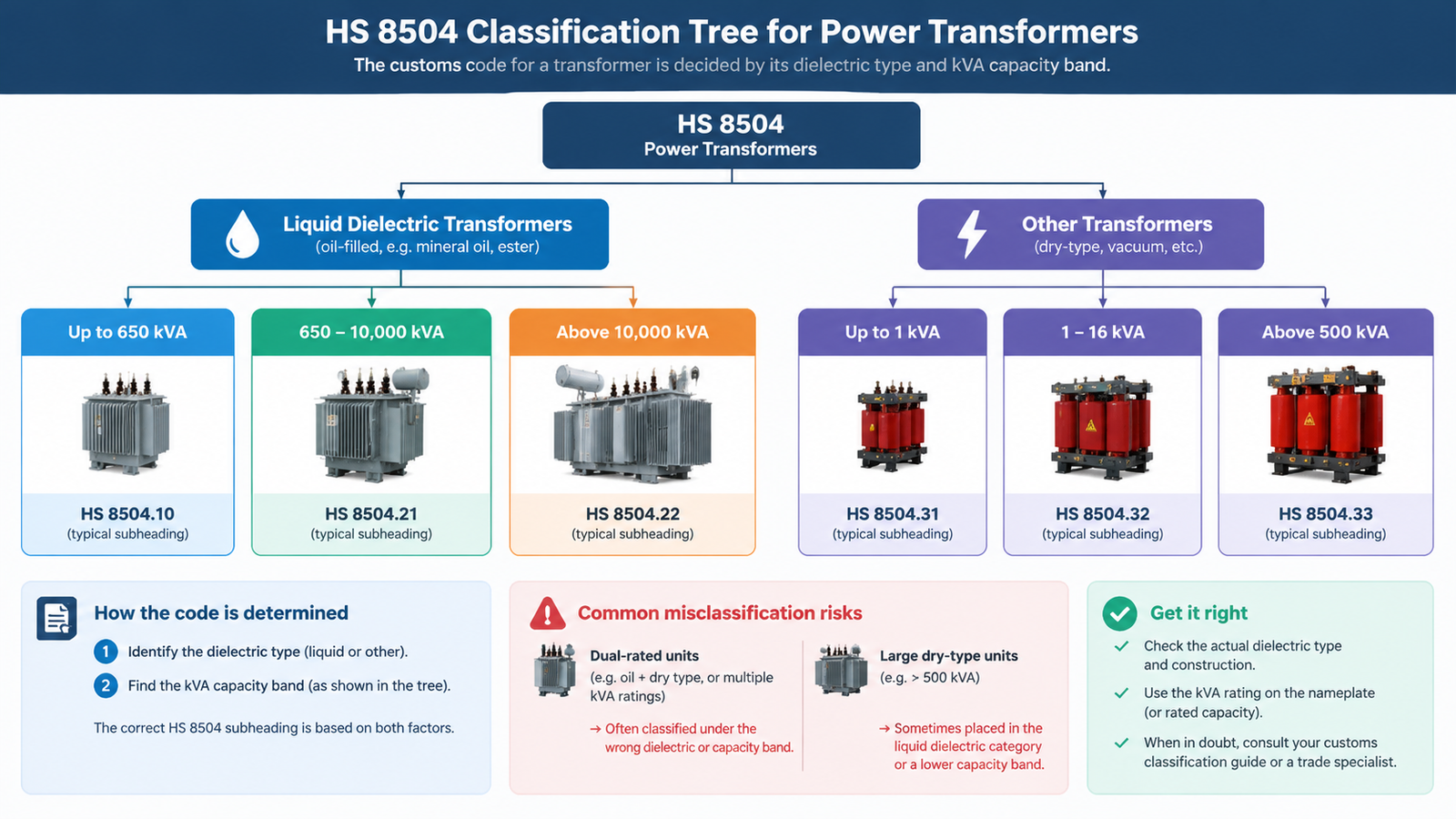
All transformers, static converters and inductors sit inside one four-digit heading: 8504. The subheadings below it split on two things only — dielectric type and rated capacity in kVA. Nothing else moves the code: not the vector group, not the tap changer, not the enclosure, not the winding material.
HS code
What it covers
Capacity band
8504.21
Liquid dielectric transformer
Not exceeding 650 kVA
8504.22
Liquid dielectric transformer
Over 650 kVA up to 10,000 kVA
8504.23
Liquid dielectric transformer
Over 10,000 kVA
8504.31
Other transformer: dry-type, cast resin, VPI, encapsulated
The word to read carefully is other. Group 8504.31 to 8504.34 is where dry-type, cast resin, vacuum pressure impregnated and encapsulated units all land, regardless of the fact that they are transformer products. The capacity bands in that group run much lower than the liquid dielectric ones, which is the single most common source of misclassification.
Where transformer classification usually goes wrong
Classification is a legal statement, not a description. Four situations account for most of the disputes and delays on transformer imports.
Dual-rated oil-immersed units
A transformer designed for ONAN and ONAF cooling carries two rated capacities on its nameplate — for example 16,000 kVA self-cooled and 20,000 kVA with fans running. Only one capacity determines the subheading, and the declaration must use the higher forced-cooling rating. Declaring the self-cooled figure moves a 20 MVA unit into the wrong band, and automated classification screening in the United States and the European Union is built to flag exactly that mismatch.
Large dry-type units filed as small ones
A 2,000 kVA cast resin unit — the size class covered by our epoxy resin dry-type transformer range — is 8504.34, not 8504.31 or 8504.33. Both the dielectric group and the capacity band have to be read off the nameplate before the code is chosen, and the ratings a compliant unit must state are listed in our reference on dry-type transformer specifications.
Transformers supplied inside another assembly
A rectifier transformer, an inverter-duty unit built into a drive package, or a transformer shipped as part of a UPS static converter can be classified as a static converter under 8504.40 instead of as a transformer. If the transformer arrives as an accessory to a machine built for another purpose, the classification can move again, to the heading of the machine. This is the point at which a broker’s opinion is worth more than a supplier’s invoice description.
Fluid type left off the paperwork
Mineral oil, synthetic ester, silicone and natural ester behave differently at the border. Enforcement on the declared dielectric fluid has tightened, so the invoice description must match the safety data sheet item by item rather than leaving the buyer to discover the difference at inspection.
Duty treatment: what the code actually costs you
Most-favoured-nation duty on transformers is modest. In the United States, 8504.21 and 8504.22 enter free, while 8504.23, 8504.33 and 8504.34 carry 1.6% and 8504.32 carries 2.4%. The European Union and the United Kingdom apply a 0% third-country duty rate across the heading. India, Vietnam and Thailand are a different story — some subheadings in those markets carry double-digit rates, which is why the destination market decides how much the classification exercise is worth.
The number that really moves a landed cost is not the MFN rate. Since 6 April 2026, the United States Section 232 metals framework has treated transformers as part of a unified derivative-article regime, and the duty is applied to the full customs value of the unit rather than to the metal content alone.
Category
Rate on customs value
Applies to
Standard derivative article
25%
Transformers classified in 8501 to 8504
Reduced list, in force to 31 December 2027
15% floor
Large transformers above 10,000 kVA (8504.23) and similar grid equipment
Standard derivative article from 2028
25%
The same reduced-list goods, once the temporary rate expires
United Kingdom origin derivatives
15%
UK-origin derivative articles
One threshold matters as much as the rates. For derivative articles classified outside chapters 72 to 76, the steel duty applies only where steel makes up at least 15% of the total weight of the article. Below that threshold the derivative duty does not attach. The annexes to these measures are amended by proclamation rather than by legislation, so confirm the figures against the current annexes with your customs broker before quoting a landed cost.
Building the landed-cost line
Duty is calculated on the CIF value, and value-added tax or GST is then charged on CIF plus duty. A workable model therefore has six lines: FOB unit price, international freight, marine insurance, import duty, VAT or GST, and destination port charges with inland transport. Two are routinely forgotten. A nitrogen-blanketed unit needs oil, labour and testing at destination before energisation, and a spare bushing set is cheaper bought with the transformer than shipped alone six months later. Our guide to power transformer pricing by kVA covers the factory-side figures that feed the top of this model.
Export packing: what a seaworthy crate contains
Transformer damage in transit almost never comes from a single catastrophic blow. It comes from vibration over three weeks, condensation inside a crate that breathes, and a unit that shifted two centimetres on every rolling movement. Packaging grade scales with weight.
Unit weight
Standard export packaging
Up to about 500 kg
Export plywood crate on a wooden pallet
500 kg to 2,000 kg
Reinforced plywood crate on a steel base frame
Over 2,000 kg
Steel-timber composite crate or welded steel frame with multi-point lashing and an anti-tilt design
Beyond container envelope
Flat rack, open top or breakbulk, on a securing plan approved by the line
Confirm every item below against photographs before loading, not after arrival.
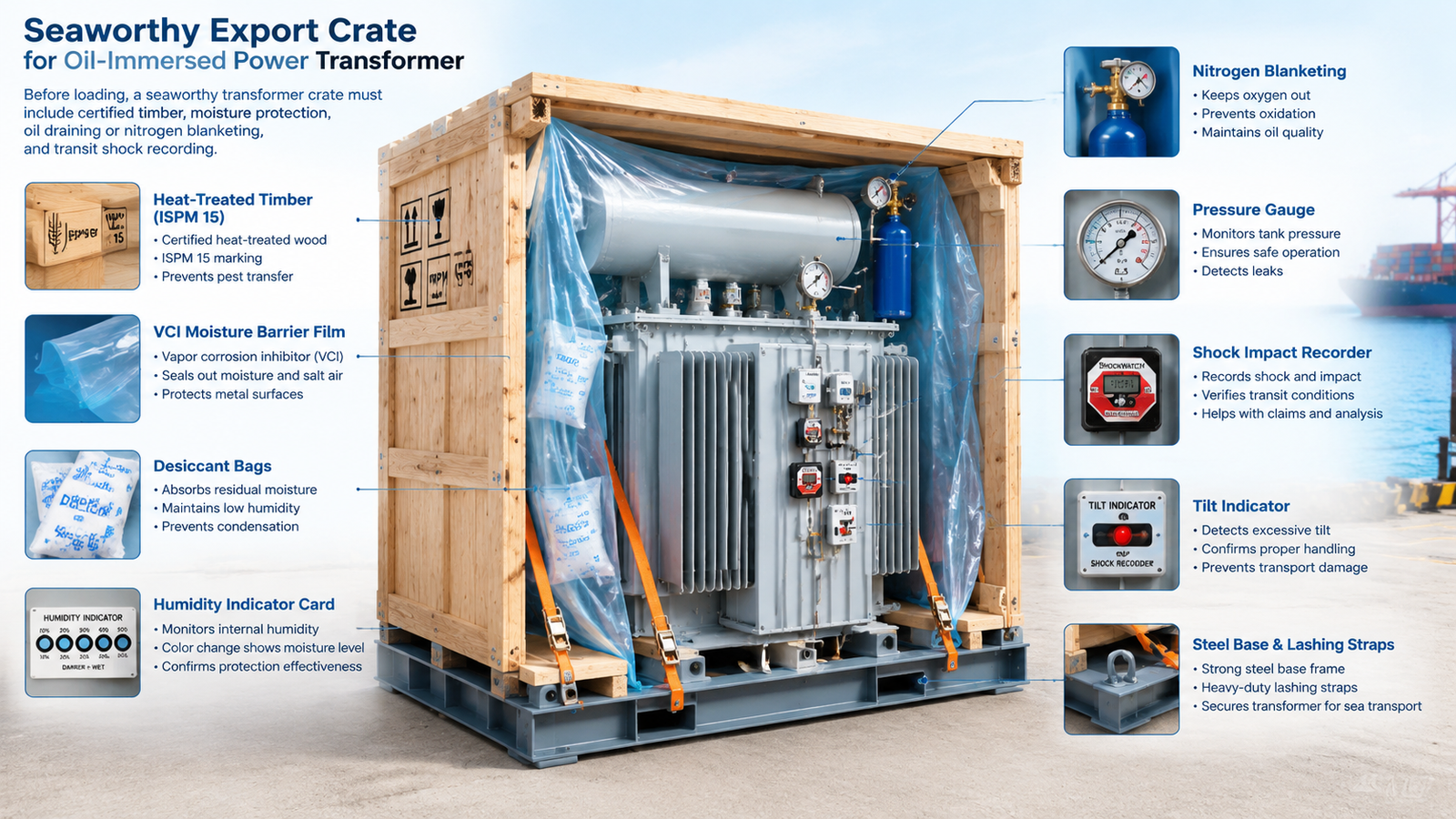
ISPM 15 timber. Solid-wood crates, pallets and blocking must be heat-treated and carry the IPPC mark, or the shipment can be destroyed at destination. Processed plywood is exempt, but then a no-solid-wood declaration is issued instead — a different document, not a missing one.
Moisture barrier. Barrier film over the unit, desiccant sized to the crate volume, a humidity indicator card the receiver can read on opening, and VCI protection on machined steel that will sit for weeks at sea.
Mechanical restraint. Shock-absorbing pads under the base, internal blocking so the tank cannot walk, and cushioned or separately packed bushings, radiator banks and fans.
Marking. Consignee, destination port, crate number, gross and net weight, dimensions, centre of gravity, lifting points and handling symbols. A 15-degree tilt limit is a standard contractual limit on this equipment — mark it on the crate as well as in the packing list.
Oil-immersed units: drained, blanketed or shipped oil-filled
An oil-immersed transformer leaves the factory in one of two states, and the difference changes your receiving procedure. Large units are normally drained and shipped under a dry-air or nitrogen blanket with a pressure gauge fitted to the tank, then filled and tested on site. Smaller distribution units, such as the oil-immersed distribution transformer range, are often shipped oil-filled to remove site oil handling altogether. Confirm which state you are buying: it affects the weight on the crate, the documents in the pack and the site work in your programme. On substation projects with a project-specific tank and cooling arrangement, the same confirmations apply to every 35 kV oil-immersed transformer in the order.
Transit instrumentation is your claim file
A shock recorder and a tilt indicator inside the crate log what happened between the factory gate and your site, and photographs of loading with a short video of the lashing are the evidence a cargo insurer will actually accept. Without them a damage claim is one party’s word against another’s, and general average can leave your container held at destination until a bond is posted.
Container or breakbulk: choosing the shipping method
Container choice is a weight and envelope calculation, not a price comparison. A standard 40-foot box looks empty long after it has reached its payload limit, and out-of-gauge cargo needs the line’s approval before booking, not at the terminal.
Equipment
Practical payload
Typical fit
20 ft general purpose
About 21 to 22 t
Distribution units and small power transformers
40 ft general purpose or high cube
About 26 to 27 t
One mid-size unit plus accessories
20 ft open top
About 28 t
Over-height units loaded from above by crane
20 ft flat rack
About 28 to 31 t
Units beyond container width or height
40 ft flat rack, standard and high cube
About 39 t to 52 t
Large power transformers, on a line-approved securing plan
Breakbulk vessel
Ship crane capacity
Above roughly 45 t or outside any container envelope
Three rules apply to whatever equipment you book. Verified gross mass must be declared under the SOLAS convention before the box is allowed to load. Lashing and blocking follow the line’s securing manual, and the layout has to be agreed in advance for flat rack cargo. And plan the calendar: a typical Asia to US West Coast ocean leg runs 15 to 25 days, to the US East Coast 30 to 40 days depending on routing, and to North-West Europe roughly 25 to 35 days, with three to seven days added for clearance at either end.
The clearance document pack
Most transformer detentions are document problems, not tax problems. Assemble and check the pack before the container is sealed.
Document
Issued by
What customs checks
Commercial invoice
Supplier
HS code, rated capacity, dielectric fluid, winding material, serial numbers, Incoterm, declared value
Packing list
Supplier
Package count, gross and net weight, dimensions, shipping marks
Bill of lading
Carrier
Consignee details, freight terms, telex release where used
Certificate of origin
Chamber of commerce
Preferential duty eligibility under the applicable trade agreement
Factory acceptance and type test reports
Manufacturer
Consistency between declared classification and equipment, and conformity to the standard
Non-PCB declaration and insulating oil test report
Manufacturer, laboratory
Mandatory for oil-immersed units in many markets, and a frequent cause of detention when missing
Safety data sheet
Manufacturer
Fluid composition and handling classification
Market certification
Certification body
CE with a declaration of conformity, SASO and SABER, TISI or EAC, depending on destination
IPPC mark or fumigation certificate
Packer
Solid-wood packaging compliance
Two habits prevent most of this. Insist on English-language test reports and certificates, because Chinese-only documents are not accepted at the destination port. Then check that model number, capacity and serial number match across the invoice, nameplate, test reports and certificates — a generic certificate with a different model number on the header is worse than no certificate, because the shipment is treated as unverified. The test programme that produces those reports is described in our guide to power transformer testing and factory acceptance tests.
Incoterms and marine insurance: who carries the risk
Freight quotes are only comparable once the Incoterm is fixed, because the term decides who books, who insures and the exact moment risk transfers.
Term
Freight booked by
Insurance
Risk transfers
EXW
Buyer
Buyer
At the factory
FOB
Buyer
Buyer
When cargo is on board at the port of loading
CIF
Seller
Seller, minimum cover only
On board at the port of loading
DAP
Seller
By agreement, usually buyer
At the named destination, not unloaded
DDP
Seller
Seller
At destination, duty paid
On CIF terms the seller insures only to 110% of contract value with minimum clauses, and those clauses are far narrower than the all-risk cover a transformer needs — the gaps are exactly the events that hurt, from handling damage and water ingress to theft and general average contribution. Institute Cargo Clauses (A) cover costs roughly 0.3% to 0.6% of CIF value, a rounding error against a custom-built unit. Also check what the freight quote excludes: lift-on and lift-off at both ends, out-of-gauge surcharges and destination terminal handling are frequently billed separately, and they are material on heavy project cargo.
Ten checks before the container is sealed
Subheading confirmed against the nameplate, at the highest cooling rating on dual-rated units.
Invoice description states the dielectric fluid and matches the safety data sheet.
Third-party inspection or a witnessed factory acceptance test booked where the order value justifies it.
Shipping state agreed in writing: drained and blanketed, or oil-filled.
Packing photographs and lashing video received before the box leaves the factory.
ISPM 15 mark photographed on every solid-wood package.
Impact recorder, tilt indicator and humidity card fitted and set.
Verified gross mass and flat rack or open top approval obtained from the line.
English test reports, non-PCB declaration and oil test report in the document pack.
All-risk cargo insurance bound for at least 110% of CIF before the vessel sails.
Conclusion
Classification, packing and documentation are three separate decisions that land on the same invoice line, and each one is cheaper to fix before loading than after arrival. Confirm the subheading from the nameplate using the highest cooling rating, ship to an agreed packing standard with recorded transit data, and buy all-risk cover rather than the minimum the Incoterm requires. If you are planning an import and want the packing specification, shipping state and document pack checked against your destination market, send us the unit rating and destination port and we will come back with the figures.
FAQ
What is the HS code for an oil-immersed transformer?
Oil-immersed units use 8504.21 up to 650 kVA, 8504.22 from above 650 kVA to 10,000 kVA, and 8504.23 above 10,000 kVA. The subheading is set by rated capacity only, so a dual-rated ONAN and ONAF unit is declared at its higher forced-cooling rating.
What HS code do dry-type transformers use?
Dry-type, cast resin and encapsulated units fall into the “other transformers” group: 8504.31 up to 1 kVA, 8504.32 to 16 kVA, 8504.33 to 500 kVA and 8504.34 above 500 kVA. A large dry-type unit is therefore 8504.34, not 8504.31.
Does a transformer need ISPM 15 packaging?
Any solid-wood crate, pallet or blocking must be heat-treated or fumigated and marked to ISPM 15 with the IPPC stamp. Processed plywood is exempt from treatment but is normally covered by a declaration of no solid-wood packaging.
How many transformers fit in a 20-foot container?
Weight stops the loading before volume does. A 20-foot general purpose container carries roughly 21 to 22 tonnes, so small distribution units may go several to a box while a single mid-size power transformer can fill one on its own. Units beyond the container envelope move on a flat rack or as breakbulk cargo.
What documents are needed to clear an oil-immersed transformer?
At minimum a commercial invoice showing the HS code and fluid type, a packing list, the bill of lading, a certificate of origin, English factory acceptance and type test reports, an insulating oil test report, a non-PCB declaration and the safety data sheet — plus CE with a declaration of conformity, SASO and SABER, TISI or EAC where the destination requires it.
How much does it cost to insure a transformer shipment?
All-risk marine cargo cover typically runs about 0.3% to 0.6% of CIF value, so a USD 200,000 unit costs roughly USD 600 to USD 1,200 to insure. Insist on Institute Cargo Clauses (A) rather than the minimum cover a CIF sale technically requires.
Routine, type and special power transformer tests under IEC 60076 explained for buyers — acceptance limits, what a FAT dossier must contain, red-flag readings and how to witness testing.
A practical 12-point checklist for auditing power transformer manufacturers in China: certifications by market, factory tests, materials, capacity and commercial terms.
How to size and specify a transformer for EV charging stations and hubs: AC input kVA, continuous load rules, demand factors, K-factor selection and site matching.