
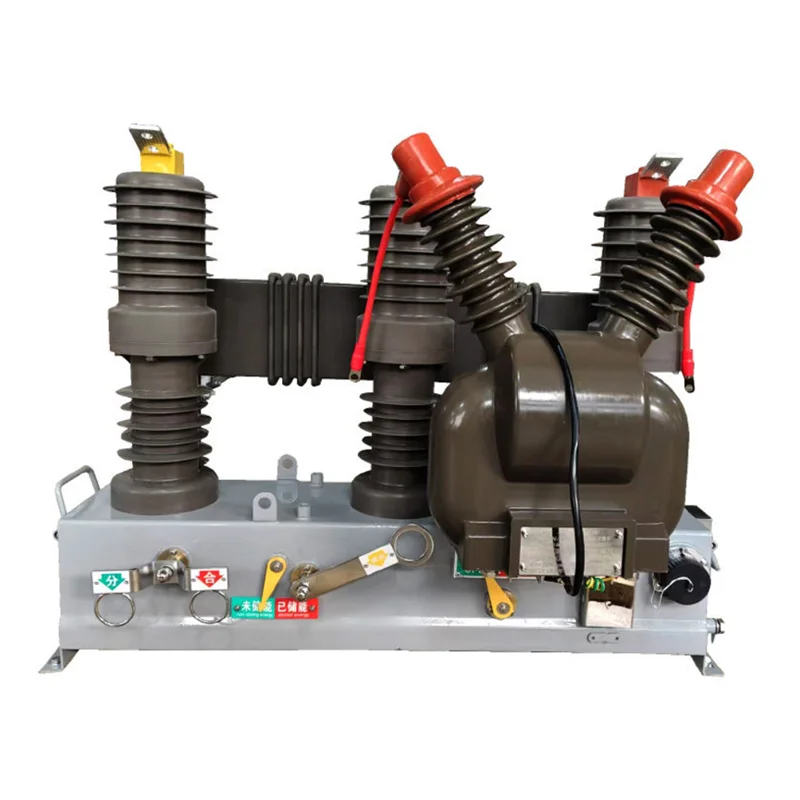
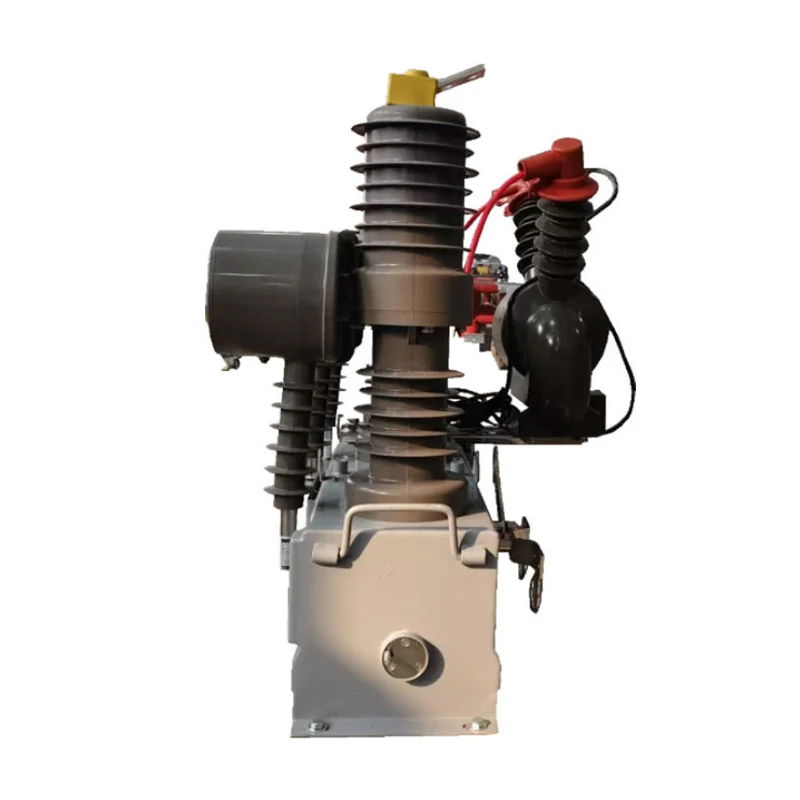
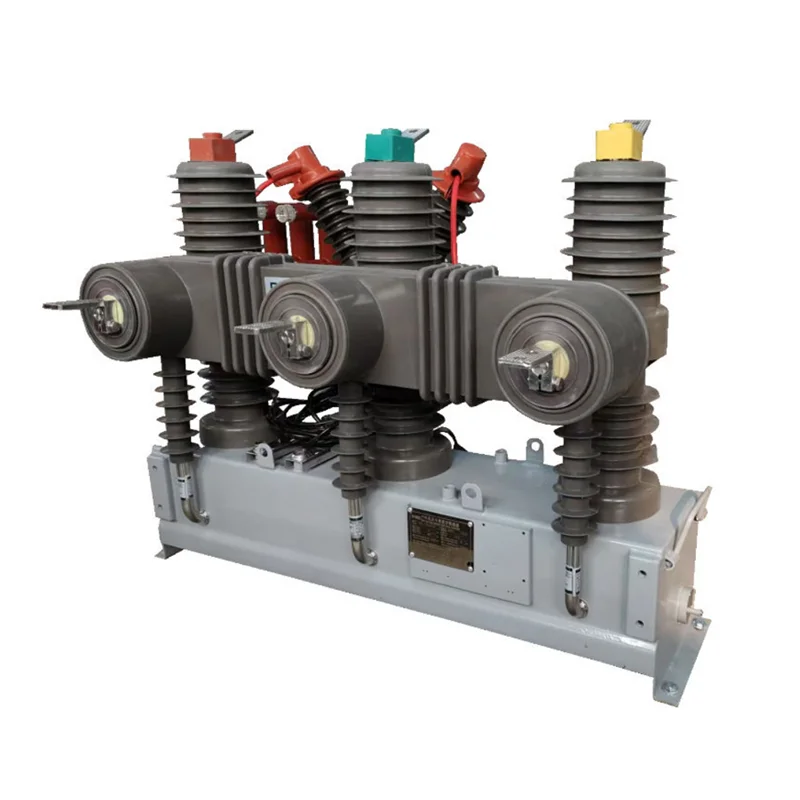
Description
ZW32 12kV-24kV at a Glance
The ZW32 12kV-24kV vacuum circuit breaker is a pole-mounted outdoor range rather than a single rating, covering overhead distribution systems at both voltage classes with one frame family. It switches load, overload and short-circuit current, and can be supplied with remote control, monitoring and automatic reclosing.
The operating mechanism is permanent-magnet rather than spring-operated. That changes the part count, the control supply requirement and the way the breaker is commissioned.
Reading the ZW32 Designation
| Element | Meaning | What it decides |
|---|---|---|
| Z | Vacuum (真空) | Vacuum interrupter |
| W | Outdoor (户外) | Weatherproof housing, pole or frame mounted |
| 32 | Design sequence | Pole-mounted outdoor family |
| 12–24 | Voltage range covered | Two classes under one frame family |
Why One Frame Covers Two Voltage Classes
The published range spans 12 kV and 24 kV. That is a convenience for a utility standardising on one product family, but it does not mean a single unit is interchangeable between the two classes.
On the ZW32 12kV-24kV vacuum circuit breaker, the pole assembly and insulation are sized per voltage class. A 12 kV unit cannot be re-rated to 24 kV, and the two variants have different dimensions and different ratings. Ordering “a ZW32 12-24 kV breaker” without stating the class produces a question rather than a quotation.
State the voltage class, the rated current and the short-circuit rating together. The range description defines the family; those three figures define the unit.
The Permanent-Magnet Mechanism
Most breakers in this class use a spring mechanism: a motor charges a spring, a latch holds it, and a trip coil releases it. The permanent-magnet mechanism replaces that chain with a magnetic latch and a coil-driven actuator.
| Permanent magnet | Spring mechanism | |
|---|---|---|
| Holding closed | Magnetic force, no current | Mechanical latch |
| Moving parts | Fewer | More, including latch and cam train |
| Operating current | Short pulse from a capacitor | Motor charge plus trip coil |
| Control requirement | Dedicated controller with capacitor bank | Motor supply plus trip circuit |
| Manual operation | Requires a manual trip accessory | Manual charging handle |
Three practical consequences:
- Fewer parts, fewer failure modes. Removing the latch and the cam train removes the components that wear in a spring mechanism. That is the basis of the reliability claim for this design.
- The controller is not optional. A permanent-magnet breaker cannot be operated without its controller, because the controller holds the capacitor bank that delivers the operating pulse. A controller failure takes the breaker out of service, which is why spares are usually held for critical installations.
- Temperature matters to the magnet. Permanent magnets lose strength at high temperature, so the ambient rating and the magnet grade are linked. Confirm the upper ambient limit for the specific unit rather than assuming the range headline.
The mechanism choice deserves its own treatment rather than a paragraph here. Coil and capacitor behaviour, controller point lists, low-temperature performance and the honest case for staying with a spring mechanism are set out on the ZW32M-12 permanent magnet vacuum circuit breaker page, which covers the permanent magnet build of this frame.
Where this mechanism is paired with a protection controller for automated distribution, the duty changes enough to treat it as a separate product: see the ZW32M intelligent vacuum circuit breaker, which covers the actuator’s role in auto reclosing, standby power on a pole, and the controller point list.
Ratings Confirmed per Variant
The ZW32 12kV-24kV vacuum circuit breaker family covers two voltage classes and several current and breaking combinations, so the technical table is issued per variant rather than as one fixed list.
| Parameter | Status |
|---|---|
| Voltage range | 12 kV – 24 kV, two separate classes |
| Rated frequency | 50 Hz |
| System | Three-phase AC |
| Installation | Outdoor |
| Operating mechanism | Permanent magnet |
| Functions | Load, overload and short-circuit switching |
| Optional functions | Remote control, monitoring, automatic reclosing |
| Rated current and breaking current | Confirmed per variant at order |
Send the system voltage, the prospective fault current and the required continuous current, and the variant is quoted against those three.
Remote Control, Monitoring and Reclosing
The optional functions are worth separating, because they are often bundled in a quotation as if they were one item.
- Remote control means the breaker can be opened and closed from a control centre, which requires a communication path and a defined point list.
- Monitoring means status, current and possibly temperature are reported back. It needs sensors and a protocol, not just a communication module.
- Automatic reclosing means the controller executes a defined sequence after a trip. It needs the dead times and the number of shots fixed at engineering stage.
Each of the three changes the controller configuration and the test procedure. Ask for them separately in the inquiry, otherwise a quotation that says “with remote control” may or may not include the monitoring and reclosing you assumed.
Pole Mounting
The ZW32 12kV-24kV pole mounted vacuum circuit breaker clamps to a pole bracket or a frame, with the primary connections taken to overhead conductors or cable terminations. As an outdoor vacuum circuit breaker it serves 11 kV outdoor overhead feeders on the 12 kV frame and 24 kV outdoor lines on the 24 kV frame; wholesale outdoor quantities are quoted per variant because the two voltage classes do not share an insulator set. Phase spacing and clearance to earth follow the outdoor insulation requirement for the voltage class, which at 24 kV is markedly larger than at 12 kV.
The mounting design also carries the wind and ice load. State the wind zone and the expected ice thickness if the line runs through exposed terrain, because those figures size the bracket rather than the breaker.

Two builds share this frame and they are ordered differently. The 12 kV build is the one specified for an 11 kV outdoor feeder, where the equipment maximum voltage covers the system with margin and the insulator height stays compact. The 24 kV build is taller, heavier and costs more, and it is wasted on an 11 kV line. State the system voltage rather than the nominal frame when you request a pole mounted vacuum circuit breaker quotation, because the two builds do not share insulators, CT ratios or bracket hardware.
For a wholesale outdoor order, mix the two voltage classes only where the project genuinely needs both. A mixed container is quoted per variant rather than per unit count, and the lead time follows the slower of the two builds.
When a Higher Class or Indoor Frame Fits Better
- 35 kV overhead lines. The ZW32 40.5 kV outdoor breaker covers that class with integrated CTs and intelligent control.
- Substation-grade 40.5 kV duty. The ZW7 40.5 kV breaker is the heavier integrated frame.
- Indoor 12 kV switchgear. The VS1 ZN63A indoor breaker is the appropriate frame once a cubicle exists.
Service Conditions
Outdoor installation, three-phase AC at 50 Hz. Confirm the ambient temperature range, altitude and pollution class for the specific variant at order: those three set the external insulation and the magnet grade, and neither can be changed after manufacture.
Where the site is coastal or industrial, state the pollution class explicitly. The creepage on an outdoor pole-mounted unit is fixed by the housing, and a unit built for a clean rural line tracks within a few wet seasons on a contaminated site.
Standards and Tests
Routine tests cover power-frequency withstand, main-circuit resistance, contact travel and a mechanical operation sequence including the controller functions where fitted. Type test reports covering temperature rise, short-circuit making and breaking, and mechanical life are available for documentation packages.
Manufacturer Supply, OEM and Wholesale
The ZW32 12kV-24kV vacuum circuit breaker range is supplied direct, with controller configuration fixed per order. Utility buyers receive drawings, point lists and test reports for approval; distributors hold a standing specification for repeat supply; OEM arrangements cover private-label marking and controller configuration to your protection scheme.
Price, MOQ and Lead Time
- MOQ. Single units. Controller configuration and private-label marking carry a higher minimum.
- Price drivers. Voltage class, current and breaking rating, controller functions, mounting arrangement and quantity.
- Lead time. Confirmed against the production schedule. Controller configuration extends it beyond a bare breaker.
- Payment. Deposit with balance against the bill of lading copy; letter of credit for utility quantities.
What to Send With Your Inquiry
- System voltage class: 12 kV or 24 kV
- Continuous current required
- Prospective fault current at the installation point
- Which optional functions are needed: remote control, monitoring, reclosing
- Reclosing sequence, if applicable
- Communication protocol and point list
- Ambient temperature range, altitude and pollution class
- Wind zone and ice loading
- Quantity, destination port and required delivery date
Send those through the quote form on this page. The voltage class and the fault current together identify the variant, so both belong in the first message.
FAQ
Is one unit available for both 12 kV and 24 kV?
What is a permanent magnet mechanism?
Can it be operated without the controller?
Are remote control, monitoring and reclosing the same option?
Does temperature affect the magnet?
What is the MOQ?
Request Quote
Tell us your specifications, quantity, or application scenario and we will reply with a tailored quote.