CKG3 vs CKJ5 vs JCZ5: Vacuum Contactor Selection Guide
Published: Author: Lisa
Three model prefixes dominate medium-voltage motor switching: CKG3, CKJ5 and JCZ5. Buyers often treat them as interchangeable 12 kV contactors and then discover, at the drawing approval stage, that one of them is a 1,140 V device, another has no short-circuit breaking rating, and the third needs a control supply the panel does not have. The three families do different jobs, and the split is decided by system voltage and switching duty long before price.
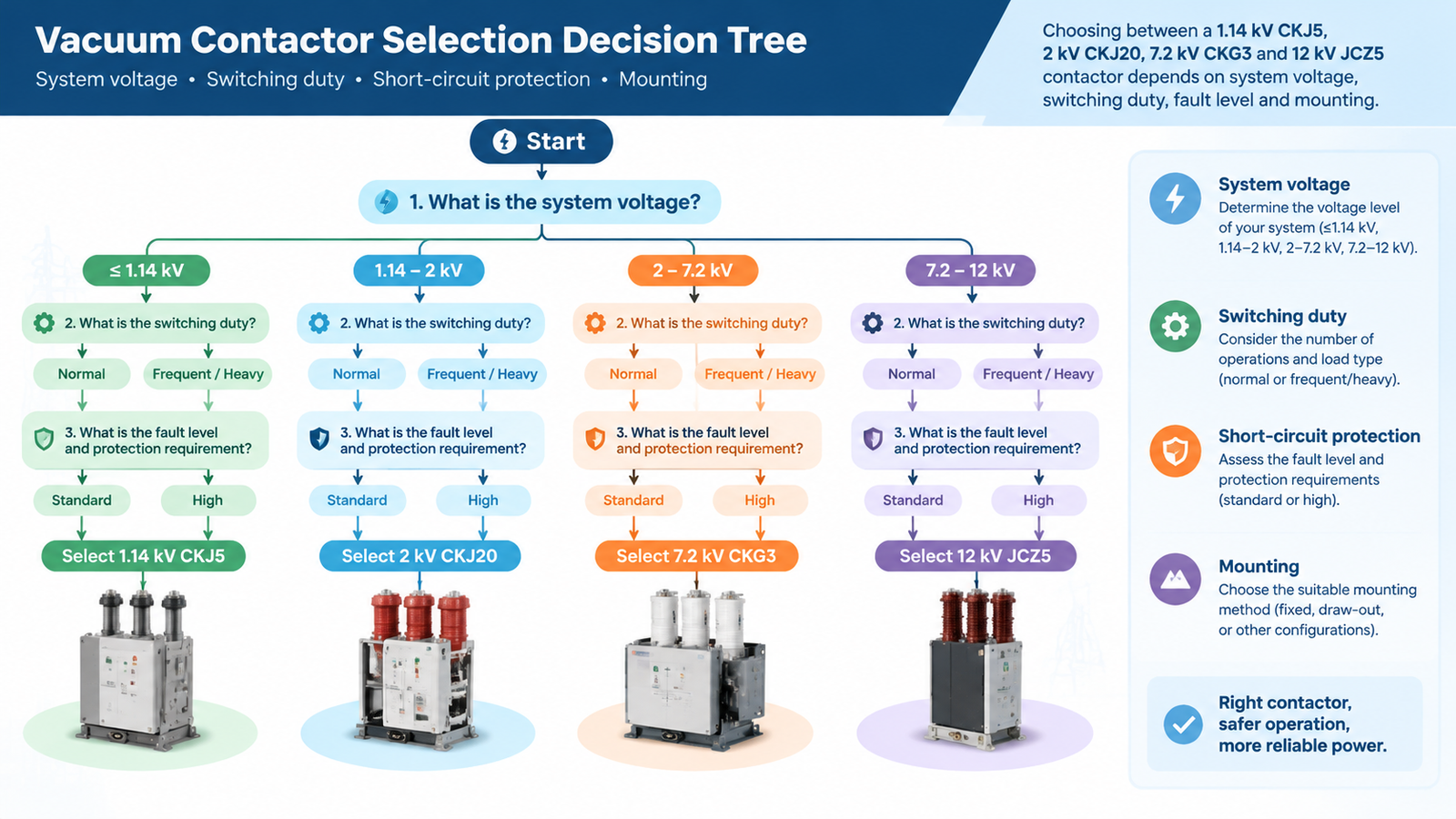
This guide compares the three series against the published ratings, then reduces the choice to four decisions: voltage class, duty, short-circuit protection and mounting. It closes with the specification fields that keep a wrong order off the factory floor. If you need the operating principle first, the vacuum contactor overview explains arcing in vacuum and why a contactor is built for frequent operation rather than fault clearing. Browsing the full vacuum contactor range first also helps, because the series names map directly to voltage classes.
The Thirty-Second Answer
If you only need the shortest possible version:
CKJ5 — a low-voltage vacuum contactor rated 380 V, 660 V or 1,140 V, for motor starters, flameproof starters and long-distance switching in LV distribution. It is not a 10 kV device, despite the family name being quoted alongside 12 kV models.
CKG3 — a 7.2 kV or 12 kV indoor vacuum contactor rated 160 A to 630 A, built for frequent starting of medium-voltage motors and switching of transformers and capacitor banks.
JCZ5 — a 7.2 kV or 12 kV indoor vacuum contactor rated 250 A to 630 A with published short-circuit breaking and short-time withstand values, so it can interrupt fault current within its rating rather than only carrying it.
That single difference in fault behaviour — carrying versus breaking — is what most selection errors come down to. A contactor that can only make and break load current must sit behind a fuse or a breaker. A contactor with a published breaking capacity can clear a limited fault itself, which changes the whole protection scheme.
Decision 1: Voltage Class Comes First
Voltage class eliminates options faster than any other criterion. The published ranges separate cleanly:
Series
Rated voltage
Rated current
Typical system
Typical use
CKJ5
380 / 660 / 1,140 V AC
250 / 400 / 600 A
400 V, 690 V, 1,140 V
LV motor starters, flameproof starters, remote switching
CKJ20
2 kV class
250 / 400 / 630 / 800 A
1.5 kV to 2 kV
Heavy LV and 2 kV motor and capacitor switching
CKG3
7.2 / 12 kV
160 / 250 / 400 / 630 A
6.6 kV, 10 kV, 11 kV
MV motor starting, transformer and capacitor switching
JCZ5
7.2 / 12 kV
250 / 400 / 630 A
6.6 kV, 10 kV, 11 kV
Repeated MV switching with limited fault breaking
The practical rule is insulation coordination, not marketing. A 12 kV contactor carries a 42 kV power-frequency withstand and a 75 kV lightning impulse withstand, which sets its pole spacing, its creepage path and its cubicle footprint. Fitting a 1,140 V CKJ5 into a 10 kV circuit is not a rating question that a purchase order can settle — the device has no impulse rating for that insulation level at all.
Conversely, ordering a 12 kV CKG3 for a 690 V motor starter wastes money and space, and often forces a larger cable chamber than the panel has. Match the contactor’s rated voltage to the system’s highest operating voltage, with the standard one-step margin used in the switchgear: 7.2 kV units on 6.6 kV systems, 12 kV units on 10 kV and 11 kV systems, and 1.14 kV units on 690 V systems.
Decision 2: What the Contactor Has to Break
Read the ratings tables carefully and a second split appears. The CKG3 publishes a rated breaking capacity of 8 Ie with 25 operations, a rated closing capacity of 10 Ie with 100 operations, a rated short-time withstand current of 10 Ie (1.6 kA to 6.3 kA across the current range) and a rated peak withstand of 25 Ie (4 kA to 16 kA). Those are load-breaking and fault-carrying numbers, not fault-clearing numbers.
The JCZ5 publishes a rated maximum breaking current of 2,000 A, 3,200 A and 5,040 A for the 250 A, 400 A and 630 A variants, alongside a 4-second thermal stability current of 2,500 A, 4,000 A and 6,300 A, and a rated closed current of the same values. In other words, the JCZ5 is documented to break current above its nominal rating for a limited number of operations.
That distinction drives three common configurations:
Contactor plus fuse (F-C scheme) — the fuse clears short circuits, the contactor switches load. Standard for MV motor feeders where the motor starter must be compact and the fault level is high.
Contactor plus upstream breaker — the breaker provides protection and isolation, the contactor provides the high operating frequency. Common where a single breaker feeds a group of contactors.
Contactor with its own limited breaking rating — acceptable where the calculated fault level is below the published maximum breaking current and the operating scheme permits it, such as capacitor switching with a current-limiting reactor.
If your specification says “contactor shall interrupt fault current”, confirm the number before the order, because a CKG3 in that role needs an upstream protective device, and the switchgear drawing changes with it. The contactor versus breaker comparison covers this boundary in more detail, including why a contactor’s electrical life is quoted in hundreds of thousands of operations while a breaker’s is quoted in thousands.
Decision 3: Duty Cycle and Operating Frequency
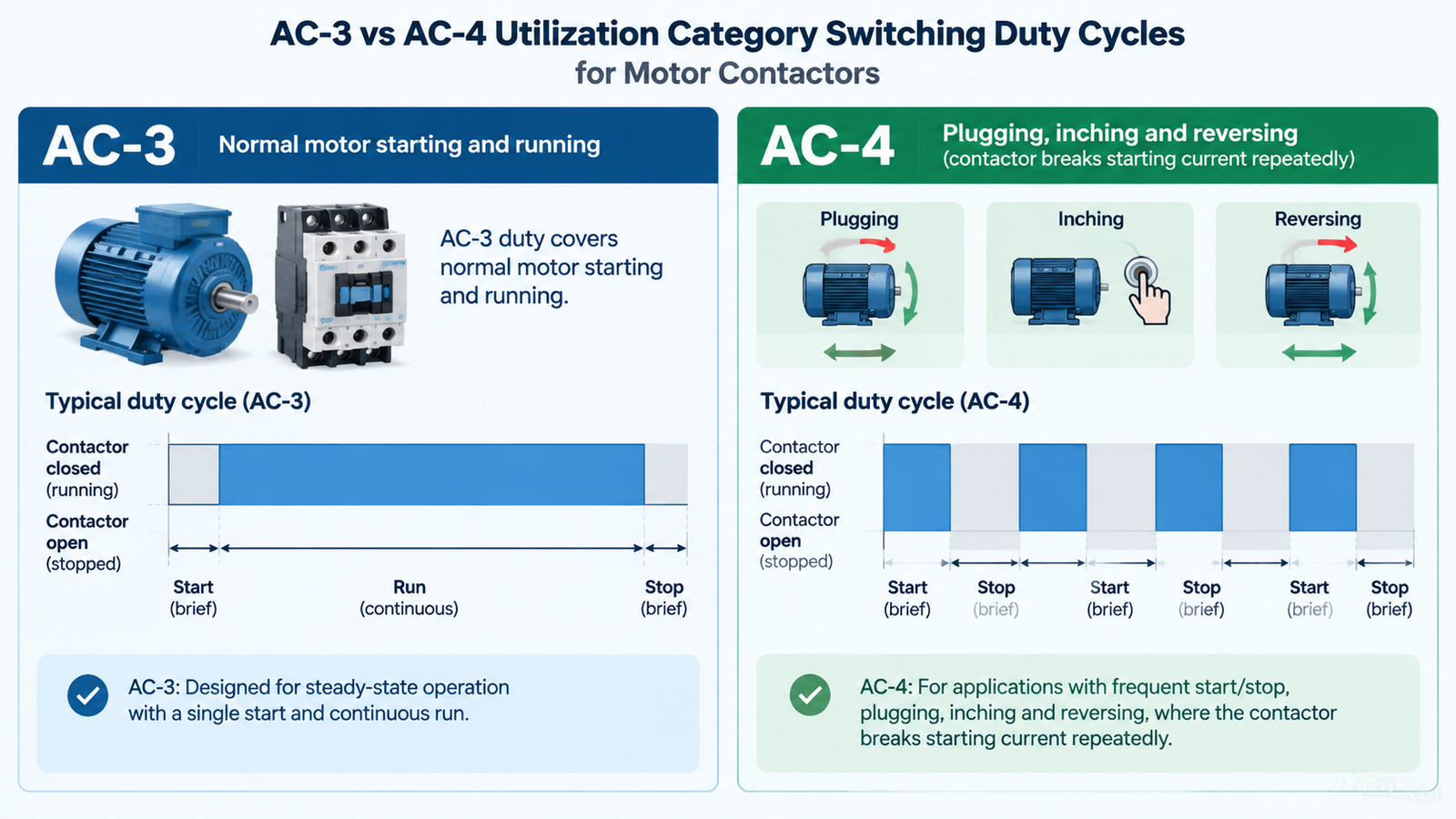
Utilization category decides the current rating you actually need. AC-3 covers squirrel-cage motor starting with the motor running up to speed before the contactor opens. AC-4 covers plugging, inching and reversing, where the contactor opens starting current repeatedly — a far harsher duty.
The published lives show the penalty clearly. The CKG3 is rated for 300 operations per hour on AC-3 and 120 operations per hour on AC-4, with 60 × 10,000 AC-3 electrical operations and 300 × 10,000 mechanical operations. The JCZ5 publishes 25 × 10,000 electrical operations on AC-3 and 10 × 10,000 on AC-4. The CKJ5 publishes 60 × 10,000 AC-3 operations and 300 × 10,000 mechanical operations, with 300 operations per hour on AC-3 and 120 on AC-4.
For a crane hoist, a winder or a mill duty drive that reverses dozens of times an hour, AC-3 numbers are meaningless — size on AC-4 and expect roughly a quarter of the electrical life. For a pump or fan that starts twice a day, AC-3 life is generous and the cost of oversizing for AC-4 is wasted.
Decision 4: Coil, Control Supply and Mounting
The control circuit is where panel builders get caught. The CKJ5 offers AC 50 Hz control voltages of 36 V, 127 V, 220 V and 380 V, with 3 NO plus 3 NC auxiliary contacts. The JCZ5 publishes AC 110 V and 220 V control, a closing-coil current up to DC 6 A or 3 A, a holding-coil current of DC 0.32 A or 0.16 A and a shunt-trip coil current of DC 2.5 A or 1.3 A. A JCZ5 that needs a DC holding supply will not run from a plain 220 V AC control bus without a rectifier module.
Mounting geometry follows the same pattern. CKJ5 horizontal units are built to sit in a starter chassis; the vertical GKJ5 arrangement exists for deep cubicles. CKG3 units mount in fixed MV cubicles and in mining and hoist control panels, where 3-pole, 4-pole and 5-pole variants with mechanical interlocking are used for reversing duty. JCZ5 units are offered in fixed and withdrawable formats for metal-clad switchgear.
Side-by-Side Comparison
Parameter
CKJ5 (horizontal)
CKG3 12 kV
JCZ5 7.2 / 12 kV
Rated voltage
380 / 660 / 1,140 V AC
12 kV
7.2 / 12 kV
Rated current
250 / 400 / 600 A
160 / 250 / 400 / 630 A
250 / 400 / 630 A
Power-frequency withstand
Not published at MV level
42 kV
42 kV
Lightning impulse withstand
Not published at MV level
75 kV
Not stated in the published table
Making capacity
10 Ie
10 Ie, 100 operations
Rated closed current 2,500 / 4,000 / 6,300 A
Breaking capacity
8 Ie; limited breaking 4,500 A (250/400 A), 6,000 A (600 A)
8 Ie, 25 operations
2,000 / 3,200 / 5,040 A
Short-time withstand
Not published
10 Ie, 1.6 to 6.3 kA
4 s thermal stability 2,500 / 4,000 / 6,300 A
Peak withstand
Not published
25 Ie, 4 to 16 kA
Not stated in the published table
Electrical life, AC-3
60 × 10,000 operations
Published per variant
25 × 10,000 operations
Electrical life, AC-4
Published per variant
Published per variant
10 × 10,000 operations
Mechanical life
300 × 10,000 operations
Published per variant
Published per variant
Control supply
AC 36 / 127 / 220 / 380 V
AC control, per order
AC 110 / 220 V with DC coils
Contact gap
Per variant
Per variant
1.5 ± 0.5 mm
Operating temperature
Per published data
-10 °C to 40 °C
-5 °C to 40 °C
Altitude limit
Per published data
1,000 m standard, 4,000 m plateau type
1,000 m
Read the table by column, not by row. Column one describes a low-voltage device. Columns two and three describe medium-voltage devices that differ mainly in how much fault current they are documented to break.
Matching Each Series to the Application
CKJ5 and CKJ20: LV motors and heavy LV loads
The CKJ5 belongs in LV motor control centres, flameproof starters for hazardous areas, and any application where the switching point is far from the operator. Its 1,140 V rating covers 690 V systems, and the 4,500 A to 6,000 A limited breaking capacity is adequate for LV fault levels when backed by fuses. Where currents climb past 600 A on a 2 kV system, the larger CKJ20 2 kV contactor extends the same principle to 800 A with 60 × 10,000 AC-3 operations and a 2.5 mm contact gap.
CKG3: the MV workhorse
The CKG3 12 kV contactor is the default choice for medium-voltage motor starters, transformer feeders and capacitor banks where switching frequency is high and fault clearing is delegated to a fuse or breaker. It is also the series used in mining hoist and winder control, where 4-pole and 5-pole variants with mechanical interlocking reverse a motor. The 160 A variant suits small motors and capacitor steps; the 630 A variant covers large fans, compressors and pumps.
JCZ5: where fault breaking is required
The JCZ5 vacuum contactor fits applications that need repeated operation plus a documented breaking capability: capacitor switching with inrush control, arc furnace and induction furnace supplies, and switchgear where the contactor is the primary switching device and the upstream protection is set above the contactor’s breaking rating. Its three-phase opening synchronism of 2 ms or better matters for capacitor and filter duty.
CKJ5 versus JCZ5 on a 10 kV system
This is the comparison that generates the most support questions. A buyer searching for a 10 kV contactor will find both families quoted, because both appear in the same catalogue. The CKJ5 cannot be applied at 10 kV at all. If the system is 10 kV or 11 kV, the choice is between CKG3 and JCZ5, and the deciding question is whether the contactor must break fault current or only carry it.
Six Specification Mistakes
Mistake
What happens
Correct approach
Quoting CKJ5 for a 10 kV feeder
Device has no 12 kV insulation level; drawing rejected at approval
Use CKG3 or JCZ5 for 7.2 / 12 kV systems
Specifying a contactor to clear fault current
No published breaking rating at the fault level; protection coordination fails
Add a fuse or upstream breaker, or select JCZ5 with a verified breaking rating
Sizing on AC-3 for a reversing drive
Electrical life collapses to a quarter of the quoted figure
Size on AC-4 and check operations per hour
Assuming an AC control supply
JCZ5 closing and holding coils are DC; the panel has no rectifier
Confirm coil type, voltage and current draw before ordering
Ignoring altitude
Standard CKG3 is limited to 1,000 m; insulation derates above that
Order the plateau type for sites up to 4,000 m
Mixing 3-pole and 4-pole variants in a reversing scheme
Mechanical interlocking cannot be fitted, or the neutral is left unswitched
State pole count and interlock requirement explicitly
What to Put on the Enquiry
A contactor quotation is only as good as the data behind it. Include the following and most technical back-and-forth disappears:
System voltage and highest operating voltage, plus the fault level at the contactor terminals.
Load type — motor, transformer, capacitor bank, furnace, resistor — and its rated current.
Utilization category, AC-3 or AC-4, with expected operations per hour and per year.
Starting method and start duration, especially for high-inertia loads.
Control supply voltage and type, AC or DC, with the available current.
Auxiliary contact count and arrangement.
Pole count and any mechanical interlocking requirement.
Cubicle type, fixed or withdrawable, and the mounting orientation.
Site altitude, ambient temperature range and humidity.
Required standards and any test reports needed for approval.
Conclusion
The three families are not competitors on price. CKJ5 is a low-voltage device, CKG3 is a medium-voltage workhorse built for frequent load switching, and JCZ5 is the medium-voltage option with a documented fault-breaking capability. Choose the voltage class first, then decide what the contactor has to break, then size for the real duty cycle, and only then compare quotations. A contactor that fits the voltage and the duty but not the protection scheme is the most expensive kind of saving.
If you are still weighing a contactor against a breaker for a specific feeder, the CKJ5 horizontal contactor and the CKG3 pages both list the full published ratings so you can compare them against your fault study directly.
Frequently Asked Questions
Is CKJ5 a 12 kV vacuum contactor?
No. The CKJ5 horizontal vacuum contactor is published for 380 V, 660 V and 1,140 V AC main circuits. Its insulation level is a low-voltage level, so it cannot be applied to 6.6 kV, 10 kV or 11 kV systems. For those systems the correct families are CKG3 and JCZ5 at 7.2 kV or 12 kV.
What is the difference between CKG3 and JCZ5?
Both are 7.2 kV and 12 kV indoor vacuum contactors with similar current ranges. The CKG3 publishes load-breaking and fault-carrying ratings — 8 Ie breaking, 10 Ie short-time withstand and 25 Ie peak withstand — and is designed for frequent motor, transformer and capacitor switching. The JCZ5 additionally publishes a maximum breaking current above its nominal rating, so it can interrupt limited fault current within that figure.
Can a vacuum contactor replace a circuit breaker?
Only when its published breaking capacity exceeds the calculated fault level and the protection scheme is designed for it. In most medium-voltage motor feeders the contactor is paired with a fuse or an upstream breaker that clears faults, while the contactor handles the frequent switching that would wear out a breaker.
Why does JCZ5 need a DC control supply?
The JCZ5 mechanism uses a closing coil drawing up to DC 6 A or 3 A, a holding coil at DC 0.32 A or 0.16 A and an optional shunt-trip coil at DC 2.5 A or 1.3 A, with AC 110 V or 220 V control-circuit input. The panel therefore needs a rectifier or a DC control bus; a plain AC bus without conversion will not hold the contactor closed.
How do I choose between AC-3 and AC-4 ratings?
Use AC-3 when the motor accelerates to full speed before the contactor opens — pumps, fans, compressors. Use AC-4 when the contactor opens starting current — plugging, inching, reversing, crane and hoist duty. Published AC-4 electrical life is roughly a quarter of the AC-3 figure, so the same contactor carries a much smaller load in reversing service.
Does the 600 A CKJ5 need special confirmation?
Yes. The published CKJ5 data carries a voltage condition on the 600 A rating, so the configuration should be confirmed against the actual system voltage before ordering. The 250 A and 400 A ratings are published without that caveat.