VS1 Fixed vs Withdrawable Vacuum Breaker: Which Mounting?
Published: Author: Lisa
Every VS1 enquiry eventually reaches the same fork: fixed type or withdrawable. Both are indoor 12 kV or 24 kV vacuum breakers with the same interrupting principle and similar ratings, so the choice is rarely about electrical performance. It is about how the panel is maintained, how much floor space the switchgear room has, and how long the plant can afford to be without that feeder.
This guide separates the two mounting forms by what they change in practice: isolation, interlocking, panel depth, commissioning time and lifecycle cost. It also covers the configuration detail that decides most real projects — whether the cubicle is metal-clad with a handcart, or fixed-pattern with a separate isolator. For the interrupting principle and the wider product context, the vacuum circuit breaker overview covers the basics; the full vacuum circuit breaker range shows which frames are offered in each form.
The Short Answer
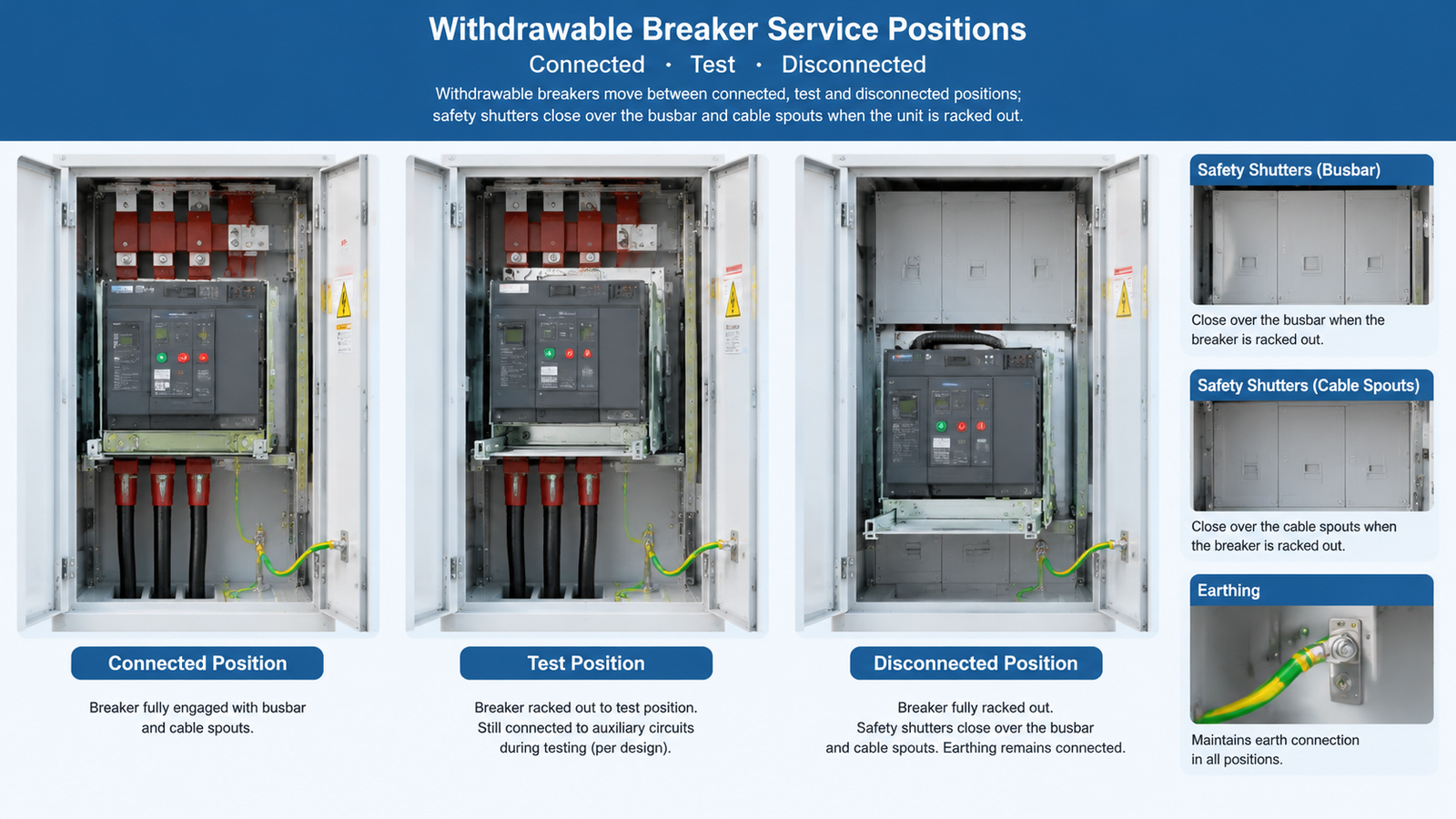
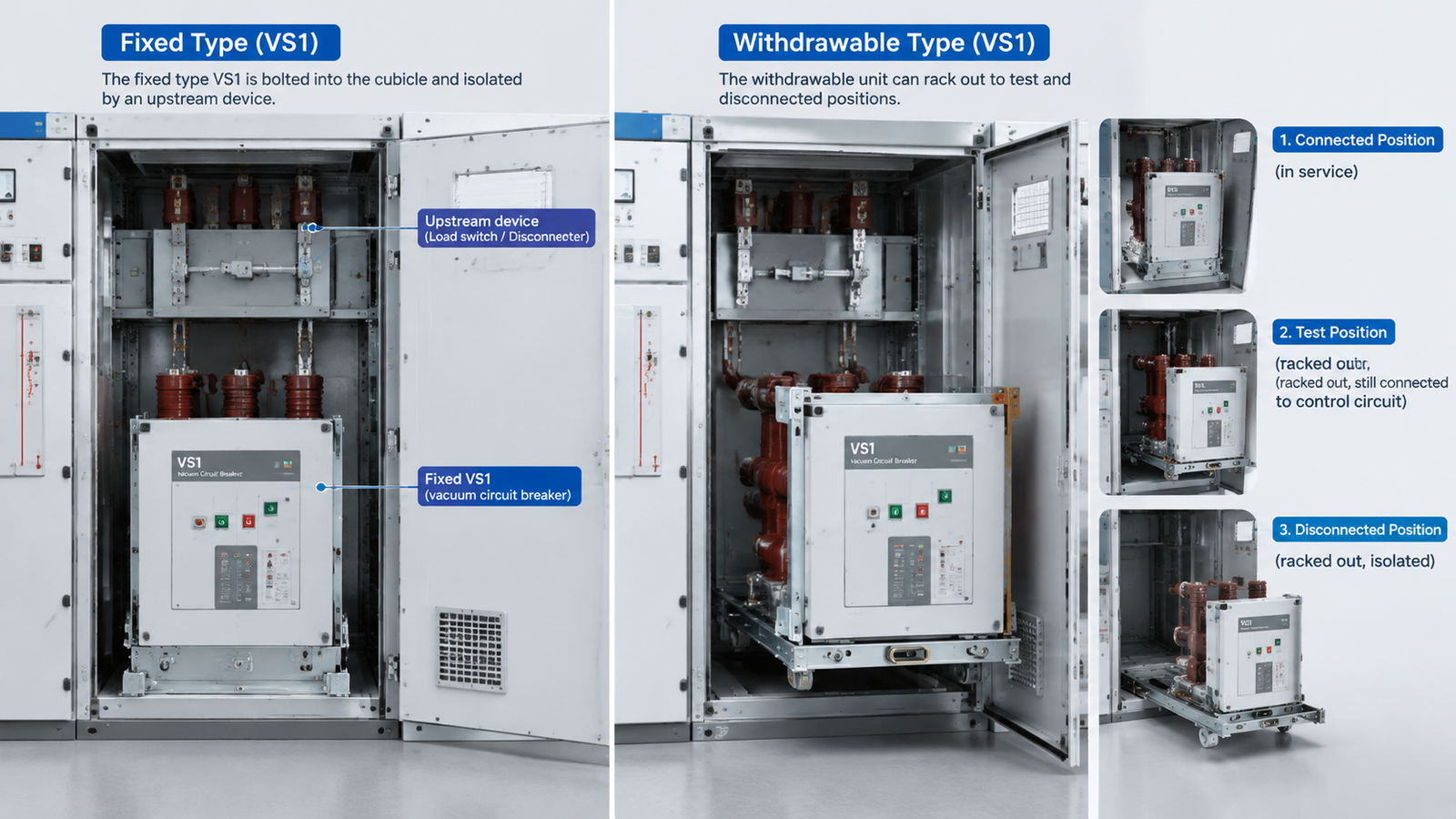
A fixed VS1 is bolted into the cubicle. Its main terminals are connected permanently, and isolation for maintenance comes from an upstream device — a load-break switch, a disconnect, or the upstream breaker feeding the section. A withdrawable VS1 sits on a handcart or a racking carriage. It travels between connected, test and disconnected positions, and in the disconnected position the main contacts are separated and safety shutters close over the fixed spouts.
The consequence is simple: withdrawable gives you fast, repeatable isolation without touching a cable termination, at the cost of a deeper cubicle, a more complex interlock scheme and a higher unit price. Fixed gives you a compact, cheaper panel, but any breaker work means isolating upstream and often opening the cable compartment.
What Withdrawable Actually Buys You
The value of a handcart is measured in maintenance hours. On a withdrawable unit, the sequence for taking a feeder out of service is mechanical and repeatable: open the breaker, rack it from connected to test, confirm the shutter is closed, then rack to disconnected and remove the unit if it needs to leave the room. The busbar and cable compartments stay sealed throughout.
On a fixed unit, the same job starts with finding and operating an upstream isolating device, proving dead, earthing, and then opening the cable box to disconnect terminations if the breaker itself has to be replaced. For a plant with a spare-breaker policy, that difference is the whole argument: a withdrawable spare can be swapped in during a shift, a fixed breaker cannot.
Three service positions define the working envelope of a withdrawable unit:
Connected — main and auxiliary contacts engaged, breaker able to close, shutters open.
Test — main contacts separated, auxiliary and control circuits still engaged, so the breaker can be closed and its protection tested without energising the feeder.
Disconnected — main and auxiliary circuits separated, shutters closed, unit removable.
The test position is the part buyers underestimate. Being able to prove the protection trip, the close circuit and the interlocking while the feeder is dead but the control supply is live turns a commissioning day into a commissioning hour, and it is impossible on a fixed breaker without temporary wiring.
What Fixed Type Buys You
A fixed VS1 removes the racking mechanism, the shutter assembly, the carriage and the position interlocks. What remains is a breaker, a set of fixed contacts and a cubicle. Fewer moving parts, fewer things to misalign, and a shallower panel — typically a meaningful saving in a switchgear room where depth is the constraint, such as a containerised substation or a retrofit into an existing building.
Fixed units also suit schemes where the breaker is not expected to be removed during its service life. Ring main units with a fixed vacuum breaker, compact secondary substations, and packaged equipment where the whole assembly is replaced rather than repaired all use fixed patterns for the same reason: the isolation function lives elsewhere.
Interlocking and the Five Safety Functions
The interlock set is where the two forms diverge technically. The ZN63 (VS1) frame is described with five interlocking functions applied after panel installation: the breaker cannot be racked with the breaker closed, cannot be closed unless it is in a valid position, cannot be racked with the earthing switch closed, the earthing switch cannot be closed with the breaker in the connected position, and the compartment door cannot be opened with the breaker in a live position.
Those five functions are properties of the cubicle and the carriage, not of the breaker alone. A fixed breaker relies on key interlocks and operating procedures instead, and the discipline burden moves to the switching programme. In plants with a mature permit-to-work system that is acceptable; in plants where the switching programme is written by whoever is on shift, the mechanical certainty of a handcart is worth the price difference.
Metal-clad switchgear, main LV/MV distribution boards
Matching the Form to the Frame
Not every VS1 frame is offered both ways in the same rating. The published data shows the split clearly:
Frame
Voltage
Current range
Short-circuit rating
Installation forms
VS1 ZN63A
12 kV
630 to 4,000 A (4,000 A subject to confirmation)
20 / 25 / 31.5 / 40 / 50 kA by configuration
Handcart, indoor metal-clad
ZN63 (VS1)
24 kV
Per configuration
Per configuration
Fixed unit or moving-base carrier unit
Two details matter when you compare quotations across these frames. First, the short-circuit rating and the current rating move together — the 12 kV frame publishes 20 kA to 50 kA depending on the current configuration, and the 40 kA and above configurations drop from 50 breaking operations to 30. Second, the operating sequence changes with the rating: O–0.3 s–CO–180 s–CO for standard configurations, and O–180 s–CO–180 s–CO for 40 kA and above. A specification that asks for auto-reclosing on a 40 kA feeder is asking for a different duty cycle than the standard one.
If stopping a feeder stops production, withdrawable wins. The ability to swap a breaker during a planned window, without an upstream outage across the whole section, is worth more than the unit-price difference on day one.
2. Containerised or prefabricated substation
Fixed usually wins. Depth and weight are constrained, the breaker is rarely removed, and the isolation function is provided by the incoming device. Paying for racking hardware inside a box that has no space for a spare unit is poor value.
3. Retrofit into an existing switchroom
Fixed, almost always. Existing cubicles rarely have the depth or the floor plate for a carriage, and matching an obsolete handcart interface is usually more expensive than replacing the breaker in place.
4. Utility or infrastructure standard
Follow the standard. Where the owner’s specification calls for metal-clad switchgear with withdrawable breakers and five-function interlocking, the decision is already made and the only question is which frame fits the fault level.
Five Mistakes in Fixed-versus-Withdrawable Specifications
Mistake
Consequence
Fix
Specifying withdrawable but sizing the room for fixed cubicles
Panel will not fit; late civil rework
Confirm cubicle depth and cable chamber clearance before layout freeze
Assuming the breaker alone provides isolation on a fixed unit
No means of proving dead at the breaker; permit-to-work cannot be issued
Add an upstream isolator or load-break switch to the scheme
Asking for auto-reclose at 40 kA
Published sequence for that rating is O–180 s–CO, not fast reclose
State the required duty cycle and confirm the configuration
Buying a spare breaker without a spare carriage
Spare cannot be racked in
Order the spare as a complete withdrawable unit
Mixing frames across a board
Different depths, different interlock logic, incompatible spouts
Keep one frame per switchboard section
What to Put on the Enquiry
System voltage, 12 kV or 24 kV, and the highest operating voltage.
Rated current required, and the calculated fault level with its duration.
Installation form: fixed, withdrawable, or either.
Cubicle type and depth, and whether it is existing or new.
Required operating sequence and any auto-reclose duty.
Control supply voltage and the protection relay interface.
Interlock functions required, and whether key interlocks are acceptable.
Ambient temperature range, altitude and humidity at site.
Spare-unit policy and whether a spare carriage is needed.
Required standards and the test reports needed for approval.
Conclusion
Fixed and withdrawable VS1 breakers interrupt the same fault current. What separates them is isolation, testing and replacement — three things that only matter after commissioning, which is exactly why they get under-specified. Decide from the maintenance philosophy first: if the feeder must return quickly and the room has depth, take the handcart; if space is tight and the breaker will stay put, take the fixed unit and put the isolation function upstream. Then confirm the frame, the fault level and the operating sequence together, because on this family they move as a set.
If the wider question is which breaker family suits the feeder at all, the VS1 versus ZW32 versus ZW7 comparison covers indoor against pole-mounted and 40.5 kV outdoor options.
Frequently Asked Questions
Is VS1 fixed type or withdrawable?
Both forms exist. The ZN63 (VS1) frame is published with fixed unit and moving-base carrier (withdrawable) installation, and the VS1 ZN63A 12 kV handcart version is the withdrawable form used in metal-clad switchgear.
Can I convert a fixed VS1 cubicle to withdrawable?
Practically, no. The conversion needs a carriage, guide rails, shutter assemblies, position interlocks, a deeper cubicle and a compatible spout arrangement. In most cases replacing the cubicle is cheaper and keeps the interlock certification intact.
How long does it take to replace a fixed versus withdrawable breaker?
A withdrawable unit can be racked out and a spare racked in within a short planned window, with the busbar and cable compartments staying sealed. A fixed breaker needs the upstream device isolated, the feeder proven dead and earthed, and the cable terminations disconnected before the breaker can be unbolted.
What is the test position used for?
In the test position the main contacts are separated but the control and auxiliary circuits remain connected, so the breaker can be closed and its protection and interlocking tested while the feeder is dead. On a fixed breaker the same test requires temporary control wiring.
Does a withdrawable breaker need a larger switchroom?
Yes. The carriage travel adds depth to the cubicle, and access space in front is needed to withdraw the unit. Fixed cubicles are shallower and suit containerised or retrofit installations where depth is the binding constraint.
Which form is required for metal-clad switchgear?
Metal-clad switchgear with compartmented busbar, breaker and cable sections is normally built around withdrawable units, because the compartment design and the five interlock functions assume a racking carriage. Fixed breakers are used in fixed-pattern and compact switchgear instead.