1kV vs 7.2kV vs 12kV Vacuum Contactors: Voltage Class Selection
Published: Author: Lisa
Search for a “1 kV vacuum contactor” and you will find devices rated 1,140 V, 2 kV, 7.2 kV and 12 kV in the same result set, often from the same manufacturer. The reason is that vacuum contactors are catalogued by voltage class rather than by the nominal system voltage they serve, and the class names are one step above the systems they protect. Picking the wrong class does not degrade performance slightly — it makes the device unusable, because insulation level, contact gap and creepage distance are all set by the class.
This guide maps plant distribution voltages to contactor classes, explains the insulation data behind each step, and shows where the trade-off between voltage and current becomes real. If the terminology is new, start with the vacuum contactor overview; the full vacuum contactor range shows which series sits in each class.
First, the Naming Trap
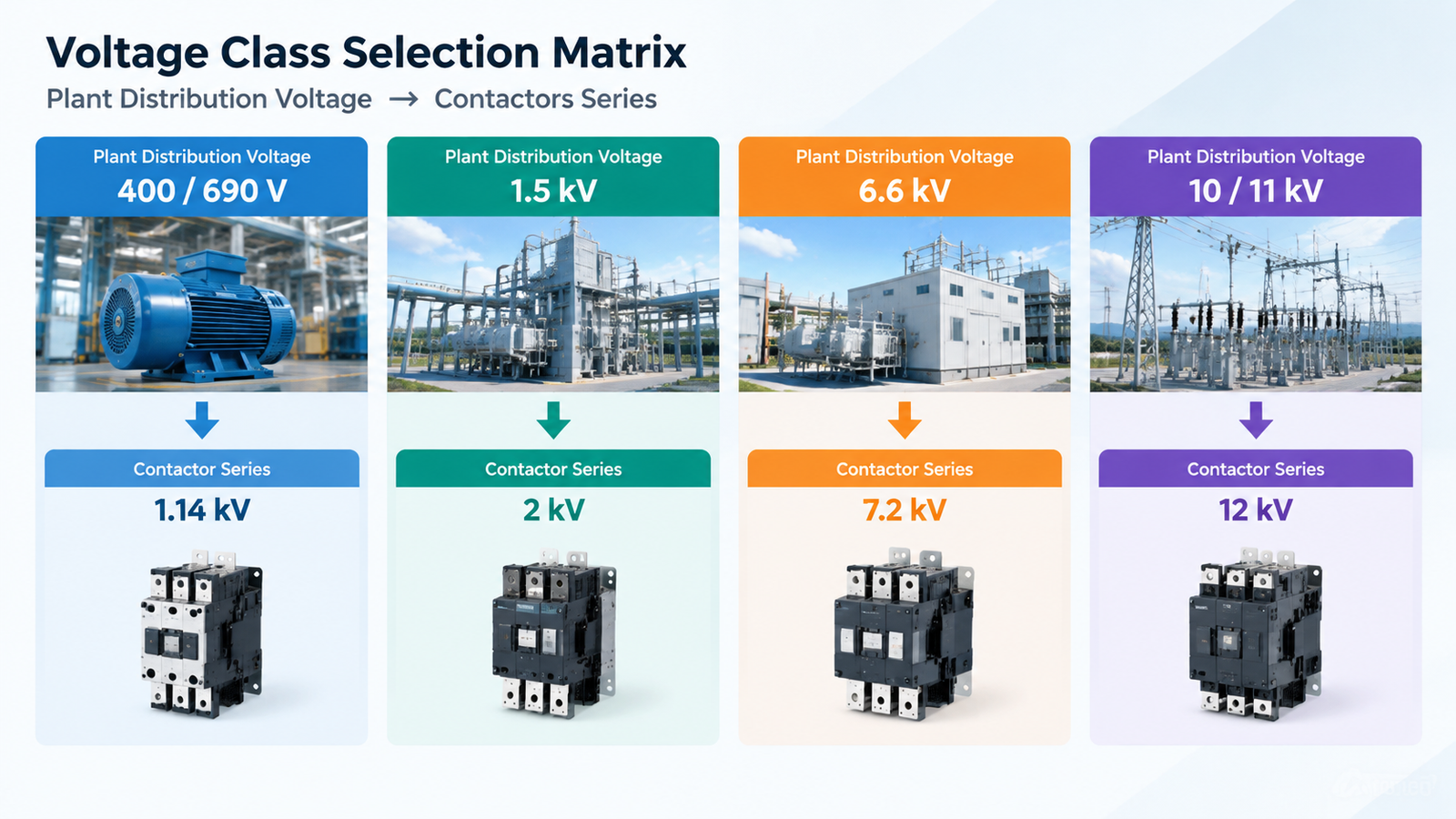
There is no such thing as a standard 1 kV contactor class. What the market calls a “1 kV vacuum contactor” is a device with a rated operating voltage of 1,140 V, chosen because that covers 1,000 V systems with margin — and, more importantly, because 1,140 V is the highest low-voltage class widely used in mining and heavy industry. The same shorthand produces “2 kV” for devices serving 1.5 kV systems, “7.2 kV” for 6 kV and 6.6 kV systems, and “12 kV” for 10 kV and 11 kV systems.
Two consequences follow. A quotation for a “1 kV contactor” should always state 1,140 V in the technical schedule, so there is no room for a 690 V device to be supplied instead. And a datasheet quoting only the nominal system voltage is incomplete — you need both the class and the insulation withstand values.
The Classes and the Systems They Serve
Contactor class
Systems served
Typical current range
Series examples
Where it sits
380 / 660 / 1,140 V
400 V, 690 V, 1,000 V, 1,140 V
250 to 600 A
CKJ5 horizontal
LV motor control centres, flameproof starters
1,140 V vertical
1,000 V, 1,140 V
250 to 400 A published
GKJ5 vertical
Deep LV cubicles, mining starters
2 kV
1,500 V, 2,000 V
250 to 800 A
CKJ20
Heavy LV, longwall mining, large drives
7.2 kV
6 kV, 6.6 kV
160 to 630 A
CKG3 7.2 kV, JCZ5 7.2 kV
MV motor starters, capacitor banks
12 kV
10 kV, 11 kV
160 to 630 A
CKG3 12 kV, JCZ5 12 kV
MV switchgear, substation feeders
Notice the pattern in the current column: as voltage class rises, the available current range narrows. The CKJ20 2 kV contactor publishes up to 800 A; the CKG3 12 kV contactor stops at 630 A. This is not a catalogue gap. Higher voltage means larger pole spacing and a bigger interrupter, and at some point forced cooling or a different device — a breaker — becomes the engineering answer rather than a bigger contactor.
The Insulation Data Behind Each Step
Voltage class determines two withstand values, and those two values drive the physical size of everything around the contactor.
Class
Power-frequency withstand
Lightning impulse withstand
What it constrains
1,140 V
Low-voltage class
Low-voltage class
Cable and busbar clearance in the starter chassis
2 kV
Low-voltage / 2 kV class
Low-voltage / 2 kV class
Contact gap 2.5 ± 0.3 mm, larger arc chutes
7.2 kV
Published per standard
Published per standard
Pole pitch, phase barriers, cubicle depth
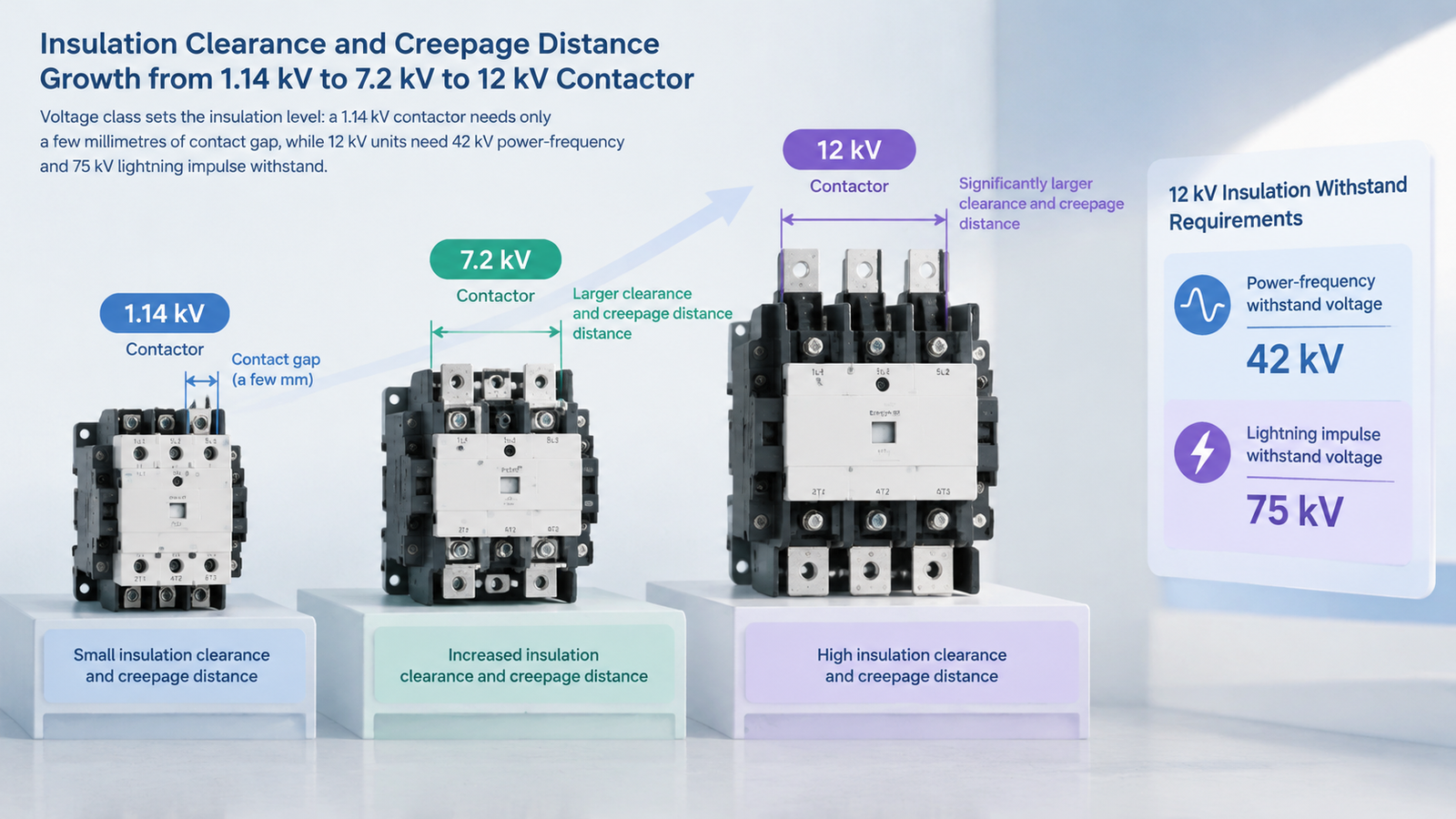
12 kV
42 kV published for CKG3 and JCZ5
75 kV published for CKG3
Pole pitch, creepage path, surge protection
One cross-market caution on the 12 kV row. Chinese-market equipment is routinely published at 42 kV power-frequency withstand for the 12 kV class, while some international tables list 28 kV for the same nominal class. The lightning impulse figure of 75 kV is common to both. When a project mixes equipment from different supply regions, state both values explicitly in the technical schedule instead of relying on the class name — otherwise a compliant device looks non-compliant on paper, or the reverse.
A second detail surprises electrical engineers new to contactors: the vacuum contact gap is short even at 12 kV. The JCZ5 publishes a contact gap of 1.5 ± 0.5 mm. Dielectric strength in vacuum is far higher than in air, so the gap does not scale with voltage the way an air-break gap does. What does scale is the external insulation — the creepage over the insulating pole, the phase-to-phase clearance in the cubicle, and the impulse withstand of the whole assembly.
Choosing the Class in Four Steps
Step 1: Take the highest system voltage, not the nominal
Use the highest voltage that can appear at the contactor terminals in normal operation, including transformer tap positions and regulation allowance. A 10 kV nominal system with a +5% and +2 × 2.5% tap range can reach above 11 kV; the 12 kV class covers that, a 7.2 kV class does not.
Step 2: Check the insulation coordination of the whole cubicle
The contactor cannot be more insulated than the compartment around it. If the panel is a 12 kV design, a 7.2 kV contactor inside it is under-insulated even if the system happens to be 6.6 kV. Fit the class that matches the switchgear, not only the system.
Step 3: Confirm the current at that class
Ratings are class-specific. Once the class is fixed, check the published current options and then apply the duty correction. The CKJ20 publishes 250 A to 800 A at 2 kV; the CKG3 publishes 160 A to 630 A at 12 kV. If the load needs 800 A at 12 kV, the answer is a breaker or a parallel scheme, not a larger contactor.
Step 4: Apply the environment correction
Altitude and ambient temperature both reduce capability. The CKJ20 and CKG3 publish an altitude limit of 1,000 m for standard units, with a plateau type available to 4,000 m for the CKG3. Above the limit, insulation withstand must be corrected rather than assumed, and the corrected value has to be compared against the impulse level at site — not against the nameplate. Temperature follows the same logic: the CKG3 publishes -10 °C to 40 °C, the JCZ5 -5 °C to 40 °C, and a cold-store or desert installation falls outside both.
Duty Differences Between Classes
Voltage class also predicts operating life, because the classes are built for different service patterns.
Parameter
CKJ5 (1,140 V)
CKJ20 (2 kV)
CKG3 (12 kV)
JCZ5 (7.2 / 12 kV)
AC-3 operations per hour
300
600
300
300
AC-4 operations per hour
120
120
120
120
AC-3 electrical life
60 × 10,000
60 × 10,000
Published per variant
25 × 10,000
AC-4 electrical life
Published per variant
6 × 10,000
Published per variant
10 × 10,000
Mechanical life
300 × 10,000
300 × 10,000
Published per variant
Published per variant
Contact gap
Per variant
2.5 ± 0.3 mm
Per variant
1.5 ± 0.5 mm
The pattern is consistent: lower-voltage classes tolerate more operations because the interrupter and the mechanism are smaller and the arc energy per operation is lower. This is why an LV motor starter can switch a pump hundreds of times a day for years — the CKJ5 horizontal contactor is built for exactly that — while a 12 kV JCZ5 contactor on the same duty needs a life-cycle check before year three.
Short-Circuit Protection Differs by Class Too
The protective device changes with the class, and the change is not cosmetic. At 1,140 V, a fuse or a moulded-case breaker in the starter provides fault clearing, and the contactor’s own limited breaking capacity of 4,500 A to 6,000 A is a backstop. At 2 kV, the same scheme applies with larger fuses. At 7.2 kV and 12 kV, the fuse becomes a high-voltage current-limiting fuse in an F-C combination, or the protection moves upstream to a vacuum breaker with a relay.
Mixing those schemes is a common source of trouble. A 12 kV contactor specified without a stated protective device will be quoted with whatever the supplier’s default is, and the panel designer’s coordination study may then assume a breaking capacity the contactor does not have. State the scheme, not just the device.
Five Mistakes in Voltage-Class Selection
Mistake
Why it happens
Result
Ordering “1 kV” without confirming 1,140 V
Class name treated as the rating
690 V device supplied; unusable at 1,000 V
Fitting a 7.2 kV contactor in a 12 kV panel
System voltage is 6.6 kV, so the class looks adequate
Insulation margin lost above 1,000 m without correction
Quoting a class without its protective device
Contactor treated as a standalone item
Coordination study assumes a breaking capacity that is not published
What to Put on the Enquiry
Nominal system voltage and highest operating voltage, including tap allowance.
Required contactor class and the insulation withstand values expected by the project standard.
Load type and rated current, plus starting current and start duration.
Utilization category and operations per hour.
Fault level at the contactor terminals and the intended protective device.
Control supply voltage, AC or DC, and auxiliary contact requirement.
Pole count and interlocking requirement.
Site altitude, ambient range and humidity.
Panel type and mounting orientation, horizontal or vertical.
Standards and test reports needed for approval.
Conclusion
Voltage class is the first number to fix, and it is fixed by the highest voltage the contactor can see — not by the nominal system voltage and not by the family name. Once the class is set, the insulation data, the available current range and the duty life all follow from it, and the protective device has to be selected with the contactor rather than after it. The classes are not interchangeable and the current ratings are not portable across them, which is why the specification should carry both the class and the withstand values.
If you are comparing series inside one class, the CKG3 versus CKJ5 versus JCZ5 comparison sets out the 12 kV and 1,140 V options against each other in detail, including the fault-breaking difference between the two medium-voltage families.
Frequently Asked Questions
Is a 1 kV vacuum contactor the same as a 1,140 V contactor?
In practice, yes. The device supplied for a “1 kV” application is normally rated 1,140 V, which covers 1,000 V systems with margin. Always write 1,140 V into the technical schedule, because a 690 V device would otherwise also match a loosely worded “low voltage” enquiry.
Can I use a 12 kV contactor on a 6.6 kV system?
Electrically it will work, and some projects do it to standardise spares. The penalty is size and cost: the 12 kV class brings 42 kV power-frequency and 75 kV impulse withstand, which means larger pole spacing and a deeper cubicle than a 7.2 kV unit needs. Standardise on 12 kV only where the switchgear is already 12 kV rated.
Why do 12 kV contactors stop at 630 A?
Because above that current the interrupter and the thermal path become impractical in a contactor frame. The 2 kV class reaches 800 A in a much smaller envelope. For high current at 12 kV, a vacuum circuit breaker is the normal device, and the contactor stays on motor and capacitor duty inside its range.
What happens if I install a contactor above its altitude limit?
Insulation withstand falls as air density drops, so the impulse and power-frequency margins at site are lower than the nameplate values. Standard CKJ20 and CKG3 units are published to 1,000 m; a plateau type of the CKG3 is published to 4,000 m. Above the limit, apply the altitude correction and verify the corrected values against the site impulse level.
Does the voltage class change the contact gap?
Less than expected, because vacuum has very high dielectric strength. The JCZ5 publishes a 1.5 ± 0.5 mm gap at 7.2 / 12 kV and the CKJ20 publishes 2.5 ± 0.3 mm at 2 kV — the larger gap is in the lower-voltage device, because its mechanism and interrupter design differ. External clearance and creepage are what actually scale with voltage class.
Which class suits a 690 V motor with a long cable run?
The 1,140 V class covers 690 V systems, and long cable runs are one of its intended uses because the contactor can switch at distance from the operator. Confirm the voltage drop and the earth-fault protection for the cable length separately, since those are cable design issues rather than contactor ratings.
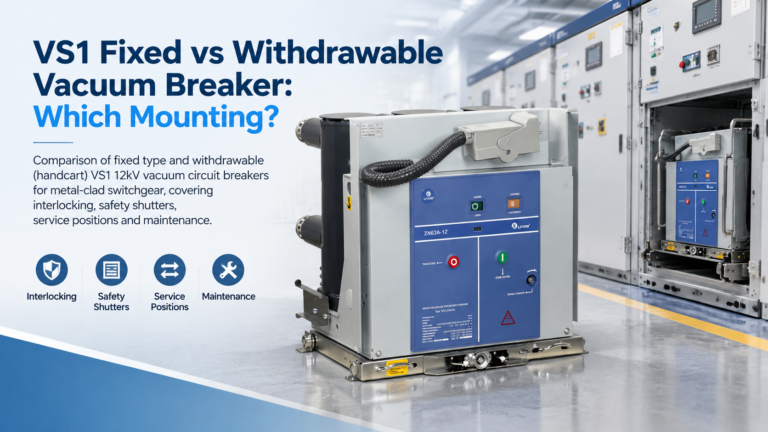
Fixed and withdrawable VS1 breakers interrupt the same fault current. The difference is isolation, testing and replacement time - here is how to choose.