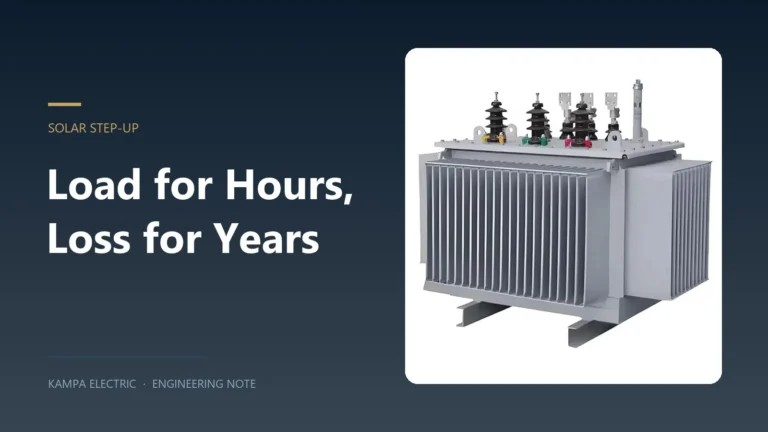
The US Department of Energy finalised amended energy conservation standards for distribution transformers in April 2024, and the date that matters commercially is 23 April 2029. From that day, every distribution transformer manufactured in or imported into the United States has to meet the new efficiency levels, which cut losses by 5 to 30 percent depending on the equipment class. The rule is five years away, which sounds comfortable until you count the redesign, re-testing and tooling time it takes to move a transformer family onto a lower-loss core.
This guide sets out what the rule actually says, which units fall inside it, how compliance is demonstrated at the test bench, and what changes on the factory floor. It is written for the people who have to quote, specify or import hardware rather than for lawyers, so the numbers are the ones that appear in the regulation itself. For the underlying efficiency classes, our note on transformer efficiency classes and losses explains how the values are built up from no-load and load loss.
What the 2024 Rule Requires
The rule amends 10 CFR 431.196, the section that sets minimum efficiency for distribution transformers. It applies to three equipment families, and the size of the cut depends on the family, the number of phases and the kVA rating:
| Equipment family |
Classes affected |
Loss reduction |
Test load point |
| Liquid-immersed |
Single-phase up to 100 kVA; three-phase 500 kVA and above |
5 percent |
50 percent of nameplate |
| Liquid-immersed |
Single-phase above 100 kVA; three-phase below 500 kVA |
20 percent |
50 percent of nameplate |
| Low-voltage dry-type |
Single-phase |
30 percent |
35 percent of nameplate |
| Low-voltage dry-type |
Three-phase |
20 percent |
35 percent of nameplate |
| Medium-voltage dry-type |
All covered classes, including three-phase units up to 5,000 kVA |
20 percent |
50 percent of nameplate |
Two details in that table cause more confusion than the percentages themselves. The first is that the reduction is a reduction in losses, not an addition to efficiency in percentage points. A transformer at 99.14 percent efficiency has 0.86 percent losses; cutting those losses by 20 percent gives 0.688 percent, which is 99.31 percent efficiency. The second is that the three families are measured at different load points, so their efficiency figures cannot be compared directly with one another or with a test report from another market.
Which Units Count as a Distribution Transformer
The definition in 10 CFR 431.192 is narrow and it is worth reading before assuming a product is covered. A distribution transformer has all four of the following:
- Input voltage of 34.5 kV or less.
- Output voltage of 600 V or less.
- Rated for 60 Hz operation.
- Capacity from 10 to 2,500 kVA for liquid-immersed units, or 15 to 2,500 kVA for dry-type units.
The regulation then excludes a long list of special-purpose units: autotransformers, drive (isolation) transformers, grounding transformers, machine-tool control transformers, nonventilated transformers, rectifier transformers, regulating transformers, sealed transformers, special-impedance transformers, testing transformers, units with a tap range of 20 percent or more, uninterruptible power supply transformers and welding transformers.
Several of those exclusions are traps rather than loopholes. A “sealed transformer” is excluded, and a “nonventilated transformer” is excluded, so a sealed nonventilated dry-type unit may sit outside the standard entirely; but the manufacturer has to know that before quoting, because the same physical product in a ventilated enclosure is covered. In the same way, a unit offered with a ±4 × 2.5 percent tap range, a 20 percent total span, falls outside the definition on the tap clause alone, and buyers who discover that after the order is placed tend to ask why the quotation specified such a wide tap range.
Exact Efficiency Values: Low-Voltage Dry-Type
The regulation expresses the standards as minimum percentage efficiency at each kVA rating, with linear interpolation for ratings that do not appear in the table. Low-voltage dry-type is the easiest family to show side by side, because both the current and the 2029 tables are short.
| Single-phase kVA |
2016 standard (%) |
2029 standard (%) |
Three-phase kVA |
2016 standard (%) |
2029 standard (%) |
| 15 |
97.70 |
98.39 |
15 |
97.89 |
98.31 |
| 25 |
98.00 |
98.60 |
30 |
98.23 |
98.58 |
| 37.5 |
98.20 |
98.74 |
45 |
98.40 |
98.72 |
| 50 |
98.30 |
98.81 |
75 |
98.60 |
98.88 |
| 75 |
98.50 |
98.95 |
112.5 |
98.74 |
98.99 |
| 100 |
98.60 |
99.02 |
150 |
98.83 |
99.06 |
| 167 |
98.70 |
99.09 |
225 |
98.94 |
99.15 |
| 250 |
98.80 |
99.16 |
300 |
99.02 |
99.22 |
| 333 |
98.90 |
99.23 |
500 |
99.14 |
99.31 |
|
|
|
750 |
99.23 |
99.38 |
|
|
|
1,000 |
99.28 |
99.42 |
The pattern in the numbers is the useful part. For a 1,000 kVA three-phase unit the 2016 standard of 99.28 percent allows 7.2 kW of losses; the 2029 standard of 99.42 percent allows 5.8 kW at the same 35 percent load point. That 1.4 kW has to come out of the design, and it comes out of the core, the winding or both.
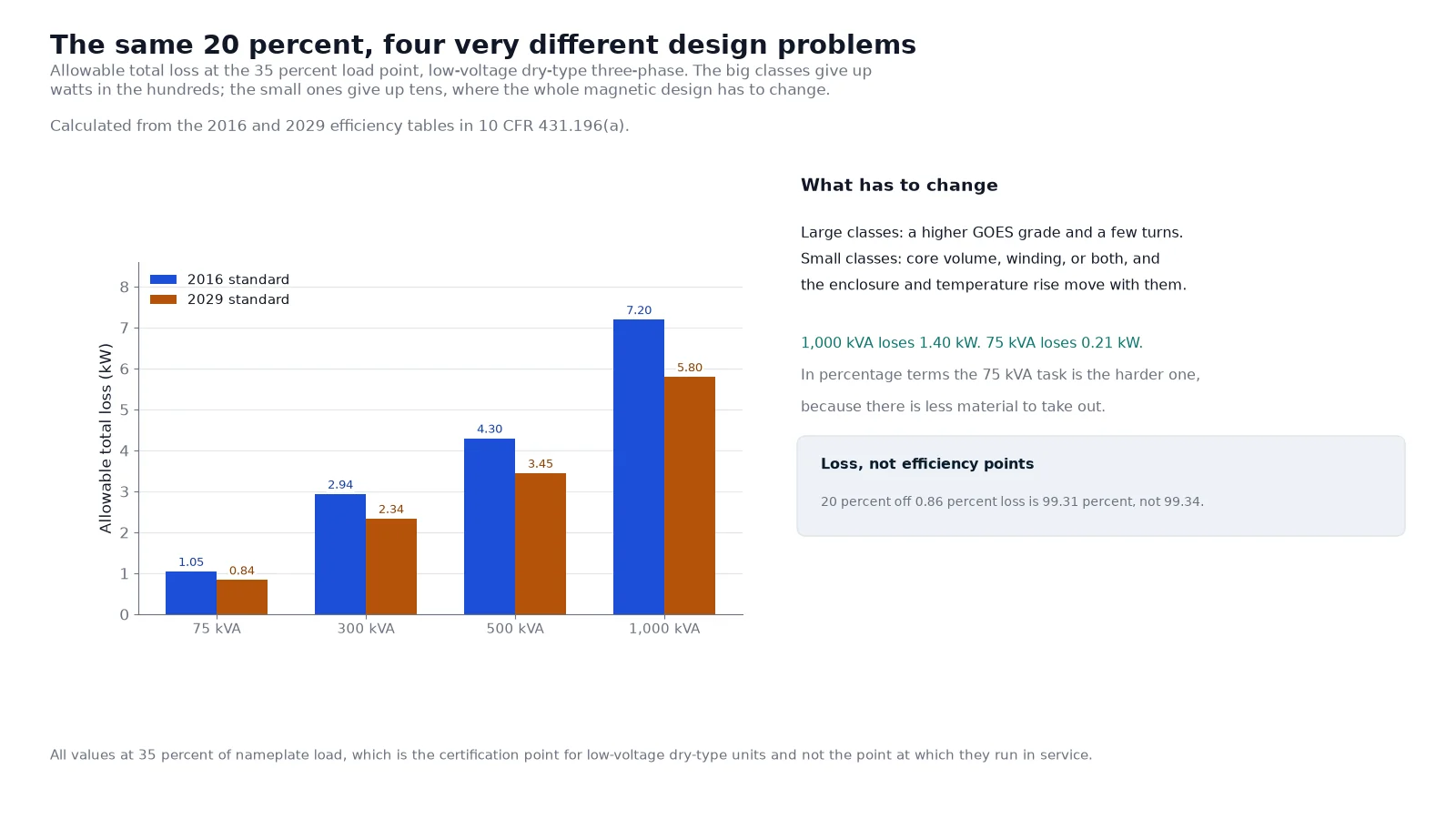
The same arithmetic explains why the smaller three-phase classes are the harder problem. A 15 kVA unit at 97.89 percent has 317 W of losses; at 98.31 percent it has 254 W. Losing 63 W from a transformer that size affects the whole magnetic and thermal design, while losing 1.4 kW from a 1,000 kVA unit is a change of core grade and a few turns.
What Changed From the 2023 Proposal
The final rule was materially softer than the January 2023 proposal, and the two changes explain most of the industry’s current planning assumptions.
Core material mix. The proposal would have pushed roughly 90 to 95 percent of the market onto amorphous metal cores. The final rule allows about 75 percent of the market to comply with grain-oriented electrical steel, with amorphous alloy covering the rest. Part of the reason is supply: domestic GOES comes from a single producer, and amorphous ribbon capacity is limited and partly imported.
Compliance time. The proposal gave three years. The final rule gives five, moving the compliance date to 23 April 2029, so that manufacturers can keep existing lines running while they build new ones.
The Department’s own accounting of the benefit is worth keeping in front of a project team when the topic comes up: over 30 years, the standards are projected to save consumers more than USD 14 billion in energy costs and 4.6 quadrillion Btu, about 10 percent of the energy use of products currently on the market.
How Compliance Is Demonstrated
The efficiency value is not measured at the load point where the transformer will actually run. It is certified at a fixed standard per-unit load, with losses corrected to a fixed reference temperature. Appendix A to Subpart K sets both.
| Item |
Liquid-immersed |
Medium-voltage dry-type |
Low-voltage dry-type |
| Per-unit load for certification |
50 percent |
50 percent |
35 percent |
| Reference temperature, no-load loss |
20 °C |
20 °C |
20 °C |
| Reference temperature, load loss |
55 °C |
75 °C |
75 °C |
| Temperature measurement tolerance |
±1.5 °C |
±2.0 °C |
±2.0 °C |
| Power loss measurement tolerance |
±3.0 percent |
±3.0 percent |
±3.0 percent |
| Voltage, current and resistance |
±0.5 percent |
±0.5 percent |
±0.5 percent |
| Instrument transformers |
Class 0.3 or better |
Class 0.3 or better |
Class 0.3 or better |
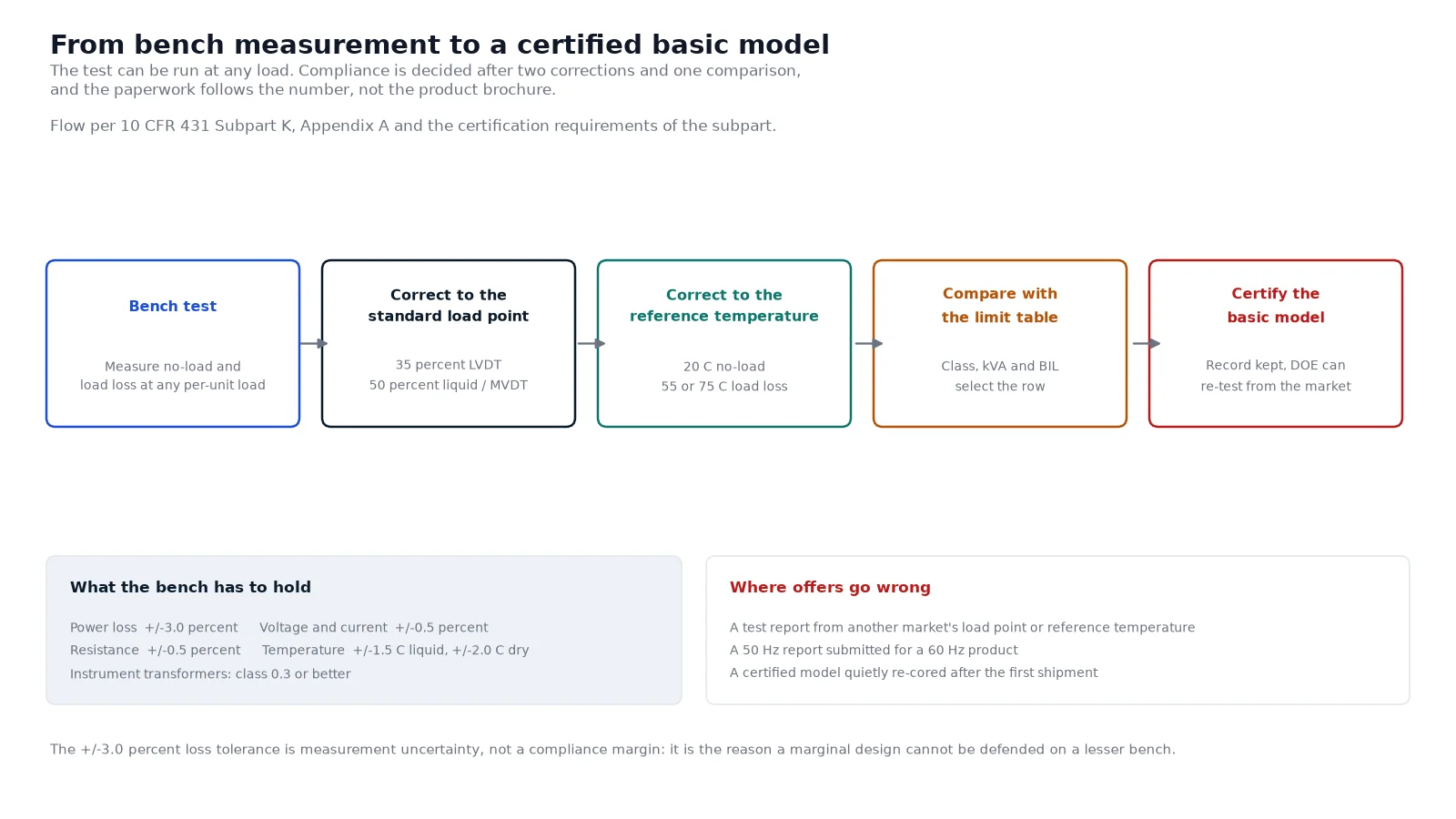
The test itself may be run at any per-unit load; the results are then adjusted mathematically to the standard load point using the equations in section 5.1 of Appendix A. Industry practice is to test at 100 percent load and calculate back, which is why a factory test report showing full-load data is perfectly acceptable as compliance evidence, provided the correction is shown.
Three practical consequences follow. A test report from a market whose standard load point is different, or whose reference temperature is different, cannot be submitted as-is. A 50 Hz test is not evidence for a 60 Hz product. And the ±3.0 percent tolerance on loss measurement is not a compliance margin: a unit measured at 2 percent better than the limit is inside the measurement uncertainty of a lesser bench, and DOE enforcement testing does not accept the manufacturer’s bench as the arbiter.
Certification, Records and Enforcement
Compliance is not self-declared on the nameplate. The manufacturer or importer certifies each basic model to DOE through the Department’s compliance certification system, keeps test records for the period required by the regulation, and makes representations of efficiency that match the certified values. DOE can and does buy units from the market and test them independently; a model that fails is subject to civil penalties and to a correction of its certified rating.
For an importer, this means the technical file has to exist before the first shipment, not after the first customer complaint. At minimum it should contain the certified basic model list, the test reports with the correction calculation shown, the reference temperature basis, and a statement of which equipment class each model belongs to. Our checklist for transformer certification for export covers the documents that US buyers typically request alongside the test report.
Design Consequences on the Factory Floor
A 20 percent cut in losses is not achieved by tightening tolerances. It changes the bill of materials, and each route has a cost.
- Higher-grade GOES. The cheapest route for most liquid-immersed and medium-voltage dry-type classes; it raises core cost and may require different annealing and cutting settings.
- More core volume. Lower flux density cuts no-load loss but increases mass, tank size and shipping weight, which matters for units already at the limit of a 40-foot container.
- More conductor. Lower current density cuts load loss but increases winding cost and can change the impedance unless the geometry is re-optimised.
- Amorphous cores. The lowest no-load loss available, but the ribbon is thin, the core is fragile, the noise level is higher and the manufacturing process is different from GOES.
- Re-testing. Every changed basic model needs new test data and a new certification entry, which is a schedule item rather than a paperwork item.
Note the interaction with noise. Both higher-grade GOES and amorphous cores can raise sound power level, and a US installation in a residential subdivision usually has a sound limit in the purchase specification. A design that meets the 2029 efficiency level but misses the noise limit is not a compliant design in practice.
What Buyers and Importers Should Put in the Purchase Order
| Clause |
Wording to require |
| Applicable standard |
10 CFR 431.196 as amended on 22 April 2024, with the compliance date that applies to the shipment |
| Equipment class |
Family, phase count, kVA and BIL stated explicitly, since the class decides the limit |
| Efficiency and load point |
Minimum efficiency at the standard per-unit load, with the reference temperatures named |
| Loss guarantee |
Maximum no-load and load loss in watts, with a tolerance and a penalty for exceedance |
| Test standard |
Appendix A to Subpart K, with the correction calculation shown in the report |
| Certification evidence |
Copy of the DOE certification for the basic model, or the importer’s own certification |
| Third-party option |
Right to witness testing or to require an independent laboratory report |
| Sound level |
Guaranteed sound pressure level at a stated distance, measured after installation |
| Frequency |
60 Hz, with a statement that no 50 Hz design or test data has been substituted |
| Change control |
Notification before any design change that affects the certified rating |
Two of those clauses are worth more than the rest. The loss guarantee turns an efficiency claim into a number that can be checked, and the change-control clause stops a supplier from quietly moving a certified design to a cheaper core after the first shipment. Our overview of IEC, IEEE, IS and GB standards explains where the US requirements sit relative to the other systems a manufacturer may already be building to.
Where the Rule Does Not Apply
The scope limits are as important as the standards, because a large share of exported equipment falls outside them.
- PV and wind step-up transformers. A 0.8/35 kV collector transformer has an output above 600 V, so it is not a distribution transformer under 431.192, even though it may be rated under 2,500 kVA.
- Substation and power transformers. Anything above 34.5 kV input, or above 2,500 kVA, is outside Subpart K entirely.
- 50 Hz products. The definition requires 60 Hz operation; a 50 Hz unit sold outside the US is unaffected.
- Excluded special-purpose types. The list above, including drive isolation, grounding, sealed and wide-tap units.
That boundary matters for anyone building a product strategy around the rule. The 2029 standards reshape the distribution transformer catalogue, not the power transformer catalogue, and a plant that makes both needs to plan the two product lines separately. The separate US restriction on foreign bulk-power equipment at 69 kV and above addresses a different voltage class again, and does not reach distribution equipment.
Timeline Risk Between Now and 2029
Three things are moving at once, and a delivery schedule built on a single assumption is fragile.
Supply chain pressure. In April 2026 the US President issued a determination under the Defense Production Act treating distribution transformers and grain-oriented electrical steel as critical to national defense, citing limited domestic capacity and long procurement cycles. That determination led DOE to reopen the 2024 standard for comment on its supply chain and manufacturing effects, through a WTO notification circulated in June 2026 with comments closing in July 2026. The 2029 date has not moved, but the rule is being actively discussed.
Lead times. Distribution transformer lead times have been running above twelve months, roughly double the historical norm, driven by data centre build-out, EV charging and industrial electrification. A redesign for the 2029 levels competes for the same manufacturing capacity as current orders.
The installed base. The average age of transformers in the US grid is around 38 years, with roughly 70 percent beyond 25 years. Replacement demand runs alongside new demand, so the market that needs compliant units is not waiting for 2029 to order.
The practical conclusion for a supplier: design and certify the 2029 levels on the models you sell most, not on the whole catalogue, and start now. For a buyer: put the 2029 level into specifications before it is mandatory, because a unit bought in 2027 will still be in service in 2055.
Frequently Asked Questions
When do the DOE 2024 transformer standards take effect?
23 April 2029, for distribution transformers manufactured in or imported into the United States on or after that date. The final rule was published on 22 April 2024 and took effect as a regulation in 2024; 2029 is when products must comply.
How much do losses have to drop?
Five percent for single-phase liquid-immersed units up to 100 kVA and three-phase units from 500 kVA; 20 percent for single-phase liquid-immersed above 100 kVA and three-phase below 500 kVA; 30 percent for single-phase low-voltage dry-type; 20 percent for three-phase low-voltage dry-type and for medium-voltage dry-type.
At what load is efficiency measured?
At 35 percent of nameplate for low-voltage dry-type, and at 50 percent for liquid-immersed and medium-voltage dry-type. Testing can be done at another load and corrected mathematically, which is why most factories test at 100 percent and calculate back.
Does the rule apply to a 2,000 kVA 34.5 kV to 480 V transformer?
Yes. Input at or below 34.5 kV, output at or below 600 V, 60 Hz and a rating within the covered kVA range puts it inside Subpart K, and it is a liquid-immersed or dry-type class depending on the cooling medium.
Does it apply to a solar plant step-up transformer?
Generally not. A 0.8/35 kV collector transformer steps up to a voltage well above 600 V, so it falls outside the definition regardless of its kVA rating.
Can a 50 Hz test report be used for a US order?
No. The covered product is defined as a 60 Hz transformer, and the test procedure requires 60 Hz testing with losses corrected to the specified reference temperatures.
Next Step
If you are preparing a US-bound order, decide first whether the unit is inside Subpart K, then write the equipment class, the standard load point and the loss guarantee into the purchase order. Our dry-type power transformer range and oil-immersed range are both built to IEC 60076 with optional IEEE testing, and we will state the certified efficiency at the DOE load point on the quotation rather than leaving it to the data sheet. Send the kVA, the voltage ratio, the BIL and the required compliance date, and we will confirm which equipment class applies and what the loss figures look like against the 2029 limits.