An outdoor vacuum circuit breaker is a complete switching point that happens to stand in the weather, not an indoor breaker inside a metal box. The structure you buy decides what civil works the site needs, where the current transformers sit, how the unit is operated and maintained, and what happens to its insulation after five years of ultraviolet light and pollution.
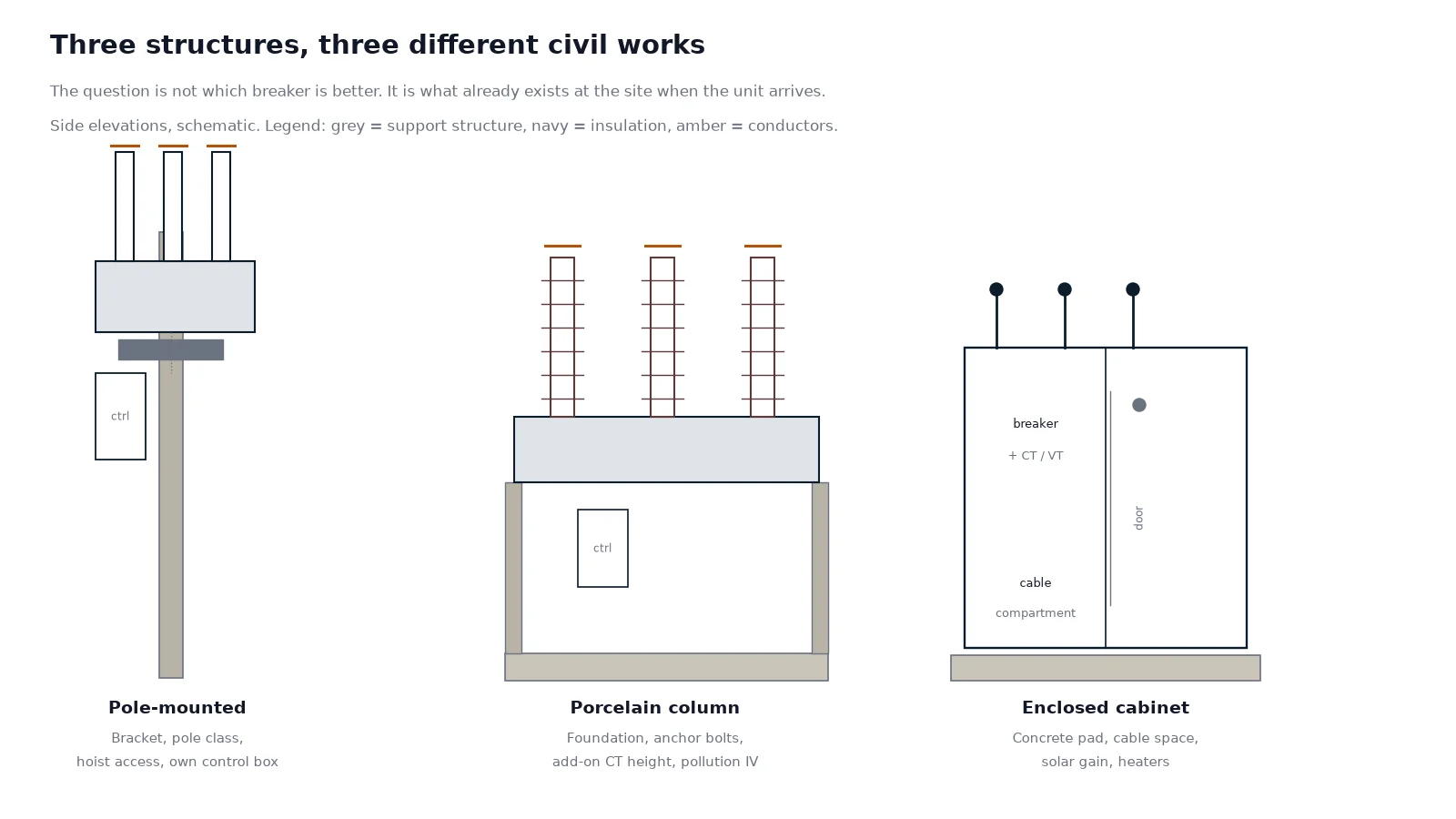
Three families cover almost every outdoor medium-voltage application. Pole-mounted breakers clamp to an overhead line support and carry their own measurement and control. Frame-mounted porcelain-column breakers stand on a concrete foundation in a substation yard. Enclosed or pad-mounted cabinets put the breaker, the transformers and the secondary equipment inside one weatherproof enclosure. Automatic reclosing is a fourth decision, but it is a function rather than a structure, and it can be built into any of the three.
This article sets out what each structure assumes about the site, the ratings that actually decide the order, and the points where a catalogue sheet stops being enough. For the wider product range, the outdoor vacuum circuit breaker category lists the current frames with their breaking capacities.
Three Outdoor Structures and What Each One Assumes
The quickest way to choose is to ask what exists at the site when the breaker arrives. A pole is not a foundation, a foundation is not a cable basement, and a cabinet wants a pad with cable access. The table below is the selection in one pass.
| Property |
Pole-mounted |
Frame, porcelain column |
Enclosed cabinet |
| Typical frame |
ZW32 series |
ZW7 series |
ZW32 or ZW7 inside a kiosk |
| Support |
Bracket on a pole or H-frame |
Concrete foundation, anchor bolts |
Concrete pad, cable trench |
| External insulation |
Epoxy or silicone composite bushings |
Porcelain columns |
Bushings through a metal enclosure |
| Current transformers |
Integrated in the column, or external add-on |
Add-on, mounted on the frame |
Inside the enclosure |
| Access for service |
Ladder or bucket truck |
Ground level |
Door and cable compartment |
| Ingress protection |
IP65 typical for the mechanism and control box |
Open frame; IP applies to the mechanism box |
IP54 or IP55 for the whole enclosure |
| Best fit |
Overhead feeders, tie points, line sectionalising |
Substation yards, 33 kV and 35 kV distribution |
Urban cable nodes, street corners, plant boundaries |
The distinction is not cosmetic. A pole-mounted ZW32 at 40.5 kV covers 630 A, 1,250 A and 1,600 A with 25 kA breaking, and integrates current transformers in the same column. A ZW7 porcelain-column frame at the same voltage covers 1,250 A and 1,600 A at 21 kA or 31.5 kA and holds pollution class IV, which puts it in coastal and heavy-industrial yards where a lighter unit would need washing. Both are described in the medium-voltage VCB overview, and the direct comparison is in this note on ZW7 against ZW32 at 40.5 kV.
Pole-Mounted Breakers and the Load They Put on the Pole
A pole-mounted breaker is a mechanical load on a structure that was designed for conductors. Four things follow:
- Bracket geometry decides the installation. Hole spacing, the distance from the pole face, and the phase spacing all have to match the pole and the conductor arrangement before the unit is hoisted. A bracket that fits a 190 mm concrete pole does not fit a steel H-frame.
- The control box needs a working height and a cable route. The cabinet is normally mounted below the breaker, with the secondary cable in conduit or armoured cable clipped to the pole. Decide the height before the pole is drilled, not after.
- Power for the control circuit has to come from somewhere. Most pole-mounted units take it from a voltage transformer, from current transformers with a power take-off, or from a small solar panel and battery. On a feeder that is dead for long periods, a CT-powered supply has nothing to harvest and the battery has to carry the controller.
- Wind and ice load act on the whole assembly. A 40.5 kV column with three bushings presents a large sail area. Where the line is exposed, the pole class and the guy arrangement belong in the same calculation as the breaker rating.
Installation practice matters more than it looks: lift the unit by its designated lugs, never by the bushings, and check the phase-to-phase and phase-to-earth clearances after the bracket is finally tightened. A unit that is 20 mm out of position at the factory drawing can be 200 mm out at the top of the bushing.
Frame-Mounted Porcelain-Column Breakers
The porcelain-column frame is the older and heavier answer, and it is still the right one for a substation yard at 33 kV to 40.5 kV. The interrupter sits inside a high-strength porcelain column, the operating mechanism and its cabinet sit below, and the whole assembly bolts to a concrete foundation through a steel base frame.
What the frame buys is mechanical margin. Porcelain carries the cantilever load of a short-circuit event and the wind load on a tall column better than a composite housing, and it keeps the live parts at a height that can be inspected from the ground. What it demands is civil work: anchor bolts at the drawing’s spacing, embedded conduit for the control cable, and enough clear height above the terminals for the connections.
Adding current transformers changes the drawing. An add-on CT set sits on the frame and raises the terminal height, so the busbar or jumper length has to be re-checked whenever transformers are added to an order that was originally quoted without them. Where the site is coastal or heavily polluted, the creepage on the porcelain is the limiting surface, and the answer is a longer column rather than a coating.
Enclosed and Pad-Mounted Cabinets
The enclosed cabinet is a breaker, its current and voltage transformers and the secondary protection in one weatherproof box on a concrete pad. It is the answer where there is no pole to hang anything on and no room for a fenced yard: urban cable networks, commercial districts, plant boundaries and street corners where the equipment has to be unobtrusive as well as weatherproof.
Selection turns on the inside of the enclosure rather than the outside:
- Cable compartment volume. Three single-core cables with terminations and a stress cone need bend radius and phase spacing. A cabinet that is adequate for a 12 kV three-core cable is often too small for a 24 kV single-core set.
- Internal ambient. A closed metal box in the sun runs hotter than the air outside it. Solar gain of 10 to 15 K is normal, which eats into the current rating before any load is connected.
- Heating and dehumidification. Anti-condensation heaters are not optional in a humid climate. Without them, the first cold morning after a warm humid night produces water on the insulation surfaces inside the box.
- Earthing and arc containment. The enclosure needs an earth bar sized for the fault current and, where the specifier requires it, internal arc classification for the operating personnel.
Where the enclosure contains a ring main unit rather than a single feeder breaker, the insulation medium becomes a separate decision. The trade-offs between gas and vacuum are covered in this comparison of SF6 and vacuum switchgear, and the regulatory direction of travel is one-way.
Recloser, Sectionalizer and Breaker: Duty Rather Than Structure
Automatic reclosing is what turns a breaker into a recloser, and it is worth separating from the structure question. Most overhead faults are transient: a branch touches a conductor, a bird bridges a gap, wind brings two phases together. A breaker that opens and stays open turns a two-second event into a two-hour outage. A recloser opens, waits a dead time, and closes again.
The duty is declared as a sequence. A single-shot auto-reclosing sequence looks like O – 0.3 s – CO – 180 s – CO: open, reclose after 0.3 s, and if the fault is still there, trip and lock out after a further attempt. The dead time is matched to the downstream protection so that the fault has time to clear before the reclose, and a dead time that is too short simply reapplies the fault to a still-ionised arc path.
The controller is where the function lives: protection curves, reclose settings, fault recording, event logs and communication. On a pole-mounted unit the controller also has to survive the same weather as the breaker, which is why the control box is a sealed enclosure with its own IP rating rather than an open terminal chamber.
A sectionalizer is a different device with a different job: it counts fault current passages and opens when the circuit is already dead, so it needs no breaking capacity of its own. Mixing the two up produces a scheme that either does not isolate the faulted section or opens under fault current it was never rated to break. The distinction is set out in this note on reclosers, sectionalizers and breakers.
Creepage and Insulation for the Site, Not the Catalogue
Two numbers decide the external insulation: the highest voltage for equipment and the pollution severity at the site. The first is a system property and is fixed; the second is a site property and is usually underestimated.
| Rated voltage |
Highest voltage for equipment |
Lightning impulse withstand |
Power-frequency withstand |
| 11 kV system |
12 kV |
75 kV peak |
28 kV rms, 1 min |
| 22 kV system |
24 kV |
125 kV peak |
60 kV rms, 1 min |
| 33 kV and 35 kV systems |
40.5 kV |
185 kV peak |
80 kV rms, 1 min |
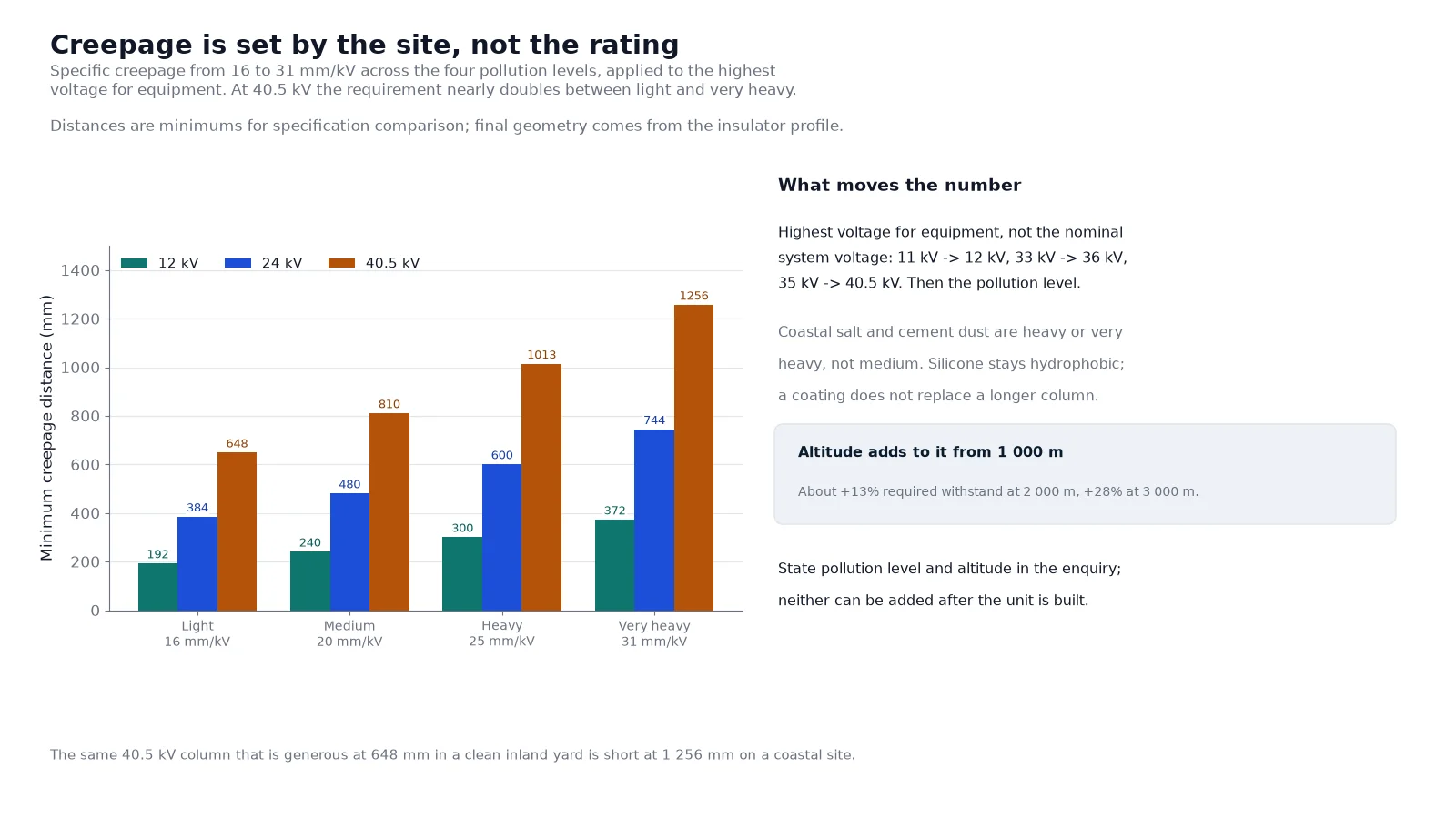
Creepage is specified as millimetres per kilovolt of the highest system voltage, and the four pollution levels used in specification work sit at roughly 16, 20, 25 and 31 mm/kV from light to very heavy. The practical effect at 40.5 kV is a creepage requirement that moves from about 650 mm to about 1,250 mm between the lightest and heaviest level, which is the difference between a compact column and a long one.
| Pollution level |
Specific creepage |
12 kV |
24 kV |
40.5 kV |
| Light |
16 mm/kV |
192 mm |
384 mm |
648 mm |
| Medium |
20 mm/kV |
240 mm |
480 mm |
810 mm |
| Heavy |
25 mm/kV |
300 mm |
600 mm |
1,013 mm |
| Very heavy |
31 mm/kV |
372 mm |
744 mm |
1,256 mm |
Altitude works on the same numbers from the other direction. Above 1,000 m the dielectric withstand of air falls, and the required withstand voltage rises by roughly 13 percent at 2,000 m and about 28 percent at 3,000 m. That is normally met by a higher insulation level rather than by a different breaker, but it has to be in the enquiry; a standard 12 kV unit specified for a 2,500 m site is being asked to do something it was not type-tested for.
Material choice follows the environment. Silicone composite insulators stay hydrophobic after pollution settles on them, so water beads and the surface leakage current stays low; porcelain is dimensionally stable and can be washed, but a polluted and wetted porcelain surface is the classic tracking path. Epoxy is fine indoors and marginal in strong ultraviolet light unless it is formulated for it.
Ambient, Solar Gain and Derating
Rated current is declared at a reference ambient of 40 C. A site that reaches 50 C in the shade is not covered by the nameplate, and the standard’s answer is a declared derating above the reference, commonly around 1.8 percent per kelvin. Take the figure from the type-test report rather than from the catalogue, because the mechanism and the primary conductors do not derate at the same rate.
Inside an enclosure the picture is worse than the weather. Solar gain adds 10 to 15 K to the internal air, and the breaker plus its cable terminations add their own losses. A 630 A unit inside a pad-mounted cabinet in a hot climate can be a 500 A unit in practice. Two remedies exist and both cost money: a larger cabinet with ventilation, or a breaker rated one frame size above the calculated load.
The cold end matters as much. A mechanism designed for -5 C will not operate reliably at -30 C: grease stiffens, and a spring that closes in a workshop may not close on a January morning. Outdoor units are normally offered to -25 C or -40 C with heaters in the mechanism box, and the heater circuit has to be part of the auxiliary supply design, not an afterthought at commissioning.
Breaking Capacity at the Point of Installation
The rated short-circuit breaking current must be at least the prospective fault current at the terminals, with the motors on the same bus included. A 20 kA frame on a feeder whose fault level is 25 kA is not a marginal choice; it is a device that may fail to clear the fault it exists to clear.
Two details are routinely left out of the comparison:
- DC time constant. Rated breaking capacity is declared for a standard DC time constant, 45 ms under IEC 62271-100. A bus fed mainly by generators or by a large inverter fleet can have a longer time constant, which lengthens the fault current’s asymmetry and makes the interruption harder. Where the source is unusual, ask for the breaking capability at 60 ms or 120 ms.
- System earthing. The first-pole-to-clear factor is 1.3 for an effectively earthed system and 1.5 for an isolated or resonant-earthed one. A 40.5 kV breaker on an unearthed rural network is working against the 1.5 case, and the type test behind the nameplate should say which one it covers.
Fault level also varies along a feeder. The busbar figure is the highest and the far end of a long overhead line is the lowest, so a unit installed at a sectionalising point sees less fault current than the source breaker. That does not license undersizing, because network reconfiguration can put the same point on a much stiffer source next year. The nameplate reading that matters for the order is set out in this guide to vacuum circuit breaker nameplate parameters.
Mechanism: Spring and Permanent Magnet in an Outdoor Frame
Both mechanisms are common outdoors and the choice is about maintenance philosophy rather than performance.
A spring mechanism charges a closing spring with a motor, then releases it to close. It has more parts, more linkages and more places for grease to dry out, but it is understood by every utility crew and can be overhauled in the field. Mechanical endurance classes put a plain spring unit at 2,000 operations and a heavier design at 10,000.
A permanent-magnet actuator holds the closed position with a magnetic latch and opens by discharging a capacitor into a coil. It has far fewer moving parts, which is why it appears on pole-mounted units that are awkward to service. The trade-offs are a controller that must be powered all the time, a capacitor that has to be monitored, and behaviour at low temperature that depends on the magnet and the controller design rather than on grease.
Whichever mechanism is chosen, the trip circuit must operate at the lowest specified control voltage, which the standard puts at 70 percent of rated voltage for opening and 85 percent for closing. That is a type-test condition, and it is the one that catches a control cable sized too small for the run to the pole.
Protection and Automation Package
The breaker is the actuator; the protection scheme is what makes it useful. Four items belong in the specification and are often separated from it:
- Current transformer cores. One core for measurement, one for protection, with the ratio and burden per core. Most pole-mounted units integrate three CTs in the column, which fixes the ratio range at the factory.
- Voltage measurement. Needed for directional elements, synchronism check and voltage-based protection. Where a VT is not fitted, the scheme has to work without voltage.
- Controller functions. Overcurrent and earth fault curves, reclose settings, fault passage indication, event recording, and the communication protocol the utility actually uses.
- Auxiliary supply. Battery, solar or VT-fed, with enough autonomy to hold the controller up through the longest expected outage. A controller that loses power loses its fault record at exactly the moment the record matters.
Selection Matrix by Site Scenario
| Site |
Structure |
Typical ratings |
What to watch |
| Rural overhead feeder, tie point |
Pole-mounted recloser |
12 or 24 kV, 630 A, 20 kA |
Bracket geometry, controller power supply |
| 33 kV or 35 kV substation yard |
Porcelain-column frame |
40.5 kV, 1,250 to 1,600 A, 25 to 31.5 kA |
Foundation, add-on CT height, pollution IV |
| Urban cable node |
Pad-mounted cabinet |
12 or 24 kV, 630 A, 20 to 25 kA |
Cable space, solar gain, heaters |
| Plant boundary, metering point |
Enclosed cabinet with CTs |
12 kV, 630 A |
CT ratio range, sealing for utility access |
| Capacitor or filter bank |
Frame or cabinet, class C2 |
12 or 24 kV, 630 A |
Back-to-back inrush, restrike performance |
| Temporary supply, mining |
Skid-mounted frame |
12 kV, 630 A |
Transport fixings, earthing, cable entry |
Enquiry Checklist
An outdoor breaker quotation is only comparable if the enquiry fixes the site, not just the electrical ratings. The list below is the minimum that produces comparable offers.
| Item |
What to state |
| System |
Nominal voltage, highest voltage for equipment, frequency, earthing method |
| Current |
Maximum load current, and the duty (feeder, transformer, capacitor) |
| Fault level |
Prospective short-circuit current and duration at the installation point |
| Structure |
Pole-mounted, frame or cabinet, with mounting drawing or pole data |
| Insulation |
Pollution level, altitude, required creepage |
| Environment |
Ambient range, humidity, salt or cement dust, seismic requirement |
| Measurement |
CT ratios, cores, burdens, VT requirement |
| Control |
Reclosing required or not, control voltage, communication protocol |
| Mechanism |
Spring or permanent magnet, mechanical endurance class |
| Evidence |
Type-test reports to IEC 62271-100 covering temperature rise, breaking, dielectric and endurance |
Frequently Asked Questions
Can an indoor vacuum circuit breaker be installed outdoors?
No. An indoor breaker relies on the switchgear enclosure for ingress protection, mechanical support and often for part of its insulation co-ordination. Outdoors it needs weatherproofing, ultraviolet-resistant insulation, longer creepage and a mechanism box that survives condensation. The two ratings are not interchangeable.
Is a recloser just a breaker with a controller?
Functionally yes, with one qualification: the breaker has to be rated for the reclosing duty cycle, which means repeated open-close operations in quick succession without exceeding its temperature limits. A standard distribution breaker can usually perform the duty, but the endurance class and the operating sequence should be stated in the offer rather than assumed.
What dead time should the reclose setting use?
Long enough for the fault arc to de-ionise, typically 0.3 to 1 s for a single shot on an overhead line. Too short and the reclose strikes the same arc; too long and downstream protection has already operated. The controller allows the sequence to be set, but the number belongs to the network study.
Why does the same 630 A breaker carry less current in a cabinet?
Because the rated current is declared at 40 C with free air around the unit. Inside a closed enclosure the air is hotter, solar gain adds to it, and the heat from the terminations has nowhere to go. The derating is a thermal calculation on the enclosure, not a property of the breaker.
How much creepage does a coastal site need?
Treat salt-laden coastal air as heavy or very heavy pollution, which means about 25 to 31 mm/kV and roughly 1,000 to 1,250 mm at 40.5 kV. Silicone composite insulation helps because it stays hydrophobic, but the creepage distance itself still has to be specified; a coating does not replace a longer column.
Does the breaker need a visible break?
If the switching point is used as an isolation point for work, yes, either through a disconnecting switch integrated in the same frame or through a separate device. A vacuum interrupter gives no visible indication of its state, and relying on the mechanism position indicator is not the same as seeing an air gap.
Conclusion
Outdoor vacuum circuit breakers are chosen in a fixed order: structure first, because it decides the civil works and the access; then insulation and creepage for the site, because they cannot be added later; then breaking capacity against the fault level at that point; and finally the mechanism, the measurement and the control scheme. Reclosing sits on top of all of it as a duty the breaker and its controller must be rated to perform.
A pole-mounted ZW32, a porcelain-column ZW7 and an enclosed cabinet are three different answers to three different sites. Decide which site you have, state the pollution level and the ambient range in the enquiry, and ask for type-test evidence against IEC 62271-100 for the ratings you actually need. Send the single-line diagram and the site conditions, and the structure, ratings and protection package can be matched to the network before the order is placed.