The SF6 versus vacuum argument used to be settled on price and voltage level. Since 2024 it is settled by regulation in Europe, and by procurement policy almost everywhere else. That does not make one technology universally correct — it makes the boundary between them sharper, and it makes the exceptions worth understanding.
This is a practical comparison for anyone specifying medium-voltage switchgear in 2026: what each medium actually does inside the arc chamber, where each technology stops being economical, what the European F-gas rules require and when, and which switching duties still separate the two. If you are already decided on vacuum and need the equipment side, the vacuum circuit breaker range covers the 12 kV to 40.5 kV classes discussed here.
The Short Answer
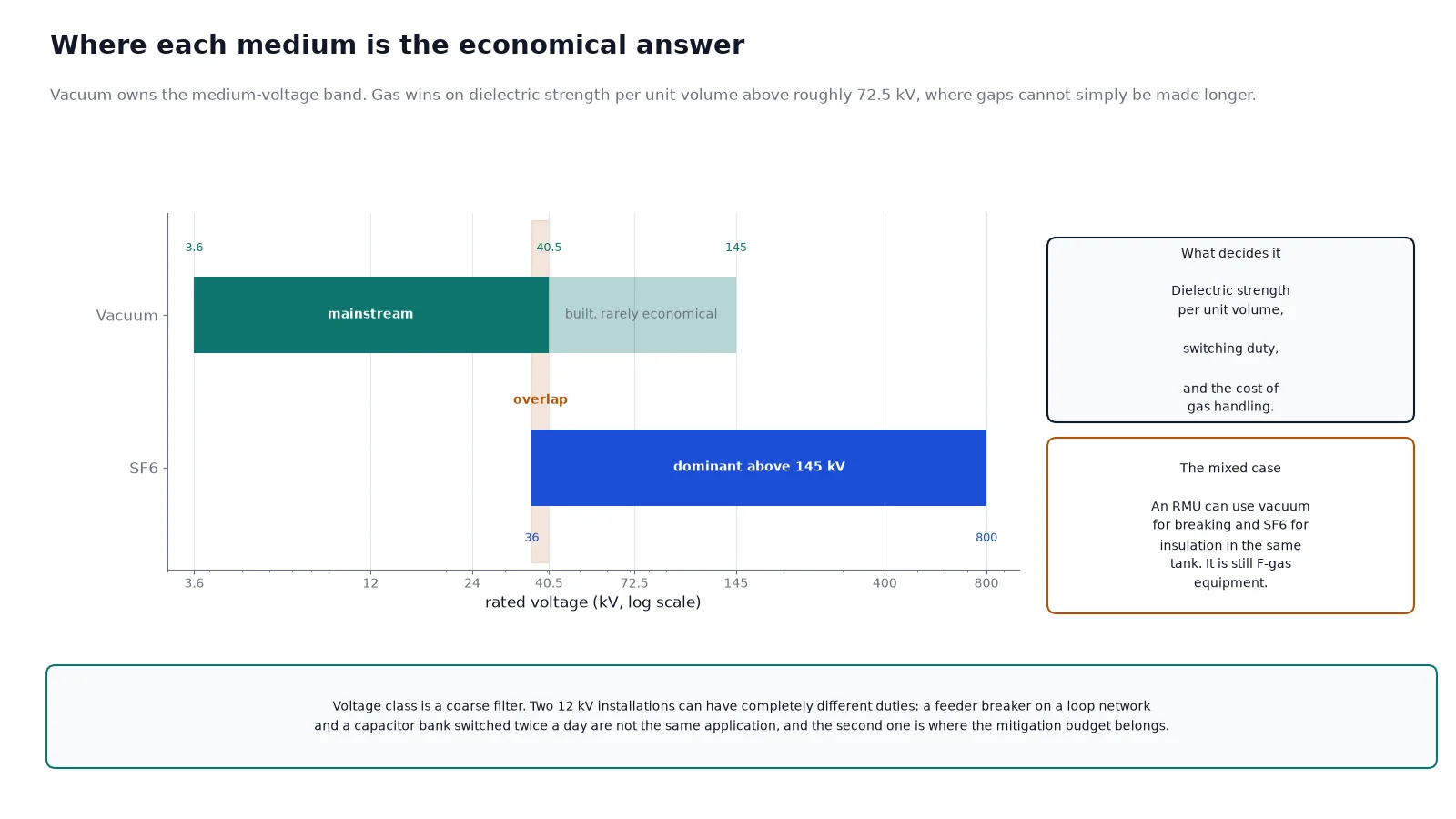
For medium-voltage distribution up to 40.5 kV — the bulk of ring main units, secondary substations, and indoor metal-clad panels — vacuum interruption is the default choice in 2026. It carries no greenhouse gas, needs no gas handling, and has a longer mechanical life. SF6 retains real advantages above roughly 72.5 kV, in gas-insulated switchgear where compactness is decisive, and in some capacitive switching duties at the top of the medium-voltage range.
The nuance that most comparison articles miss: in many medium-voltage installations, SF6 is not the interrupting medium at all. It is the insulating medium. The breaking duty is performed by a vacuum interrupter sitting inside an SF6-filled tank. Those units are regulated as F-gas equipment even though they are “vacuum” in the sense that matters to a maintenance engineer. Read the datasheet for both functions, not just the breaker type.
Two Different Jobs: Insulation vs Interruption
Switchgear has to do two things: hold off voltage when open, and extinguish an arc when opening under load or fault. The two media are not equally good at both jobs.
- SF6 is an excellent insulator — roughly two to three times the dielectric strength of air at the same pressure — and an excellent arc-quenching gas, because it dissociates in the arc and recombines quickly, recovering dielectric strength fast. That combination allows small gaps and compact equipment.
- Vacuum has almost no ionisable medium at all. The arc burns in metal vapour from the contacts themselves, and that vapour condenses within microseconds of current zero. Dielectric recovery is extremely fast, but a vacuum gap has no isolating distance: it holds off voltage, it does not provide a visible, verifiable break.
That last difference is a design requirement, not a footnote. Many vacuum switchgear designs add a series disconnector or an earthing switch with a defined isolating distance so that maintenance work does not rely on the interrupter alone. It also means the operating sequence and the interlocks carry more weight in a vacuum panel than in an SF6 one.
How Each Medium Handles an Arc
SF6 breakers use either a puffer design, where a piston compresses gas through the arc, or a self-blast design, where the arc’s own energy pressurises a chamber. Both rely on gas density, so a slow leak degrades breaking capacity before it causes a failure. That is why SF6 equipment carries gas density monitoring and why leak detection is part of routine maintenance.
Vacuum interrupters extinguish at the first natural current zero, typically well inside 20 ms, with contact travel of roughly 8 to 12 mm. Contact erosion is minimal, which is why electrical endurance is high and why frequent switching is not a problem.
Vacuum has three known behaviours that need design attention:
- Current chopping. When interrupting very small inductive currents — a few tens of amps, and under 5 A in advanced designs — the arc can be cut before the natural zero. The resulting di/dt produces an overvoltage across the load. A no-load transformer is the classic case.
- Multiple reignitions and voltage escalation. In inductive switching, a very short gap can restrike several times in quick succession. Each reignition escalates the voltage seen across the gap.
- Restrikes in capacitive switching. When switching capacitor banks or unloaded cables, a late restrike can reverse the trapped charge and escalate the load-side voltage from 1 per unit towards 2.5, then towards 4 per unit in a repeat event. Surge arresters or RC snubbers are the standard mitigation.
None of these is a defect. They are the price of a medium that extracts the arc from metal vapour, and they are managed at design stage — by specifying the right arrester, by choosing an interrupter with low chopping current, or by selecting SF6 for the specific duty. Which is where the next section starts.
Where Each Technology Actually Stops
| Parameter |
Vacuum |
SF6 |
| Mainstream voltage range |
3.6 kV to 40.5 kV; development units to 145 kV exist but are not the economical default |
36 kV upward, dominant above 145 kV |
| Arc-quenching medium |
Sealed vacuum chamber, no pressurised gas |
Pressurised SF6, puffer or self-blast |
| Contact travel |
About 8 to 12 mm |
Short, but gas dynamics govern the design |
| Mechanical endurance |
Up to IEC class M2 (10,000 operations); commercial claims reach 30,000 |
Typically up to 10,000 operations |
| Routine maintenance focus |
Mechanism, contact resistance, interrupter integrity |
Gas density, purity, moisture, leak detection |
| Greenhouse gas |
None |
GWP100 around 23,500 to 25,200, atmospheric lifetime about 3,200 years |
| Footprint at the same rating |
Larger at higher voltages |
Smaller, decisive at high voltage and in GIS |
Both technologies are governed by the same circuit-breaker standard, IEC 62271-100, and both are assembled into metal-enclosed switchgear under IEC 62271-200 with declared internal arc classification — the same panel-level rules that govern installing a vacuum breaker in a KYN28 switchgear. The standards are a level playing field. The medium is not.
Ratings are read the same way whichever medium you choose. Rated voltage, rated normal current, short-circuit breaking current, and the endurance classes M1 or M2 and E1 or E2 appear on every breaker — and a specification that omits the class letters is comparing equipment by headline numbers alone. The fields and what they actually commit the supplier to are set out in our guide to vacuum circuit breaker nameplate parameters.
The Regulation That Settled the MV Argument
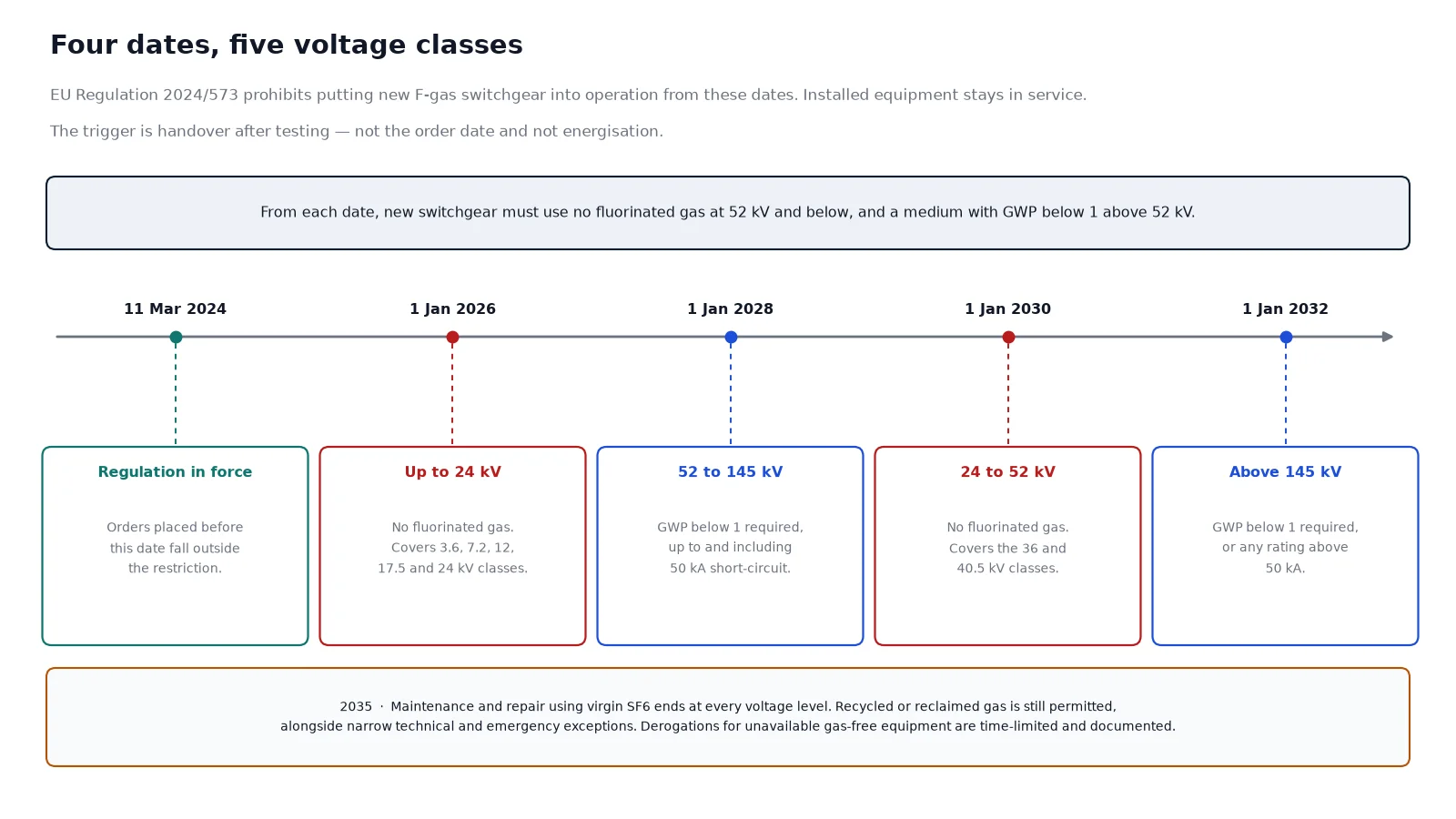
EU Regulation 2024/573, in force since 11 March 2024, sets prohibition dates for putting new switchgear into operation when the insulation or breaking medium is a fluorinated gas. The dates by voltage class:
| Rated voltage |
Requirement for new switchgear |
Applies from |
| Up to and including 24 kV |
No fluorinated gas in insulation or breaking medium |
1 January 2026 |
| Above 24 kV, up to and including 52 kV |
No fluorinated gas |
1 January 2030 |
| Above 52 kV, up to and including 145 kV and up to 50 kA |
Gases with GWP below 1 only |
1 January 2028 |
| Above 145 kV, or above 50 kA |
Gases with GWP below 1 only |
1 January 2032 |
| All voltage levels — maintenance and repair |
SF6 permitted only if recycled or reclaimed, or in defined technical and emergency cases |
1 January 2035 |
Five details decide whether a specific project is caught:
- The trigger is “putting into operation”, meaning handover after testing — not the order date and not energisation. Equipment ordered before 11 March 2024 is outside the restriction.
- Existing equipment is not condemned. There is no mandatory replacement of installed SF6 switchgear, but leak checking and record keeping apply, and periodic leak checks can be waived only where the tested leakage rate is below 0.1% per year.
- Derogations exist and are narrow. If a tender produces no compliant bid, or compliant bids from only one manufacturer, a limited exception applies — capped at two years after the relevant date, and requiring documented evidence retained for at least five years.
- Extensions and repairs are treated separately. Adding a unit to existing SF6 switchgear can be permitted where no gas-free unit is compatible, and replacing a unit inside existing switchgear is allowed provided the total SF6 quantity does not increase.
- The compliance owner is the operator, defined as the entity with actual control over the equipment’s operation — not necessarily the installer or the EPC.
Outside the EU the dates differ but the direction does not. Procurement policies at large utilities and data-centre operators increasingly write SF6-free into the specification regardless of local law, because the equipment outlives the policy cycle.
GWP in Real Numbers: What a Leak Actually Costs
SF6 has a 100-year global warming potential of about 23,500 under AR4 values and 25,200 under AR6, with an atmospheric lifetime near 3,200 years. The abstract number becomes concrete quickly.
A single 12 kV ring main unit might hold 1 to 3 kg of SF6. Take 2 kg at a GWP of 25,200: that is roughly 50 tonnes of CO2 equivalent in one enclosure. Reported leakage from well-maintained networks is typically below 1% of installed inventory per year, but that is a percentage of a large number. A thousand such units leaking at 1% release the equivalent of about 500 tonnes of CO2 equivalent annually — from equipment that is otherwise doing nothing remarkable.
Two engineering consequences follow. First, gas tightness is a design and quality-control property, not just a maintenance task: sealed-for-life designs with factory-welded tanks exist precisely to remove the gasketed joints that leak. Second, end-of-life handling matters. SF6 must be recovered and reclaimed rather than vented, which is why handling procedures under IEC 62271-4 and certified personnel are part of the operating cost.
Vacuum has no equivalent line item. Its environmental cost sits in manufacturing and in recycling the ceramic-metal interrupter assembly at end of life — real, but two to three orders of magnitude smaller in climate terms.
Switching Duties That Still Separate Them
Voltage level is a coarse filter. The duty is a better one.
| Duty |
Better fit |
Why |
| Feeder and transformer protection, frequent operation |
Vacuum |
Minimal contact erosion, high mechanical and electrical endurance |
| Motor starting and repeated switching |
Vacuum |
Long electrical life; check chopping overvoltage against motor insulation |
| Capacitor bank switching |
Either, with care |
Vacuum needs restrike-managed designs plus arresters; SF6 handles capacitive current more forgivingly at the top of the MV range |
| No-load transformer energisation and de-energisation |
Either, with care |
Vacuum chopping current can produce overvoltage; SF6 is softer |
| Arc furnace and high-duty industrial loads |
Vacuum, high electrical class |
Frequent fault-level interruptions; specify E2 class electrical endurance |
| High-voltage transmission, GIS, space-constrained indoor |
SF6 or SF6-free gas mixtures |
Dielectric strength per unit volume favours gas at high voltage |
Where vacuum is selected for a capacitive or low-current inductive duty, the correct response is not to switch to SF6 by reflex. It is to specify the mitigation: surge arresters on the load side, an RC snubber, or an interrupter with a documented low chopping level. Well-proven vacuum designs are used for capacitor switching in large numbers; the failures happen when the duty is specified and the mitigation is not.
Beyond the Binary: What Replaces Both
The 2026 market is not vacuum-versus-SF6. It is four families:
- Vacuum interruption with air or solid insulation — the mainstream medium-voltage answer, and what most circuit breaker panels and ring main units now use.
- Vacuum interruption with SF6 insulation — compact, still common in service, and increasingly hard to place in new EU projects under 24 kV.
- SF6-free gas mixtures — fluoronitrile or fluoroketone blends with CO2 or dry air, offering gas performance with a GWP in the hundreds rather than the tens of thousands. Note that some of these gases face separate regulatory uncertainty under proposed PFAS restrictions.
- Solid-insulated or shielded solid insulation designs — no gas at all, sealed for life, well suited to harsh and humid environments. An embedded-pole 12 kV vacuum breaker is the clearest example: the interrupter is cast into epoxy, so the insulation and the vacuum chamber are one part.
The practical question for a specification is not which family is best. It is which family your maintenance organisation can support for twenty years in the environment the equipment will actually live in.
A Selection Checklist for 2026 Projects
- Confirm the destination market’s rules. EU F-gas dates apply by voltage class and by date of putting into operation, with narrow derogations. Other regions rely on procurement policy rather than statute.
- Separate insulation from interruption. A unit described as vacuum may still contain SF6 as an insulating medium, which changes both its regulatory status and its maintenance regime.
- List the switching duties, including the uncomfortable ones: capacitor banks, no-load transformers, motor starting, and how many operations per year.
- Check the isolating distance. Vacuum switchgear usually relies on a series disconnector or earthing switch for a verifiable break; confirm the interlocks and the operating sequence.
- Price the whole life. Gas monitoring, leak checks, certified handling, and end-of-life reclamation are operating costs that vacuum does not carry, and they usually exceed the initial price difference over twenty years.
- Match the enclosure to the site. Internal arc class, IP rating, and pressure relief direction are siting constraints, not catalogue decorations.
If the project involves the substation as a whole rather than a panel alone, the interface between the MV section and the transformer is where most delays originate — the same set of constraints we cover in switchgear and substation solutions and in the comparison of VS1, ZW32, and ZW7 breakers.
Conclusion
Up to 40.5 kV, vacuum wins on operating cost, maintenance simplicity, and regulation. Above roughly 72.5 kV, SF6 — or an SF6-free gas mixture — still wins on physics, because dielectric strength per unit volume is what makes high-voltage equipment buildable at all. The interesting cases sit between: capacitive switching, low-current inductive switching, and compact indoor installations where the enclosure, not the interrupter, is the constraint.
Specify from the duty list outward. Voltage class, switching frequency, environment, and the maintenance capability you will actually have in year fifteen will select the technology faster than any generic comparison table — including this one.
FAQ
Is vacuum switchgear always SF6-free?
No. Many medium-voltage ring main units use vacuum interrupters for breaking but SF6 for insulation inside the tank. Those units are regulated as F-gas equipment and need gas monitoring. Check both the interrupting medium and the insulating medium on the datasheet.
What is the GWP of SF6?
About 23,500 under AR4 values and 25,200 under AR6, with an atmospheric lifetime near 3,200 years. Two kilograms of SF6 is therefore roughly 50 tonnes of CO2 equivalent.
When does the EU ban on SF6 medium-voltage switchgear start?
1 January 2026 for new switchgear up to and including 24 kV, and 1 January 2030 for equipment above 24 kV up to 52 kV. The trigger is putting the equipment into operation, meaning handover after testing, not the order date.
Does the EU regulation require replacing existing SF6 switchgear?
No. Installed equipment can stay in service, subject to leak checking and record keeping. Periodic leak checks can be waived where the tested leakage rate is below 0.1% per year. From 2035, maintenance and repair may only use recycled or reclaimed SF6, with defined technical and emergency exceptions.
Why does vacuum switching cause overvoltages?
Because a vacuum arc is fed by metal vapour from the contacts, and very small inductive currents can be chopped before the natural current zero. Multiple reignitions across a short gap can escalate the voltage. Surge arresters, RC snubbers, or low-chopping interrupter designs are the standard mitigation.
Which technology has the longer service life?
Vacuum generally has the longer mechanical endurance — IEC class M2 calls for 10,000 operations, and commercial vacuum designs claim up to 30,000. SF6 breakers typically reach around 10,000. The real comparison is total life-cycle cost, where gas handling and leak management usually widen the gap further.