Vacuum contactor ratings look like a simple ladder: 160 A, 250 A, 400 A, 630 A, then a jump to 800 A and 1,000 A in the low-voltage frames. Buyers treat the steps as interchangeable and pick the next size up when a motor is close to the line. That works until the contactor is switched often, because the current rating and the electrical life are separate numbers, and the life number is the one that decides when the device is replaced.
This guide works through the ratings as they are actually published — making capacity, breaking capacity, ultimate breaking capacity and the AC-3 / AC-4 electrical life — using the frames in the vacuum contactor range as worked examples. If the device itself is new to you, the vacuum contactor overview covers the construction first; this page is about the numbers on the datasheet.
The Four Numbers That Make Up a Rating
A contactor datasheet does not carry one current rating. It carries four, and they answer four different questions. Confusing them is the most common reason a correctly sized device fails early or a correctly rated device gets rejected at inspection.
| Number on the sheet |
The question it answers |
What it is not |
| Rated operating current, Ie |
The load it switches continuously at rated voltage |
Not a fault rating — it says nothing about a short circuit |
| Making capacity |
The peak current it can close onto, usually stated with the number of operations |
Not a continuous figure; it applies for a fraction of a second |
| Breaking capacity |
The current it can interrupt, stated with the number of permitted operations |
Not the same as making capacity, and usually lower |
| Ultimate breaking capacity |
The current it can interrupt a few times before inspection |
Not a repeatable duty — three operations is not a rating you design to |
There is a fifth figure that sits underneath all of them: the short-time withstand current, which is what the device survives while an upstream fuse or breaker clears a fault. A contactor does not clear faults. It holds together long enough for something else to do it, and the withstand rating is the measure of how long that is.
How the Ladder Actually Scales
Take the CKG3 7.2 kV frame, which publishes all four steps from 160 A to 630 A on one datasheet. The published values make the scaling rule visible.
| Parameter |
160 A |
250 A |
400 A |
630 A |
| Making capacity, 100 operations |
1,600 A |
2,500 A |
4,000 A |
6,300 A |
| Breaking capacity, 10 operations |
1,280 A |
2,000 A |
3,200 A |
5,000 A |
| Ultimate breaking capacity, 3 operations |
3,200 A |
4,000 A |
4,500 A |
6,300 A |
| Making as a multiple of Ie |
10× |
10× |
10× |
10× |
| Ultimate breaking as a multiple of Ie |
20× |
16× |
11.3× |
10× |
Two things follow, and only one of them is obvious.
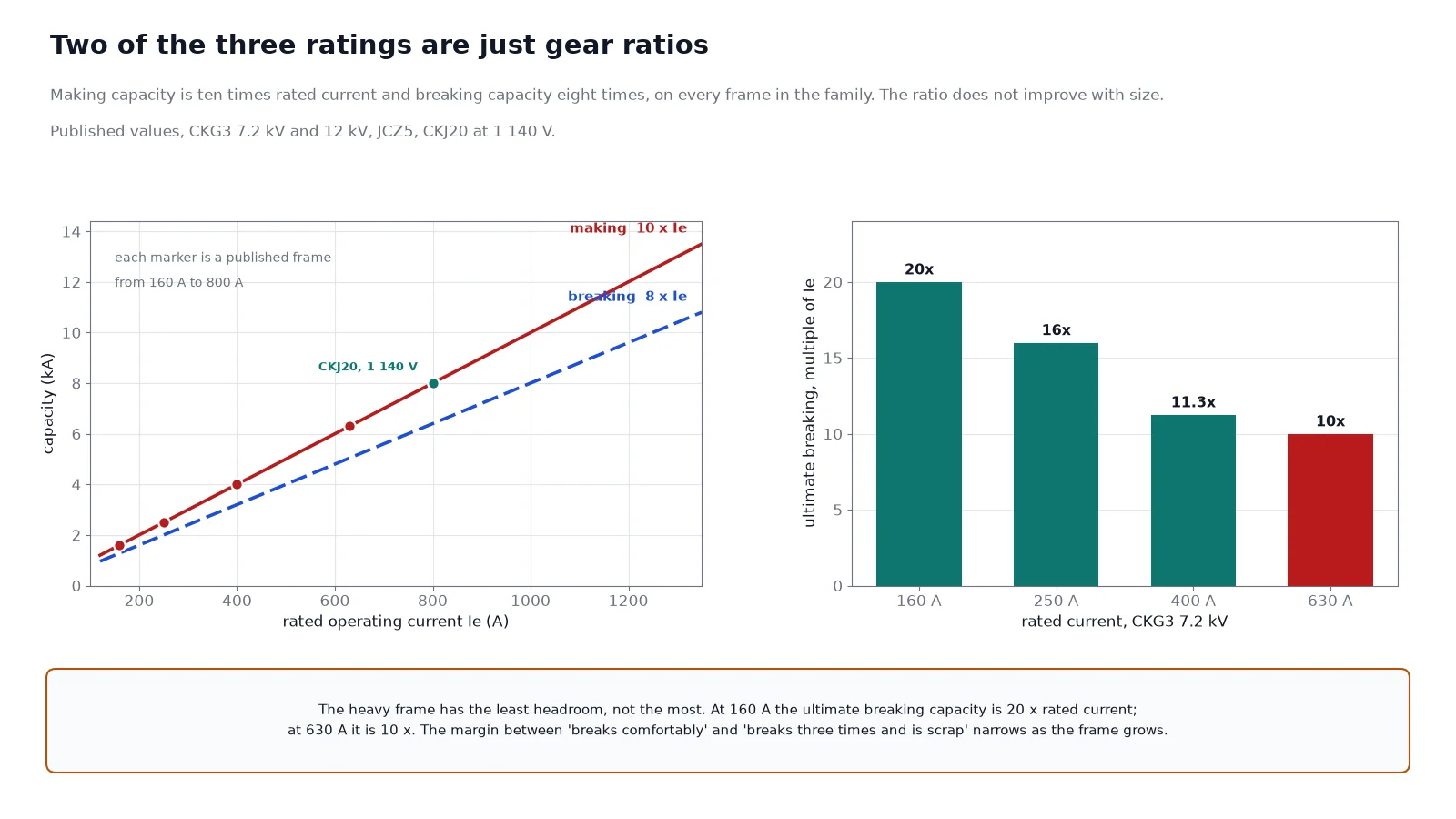
The obvious one: making capacity is ten times rated current across the whole frame family, and breaking capacity is eight times. The same pattern holds on the JCZ5 contactor, which publishes 2,500 A making on the 250 A unit, 4,000 A on the 400 A unit and 6,300 A on the 630 A unit — again exactly ten times rated current. So the ladder is proportional, and a bigger frame is not a better protected frame; it is the same ratio in a larger body.
The less obvious one: the ultimate breaking capacity does not scale proportionally. On the 160 A frame it reaches 20 times rated current; on the 630 A frame only 10 times. The heavy frame has the least headroom above its normal duty. That is a physical outcome, not a catalogue decision — the interrupter that carries 630 A continuously has a larger contact and more stored energy in the arc, so the margin between “breaks comfortably” and “breaks three times and needs replacing” narrows.
What 1,000 A Actually Buys You
The top of the ladder is not a stretched 630 A frame. At 1,140 V the GKJ5 three-phase contactor covers 1,000 A and 1,250 A in a vertical three-pole frame, and the published data describes a different machine from the 12 kV family:
- A DC magnetic system fed from an AC control supply through a rectifier bridge, with a current-limiting resistor switched in after pull-in. No AC hum, and lower holding current — which matters in a hot cubicle where the coil is the first thing to cook.
- Three million mechanical operations, against 500,000 on the 12 kV CKG3 frame and one million on the 7.2 kV CKG3.
- An AC-4 electrical life of more than 60,000 operations, with an AC-4 operating frequency of 240 operations per hour and a short-time rating of 2,000 operations per hour for 20 seconds.
- Contact opening distance of 2.0 mm with 1.0 mm overtravel — a low-voltage gap, an order of magnitude shorter than the 5.5 mm gap on a 12 kV contactor.
Read the pattern: the current goes up, the voltage comes down, and the mechanical life goes up by a factor of six. The 1,000 A frame is a low-voltage device built for very frequent operation — mill drives, mine starters, heavy plant. It is not a substitute for a 630 A medium-voltage contactor when the system is 10 kV, and its ratings are not portable to that duty.
The CKJ20 contactor shows the same logic one step lower: 630 A and 800 A at 1,140 V, 6,000 A and 8,000 A making, three million mechanical operations, and an AC-3 life of 600,000 against an AC-4 life of 60,000. A ratio of ten to one on the same device.
AC-3 and AC-4 Are Two Different Ratings
This is the part of a vacuum contactor rating that most datasheets bury and most buyers skip. The utilisation category describes what the contactor breaks, not how much current it carries.
AC-3 is the normal motor duty: close onto the starting current, break the running current. The arc at break is small because the motor is already up to speed and the current has fallen to rated value.
AC-4 is the hard duty: close onto the starting current and break the starting current. Plugging, inching, reversing, and any application where the contactor opens while the motor is still accelerating. The arc at break is five to eight times larger, and the contact erosion is not linear in current — it is closer to the square.
The published numbers show what that does to life:
| Frame |
Voltage class |
Electrical life, AC-3 |
Electrical life, AC-4 |
Ratio |
| CKG3 12 kV |
12 kV |
250,000 |
100,000 |
2.5 : 1 |
| JCZ5 |
7.2 / 12 kV |
250,000 |
100,000 |
2.5 : 1 |
| CKJ5 horizontal |
380 / 660 / 1,140 V |
600,000 |
120 operations/hour max, life not published |
— |
| CKJ20 |
1,140 V |
600,000 |
60,000 |
10 : 1 |
| GKJ5 three-phase |
1,140 V |
Not published |
Over 60,000 |
— |
Why the medium-voltage frames show 2.5 : 1 while the low-voltage frames show 10 : 1 is worth pausing on. The medium-voltage interrupter is already working hard at every break — the arc voltage, the contact geometry and the recovery voltage are set by the voltage class, so the difference between breaking 250 A and breaking 1,600 A is smaller in proportion than it is at 1,140 V. The low-voltage device has an easy AC-3 duty and a punishing AC-4 duty, and the ratio reflects that gap.
The practical consequence is that a 2.5 : 1 ratio sounds generous and is not. A 12 kV contactor on genuine AC-4 duty still loses 60 percent of its published AC-3 life.
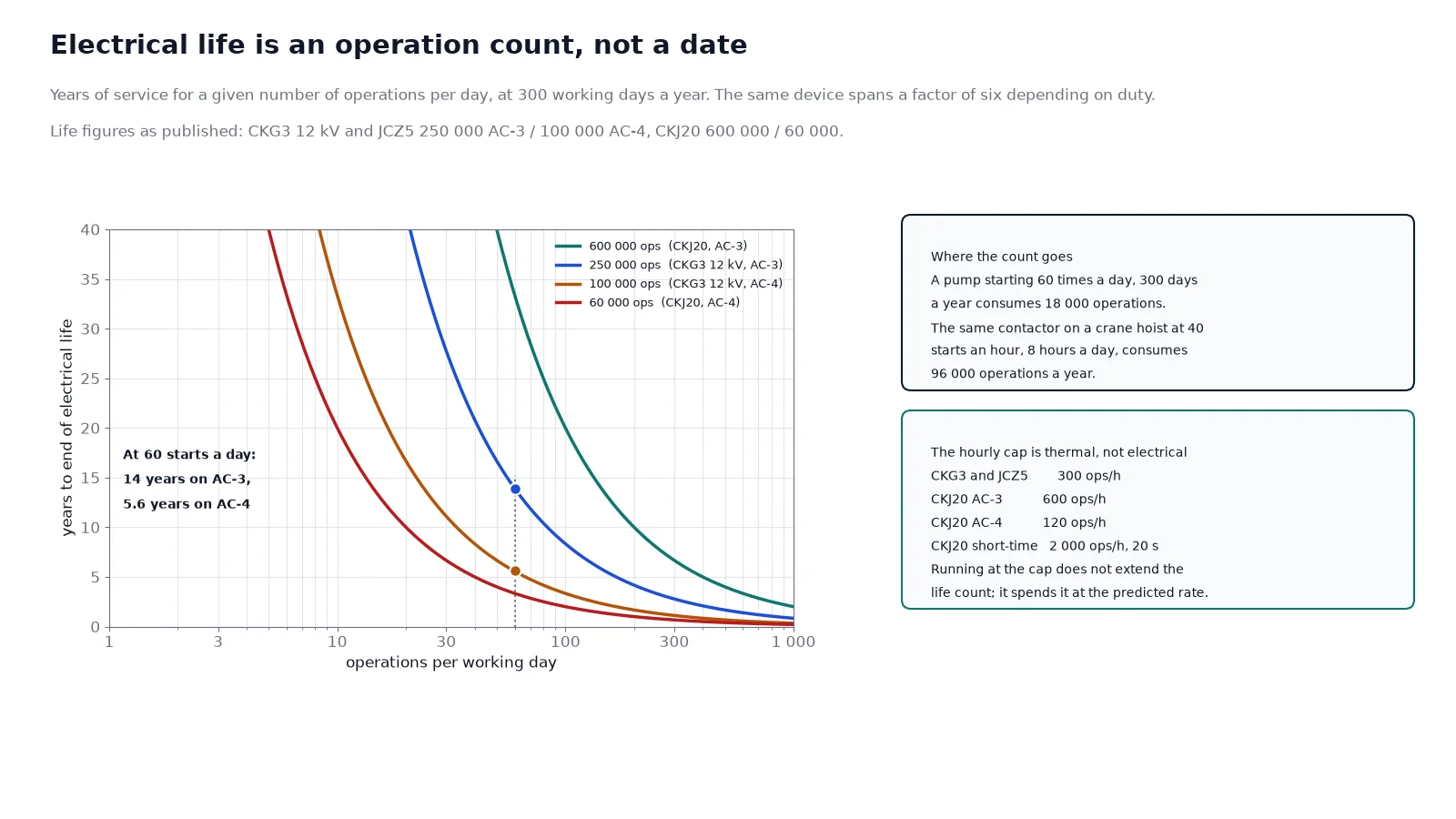
Turning Electrical Life Into Years
Operations are not a unit anyone plans in. Convert them to time and the sizing decision becomes obvious.
Take a 250 A CKG3 12 kV contactor on a pump that starts 60 times a day, 300 days a year. That is 18,000 operations a year. At the AC-3 life of 250,000 operations, the contactor reaches its electrical limit in about 14 years — longer than the plant will run it, so the life number is irrelevant and the mechanical life of 500,000 operations is the binding limit at roughly 28 years.
Now put the same contactor on a crane hoist doing 40 operations an hour, eight hours a day. That is 320 operations a day, or roughly 80,000 a year. On AC-3 life that is three years. On AC-4 life of 100,000 operations it is fifteen months. Same device, same current, same voltage — twelve times the replacement rate.
Two caps sit on top of this arithmetic, and both are thermal rather than electrical. The CKG3 publishes 300 operations per hour, and the JCZ5 the same. The CKJ20 allows 600 operations per hour on AC-3 but only 120 per hour on AC-4, with a 2,000 per hour short-time rating for 20 seconds. Those frequency limits protect the contact and the interrupter from heat that has not had time to dissipate; they do not extend the life count. Run a contactor at its hourly limit continuously and the electrical life is consumed at exactly the rate the arithmetic predicts.
Sizing the Frame to the Motor, Not to the Cable
The calculation is the ordinary three-phase one, and the mistake is leaving out efficiency and power factor:
I = P / (√3 × U × η × cos φ)
Three worked cases, all of them common enquiries:
- 110 kW at 400 V, η 0.95, cos φ 0.89 → 188 A. The next frame is 250 A. Sizing at 200 A on the strength of the nameplate kW alone would leave no margin for the motor’s service factor and no allowance for a 45 °C panel.
- 110 kW at 690 V, same motor data → 109 A. The 160 A frame covers it, one step down the ladder for the same power. This is why the voltage class decision has to be settled before the current rating.
- 900 kW at 1,140 V, η 0.96, cos φ 0.88 → 540 A. The 630 A CKJ20 frame is the entry point, and the AC-4 life of 60,000 operations is the number to check against the actual starting regime.
Note what the third case implies for a contactor enquiry: the same 900 kW load at 690 V would draw 885 A and fall between frames. Voltage class changes the current rating you need, and the frame family changes with it. Comparing a 12 kV 630 A unit against a 1,140 V 630 A unit on the current number alone is meaningless.
The Rating Traps
Ambient. The CKG3 and JCZ5 families are published for -10 °C to 40 °C. A cubicle sitting at 45 °C in a tropical plant room is outside the published envelope, and the contactor’s continuous current has to be derated accordingly. This is the most common omission on a warm-climate project and the one most likely to produce an early failure that looks like a manufacturing fault.
Altitude. The CKG3 7.2 kV is published in two builds: an ordinary type up to 1,000 m and a plateau type to 4,000 m. Insulation withstand falls with air density, so the 32 kV power-frequency withstand on the ordinary type is not a site value above 1,000 m. If the project is at altitude, the plateau build is a line item, not an option.
Fault level. A contactor is not a fault-clearing device. The CKG3 12 kV publishes a short-time withstand of 10 times rated current for the frame — 6.3 kA on the 630 A unit, 1.6 kA on the 160 A unit. If the upstream protection does not clear the fault before that withstand is exhausted, the contactor is damaged regardless of its current rating. The difference between a contactor and a breaker is exactly this: one is built for frequent switching, the other for fault interruption.
Control voltage. On the CKJ5 the main-circuit rating and the control-circuit voltage are specified together, with 36 V, 127 V, 220 V and 380 V AC options. On the JCZ5 the control circuit is AC 110 V or 220 V with closing coil current up to DC 6 A and holding current down to DC 0.16 A. A quotation that omits the control voltage is incomplete, and the coil is not a field-changeable accessory on most frames.
What to Put on the Enquiry
- System voltage and the voltage class the switchgear is built to.
- Motor kW, efficiency, power factor and service factor — or the measured running current.
- The utilisation category you actually expect: AC-3, AC-4, or a mixture, with the number of operations per hour and per day.
- Starting method and starting current multiple, plus whether inching or plugging is part of the duty.
- Prospective fault current at the contactor terminals and the upstream protective device.
- Ambient range, altitude, and whether the cubicle is ventilated.
- Control-circuit voltage and whether a mechanical latch or shunt trip is needed.
Ordering a contactor on current alone is how a plant ends up with a 630 A frame that lasts fifteen months in a crane panel and a 160 A frame that outlives the building. The current rating sets the terminal size; the duty sets everything else. Our engineering desk will run the life arithmetic against your actual switching regime before the frame is fixed.
Conclusion
Vacuum contactor ratings are a proportional ladder on paper and a very disproportional one in service. Making capacity stays at ten times rated current across every frame in the family, so a bigger device is not a better protected device. What changes with frame size is the margin at the top of the curve, the mechanical life, and — decisively — the electrical life under AC-3 against AC-4 duty. Fix the voltage class first, then the current from the motor data, then check the electrical life against the real number of operations per day. That sequence produces a contactor that reaches its maintenance interval on schedule instead of a replacement order in the first year.
Frequently Asked Questions
Is a 1,000 A vacuum contactor just a bigger 630 A frame?
No. At 1,140 V the 1,000 A frames are vertical low-voltage devices with a DC magnet fed through a rectifier bridge, three million mechanical operations and AC-4 electrical life, while the 630 A medium-voltage CKG3 frame is a 12 kV device with a 5.5 mm contact gap and 500,000 mechanical operations. The current number is the only thing they share.
Why is making capacity ten times the rated current but breaking capacity only eight?
Closing is a mechanical event: the contacts touch and the current is limited by the circuit, so the interrupter only has to survive the electromagnetic force. Opening is a thermal event: the arc must be extinguished and the contact surface has to absorb the erosion. Breaking is therefore rated with a lower multiple and a lower permitted operation count — ten operations on the CKG3, against a hundred for making.
What is the difference between AC-3 and AC-4 in practice?
AC-3 breaks the running current; AC-4 breaks the starting current. On the CKG3 12 kV that is 250,000 operations against 100,000, and on the CKJ20 at 1,140 V it is 600,000 against 60,000. If the contactor ever opens while the motor is still accelerating — inching, plugging, reversing — the AC-4 figure applies to that portion of the duty.
Can I use the AC-3 life figure for a crane or a hoist?
Only for the hoisting operations where the load is at speed. Lowering, inching and plugging are AC-4 duty, and the published AC-3 life does not cover them. The crane duty guide works through the mixed regime, and the honest approach is to split the annual operation count between the two categories and consume each life separately.
Does a higher current rating give more short-circuit protection?
No. Short-time withstand rises with frame size — 1.6 kA on the CKG3 12 kV 160 A unit against 6.3 kA on the 630 A unit — but it is still a withstand rating, not a breaking rating. The upstream fuse or breaker clears the fault, and the contactor-fuse combination is the arrangement that makes the coordination explicit.
How do I know when a contactor has reached the end of its electrical life?
By the operation counter, not by inspection. Vacuum interrupters do not show contact erosion from outside, and the loss of vacuum is not visible. Log the operations by category and replace on the published count, with a margin for the AC-4 share. A contactor that fails a power-frequency withstand test is already past the point where the counter would have retired it.
For a direct comparison of the frames above on voltage class, mounting and breaking duty, the CKG3, CKJ5 and JCZ5 comparison sets the three families side by side. Where the load is a large mill drive rather than a plant motor, the 1,000 A vertical contactor case study follows the same ratings through a real installation.