Three devices are drawn on the same single-line diagram, look roughly similar in a catalogue, and are not interchangeable. The question that separates them is not voltage, current or price: it is whether the device can interrupt fault current by itself. A circuit breaker can. A load break switch cannot, and depends on a fuse or an upstream breaker to clear the fault. A disconnector cannot interrupt anything worth interrupting and exists to create a visible gap after someone else has removed the current.
Getting this wrong is expensive in both directions. Buying breakers where a vacuum load break switch would do doubles the cost of a ring main unit for no added protection. Buying a switch where the fault level demands a breaker leaves a device in the network that is expected to do something it was never rated for. This guide sets out the duty boundaries in IEC terms, the transfer current that makes a switch-fuse combination work, and the selection logic for the feeder types that appear in most 12 kV and 24 kV projects.
The One Question That Separates the Three Devices
Ask what the device does when 20 kA flows through it because of a fault downstream. A circuit breaker opens and extinguishes the arc in a vacuum interrupter designed for it, and does so repeatedly over its rated electrical endurance. A load break switch either holds closed until a fuse clears the fault, or trips open on the fuse striker after the fuse has already interrupted the current. A disconnector must never be asked the question at all: opening it under fault current is a failure of the operating procedure and usually of the equipment.
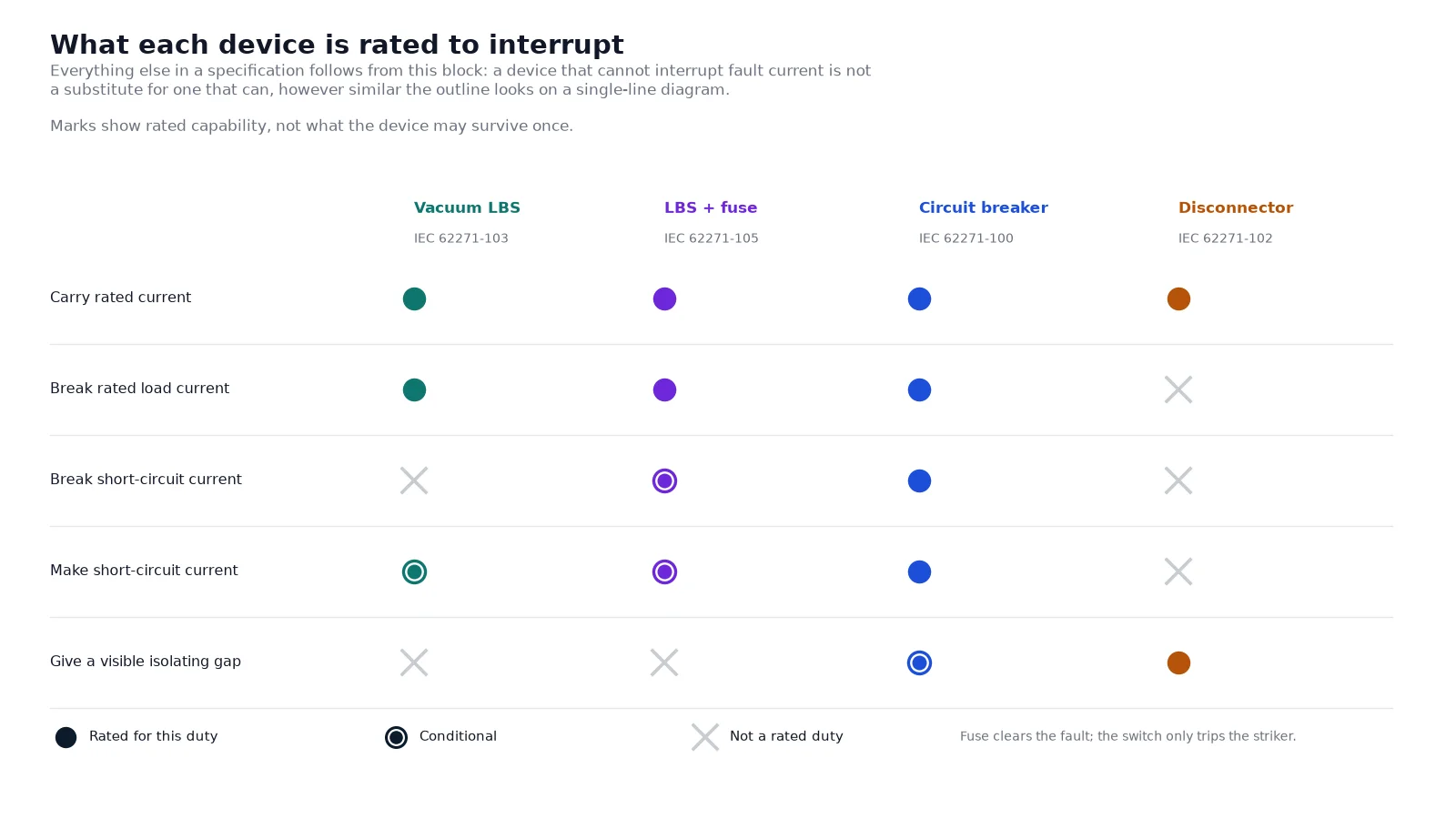
Everything else follows from that single capability. Continuous current ratings are similar across the three families. Short-time withstand is similar. It is the breaking duty that differs, and the breaking duty is what the protection scheme is built around.
Rated Duties in IEC Terms
The four device families are covered by four different parts of IEC 62271, and the part number tells you what the device is allowed to do.
| Device |
Standard |
Rated to break |
Rated to make |
| Circuit breaker |
IEC 62271-100 |
Rated short-circuit breaking current, with reclosing duty |
Rated short-circuit making current, at least 2.5 times the breaking current |
| Switch (load break switch) |
IEC 62271-103 |
Rated normal current, closed-loop current, cable and line charging current, no-load transformer current |
Load current, and limited fault current up to the peak withstand value |
| Switch-fuse combination |
IEC 62271-105 |
Transfer current or take-over current; the fuse clears everything above it |
As the switch, plus the fuse element |
| Disconnector and earthing switch |
IEC 62271-102 |
Negligible currents only, typically 0.5 A, plus rated bus-transfer current |
Negligible currents, plus rated bus-transfer current |
Two consequences are worth spelling out. First, the making rating of a breaker is higher than its breaking rating, because the asymmetrical first peak of a fault is roughly 2.5 times the symmetrical r.m.s. value at 50 Hz. Second, the switch-fuse combination is the only family whose breaking capability is a coordination result rather than a device property: what the switch can break depends on which fuse is fitted.
Vacuum Load Break Switch: Load Current and the Duties Around It
A load break switch is a genuine interrupting device, just not for fault current. Inside a vacuum bottle or a small SF6 chamber it opens the rated normal current, and the IEC 62271-103 duty list goes further than most buyers expect:
- Rated normal current, which for a distribution unit means 400 A or 630 A at 12 kV or 24 kV.
- Closed-loop current, the circulating current that flows when two feeders are paralleled during a transfer.
- Cable charging current on energising or de-energising a cable section.
- Line charging current on an overhead section.
- No-load transformer current, the magnetising inrush that a switch sees when it energises an unloaded transformer.
Electrical endurance is classified E1 or E2 and mechanical endurance M1 or M2, and the class matters when a switch is used for daily ring switching rather than occasional isolation. A switch that opens 630 A twice a week for fifteen years is doing thousands of operations; a switch specified for isolation duty only is not built for that.
What the switch will not do is open a fault. Its making capacity is usually equal to the peak withstand current, so it can be closed onto a fault that another device will then clear, but the fault current path through the switch is a thermal and mechanical event with no interruption at the end of it.
Switch-Fuse Combination: Transfer Current and Take-Over Current
The switch-fuse combination works because the fuse and the switch share the current range. Below a certain current the switch opens first and the fuse is untouched; above it the fuse clears the fault and its striker pin trips the switch open. The boundary is defined in two ways, and the difference matters when you compare offers.
Transfer current applies to striker-operated combinations. It is the current up to which, in a three-pole fault, one fuse may operate first and the switch then clears the remaining two-phase fault. The switch has to be able to break that current, so the manufacturer states it as a rated value. In practice the transfer current sits in the range of roughly five to fifteen times the rated fuse current, which is why the same switch body carries different transfer ratings with different fuses.
Take-over current applies to release-operated combinations, where a release rather than a striker initiates the trip. It is the current at which the fuse time-current curve and the switch opening time cross, and above it the fuse is guaranteed to clear the fault before the switch reaches its own breaking limit.
| Parameter |
What it fixes |
Why the buyer should check it |
| Rated transfer current |
Highest current the switch itself will interrupt in the combination |
Must be quoted with the specific fuse reference, not as a switch property |
| Rated take-over current |
Crossing point of the fuse curve and the switch opening time |
Sets the top of the range the switch is trusted to break |
| Rated short-circuit breaking current |
Highest fault current the fuse will clear |
Must exceed the fault level at the installation point |
| Fuse voltage against system voltage |
Whether the fuse can interrupt at the actual recovery voltage |
System voltage must stay within about 87 percent of the fuse rated voltage in isolated systems |
That last row is the one most often missed in tenders. High-voltage fuse breaking capacity is type-tested at 87 percent of rated voltage, and in a system with an isolated or resonant-earthed neutral a phase-to-earth fault can apply close to full phase-to-phase voltage across a fuse. A 12 kV fuse in a 12 kV isolated system is therefore not automatically a correct choice, which is why the fuse reference in a switch-fuse combination is specified rather than assumed.
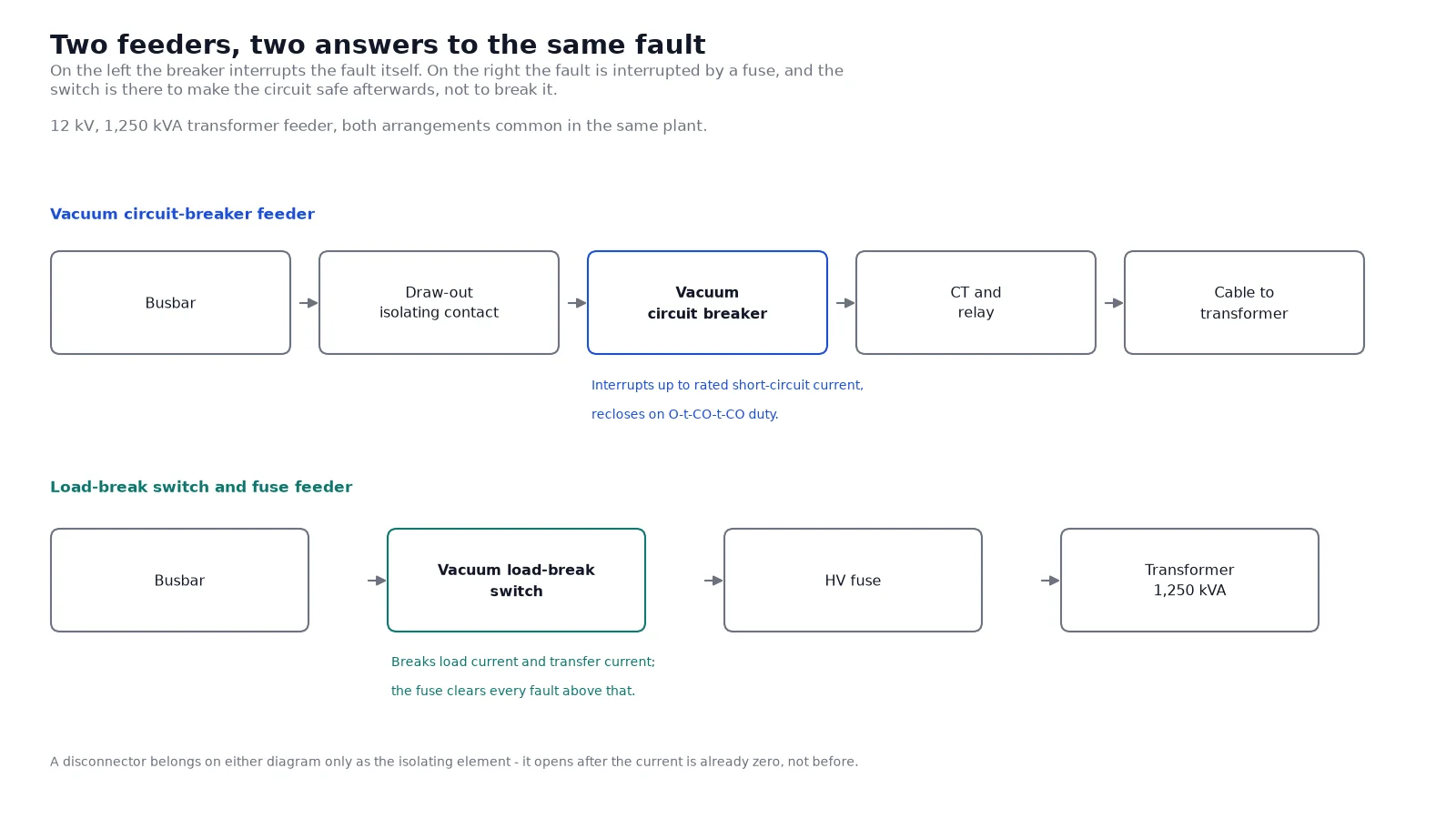
Fuse selection also has to survive transformer inrush without operating and still clear a secondary fault. That window is narrow for small transformers, and it is the reason a 630 kVA transformer feeder and a 1,600 kVA transformer feeder often end up with different answers — one on a fuse, one on a breaker with a relay.
Circuit Breaker: Short-Circuit Breaking and Reclosing Duty
The circuit breaker is the only one of the three that interrupts fault current as a normal, repeated, rated duty. In a vacuum interrupter the arc is diffuse and extinguishes at current zero, and the contact erosion per operation is small enough that a 12 kV breaker is rated for tens of thousands of mechanical operations and a defined number of full short-circuit interruptions.
Reclosing is the other half of the duty. A breaker on an overhead feeder is expected to perform O-t-CO-t-CO: open, wait, close onto the fault, wait, open again. A switch cannot do this, and a switch-fuse combination cannot do this either, because after the fuse has operated there is nothing left to reclose. Auto-reclosing is therefore a breaker requirement, not a preference, on any feeder where transient faults are expected.
The electrical and mechanical classes carry real selection information. Class E2 denotes a breaker tested for a defined number of short-circuit operations without maintenance, M2 for extended mechanical endurance, and C2 for back-to-back capacitor bank switching. A tender that specifies only voltage and current leaves the class open, and a cheap offer will fill the gap.
Disconnector and Earthing Switch: Isolation Without Interruption
A disconnector provides a visible gap in the circuit. That is its entire function, and it does it well: the gap is proof, not a control action, which is why safety procedures are written around it. IEC 62271-102 gives it a rated short-time withstand current and a rated peak withstand current so that the gap can carry fault current while closed, and a negligible-current switching capability of the order of 0.5 A.
Two rated duties go beyond “negligible”. A disconnector may be rated to break bus-transfer current, the current that flows when a feeder is transferred from one busbar to another in a substation with a double busbar arrangement, with a corresponding bus-transfer voltage. It may also be rated for small inductive and capacitive currents, such as the charging current of a short length of busbar. Neither extends to load current, let alone fault current.
The earthing switch is a separate device in the same standard and usually the same enclosure. It is rated to make, but not break, short-circuit current: closing it onto a live circuit is a controlled fault, which is why the interlock, not the operator’s memory, is what makes it safe.
Interlocking and the Operating Sequence in a KYN28 Panel
In a metal-clad panel the three devices appear as a sequence rather than a choice. The withdrawable truck carries the breaker; the isolating contacts behind the shutters provide the gap; the earthing switch earths the cable compartment. The interlocks enforce:
- The truck cannot be racked in or out unless the breaker is open.
- The breaker cannot be closed unless the truck is in the service or test position, with the contacts engaged or the auxiliary circuit connected.
- The earthing switch cannot be closed unless the breaker is open and the truck is withdrawn to the test position.
- The breaker cannot be closed while the earthing switch is closed.
Those four rules are mechanical. They are also the part of the specification that a buyer can verify without opening the panel: ask for the interlock functional test report, and check that the sequence is proved in both directions rather than only in the safe direction. A panel where the earthing switch can be closed with the truck in service has passed a factory test incorrectly.
Selection by Feeder Type
| Feeder |
Typical answer |
Reason |
| Transformer feeder up to about 1,250 kVA, no reclosing required |
Load break switch with fuse |
Fuse clears the fault; the switch provides load switching and isolation |
| Transformer feeder above that, or where protection settings must be graded |
Circuit breaker with relay |
Fuse curves cannot be graded finely enough, and inrush sets a hard limit |
| Motor feeder |
Circuit breaker or contactor plus fuse |
Starting current and protection curves need adjustable settings |
| Outgoing overhead line |
Circuit breaker with reclosing |
Transient faults need O-t-CO-t-CO duty the switch cannot provide |
| Ring main unit incomer or ring switch |
Load break switch |
Loop and cable charging duty only; fault cleared by the feeding breaker |
| Busbar section |
Circuit breaker, or a switch with an interlock proving no load |
Paralleling two sources is a fault-current duty if the buses are at different potentials |
| Isolation for maintenance anywhere |
Disconnector or withdrawable truck |
Visible gap after the current is already zero |
Cost, Footprint and Lifecycle Differences
A vacuum circuit breaker with a protection relay, current transformers and a withdrawable truck costs several times what a load break switch with three fuses costs, and occupies more panel width. On a compact ring main unit the difference decides the enclosure size. Against that, the switch-fuse combination has a consumable: every fuse operation is a replacement, and a fuse that has operated once may have been damaged by the arc even if it looks intact.
The lifecycle calculation is not complicated. Where faults are rare and the transformer is small, the fuse is cheaper over twenty years. Where the feeder trips a few times a year, uses auto-reclosing, or needs settings that can be changed as the network grows, the breaker pays for itself in avoided outages and avoided fuse stock. What does not pay for itself is a switch installed where the fault level exceeds what the combination can clear, because the consequence is a failed interruption rather than a maintenance cost.
Tender Errors Worth Catching Early
| What the document says |
What it leaves open |
What to ask for |
| “Load break switch, 630 A, 12 kV” |
Whether a fuse is included, and which one |
Rated transfer current with the named fuse reference |
| “Circuit breaker, 25 kA” |
Reclosing duty, electrical class, capacitor switching class |
O-t-CO-t-CO confirmation, E2 and M2, C2 where relevant |
| “Isolator, 630 A” |
Whether any breaking duty has been assumed |
Rated bus-transfer current, and a statement that load breaking is excluded |
| “Fuse 63 A” |
Voltage rating against system voltage, and the 87 percent rule |
Fuse voltage relative to the maximum system voltage |
| “Interlocked” |
Which interlocks, proved in which direction |
Interlock functional test record for all four sequences |
None of these gaps is exotic. They appear because a single-line diagram shows a box with a symbol, and the symbol does not carry the duty. Reading the duty back into the symbol — can it break fault current, yes or no — resolves most of them before the enquiry goes out.
FAQ
Can a load break switch interrupt a short circuit?
No. It is rated to break load current, closed-loop current and charging current. Fault current is cleared by a fuse in a switch-fuse combination, or by an upstream circuit breaker, and the switch then opens on the striker or by interlock.
What is the difference between transfer current and take-over current?
Transfer current applies to striker-operated combinations: the highest current the switch itself will interrupt when one fuse has operated first. Take-over current applies to release-operated combinations: the current at which the fuse curve and the switch opening time cross.
Can a disconnector be used to switch a load?
No. Its rated switching capability is limited to negligible currents of the order of 0.5 A and, where rated, bus-transfer current. Load current must be interrupted by a breaker or a switch first.
Why does a circuit breaker have a higher making rating than breaking rating?
Because the first peak of a fault current is asymmetrical. At 50 Hz the peak is about 2.5 times the symmetrical r.m.s. breaking current, and the contacts must withstand closing onto that peak without welding.
When is a switch-fuse combination the better choice over a breaker?
On transformer feeders where the transformer is small enough for a fuse curve to protect it, where auto-reclosing is not needed and where the fault level is within the fuse rating. It is cheaper, smaller and needs no relay settings.
Does a ring main unit need a circuit breaker?
Not for the ring switches, which only break loop and charging current. The transformer feeder inside the same unit may still need one, depending on transformer size, fault level and whether the protection has to be graded with the upstream device.
If you are comparing a VZFR-12 switch-fuse combination against a breaker feeder for the same transformer, the deciding numbers are the fault level at the terminals and the transformer inrush. For a breaker feeder the equivalent starting points are the VBI-12 and VS1 handcart ranges, both built for the KYN28 arrangement described above. The KYN28 installation sequence and the nameplate parameters guide cover what to check when the panel arrives.