A crane hoist contactor does not die of old age. It dies of arithmetic. A general-purpose AC contactor rated for AC-3 duty might be expected to survive somewhere between half a million and a million electrical operations on a pump or a fan, and that sounds like a long life until you multiply it by the operating rate of a foundry hoist that cycles three hundred times a shift. The same arithmetic explains why a contactor that is perfectly adequate on a conveyor fails in eight months on a grab bucket.
Crane, hoist and other frequent-switching duties are the hardest normal application for a medium-voltage or heavy-duty control contactor, because the load is not just started and stopped. It is plugged, inched, held against gravity, reversed under load and braked by DC injection. This guide explains what that duty actually is in IEC terms, why conventional air-break contactors struggle, and how to size a vacuum contactor for it without either over-buying or discovering the limit on site.
Quick answer: what crane duty actually demands
IEC 60947-4-1 defines utilisation categories by what the contactor has to make and break. AC-3 is the ordinary motor duty: make the locked-rotor current, break the running current. AC-4 is the hard one: make the locked-rotor current and break it while the motor is still accelerating or is being plugged, which means breaking currents of five to eight times rated current with a power factor far worse than a running motor. Hoist and crane travel motions sit firmly in AC-4, and grab or magnet hoists sit at the top of it.
| Utilisation category |
Typical load |
Making current |
Breaking current |
Typical operations at rated current |
| AC-1 |
Resistive, heaters |
1 x Ie |
1 x Ie |
Very high, over 1 million |
| AC-3 |
Pumps, fans, compressors |
6 to 8 x Ie |
1 x Ie |
0.5 to 1 million |
| AC-4 |
Crane hoist, plugging, inching |
6 to 8 x Ie |
6 x Ie |
100,000 to 250,000 air-break |
| AC-4 with DC injection braking |
Hoist with dynamic braking |
6 to 8 x Ie |
6 x Ie plus DC arc |
Poorly defined, often the real limit |
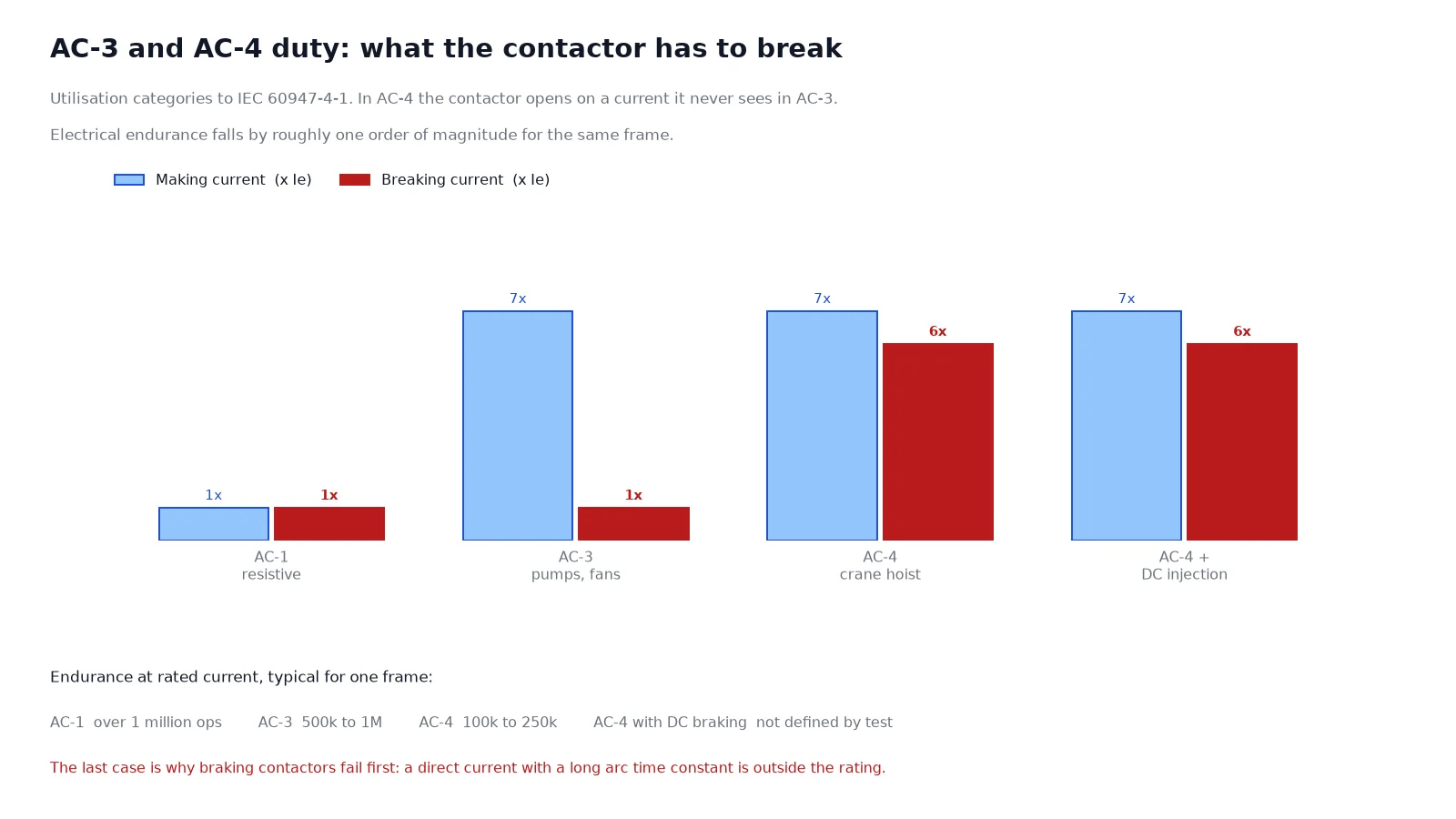
The last row is the one that catches people out. DC injection braking is common on hoists because it stops the load without a mechanical brake fighting the motor. The contactor that inserts the DC is interrupting a direct current with a long arc time constant, which is a much harsher duty than any AC-4 rating in the standard anticipates. If the braking contactor is the same frame as the main one, it will be the first to fail.
Why an air-break contactor fails early on a hoist
Four mechanisms account for most hoist contactor failures, and only one of them is about contact wear in the ordinary sense.
Contact welding. When the contactor closes onto a motor that is still rotating in the opposite direction, the first half cycle sees a current made up of the supply inrush plus the back EMF of the spinning motor. The contacts bounce for a millisecond or two, the arc concentrates on a small spot, and the surfaces micro-weld. A weld that is weak breaks on the next operation and takes a chunk of contact material with it. A weld that holds is a closed contactor with the coil de-energised, which is a load that will not stop.
Arc erosion from repeated breaking. In AC-4 the contactor breaks a current several times rated on almost every operation. Air-break arc chutes split and cool the arc, but they also accumulate copper and copper oxide, and a contaminated chute extinguishes more slowly on the next break. The erosion accelerates rather than staying linear.
Coil thermal ageing. Hoist contactors are energised for long periods while the load is held, in a crane cab or a mill bay that is often 50 degrees Celsius or more, with a coil designed for a 40 degree reference. Insulation class F has margin, class B does not, and a coil that has been running hot for two years fails on the first hot day of the third summer.
Mechanical wear of the magnet and the springs. The armature gap grows as the magnet faces erode, the closing force drops, the bounce gets worse, and the whole failure mode feeds itself. This is why an air-break contactor on a hoist tends to fail suddenly after a long period of looking acceptable.
Where the vacuum interrupter changes the economics
A vacuum contactor replaces the open arc and the arc chute with a sealed ceramic bottle in which the contacts part in a vacuum of the order of 0.0001 Pa. There is almost nothing to ionise, so the arc that does form is a metal-vapour arc that extinguishes at the first current zero and leaves the contact surfaces remarkably intact. The practical consequences for crane duty are specific.
Electrical endurance at rated current moves from the low hundreds of thousands into the range of a million or more operations, and the endurance is much less sensitive to how hard each operation is. There is no arc chute to contaminate, no exposed arc to ignite dust in a mill, and no arc products depositing on insulation in a humid cable trench. The contactor is also largely indifferent to the atmosphere, which matters in a steel plant where the air is abrasive.
The trade-off is real and should be stated plainly. A vacuum interrupter chops current, and chopping a motor current produces a switching overvoltage whose magnitude depends on the surge impedance of the circuit between contactor and motor. On a short cable run to a small hoist motor the overvoltage is modest. On a long run, or a motor with a high surge impedance, it is worth fitting an RC suppressor or a metal-oxide surge arrester at the motor terminals. This is a small cost and a large reduction in motor insulation risk, and it is the one thing most often omitted when a plant retrofits vacuum contactors onto an existing crane.
Definite purpose and mechanically latched contactors
Two terms appear constantly in crane enquiries and they mean different things.
A definite purpose contactor is one designed and rated for a specific, defined load rather than for general use. In a crane context it means the contactor’s ratings and endurance were established on a hoist duty cycle rather than on a generic AC-3 test. It is a claims-and-testing distinction, and the evidence for it is the manufacturer’s duty table, not the label.
A mechanically latched vacuum contactor holds its closed position with a mechanical latch rather than with continuous coil current. Closing is done by a coil pulse; opening is done by a separate trip coil releasing the latch. The benefits are concrete: no continuous coil dissipation in a hot cabinet, no AC hum, no drop-out on a brief voltage dip, and no coil failure mode at all in the hold state. That last point is significant on a hoist where the contactor may be closed for hours.
The constraint is equally concrete. A latched contactor does not fail safe. If control power is lost, a normal contactor opens and the hoist brake sets; a latched contactor stays closed and the load stays energised. Where the load must drop out on loss of control supply, a latched contactor is the wrong device, or it must be combined with an undervoltage release that trips the latch. Ask the question explicitly before ordering, because the two versions look identical on a catalogue page.
Sizing table by hoist motor rating
The following is a starting point for 50 Hz systems at 380 to 415 V, with the contactor chosen for AC-4 duty and an ambient of 40 degrees Celsius. Above that ambient the frame moves up one step, not the other way round.
| Hoist motor rating |
Approximate full load current |
Vacuum contactor frame |
Typical bottle rating |
Note |
| 7.5 kW |
15.5 A |
160 A frame |
160 A, 12 kV class |
Smallest common frame, AC-4 rated |
| 15 kW |
30 A |
160 A frame |
160 A |
Large margin, preferred for grab duty |
| 30 kW |
58 A |
250 A frame |
250 A |
Standard for 10 to 30 t hoists |
| 55 kW |
104 A |
400 A frame |
400 A |
Check reversing pair spacing |
| 90 kW |
168 A |
630 A frame |
630 A |
Often vertical format in a crane panel |
| 132 kW |
245 A |
630 A frame |
630 A |
Confirm duty cycle before sizing down |
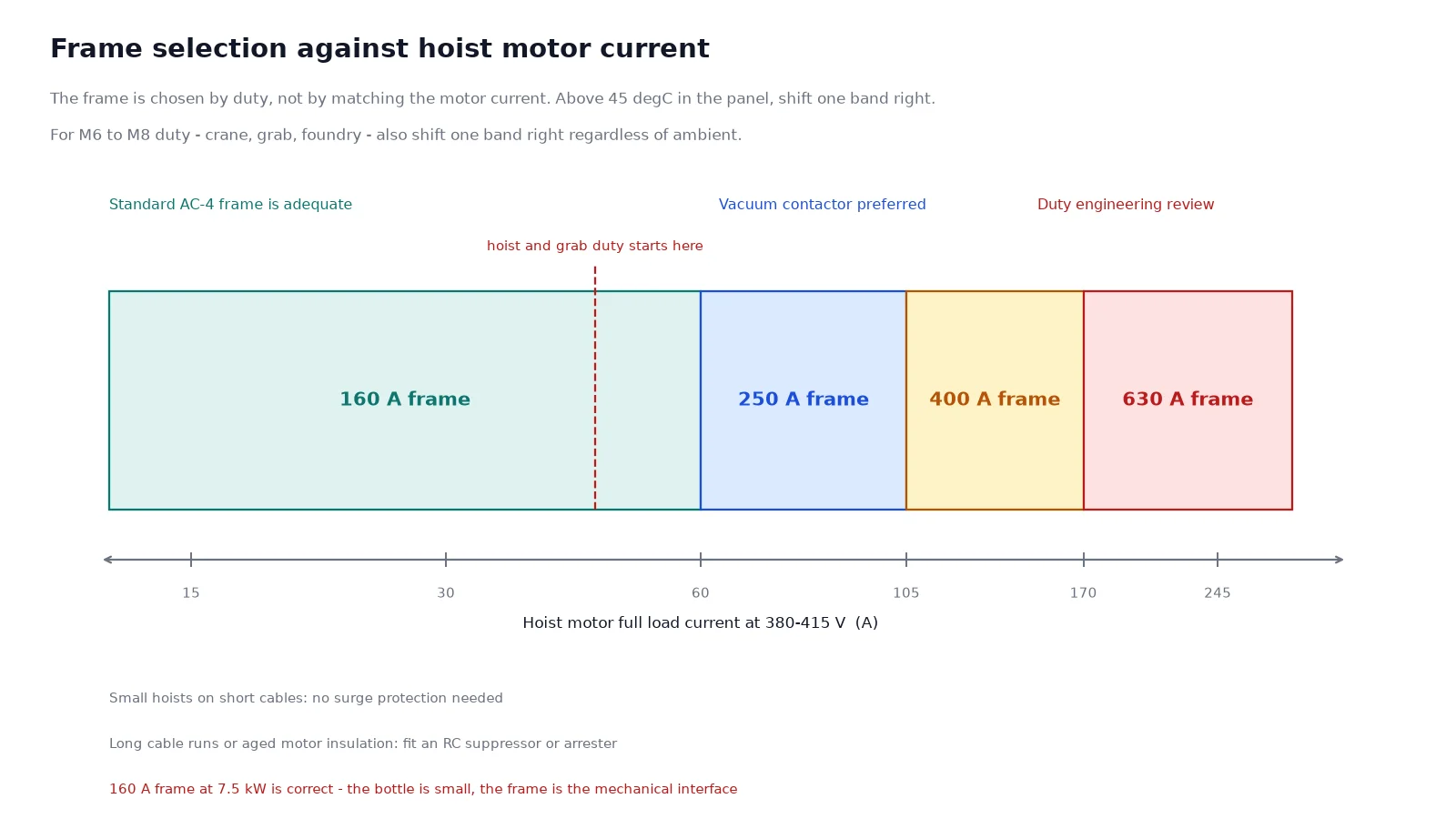
The 160 A frame at 7.5 kW looks absurdly oversized if you compare it with an air-break contactor of the same current rating, and that is the point. A vacuum bottle rated 160 A has a much smaller contact structure than an air-break contactor rated 160 A, and the frame around it is the mechanical interface, not the thermal limit. Sizing down to match the motor current is the most common specification error on small hoists.
Operations per hour and the thermal check
Endurance is not the only limit. Every operation dissipates energy in the contacts and in the coil, and the panel has to get rid of it. The relevant figure is operations per hour at the actual current, not the catalogue endurance.
| Duty class (ISO 4301 / FEM) |
Typical application |
Operations per hour |
Contactor requirement |
| M3 / 1Bm |
Workshop crane, light use |
Up to 60 |
Standard AC-4 frame |
| M5 / 2m |
General production crane |
60 to 150 |
AC-4 frame, one size up for ambient above 45 degrees |
| M6 / 3m |
Foundry, heavy fabrication |
150 to 300 |
Vacuum contactor strongly preferred |
| M7 / 4m |
Continuous casting, grab hoist |
300 to 600 |
Vacuum contactor, forced ventilation or larger panel |
| M8 / 5m |
Bucket wheel, ore handling |
Above 600 |
Vacuum contactor with duty engineering review |
Two practical notes on this table. First, an enclosure that was sized for an oil-filled starter will cook a vacuum contactor of the same nominal rating, because the vacuum bottle runs hot and the volume is filled with more equipment than before. Second, panel ventilation is part of the rating. A contactor rated 630 A at 40 degrees in free air is not a 630 A contactor in a sealed IP54 box in a mill bay at 55 degrees.
Coil voltage, control supply and what to specify
Coil selection on a crane is driven by the control circuit, not the main circuit. Common options are 220 V AC or 380 V AC from a control transformer, and 110 V DC or 220 V DC from a station battery. DC coils are the better choice where long hold periods are involved because there is no AC hum and no shading-ring wear, but they draw more current than an equivalent AC hold and the supply has to be sized for the inrush. The available voltage classes and their practical limits are covered in our guide to vacuum contactor voltage classes.
Voltage dip ride-through is worth thinking about separately. A crane fed from a long LV run sees dips when a large hoist starts, and a contactor that drops out on a 30 percent dip for 100 ms will drop the load. If the process cannot tolerate that, a latched contactor or a delayed-dropout control relay is the fix, not a bigger coil.
When the enquiry goes out, five pieces of information determine the answer: hoist motor rating and full load current, system voltage and frequency, the duty class or operations per hour, the ambient temperature inside the panel, and whether the circuit requires fail-safe drop-out. Add the control voltage and whether reversing duty is involved, and the specification is complete. Our overview of what a vacuum contactor is covers the construction if the starting point is unfamiliar, and the comparison of CKG3, CKJ5 and JCZ5 vacuum contactors explains how the families differ mechanically for the same electrical duty.
FAQ
Can I use a standard AC contactor for a crane hoist?
You can, and it will work until the operations add up. A standard AC-3 contactor on a hoist is being used outside its utilisation category, so its declared electrical life does not apply and the failure is unpredictable rather than simply early. Where the duty is under about sixty operations an hour and the load is a simple travel motion, a heavy-duty AC contactor sized two frames up can be acceptable. For hoist and grab motions with plugging, the vacuum contactor is usually cheaper over five years than two or three replacements plus downtime.
What does AC-4 duty mean in practice?
It means the contactor breaks the motor current while the motor is accelerating, stalled or being plugged, so the current at the moment of opening is roughly five to eight times rated. Compare that with AC-3, where opening happens at running current. The difference in arc energy per operation is an order of magnitude, which is why the declared endurance differs by the same order.
Does a vacuum contactor need surge protection on a hoist motor?
It needs it more often than an air-break contactor does, because vacuum interrupters chop the current at a high di/dt and the resulting overvoltage is set by the circuit. Short cable runs to a small motor usually need nothing. Long runs, high-impedance motors, or motors with aged insulation benefit from an RC suppressor or an arrester at the motor terminals. Treat it as a design decision rather than an accessory.
What is a mechanically latched vacuum contactor used for?
Holding a circuit closed for long periods without coil current. It removes continuous coil dissipation from a hot panel and makes the closed state immune to control supply dips. It is the wrong device wherever the circuit must open on loss of control power, unless it is fitted with an undervoltage trip that releases the latch.
How many operations will a vacuum contactor last on a hoist?
At rated current the electrical endurance of a vacuum bottle is typically in the range of 250,000 to one million operations, and mechanical endurance is higher. On a crane the limiting factor is often the coil and the auxiliary contacts rather than the bottle, so the honest answer is that the bottle outlives the rest of the contactor. That is a good reason to check auxiliary contact blocks and coils at the same service interval.
Why does my crane contactor coil keep burning out?
Almost always ambient plus continuous energisation. A coil rated for 40 degrees installed in a 55 degree panel with the contactor closed for most of the shift is running above its insulation class margin, and a voltage that is ten percent high adds the rest. Check the actual panel temperature with the doors closed before replacing the coil, or the replacement will follow the same path.
If you have the hoist motor rating, duty class and panel ambient, send them and we will confirm the frame and coil rather than the nearest catalogue unit. The contactor range lists the frames with their AC-4 ratings, and the CKG3 12 kV vacuum contactor is the common choice for crane panels up to 630 A. Where the circuit is a hoist supplied through a switchgear panel rather than a dedicated starter, the difference between a vacuum contactor and a breaker is worth settling first, since the protection and the duty rating are not interchangeable.