Every ZW32 enquiry ends with the same question, usually in the last line of the email: permanent magnet or spring mechanism? It is a reasonable question and it is usually asked for the wrong reason. The buyer is comparing technologies; what decides the answer is the auxiliary supply, the ambient temperature, and whether anyone within reach of the site can service what arrives.
Both mechanisms switch the same vacuum interrupter, carry the same ratings and sit in the same tank. What separates them is how the stored energy that closes and opens the contacts is created, held and released. This guide compares the two at the level that matters for specification, and ends with the decision table we use when a buyer cannot decide.
Quick answer: the difference in one paragraph
A spring operating mechanism stores energy in a spring, charges it with a motor or a manual handle, and releases it through a latch and a linkage of perhaps sixty to eighty moving parts. A permanent magnet actuator stores the closed and open positions in the flux of a permanent magnet, moves the contacts with a single coil pulse, and has roughly forty percent fewer moving parts with no latch, no trip coil linkage and no mechanical energy storage at all. The spring mechanism is easier to repair with local skills and indifferent to temperature. The permanent magnet actuator is more consistent, needs far less maintenance, and is far more dependent on a healthy DC supply and a healthy capacitor.
How each mechanism actually works
The spring mechanism is a century-old idea executed well. A motor, or a manual handle during commissioning and after a supply failure, compresses a closing spring. The spring is held by a closing latch. A close command releases the latch, the spring discharges through a cam and linkage, the contacts close, and a second spring — the opening spring — is charged as a by-product of the closing stroke. An opening command releases the opening latch directly. The mechanism therefore stores energy in metal and holds it there with a latch surface, and the whole sequence depends on that latch being clean, lubricated and correctly adjusted.
The permanent magnet actuator replaces the latch with magnetism. A permanent magnet provides holding flux that keeps the armature in whichever end position it occupies. A close coil pulse drives the armature to the closed position, where the magnet flux alone holds it. A trip coil pulse cancels that flux through a bucking field, and a repulsion spring drives the contacts open. Because the closed position is held magnetically, there is no latch to wear out and no continuous current in the close coil.
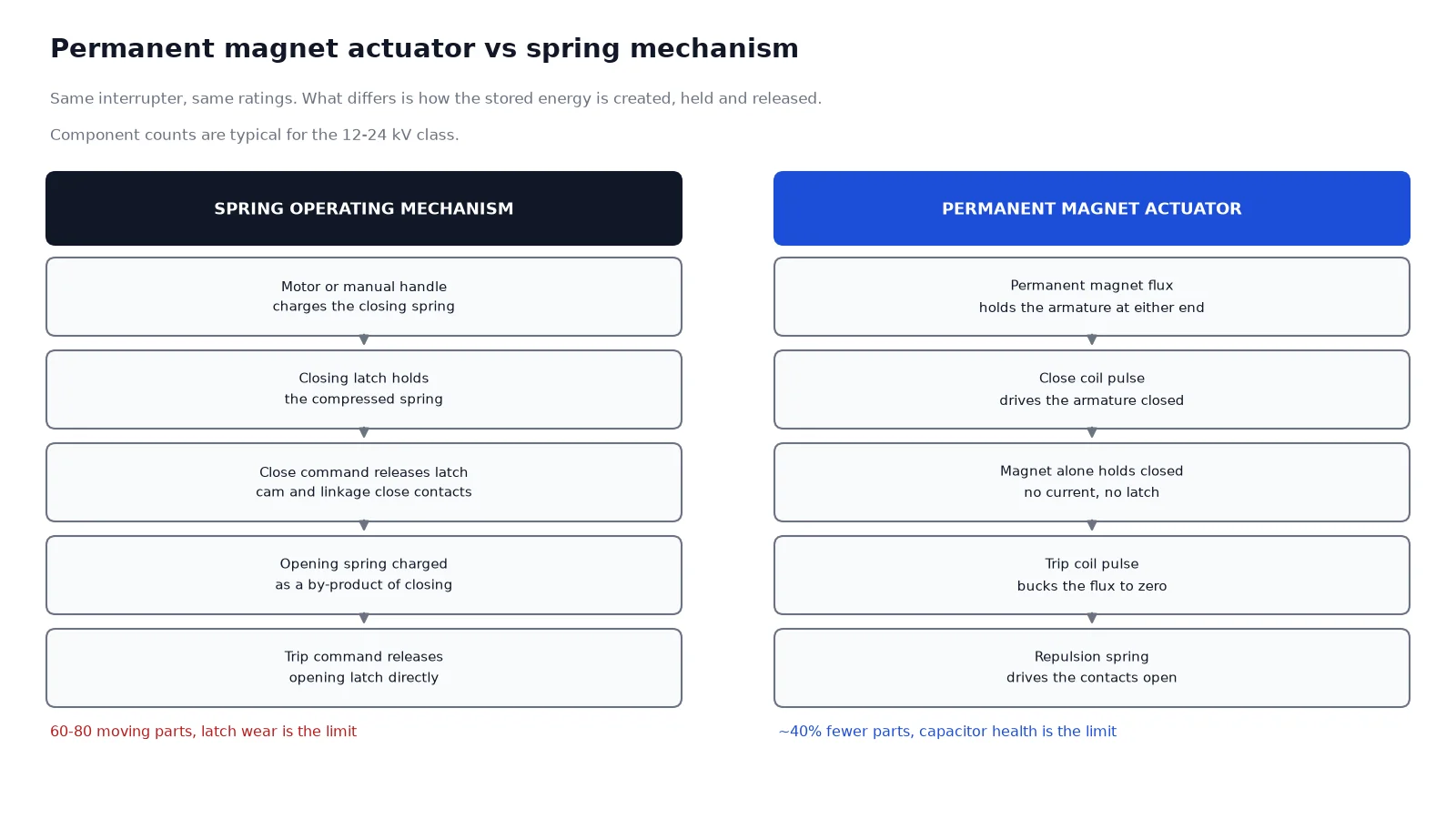
Both are single-pulse devices in normal operation, which is what makes the comparison interesting. The stored energy that a spring mechanism keeps in a compressed spring is kept in a magnet in the PMA. When people say the PMA is maintenance-free they mean there is no latch, cam or linkage to lubricate. They do not mean there is nothing that can fail.
Side-by-side comparison
| Property |
Spring operating mechanism |
Permanent magnet actuator |
| Moving parts |
60 to 80 including latch, cam, linkage |
Around 40 percent fewer, no latch or cam |
| Energy storage |
Compressed closing spring |
Permanent magnet flux in the closed position |
| Holding closed |
Mechanical latch, no current |
Magnetic force, no current |
| Auxiliary supply needed |
Motor supply to recharge after each close |
Charged capacitor plus DC supply for the coils |
| Recharge time after closing |
8 to 15 seconds before the next close is available |
Capacitor recharge, typically under 10 seconds |
| Manual operation |
Manual charge handle plus manual close and trip |
Manual trip release only, no manual close |
| Closing time scatter |
Plus or minus 5 ms typical |
Plus or minus 2 ms typical |
| Temperature sensitivity |
Low |
Magnet holding force falls with temperature |
| Mechanical endurance |
10,000 to 30,000 operations typical |
30,000 to 100,000 operations typical |
| Field serviceability |
Repairable with standard workshop skills |
Module replacement, limited local repair |
| Typical cost, same rating |
Reference |
10 to 25 percent higher |
The temperature row deserves more than a line, because it is the one that produces field failures rather than debate.
The temperature question, stated properly
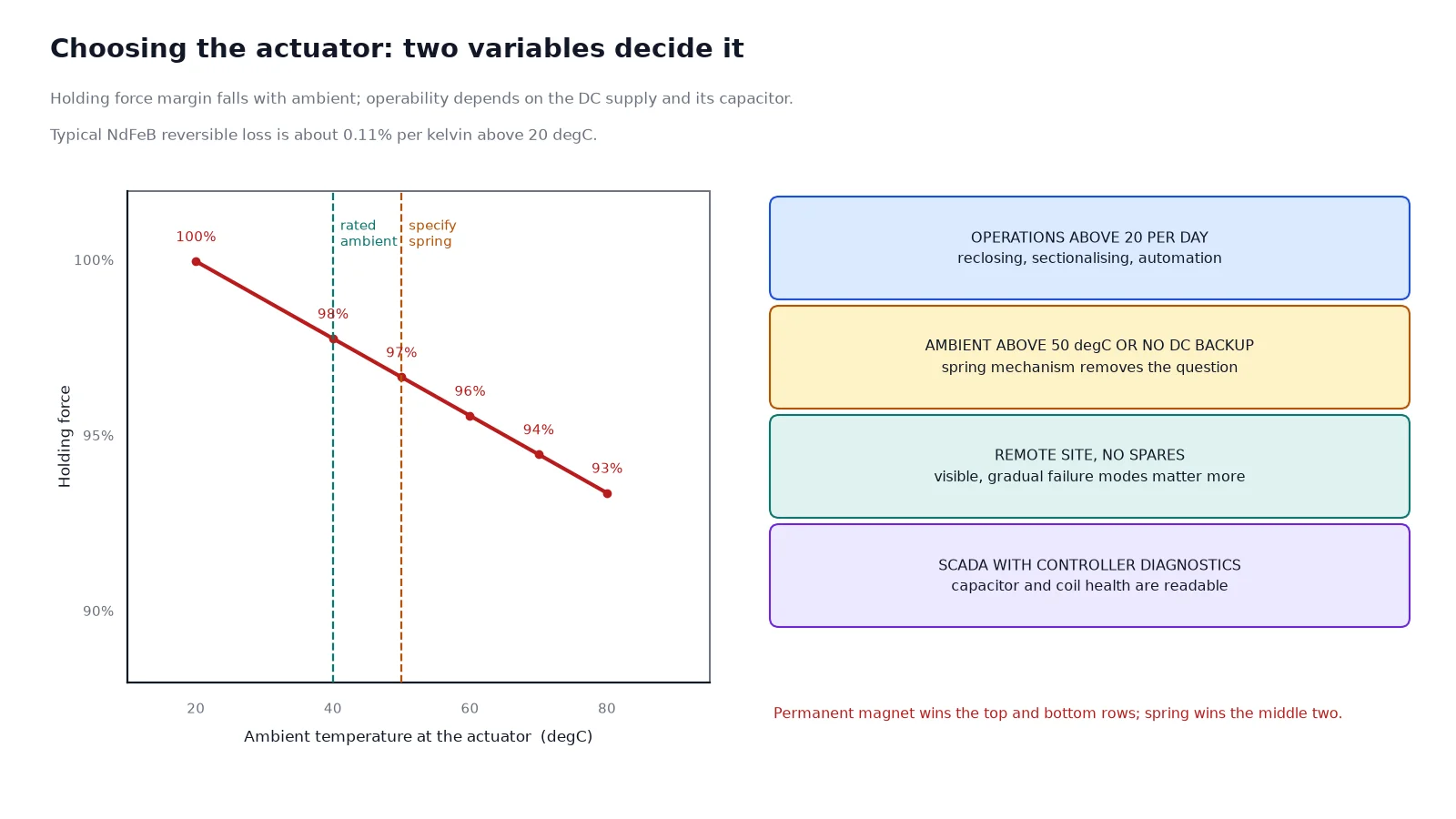
Sintered neodymium-iron-boron magnets, which is what almost all PMAs use, lose remanence as temperature rises. The reversible coefficient is around 0.11 percent per kelvin, which means the holding force at 60 degrees Celsius is roughly 95 percent of the value at 20 degrees. That on its own is not a problem, because the actuator is designed with margin. The problem is what happens above the design limit and what happens after a period at high temperature, because part of the loss becomes irreversible.
A ZW32 installed on a pole in a market where the shade temperature reaches 45 degrees and the tank surface reaches 70 degrees in direct sun is in a different thermal environment from the same unit in a temperate substation. Reputable PMA breakers are rated for an ambient of 40 degrees with derating above it, and the derating is on the holding force margin, not on the current rating. Ask for the ambient rating of the actuator explicitly and compare it with the site maximum, not the site average. Where the answer is marginal, the spring mechanism removes the question entirely.
What the auxiliary supply really has to do
This is where most procurement mistakes happen, and it happens on both technologies for opposite reasons.
A spring mechanism needs a motor supply that is present for long enough to recharge the spring after every closing operation. If a site has a small solar-battery station supply that sags during a fault, the breaker may close once and then be unable to reclose, which matters on a reclosing scheme where the whole point is a second attempt 300 ms later. Check that the motor recharges inside the dead time of the protection scheme, or specify a mechanism with a fast recharge and a capacitor-assisted close.
A PMA needs a DC supply for the coils and, critically, a charged capacitor bank. The capacitor is what delivers the close and trip pulse, and it is charged from the DC supply. If the DC supply is intermittent, the capacitor is the buffer that keeps the breaker operable, and if the capacitor is aged or its charging circuit is faulty, the breaker will not operate at all — with no mechanical backup. This is the single most important commissioning check on a PMA breaker: confirm the capacitor charges to its set voltage, confirm the ready indication, and confirm that a trip is possible immediately after a close. Our guide to vacuum circuit breaker nameplate parameters covers the auxiliary supply field, and it is worth reading the rating plate on the actuator module separately from the breaker plate.
Failure modes and what each one costs
Spring mechanism. The latch surface wears and eventually fails to hold, which shows up as a breaker that will not stay closed or, worse, one that trips spontaneously. Cam and linkage lubrication dries out, closing time drifts, and the mechanism becomes noisy before it becomes unreliable. All of this is visible, audible and repairable. A spring mechanism rarely fails without warning.
Permanent magnet actuator. Failure is electrical and often silent. A capacitor loses capacitance with age and the close pulse becomes marginal; the breaker closes slowly, bounces, or refuses. A coil open-circuits and that operation is simply unavailable. Magnet degradation after thermal excursions reduces holding margin until a shock or a vibration event releases the armature. None of these announce themselves, which is why PMA breakers need their controller diagnostics read rather than their mechanism inspected.
The consequence for specification is straightforward. On a site with competent maintenance and a routine inspection programme, either technology is fine. On a remote site with no maintenance presence and no spares, the mechanism with visible, gradual failure modes is the safer choice; on a site with remote monitoring and a competent control system, the PMA’s diagnostics are an advantage and its low parts count pays back.
Where each one wins
| Application condition |
Preferred mechanism |
Reason |
| Frequent switching, 20 to 100 operations per day |
Permanent magnet |
No latch wear, endurance 3 to 4 times higher |
| Auto-reclosing on overhead distribution |
Permanent magnet |
Short recharge, consistent closing time |
| Ambient above 50 degrees, or strong direct sun |
Spring |
No magnet holding force margin to lose |
| No reliable DC station battery |
Spring |
Manual charging possible without any supply |
| Remote site, no spares, local workshop only |
Spring |
Repairable with standard skills |
| SCADA with remote diagnostics |
Permanent magnet |
Controller reports capacitor and coil health |
| Sealed or maintenance-free installation |
Permanent magnet |
No lubrication interval |
| Retrofit into an existing panel with limited space |
Permanent magnet |
Smaller mechanism envelope |
Two of these deserve a caveat. The manual-charging argument for the spring mechanism is real but limited: a manual handle lets you close the breaker once during commissioning or after a total supply loss, and it does not restore reclosing. The remote-diagnostics argument for the PMA is also real but conditional on someone reading the diagnostics, which is a process question rather than a product one.
Interlocks, sequence and the rest of the rating
Whichever mechanism is chosen, the ZW32 frame is rated for the standard operating sequence O-0.3s-CO-3min-CO, which is the auto-reclosing sequence for overhead distribution. The mechanism only affects whether the second close is available in time, not whether the sequence is permitted. Rated voltage, insulation level, breaking current and short-time withstand current are properties of the interrupter and the frame, and they do not change with the actuator.
That is worth saying because enquiries sometimes read as though the PMA option comes with different ratings. It does not. A 12 kV ZW32 with a PMA still serves 10 kV and 11 kV systems on the same insulation coordination basis as the spring version, and the pairing of frame to system voltage follows the same logic throughout the range — our note on 10 kV, 11 kV and 13.8 kV voltage classes explains why a 12 kV frame covers an 11 kV system but a 24 kV frame does not cover 25 kV.
What to put in the enquiry
Six items settle the mechanism question in one exchange: the system voltage and the frame you are considering, the ambient maximum including solar gain, the auxiliary DC supply available and its reliability, the expected number of operations per day, whether reclosing is required, and whether the site has maintenance capability. Add the protection and control arrangement if the breaker is part of a remote-controlled scheme.
For the frames and the ratings, the ZW32 12 and 24 kV outdoor vacuum circuit breaker page lists both mechanism options with their auxiliary supply requirements. Where the requirement extends to remote operation, telemetry and fault indication rather than mechanism choice, the intelligent ZW32 configuration covers the controller and communication layer. Where the open question is which 12 kV pole-mounted frame to put on the feeder rather than which actuator, our ZW8-12G and ZW32 comparison covers that side of the decision. If the choice is still open between a pole-mounted breaker and an indoor unit, the three-way comparison in our VS1, ZW32 and ZW7 comparison is the better starting point, and the full vacuum circuit breaker range lists every frame with its rating class.
FAQ
Is a permanent magnet actuator more reliable than a spring mechanism?
It has fewer parts and no latch to wear, so it is more reliable in the sense of mechanical endurance per year of service. It is less reliable in the sense of failure transparency, because its failure modes are electrical and silent. For a site with diagnostics and a spare controller it is the better device; for a site with neither, the spring mechanism’s gradual, visible degradation is worth more than the parts count.
Can a permanent magnet ZW32 be operated manually?
It can be tripped manually by a mechanical release, and it generally cannot be closed manually without the DC supply and a charged capacitor. That is the practical limitation during commissioning and after a total station battery failure. If manual closing is a requirement, specify it and confirm the answer for the exact model rather than assuming.
Why does my PMA breaker sometimes fail to close in cold weather?
Cold is not usually the magnet. It is the capacitor, whose capacitance falls at low temperature, and the DC supply, whose voltage sags under the higher coil current. A capacitor that is marginal at 20 degrees can be well outside tolerance at minus 10. Check the capacitor charge voltage and the capacitor capacitance before replacing the actuator.
Do both mechanisms use the same vacuum interrupter?
Within a given frame, yes. The interrupter is selected by rated voltage and breaking current, and the actuator is a separate choice. That is why the electrical ratings do not change when the mechanism changes, and why the mechanism decision should not be allowed to drive the rating decision.
How long does the spring mechanism take to recharge after closing?
Typically 8 to 15 seconds for a motor-charged mechanism of this class. That matters on a reclosing scheme with a 0.3 second dead time, because the mechanism cannot complete a second close in that window unless it has a capacitor-assisted close or a design that recharges during the opening stroke. Confirm the recharge time against the protection scheme, not against the catalogue headline.
Which mechanism has lower total cost of ownership?
Over ten years on a frequently operated pole-mounted breaker with reliable DC supply, the permanent magnet unit usually wins on maintenance and on avoided replacements. On a rarely operated breaker in a hot climate with an unreliable battery, the spring mechanism wins because it does not need anything the site cannot provide. The crossover is set by operations per year and by DC supply quality, not by purchase price.
Send the system voltage, ambient maximum, operations per day and the auxiliary supply arrangement, and we will come back with one recommendation rather than two options.