Certification is the first filter in almost every export enquiry, and it is also where buyers waste the most time. A purchasing manager in Riyadh asks for “CE and SASO certificates”, a contractor in Bangkok asks for “TISI”, a trader in Moscow asks for “EAC”, and the answers are genuinely different in each case — not because the transformer changes, but because each market regulates a different thing. Some regulate product safety. Some regulate energy efficiency. Some regulate the conformity assessment process itself.
This guide separates the five schemes that appear in real transformer tenders — CE, UL, SASO, TIS and EAC — and sets out what each one actually certifies, what document it produces, who is allowed to hold it, and where the scheme simply does not apply to a medium-voltage transformer at all. Getting that last point right saves months.
The Uncomfortable Starting Point
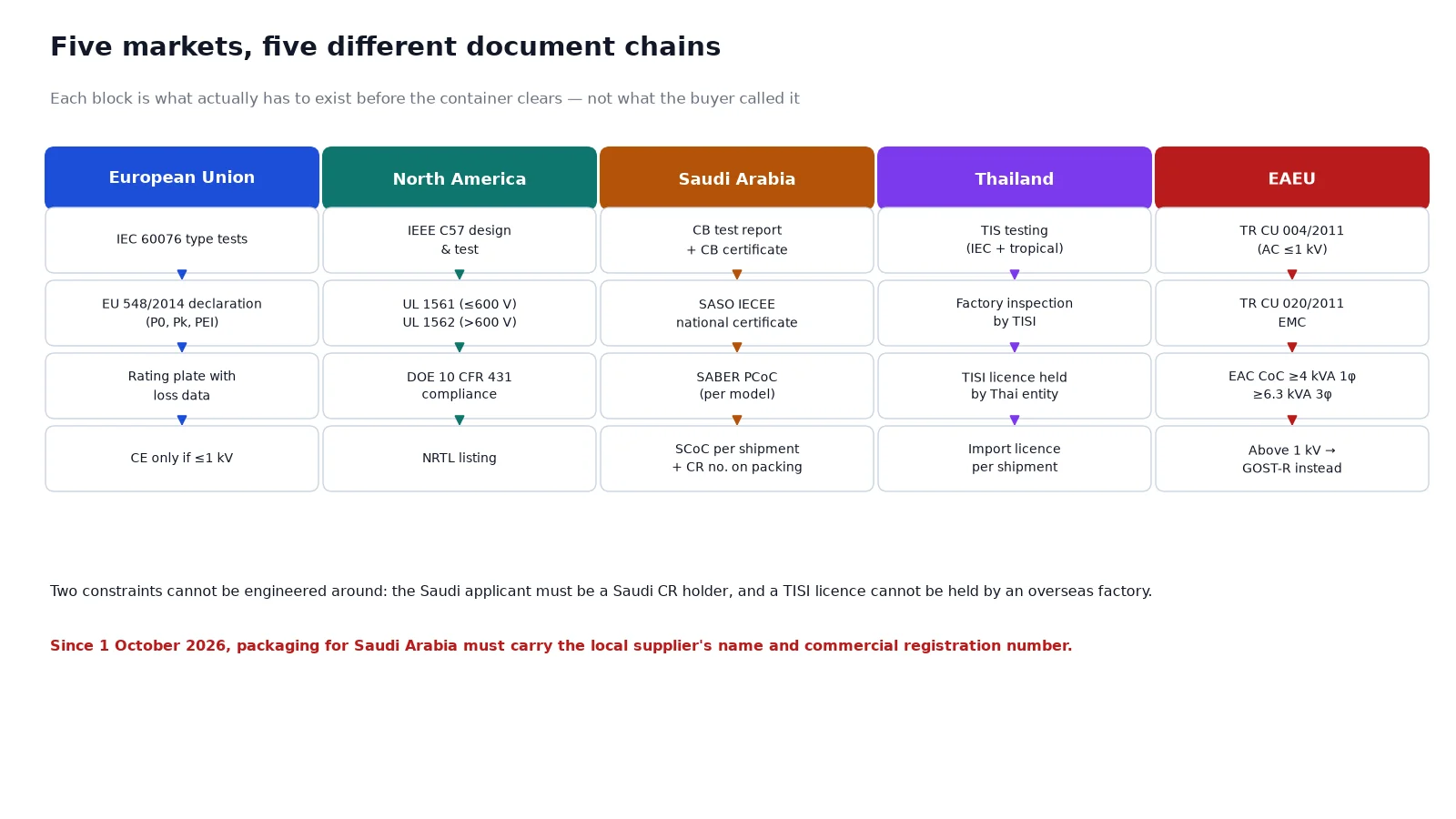
Most 11 kV to 36 kV transformers cannot be CE marked in the sense that most buyers mean. The EU Low Voltage Directive covers equipment rated between 50 and 1,000 V AC. A transformer with a 33 kV primary winding sits outside that range by more than an order of magnitude, so an LVD-based CE declaration is not available for it. What governs a medium-voltage transformer placed on the EU market is Ecodesign Regulation (EU) 548/2014, which sets mandatory efficiency limits, plus the requirements of the installation code in the destination country.
That distinction matters commercially. A buyer who insists on “CE certificate for 33 kV transformer” will either be sold a piece of paper that means nothing, or will spend weeks discovering that the requirement has to be rewritten. The professional answer is to ask for the efficiency declaration and the type test report instead. The comparison of IEC, IEEE, IS and GB standards explains the design framework these documents sit on.
What Each Market Actually Requires
| Market |
Mandatory instrument |
Document produced |
Applies to |
| European Union |
Ecodesign 548/2014 (Tier 2 since 1 July 2021) |
Declaration of conformity with loss values and PEI |
Medium and large power transformers, HV winding above 1 kV |
| European Union, LV dry-type |
LVD 2014/35/EU, EMC 2014/30/EU, RoHS |
CE declaration + technical file |
Units rated 50–1,000 V AC |
| United States / Canada |
UL 1561 (≤600 V) or UL 1562 (>600 V); DOE 10 CFR 431 |
NRTL listing + efficiency compliance certificate |
All distribution and power transformers |
| Saudi Arabia |
SASO SALEEM programme via SABER; IECEE certificate required for listed categories |
PCoC (product) + SCoC (per shipment) |
Regulated electrical products, importers only |
| Thailand |
TISI mandatory certification, TIS standards |
TISI licence + import licence per shipment |
Transformers are on the mandatory list |
| EAEU (RU, BY, KZ, AM, KG) |
TR CU 004/2011, TR CU 020/2011, TR EAEU 037/2016 |
EAC certificate (CoC) or declaration (DoC) |
AC 50–1,000 V / DC 75–1,500 V equipment |
| EAEU, above 1 kV |
National schemes, e.g. GOST-R in Russia |
GOST-R certificate |
High-voltage equipment outside TR CU 004 scope |
CE: Three Directives, Only One of Which Bites
The CE mark is a declaration by the manufacturer that the product meets all applicable EU legislation. For a transformer, the question is which legislation applies.
Low Voltage Directive 2014/35/EU covers 50–1,000 V AC and 75–1,500 V DC. This catches low-voltage dry-type and control transformers and misses everything at medium voltage.
EMC Directive 2014/30/EU covers apparatus liable to cause or be affected by electromagnetic disturbance. A passive transformer is a weak candidate, but the moment the unit is supplied with forced-cooling fans, a temperature controller, a monitoring relay or a smart terminal, the assembly includes active electronics and the assessment has to be made on the assembly.
RoHS restricts hazardous substances in electrical and electronic equipment. A transformer supplied as a component is not itself EEE in the usual sense, so compliance is normally declared at material level in the technical file rather than marked on the product. Where the transformer is delivered as a complete fixed installation, RoHS treatment depends on the installation’s classification.
The requirement that does apply: Ecodesign 548/2014
Regulation 548/2014 is the real EU gate for medium and large power transformers, and Tier 2 has been in force since 1 July 2021. It sets minimum Peak Efficiency Index values, not simple full-load efficiency, which is why the numbers look unfamiliar:
| Category |
Rating |
Tier 2 minimum PEI |
| Liquid-immersed, medium power |
3,150 < Sr ≤ 4,000 kVA |
99.532% |
| Liquid-immersed, medium power |
10,000 kVA |
99.615% |
| Liquid-immersed, medium power |
40,000 kVA |
99.724% |
| Dry-type, medium power |
3,150 < Sr ≤ 4,000 kVA |
99.382% |
| Dry-type, medium power |
≥ 10,000 kVA |
99.390% |
| Dry-type, large power, Um ≤ 36 kV |
≤ 4 MVA |
99.225% |
| Dry-type, large power, Um ≤ 36 kV |
≥ 63 MVA |
99.626% |
Values between the listed ratings are obtained by linear interpolation. Two details in the regulation are routinely missed. First, transformers rated up to 3,150 kVA with on-load or off-circuit tapping for voltage regulation get a 10% relaxation on no-load loss in Tier 2. Second, the regulation also imposes product information duties — rated power, load loss, no-load loss, PEI and the power at which it occurs, plus the weight and nature of the conductor and core — and these must appear in the documentation and on the rating plate for medium and large units.
North America: UL Plus a Separate Efficiency Regime
Safety listing and efficiency compliance are two different filings and both are needed. Dry-type units are listed to UL 1561 at 600 V and below and to UL 1562 above 600 V — the voltage class sets the standard, and specifying “cast coil to UL 1562” for a 480 V unit is a mistake that appears in real tender documents. Liquid-immersed units are evaluated against the IEEE C57 design and test framework and listed by an NRTL under the applicable product category.
Efficiency is regulated separately under DOE 10 CFR 431. The 2024 revision took effect on 8 July 2024 with compliance from 23 April 2029: low-voltage dry-type loss limits tighten by 30% for single-phase and 20% for three-phase units, medium-voltage dry-type by 20%, and the medium-voltage three-phase scope extends from 2,500 kVA to 5,000 kVA. Units in scope must be certified and the compliance data filed before shipment. Note the DOE test basis: low-voltage dry-type efficiency is assessed at 35% of rated load, while medium-voltage dry-type and liquid-immersed units are assessed at 50%. The three numbers are not comparable, and quoting one against another is the most common efficiency argument heard in North American bid clarification meetings.
Saudi Arabia: SABER, IECEE and the 2026 Changes
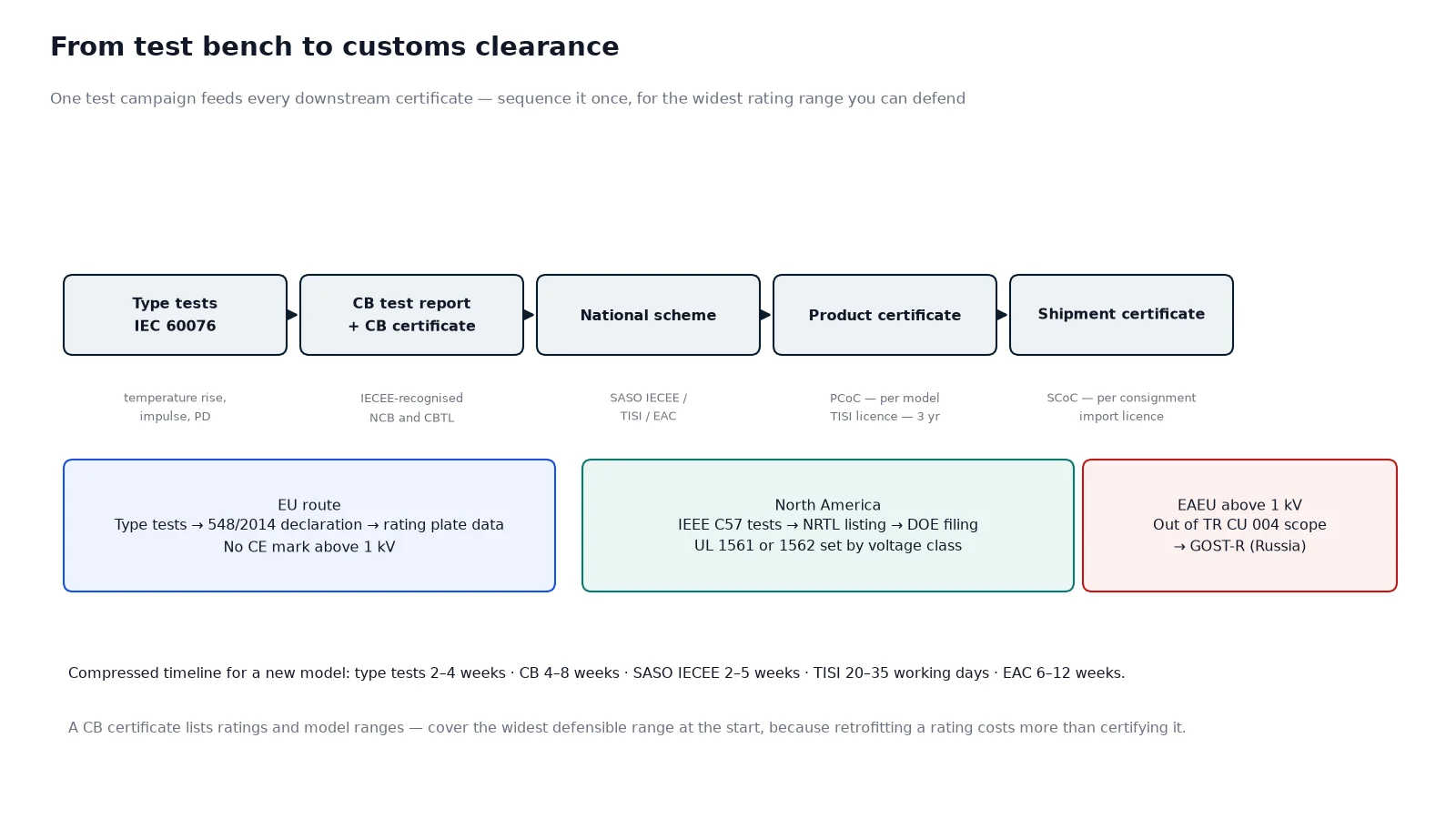
Saudi Arabia runs the SALEEM product safety programme, and every regulated consignment moves through the SABER platform. The chain has three links and each one depends on the previous:
- CB test report and CB certificate from an IECEE-recognised certification body and testing laboratory, covering the standard version adopted by Saudi Arabia plus national differences.
- SASO IECEE national certificate issued on the basis of that CB certificate, for categories where IECEE recognition is mandatory.
- PCoC (product certificate of conformity, per model, typically valid one year) followed by SCoC (shipment certificate of conformity) for every consignment. No SCoC, no customs clearance.
Two 2026 changes are now live and both surprise exporters. From 1 July 2026 the upgraded SABER system applies finer-grained document review, so applications with loosely defined model ranges are being sent back for clarification. From 1 October 2026, packaging must carry the Saudi local supplier’s name and commercial registration number. Since today’s date falls after both, any shipment planned now should assume both rules apply.
One structural constraint is worth repeating because it cannot be engineered around: the applicant must be a Saudi entity holding a commercial registration. The exporter cannot register in SABER alone. Arabic labelling and Arabic documentation are required, and the model designation on the CB certificate, the PCoC and the physical nameplate must be identical — a mismatch is the most common cause of a hold at the port.
Thailand: TISI and the Importer-as-Applicant Rule
Transformers appear on Thailand’s mandatory TISI list, which means a TISI licence and a TISI mark are required before import, sale or use. The applicable standard family is the TIS series, aligned with IEC but with added clauses for tropical humidity and for the Thai 220/50 Hz supply.
The constraint that derails most first-time exporters is the same as in Saudi Arabia: an overseas factory generally cannot hold a TISI mandatory licence. The application must come from a Thai importer, agent or locally registered company, which then owns the licence and carries the legal responsibility. A CB report can reduce the amount of re-testing, but it is not accepted in place of TIS testing and certification — CE and FCC certificates carry no direct recognition at all.
The process is type test plus factory inspection plus post-licence surveillance: a licence valid for three years, with annual surveillance and market sampling. Factory inspection covers incoming inspection records, process control, calibration and non-conforming product handling, and inspectors have been known to raise findings over missing supplier certificates of analysis. Plan for 20–35 working days of testing on top of factory inspection scheduling.
On the commercial side, Thailand is an ACFTA partner, so a FORM E certificate of origin delivers 0% import duty on Chinese-origin transformers. That is worth more than most certification savings and is routinely forgotten in the same conversation.
EAEU: EAC Covers Low Voltage, and That Is the Trap
The Eurasian Economic Union applies three technical regulations to electrical equipment: TR CU 004/2011 on low-voltage equipment safety, TR CU 020/2011 on electromagnetic compatibility, and TR EAEU 037/2016 on hazardous substance restriction. The EAC mark is the evidence of conformity, registered in the FGIS database and valid across Russia, Belarus, Kazakhstan, Armenia and Kyrgyzstan.
The scope of TR CU 004/2011 is AC 50–1,000 V and DC 75–1,500 V. A 10 kV or 35 kV transformer is outside it. In Russia, high-voltage equipment is instead handled through the national GOST-R system, which requires a Russian authorised representative, a full Russian-language technical passport, testing in a Russian-accredited laboratory and, for series production, a factory audit. Exporters who assume that an EAC certificate covers a 35 kV unit discover the gap at customs.
Within the low-voltage range, the certification mode depends on risk. Power transformers at 4 kVA single-phase or 6.3 kVA three-phase and above require an EAC certificate of conformity, which involves sample testing plus factory audit and carries annual surveillance. Smaller control, isolation and autotransformers may use a declaration of conformity, with testing but no factory audit. Very small units fall under the Russian exemption list.
What to Ask For in the RFQ
Ask for documents by name, not by scheme. A request for “certification” produces a brochure; a request for these produces a file that can be checked:
- EU: declaration of conformity to Regulation 548/2014 with P0, Pk, PEI and the power at which PEI occurs; type test reports to IEC 60076 parts 2, 3, 5, 10 and 11 as applicable.
- North America: NRTL listing file number and the UL standard cited, plus the DOE compliance certificate with the efficiency at the correct load point.
- Saudi Arabia: CB certificate and report with the Saudi national differences, IECEE national certificate, PCoC number, and confirmation that the SCoC will be issued before shipment.
- Thailand: TISI licence number and the name of the licence holder, plus confirmation of which TIS standard edition was tested.
- EAEU: EAC certificate or declaration number with the FGIS registration, and — for anything above 1 kV — a clear statement on whether GOST-R is required.
In every case, check three things on the document itself: that the certificate is in the name of the entity you are buying from, that the model designation covers the exact unit, and that the standard edition is current. A CB certificate to a superseded edition is the most common defect we see in files forwarded by buyers. The inspection and document guide sets out the full package.
Spotting a Certificate That Will Not Survive Customs
Four patterns come up repeatedly:
A CE “certificate” issued by a body with no notified status. The CE mark is a self-declaration; the supporting document is a declaration of conformity signed by the manufacturer, plus a technical file. A third-party “CE certificate” for an out-of-scope product is decoration.
A CB certificate whose scope does not match. CB certificates list ratings and model ranges. A certificate for a 1,000 kVA unit does not cover a 2,500 kVA unit, even in the same family, unless the range is explicitly stated.
A SASO document without a SABER reference. Since SALEEM was introduced, the operative documents are the PCoC and SCoC issued through SABER. A legacy SASO certificate with no SABER trail is not a clearance document.
An EAC certificate held by a party with no EAEU presence. Certificates must be held by an EAEU-registered entity, and the authorised representative arrangement has to be in place before the application, not after.
Timeline and Cost Planning
Certification is usually the longest lead item after the transformer itself, and it is the one buyers start last. A workable sequence for a new model going to multiple markets:
| Step |
Elapsed time |
Notes |
| Type tests to IEC 60076 (routine plus type) |
2–4 weeks after build |
Can run in parallel with routine production |
| CB test report and certificate |
4–8 weeks |
Longer if national differences must be added |
| SASO IECEE certificate |
2–5 weeks after CB |
SABER review is the variable |
| PCoC, then SCoC per shipment |
1–2 weeks / 2–5 days |
SCoC must precede vessel departure |
| TISI testing and factory inspection |
20–35 working days plus audit scheduling |
Applicant must be Thai |
| EAC certification with factory audit |
6–12 weeks |
Russian-language technical passport is the bottleneck |
| GOST-R for HV equipment |
8–16 weeks |
Separate from EAC, Russia only |
None of this is unavoidable cost. Certification run once, for a defined model range, at the start of a product line serves every subsequent order in that market. Certification run per order, under time pressure, costs several times as much. The manufacturer audit checklist includes a section on certificate currency for exactly this reason.
Frequently Asked Questions
Can a medium-voltage transformer be CE marked?
Not under the Low Voltage Directive, which stops at 1,000 V AC. What applies to a medium-voltage transformer in the EU is Ecodesign Regulation 548/2014, and the deliverable is a declaration of conformity with loss values and PEI rather than a CE mark on the tank.
Is a CB certificate enough for Saudi Arabia?
It is the necessary first step, not the clearance document. The CB certificate supports a SASO IECEE national certificate, which in turn supports the PCoC in SABER, and every shipment still needs its own SCoC.
Can our factory apply for TISI directly?
Generally no. The mandatory TISI licence must be held by a Thai importer, agent or registered company. Choose that partner before the first shipment, and put certificate ownership and cost allocation in the contract.
Does EAC cover a 35 kV transformer?
No. TR CU 004/2011 covers AC up to 1,000 V, so a 35 kV unit falls outside it. Russia requires GOST-R certification for high-voltage equipment, which is a separate process with its own documentation in Russian.
How long is a UL listing valid?
The listing remains valid while the product and the factory’s quality system continue to meet the requirements, and it is maintained through periodic factory surveillance. A change of critical components or manufacturing location requires a listing update.
Do we need separate certificates for each rating in a family?
Usually not, if the certificate explicitly covers a rating range and the construction is common. That is why certificates should be obtained for the widest defensible range at the outset — retrofitting a rating onto an existing certificate is slower than covering it from the start.
The Decision in One Paragraph
Match the certificate to the market’s actual instrument, not to the word the buyer used. In the EU that means the efficiency declaration, not a CE mark, for anything above 1 kV. In North America it means UL 1561 or 1562 depending on voltage plus a separate DOE filing. In Saudi Arabia it means a CB certificate feeding a SABER PCoC and a shipment-level SCoC, with the 2026 labelling rule now in force. In Thailand it means a TISI licence held by your Thai partner. In the EAEU it means EAC below 1 kV and GOST-R above it. Get those five right and certification stops being the reason a container sits at anchor. The manufacturer profile lists the schemes we currently hold and the export desk can confirm the document set for a specific destination before you commit to a delivery date.