Ask four engineers in four countries what standard a 2,000 kVA, 33 kV distribution transformer is built to and you will get four different answers — and all four will be correct. IEC 60076 governs in Europe, the Gulf, Africa and most of Asia. IEEE C57 governs in North America and in projects with US-based engineering contractors. India runs its own IS 2026 and IS 1180 series alongside IEC. China runs GB 1094 and GB/T 10228 with a separate mandatory efficiency grade.
The problem is not that the standards disagree about physics. It is that they disagree about reference conditions, insulation levels, test tolerances and efficiency baselines — and those differences are large enough that a transformer which is fully compliant in one framework can be non-compliant, or simply oversized, in another. This article maps the four families against each other, marks the points where they genuinely conflict, and gives the specification language that survives mixed sourcing.
Why Four Families Exist at All
IEC 60076 grew out of a European effort to make one document portable across borders. IEEE C57 grew out of the North American utility practice of rating equipment against average ambient conditions and listing it through UL and NEMA. India adopted IEC as the technical basis but kept national distribution-transformer standards because its network topology, loading practice and specification culture are different. China harmonised with IEC in structure but set its own parameter tables and its own mandatory energy-efficiency grades, because efficiency is regulated there rather than negotiated.
For a buyer, that means three practical consequences. First, a standard is not a quality grade — it is a reference framework, and quality has to be specified separately. Second, cross-standard comparisons always need a normalisation step. Third, when you buy from China for a project in India or Africa, both standards may be named in the same purchase order, and the supplier will build to whichever one is not contradicted.
The IEC 60076 Architecture
IEC 60076 is a multi-part standard, and citing “IEC 60076” without a part number is close to meaningless. The parts that appear in real tenders are these:
| Part |
Subject |
Where it bites in a tender |
| IEC 60076-1 |
General |
Rating definitions, tolerances, rating plate, general requirements |
| IEC 60076-2 |
Temperature rise |
Top-oil and winding rise limits; the 40 °C ambient basis |
| IEC 60076-3 |
Insulation levels, dielectric tests, clearances |
LI and SI levels for each Um; the external clearance table |
| IEC 60076-5 |
Ability to withstand short circuit |
Through-fault qualification, the test that aluminium-vs-copper debates revolve around |
| IEC 60076-7 |
Loading guide, oil-immersed |
Overload capability and insulation ageing calculations |
| IEC 60076-10 |
Determination of sound levels |
Guaranteed sound power, and how the measurement distance is stated |
| IEC 60076-11 |
Dry-type transformers |
Environmental, climatic and fire classes; partial discharge limits |
| IEC 60076-12 |
Loading guide, dry-type |
Overload for cast resin and VPI units |
| IEC 60076-18 |
Frequency response analysis |
FRA baseline for transport and post-fault diagnosis |
The 2018 edition of Part 11 is the one that matters most for this article. It extended the scope beyond the old 36 kV ceiling to 72.5 kV, formalised the E (environmental), C (climatic) and F (fire) classification, added altitude correction for both dielectric and thermal behaviour, and tied enclosure protection back to IEC 60529. A datasheet still quoting IEC 60076-11:2004 is a datasheet that has not been revised in eight years.
IEEE C57: The Same Physics, a Different Reference Frame
IEEE C57 is a large family. The titles a transformer buyer will actually meet are C57.12.00 (general requirements for liquid-immersed distribution, power and regulating transformers), C57.12.01 (general requirements for dry-type distribution and power transformers), C57.12.90 (test code), C57.91 (loading guide for liquid-immersed), C57.96 (loading guide for dry-type) and C57.12.70 (terminal markings and connections).
Three differences matter commercially.
Ambient reference
IEC ratings are set against a maximum ambient of 40 °C with a 30 °C annual average and a 25 °C monthly average for water cooling. IEEE practice rates against a 30 °C average ambient with a 40 °C maximum. A transformer quoted at the same 65 K winding rise means a materially different thermal design under the two frameworks, because the baseline the rise is added to is not the same. Comparing an IEC nameplate with an IEEE nameplate without normalising for ambient is one of the most common tender errors, and it usually shows up as a unit that runs hot in its first summer.
Insulation levels
IEC and IEEE use different voltage class ladders, so the classes do not line up. A 34.5 kV IEEE design typically carries a BIL of 150 kV or 200 kV depending on the class selected, while the corresponding IEC 36 kV level is 170 kV or 200 kV. A 25 kV IEEE design sits at 125–150 kV, while IEC would use the 24 kV row at 125 kV or the 36 kV row at 170 kV. The point in practice: never translate a voltage class across frameworks by arithmetic. Translate the BIL requirement, and then let the designer pick the class. Our note on choosing between 10 kV, 11 kV and 13.8 kV covers the same trap on the distribution side.
The listing route
IEEE compliance does not by itself make a unit acceptable in North America. Dry-type units are listed to UL 1561 at 600 V and below and to UL 1562 above 600 V — pairing “cast coil” with UL 1562 for a 480 V unit is a common and revealing specification error. Efficiency is regulated through DOE 10 CFR 431, not through IEEE. The export certification guide sets out the document chain for each market.
IS 11171 Is Withdrawn — What Replaced It
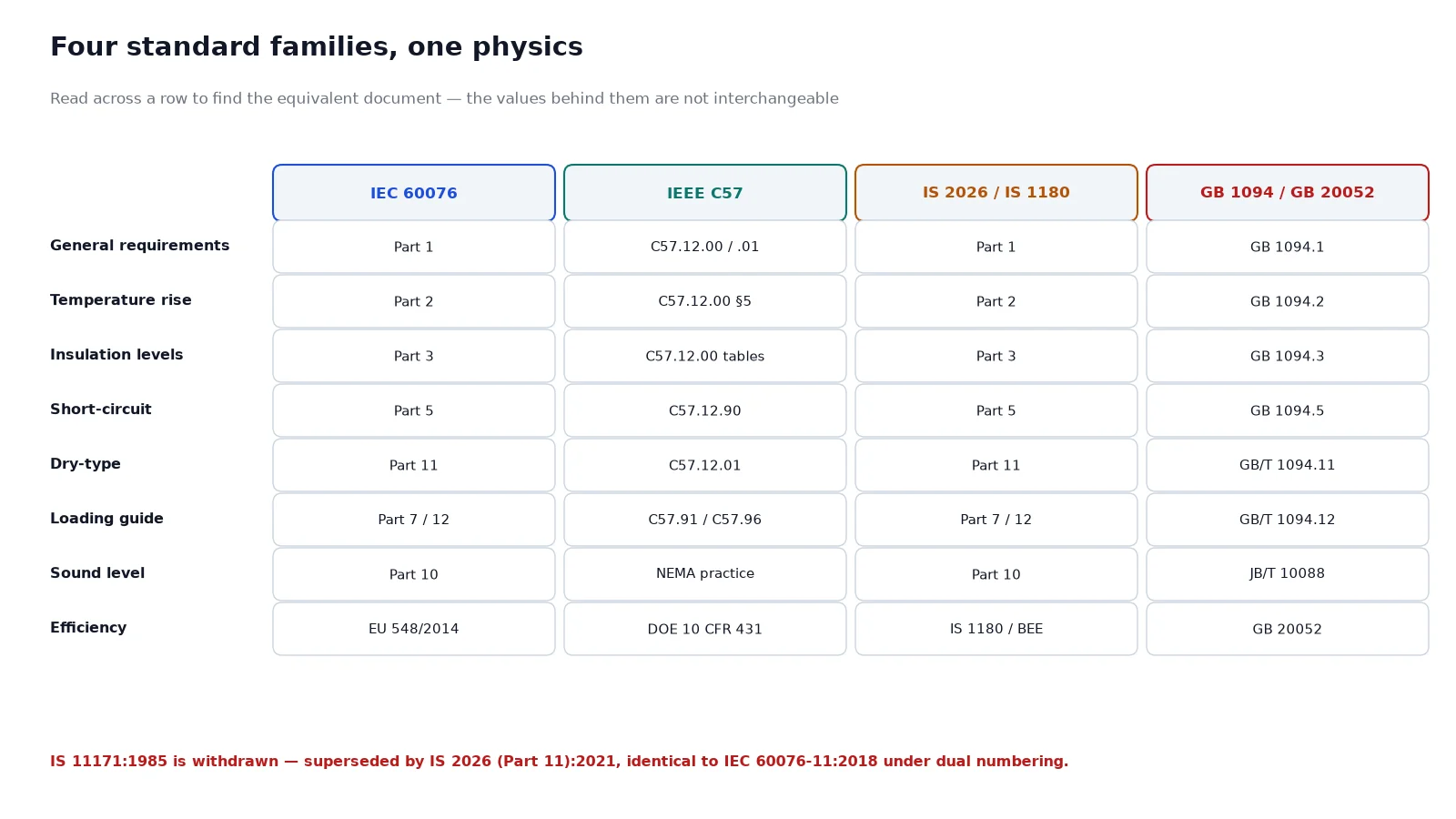
This is the single most useful fact in this article for anyone buying for an Indian project. IS 11171:1985 is superseded. The Bureau of Indian Standards adopted IEC 60076-11:2018 as IS 2026 (Part 11): 2021, and the BIS record explicitly states that with the publication of the new standard, IS 11171:1985 “is superseded and hence shall be withdrawn.”
The equivalence is not approximate. IS 2026 (Part 11):2021 is identical to IEC 60076-11:2018 under dual numbering. So an Indian dry-type specification that still says “IS 11171” is quoting a 1985 document that no longer exists, and a supplier who cheerfully agrees to it is telling you something about how carefully the bid was read.
The rest of the IS 2026 series mirrors the IEC parts — Part 1 general, Part 2 temperature rise, Part 3 insulation levels, Part 5 short-circuit, Part 7 loading guide, Part 10 sound, Part 12 dry-type loading guide, Part 18 frequency response. The genuinely Indian element is a different standard: IS 1180 for distribution transformers up to 2,500 kVA at 11 kV and 33 kV. Indian utilities specify distribution transformers to IS 1180 and power transformers to IS 2026, and the two have different loss tables. A Chinese supplier told to “build to IS 2026” for a 630 kVA pole-mounted unit will deliver something that does not match the utility’s expectation.
China: Three Different Documents Doing Three Different Jobs
GB is often quoted as a single standard. It is at least three, and confusing them is the most frequent error in Chinese-origin documentation.
| Document |
Job |
Notes |
| GB 1094.1 / .2 / .3 / .5 |
General, temperature rise, insulation levels, short-circuit |
Structurally aligned with IEC 60076 parts 1, 2, 3 and 5 |
| GB/T 1094.11-2022 |
Dry-type transformers |
Aligned with IEC 60076-11; the 2022 revision is the current text |
| GB/T 10228-2023 |
Technical parameters and requirements for dry-type power transformers |
Replaced the 2015 edition; changed no-load loss and no-load current values for 6 kV and 10 kV classes |
| GB/T 6451 |
Technical parameters for three-phase oil-immersed transformers |
The parameter table Chinese factories actually design against for S11/S13/S20 families |
| GB 20052 |
Mandatory energy efficiency limits and grades for three-phase distribution transformers |
The 2024 revision took effect in February 2025 and added limits for renewable-generation transformers |
The critical distinction is between GB/T and GB. A GB/T document is recommended; a GB document is mandatory. GB 20052 is the one that can stop a product being sold in China, which is why Chinese factories talk about “grade 1, grade 2, grade 3” efficiency far more fluently than their export customers do. When a Chinese quotation says “meets GB 20052 grade 2”, that is a loss declaration with legal force behind it inside China — and a convenient, verifiable efficiency anchor for an export buyer too.
Where the Four Actually Conflict
| Topic |
IEC 60076 |
IEEE C57 |
IS |
GB |
| Ambient reference |
40 °C max, 30 °C annual average |
30 °C average, 40 °C max |
Follows IEC, with 50 °C clauses for hot inland sites |
Follows IEC, 40 °C default |
| Oil-immersed winding rise |
65 K average (ONAN) |
65 K average over 30 °C ambient |
Follows IEC |
Follows IEC |
| Insulation level ladder |
Um-based: 12 / 24 / 36 / 40.5 / 52 kV |
Class-based: 15 / 25 / 34.5 / 46 kV |
Um-based, following IEC |
Um-based, following IEC |
| Dry-type PD limit |
10 pC at 1.2 Um |
Specified per contract, commonly 10–50 pC |
10 pC via IS 2026 Part 11 |
10 pC via GB/T 1094.11 |
| Efficiency |
Not in 60076; see EU 548/2014 |
DOE 10 CFR 431 |
IS 1180 loss tables and BEE star rating |
GB 20052 mandatory grades |
| Sound level statement |
Sound power, IEC 60076-10 |
Sound level at defined distance, NEMA practice |
Follows IEC |
Follows IEC plus JB/T 10088 limits |
| Who certifies |
Manufacturer’s type and routine tests |
UL listing or third-party witness |
BIS licence where notified |
CQC or third-party type test |
Sound is a good example of how an apparently trivial difference causes disputes. IEC states guaranteed sound power level in dB(A) referenced to a defined measurement surface; North American practice very often states sound pressure at a specified distance. A 62 dB(A) sound pressure at 1 m is not the same claim as 62 dB(A) sound power, and the gap between them is roughly 8–10 dB for a typical distribution transformer. If the specification does not name the quantity and the standard, the guarantee is unenforceable in either direction.
Which Standard Applies to Your Project
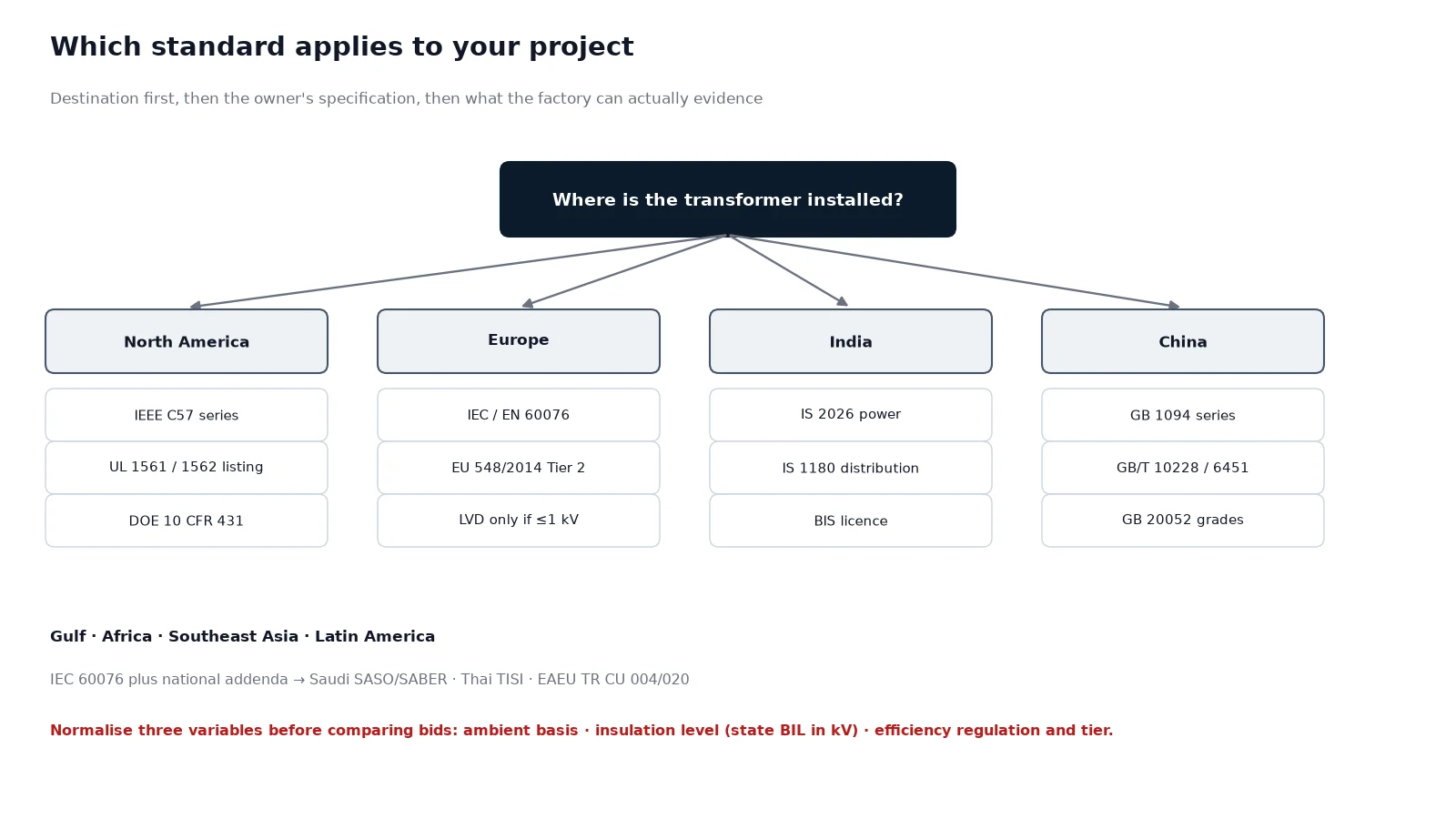
- Start with the destination. North America → IEEE C57 plus UL plus DOE. Europe → IEC/EN plus EU 548/2014. India → IS 2026 for power, IS 1180 for distribution. China → GB 1094 with GB 20052 grades. Gulf, Africa, Southeast Asia, Latin America → IEC 60076 in most cases, with national addenda.
- Then read the owner’s specification. Utilities and EPC contractors routinely layer their own requirements on top — a Saudi utility may specify IEC plus a SASO conformity route, an Indian state utility may specify IS 1180 plus a BEE star rating, and a mining house in Chile may specify IEEE because its engineering contractor is American.
- Then check what the supplier can actually evidence. A factory that builds to GB and IEC daily can usually build to IS; a factory that has never run an IEEE C57.12.90 test sequence will struggle with the test report format even when the hardware is fine.
- Finally, resolve the conflicts on paper. Where a purchase order names two frameworks, add a precedence clause: which one governs in the event of a conflict, and which tests are performed to which standard.
The power transformer guide covers the equipment-level view if you need the physical context behind these documents, and the FAT and routine test guide sets out what each framework actually tests.
Specification Language That Survives Mixed Sourcing
Five clauses remove most of the ambiguity:
- Name the part, not the family. “IEC 60076-11:2018” not “IEC 60076”. “IEEE C57.12.01” not “IEEE standards”.
- State the ambient basis explicitly — maximum ambient, annual average, and altitude — because every temperature rise figure depends on it.
- State BIL in kV, not voltage class, when the unit may be sourced across frameworks.
- State the efficiency basis by naming the regulation and the tier, and require P0 and Pk in watts on the test certificate.
- Name the test standard for each test, so that the routine test report can be checked line by line rather than accepted as a PDF.
Add one more: require the standard designation to appear on the rating plate exactly as it appears in the purchase order. Rating plate discrepancies are one of the first things a third-party inspector checks and one of the easiest things a factory gets wrong when it reuses a plate template. The quality inspection guide lists the document set that should match the plate.
Frequently Asked Questions
Is IEC 60076 stricter than IEEE C57?
Neither is stricter overall; they draw the line in different places. IEC’s 40 °C maximum ambient basis is harsher than IEEE’s 30 °C average basis for the same stated rise, which is why IEC-rated units are often thermally conservative in North American service. IEEE’s test code is more prescriptive about some measurements, and its loading guides are more detailed for cyclic duty.
Can a transformer comply with both IEC and IEEE at once?
Usually yes for the hardware, with a caveat on documentation. The insulation level has to be chosen to satisfy both ladders, temperature rise has to be declared against both ambient bases, and the test report has to be issued twice in two formats. Expect a 3–8% price premium for dual compliance, driven by documentation and testing rather than iron and copper.
Is IS 11171 still valid?
No. IS 11171:1985 was superseded by IS 2026 (Part 11):2021, which is identical to IEC 60076-11:2018 under dual numbering. Any current Indian tender that still cites IS 11171 should be clarified with the owner before quoting.
What is the difference between GB 1094 and GB/T 10228?
GB 1094 is the design and test standard, structurally parallel to IEC 60076. GB/T 10228 is the parameter table — the actual loss, impedance and current values Chinese dry-type transformers are built to. Both are needed: one defines how to verify, the other defines what the numbers should be.
Does GB 20052 apply to exported transformers?
Not legally, but it is a useful benchmark. The grades are published, verifiable and strict enough that a unit meeting GB 20052 grade 2 will generally sit comfortably inside an IEC-based efficiency specification. Ask for the grade declaration even when it is not required.
Which standard applies to a dry-type transformer in a data centre?
IEC 60076-11 for the design and classes, plus the local code for installation — NEC 450 in the United States, the national wiring rules in most other markets. The installation code is often more restrictive than the product standard, particularly on indoor fire protection and clearances, so it needs to be read before the layout is fixed.
The Decision in One Paragraph
Pick the standard by destination and owner first, then normalise the three variables that actually diverge — ambient basis, insulation level and efficiency regulation — before comparing any two quotations. Cite part numbers rather than family names, and make the rating plate match the purchase order. Treat IS 11171 as a document that no longer exists, and treat “IEC 60076” without a part suffix as an incomplete reference. Do that, and the standard stops being a source of disputes and starts being what it was written to be: a common language between a buyer and a factory on opposite sides of the world.