DGA Oil Test: Reading Gas Ratios and the Duval Triangle
Read a DGA report in four passes: gas bands, acetylene, the Duval triangle, then the trend. The most common error is stopping at step one.
Read More

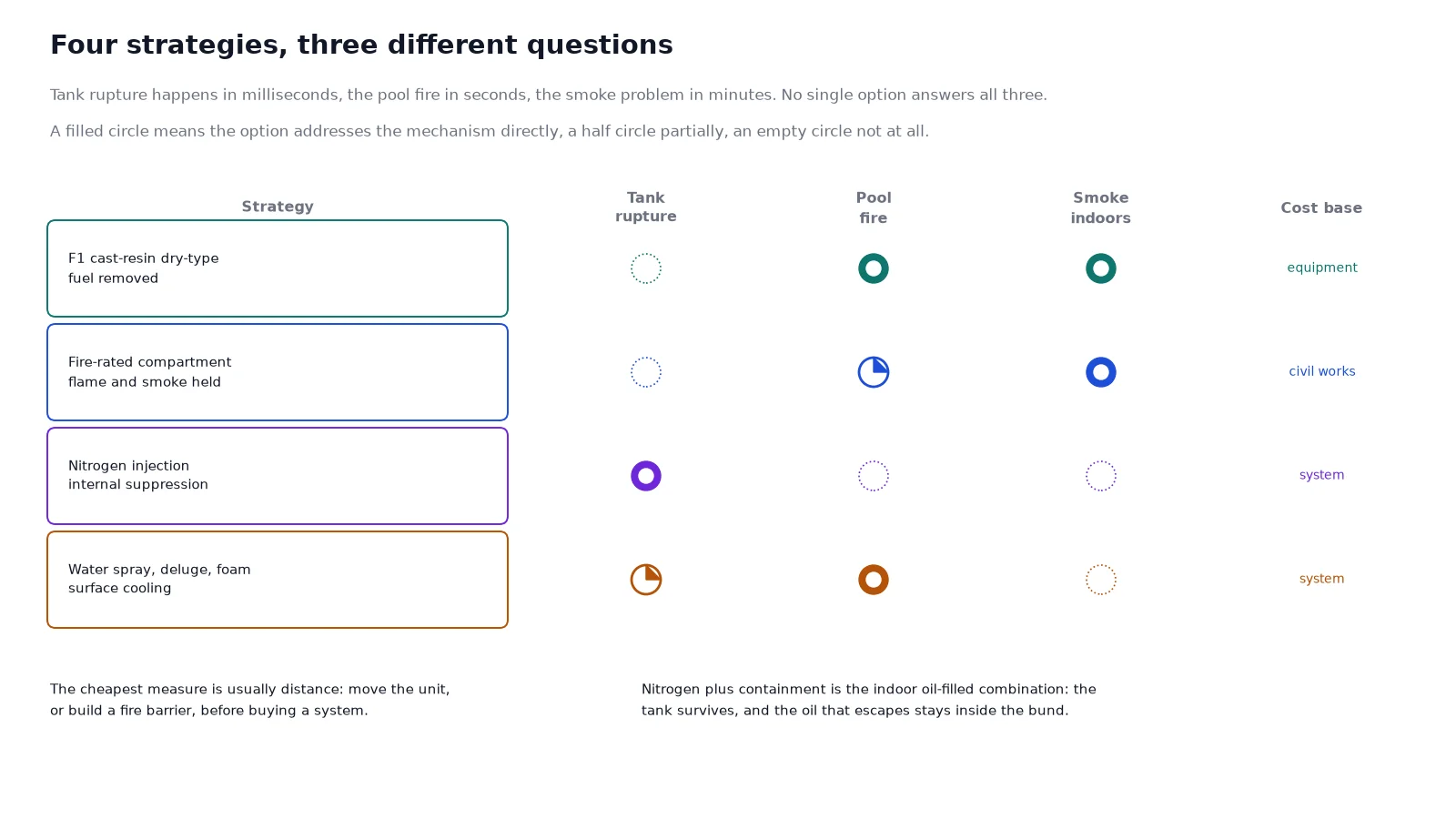
A transformer fire is rarely a fire in the way a warehouse fire is. The oil ignites because something inside the tank failed — an arcing turn, a bushing flashover, a tap changer that broke down — and the resulting pressure wave is what destroys the tank. The burning oil that follows is a consequence, not the cause. That distinction decides which of the four transformer fire protection strategies is actually appropriate, because only one of them attacks the event inside the tank.
The four strategies are: remove the fuel by specifying a dry-type power transformer, contain the unit in a fire-rated compartment, suppress the fault inside the tank with nitrogen, or cool the outside with water spray or foam. Most projects use one, well-chosen; a few use two. Choosing badly is expensive in both directions — an F1 dry-type unit where a fire wall would have done, or a sprinkler system protecting a tank that will rupture before the water arrives.
Three elements have to be understood before comparing options.
Any credible protection scheme therefore has to answer three separate questions: can the fault be prevented from rupturing the tank, can the escaping oil be kept from igniting or kept from spreading, and can the smoke be kept out of occupied space.
| Strategy | What it addresses | Where it fits | Main limitation |
|---|---|---|---|
| Dry-type unit with F1 fire class | Removes the fuel entirely | Indoor, occupied buildings, data centres, hospitals, basements | Higher purchase price; larger footprint at the same rating; no oil to buffer overload |
| Fire-rated compartment | Contains flame, smoke and heat for a defined period | Oil-filled units indoors, or where the oil volume mandates a vault | Consumes floor area; adds ventilation, dampers and fire doors; does not stop the tank rupturing |
| Nitrogen injection | Suppresses the internal fault and prevents tank rupture | Oil-filled units of significant rating, especially indoor or close to other plant | Does not extinguish a pool fire from oil already released; needs a gas-tight tank and bottle maintenance |
| Water spray, deluge or foam | Cools the tank and extinguishes a spill fire | Outdoor yards, large oil volume, utility substations | Needs a reliable water supply and drainage; adds water damage risk; slow relative to the pressure event |
The cleanest solution is to not have the problem. A cast-resin transformer has no liquid to leak, spray or burn, which removes the pool fire, the containment pit, the vault requirement and most of the smoke load. What remains is the resin itself, and that is where the IEC 60076-11 fire class becomes the specification item.
The F classification is a tested property, not a marketing claim:
F1 is normally mandatory for indoor occupied buildings — hospitals, schools, high-rise basements, data centres — and is usually accepted by the authority having jurisdiction in place of a fire-rated compartment for the transformer itself. It is almost always paired on the nameplate with E2 (environmental, frequent condensation and heavy pollution) and C2 (climatic, operation down to −25 °C), which is why “E2-C2-F1” reads as a single specification phrase in tender documents.
Three limits are worth stating plainly. F1 does not mean fireproof: a cast-resin unit in a fully developed building fire will be destroyed like anything else, so it does not remove the need for compartmentation of the room. F1 units still produce smoke and heat under an internal fault. And the F class is a type-tested property of a design, so it belongs to the specific product family, and the way the resin is applied — cast resin, VPI or open wound — changes both the fire behaviour and the cooling — the comparison of SCB and SGB dry-type constructions shows how different the underlying insulation systems can be under the same generic description.
The cost comparison is not as one-sided as it first appears. A cast-resin unit costs more than an equivalent oil-immersed unit, but it eliminates the oil containment pit, the vault walls, the fire door, the drainage interceptor and part of the mechanical ventilation. On an indoor project, the installed cost difference is usually much smaller than the equipment price difference — see the commercial building transformer note for the space consequences in a typical plant room.
Where oil is retained — for cost, for rating, for overload capability or for an outdoor yard that happens to be close to a building — the second strategy is to accept the fire and bound its consequences.
In North American practice the governing requirements come from NEC Article 450. Three of them decide the room:
The vault requirement is the expensive one: walls, floor and ceiling with a fire rating, a door that closes and latches, and ventilation that does not defeat the rating. The classic failure is a vault with a fixed louvre, which turns a rated compartment into a chimney. Where ventilation must be maintained, fire dampers rated for the compartment are part of the compartment, not an accessory.
Outside North America, IEC 61936-1 and the local building code set the equivalent requirements, and they are usually expressed in terms of oil volume and distance to occupied space rather than the NEC’s equipment categories. The principle is the same: the compartment buys time, measured in hours, for the fire service to arrive and for the building to be evacuated.
Nitrogen injection is the option that addresses the actual initiating event, and it is standard practice in China, Korea and Japan for oil-immersed transformers of significant rating, particularly indoors and in substations close to other equipment. It is much less common in North America, where NFPA does not recognise it as a primary protection method.
The principle is straightforward. A fault inside the tank generates gas faster than the tank can vent. Injecting nitrogen into the tank through a dedicated pipe does three things at once: it displaces oxygen so that the decomposed gas cannot ignite, it raises the internal pressure in a controlled way that helps keep the oil from boiling, and it stirs the oil, moving hot oil away from the fault and cooling the gas bubble. The result is that the tank does not rupture and the oil stays inside it.
Typical system elements:
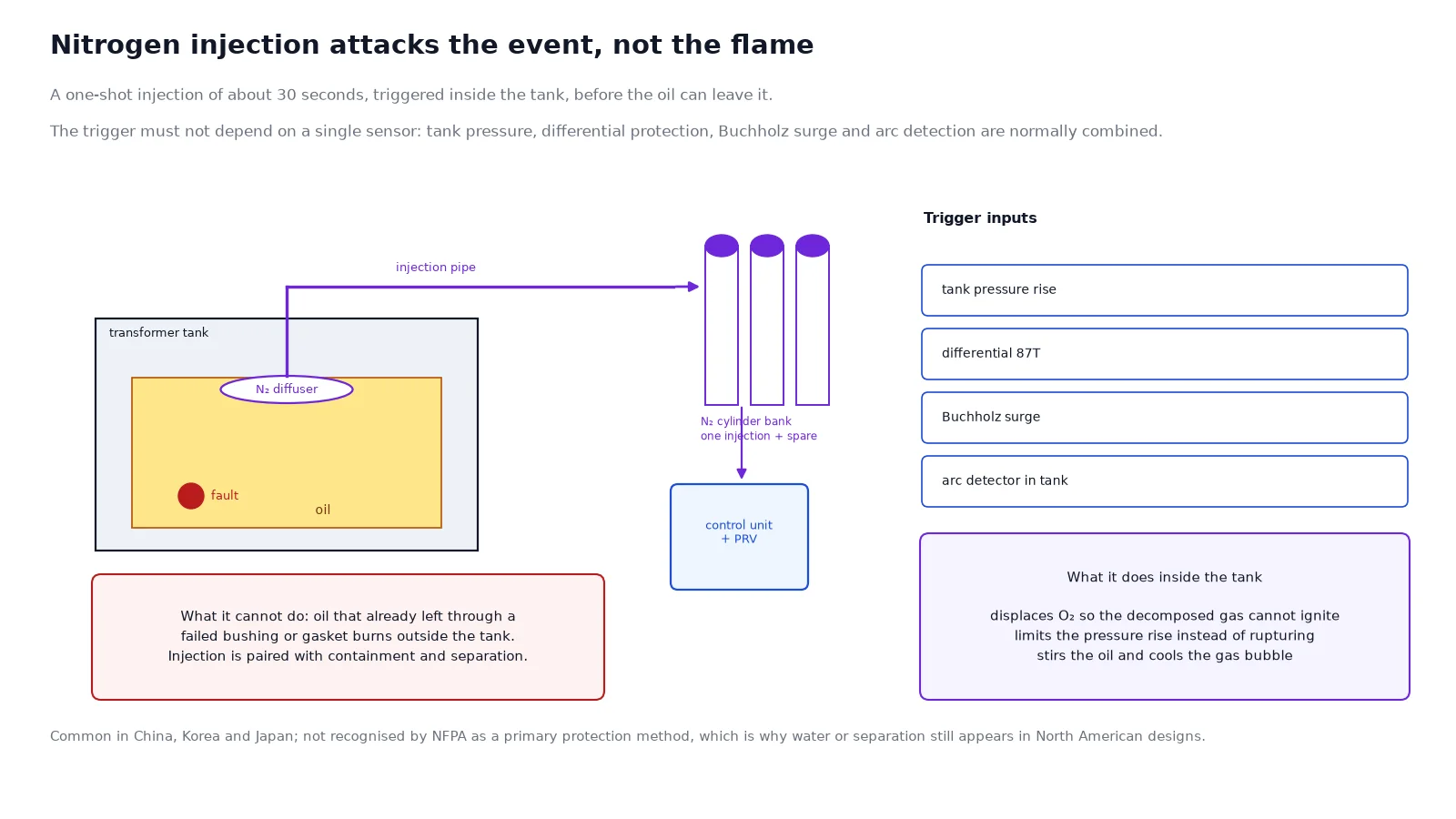
The advantage over water is speed and location: injection begins within a fraction of a second of the trigger, inside the tank, where the water cannot reach. The limitation is the pool fire — oil that has already left the tank through a failed bushing or a gasket will burn outside, and nitrogen does nothing about it. That is why nitrogen injection is often paired with oil containment and a separation distance rather than used alone.
Nitrogen stops the tank from becoming a bomb. It does not stop the oil that is already on the floor from burning.
Water-based protection is the traditional answer for outdoor oil-filled transformers and remains the reference solution for large units in utility yards. It works by removing heat from the tank surface so that the oil inside does not reach ignition temperature, and by knocking down a spill fire in the containment area.
Three distinct systems are usually confused:
| System | Mechanism | Typical application |
|---|---|---|
| Water spray (NFPA 15 style) | Directed nozzles apply a defined density over the tank and bushings | Outdoor transformers with a reliable water supply; density commonly around 0.3 gpm/ft² of exposed surface |
| Deluge | Open nozzles flood an area on detection | Where a coarse, high-volume application is acceptable and drainage exists |
| Foam | Blankets the oil surface in the containment pit | Spill fires in bunded areas; complements but does not replace tank cooling |
Two engineering realities constrain the choice. First, water protection needs a water supply that is available during the event; a system fed from the same plant water main that the fire may have interrupted is not a system. Second, the drainage has to handle the combined volume of water and displaced oil, and it has to route through an oil interceptor. A deluge system without an interceptor converts a transformer fire into a contamination incident.
Distance is the oldest and most reliable fire protection measure, and it is usually the one that gets designed last. Where a yard has space, moving the transformer away from the building or from the adjacent unit is cheaper and more robust than any active system, provided the separation is measured between the oil-filled equipment and the exposed wall or opening, not between fence lines.
Where space is not available, the same effect is achieved with a fire barrier — a wall rated for the exposure, positioned to block radiant heat. A barrier that is rated but has a gap at the top, or that has a cable tray passing through it, is a barrier in name only. The relevant separation distances and barrier ratings are set by the local code and by NFPA 850 for generating plants; the principle is that the barrier must interrupt the line of sight from the oil to anything that must not ignite.
| Installation | Usual answer | Why |
|---|---|---|
| Hospital, school, office basement | F1 dry-type, in a 1-hour room | No fuel, no smoke load in the occupied building; compartment handles a building fire from elsewhere |
| Data centre white space or adjacent hall | F1 dry-type, E2-C2 rated | Insurer and code both require oil-free equipment near IT load; no containment pit to maintain — the data centre transformer requirements set out the redundancy and loading rules that go with it |
| Industrial plant, indoor oil-filled unit | Fire-rated compartment plus nitrogen injection | Oil retained for rating and overload; nitrogen prevents tank rupture in a confined space |
| Outdoor utility yard, single unit | Separation distance, oil containment, water spray where space is tight | Distance is enough when it is available; water only where it is not |
| Rooftop or podium substation | F1 dry-type, or oil-filled with nitrogen and full containment | Water runoff is unacceptable at height; oil volume and weight drive the decision |
The economic ordering is worth knowing even without a quotation: substituting a dry-type unit is a capital cost on the equipment with a credit on the civil works; a fire-rated room is a pure civil cost that consumes rentable floor area; nitrogen injection is a system cost that scales with the number of units and needs periodic bottle and valve maintenance; water protection is the highest maintenance burden of the four, because the system sits idle for years and is expected to work on the one day it is needed.
Under NEC 450.21(B), an indoor dry-type unit above 112.5 kVA normally requires a room with a one-hour fire-resistant rating, unless the exception applies — insulation class of at least Class 155 and a totally enclosed construction apart from ventilation openings. Local codes vary, and insurers frequently add their own requirement, so the nameplate class and the enclosure type both matter.
F1 is the IEC 60076-11 fire behaviour class. It declares that the unit is self-extinguishing after the ignition source is removed, releases limited heat, and produces restricted smoke opacity and toxicity. It is a type-tested property of a specific design, not a general statement about cast-resin transformers.
On detection of an internal fault — by tank pressure rise, differential protection, Buchholz surge or arc detection — nitrogen is injected into the tank through a dedicated pipe for about 30 seconds. The nitrogen displaces oxygen, limits the pressure rise and stirs the oil to cool the gas bubble, which prevents the tank from rupturing and keeps the oil inside. It does not extinguish a pool fire from oil that has already escaped.
It is effective at cooling the tank so that the oil does not reach ignition temperature, and at controlling a spill fire when combined with foam. It is not effective against the internal pressure event, which happens in milliseconds, and it requires a fire-protected water supply plus drainage through an oil interceptor.
It is set by the local code as a function of oil volume and of whether the building wall is rated, and by NFPA 850 for generating plants. Rather than a single number, the requirement is a distance that prevents radiant ignition, or a fire barrier that interrupts the exposure — and the barrier must be complete, including at the top and at cable penetrations.
Yes, but it will normally require a vault or a fire-rated compartment with oil containment sized for the full oil volume, plus ventilation that does not compromise the rating. Many projects reach that point and then re-evaluate a dry-type unit, because the civil cost of the vault often exceeds the equipment price difference.
Four strategies, three questions. If the priority is life safety in an occupied building, remove the fuel and specify F1. If oil must be retained indoors, contain it in a rated compartment and consider nitrogen injection so the tank survives the fault. If the unit is outdoors with space, buy separation before buying a system. And in every case, verify the compartment, the tank tightness or the water supply on the as-built drawing — because the protection you have is the one that was installed, not the one that was specified.
If you are deciding between an F1 cast-resin unit and an oil-filled unit for a specific building, send us the rating, the room dimensions and the code jurisdiction; we will return both options with the fire class documentation and the footprint difference so the comparison can be made on installed cost rather than equipment price.