Most supplier pages for this class answer a technical question: which kVA, which losses, which tap range. That question is already settled by the time a buyer starts sourcing. What is not settled is whether the unit that arrives in eight weeks is the unit that was quoted, and that depends on roughly nine line items that the enquiry either states or silently leaves to the supplier. A 35kV oil immersed transformer enquiry usually arrives as a kVA figure, a destination port and a required date, and it is the other nine items that decide the outcome. This guide is about the second problem, not the first.
A 35 kV oil-immersed power transformer is not a catalogue item in the way a 500 kVA 10 kV unit almost is. Above 24 kV every order re-opens the insulation design, the bushing set and often the tank itself, which is exactly why two quotations for “the same” unit can differ by 30 % and both be legitimate.
What a 35 kV order actually specifies
The first thing to settle is what the number 35 means, because it is a system voltage, not an equipment rating. In the IEC hierarchy a 35 kV nominal system sits in the 40.5 kV equipment class, and that class fixes two numbers the transformer must survive: a rated lightning impulse withstand of 200 kV peak and a short-duration power-frequency withstand of 85 kV.
Some specifications, particularly in China and in older utility standards, instead call for the 36 kV class, which drops those figures to 170 kV and 70 kV. Both are quotable. They are not interchangeable, and the difference is not in the winding only: bushing length, phase clearance and tank height all follow the class.
| Item |
Common 35 kV build |
Where it comes from |
| Highest voltage for equipment (Um) |
40.5 kV, or 36 kV on request |
IEC 60076-3 insulation table |
| Rated lightning impulse withstand |
200 kV peak, or 170 kV for 36 kV class |
IEC 60076-3 Table 2 |
| Power-frequency withstand |
85 kV r.m.s. 1 min, or 70 kV |
IEC 60076-3 Table 2 |
| High voltage |
35 kV or 38.5 kV |
System nominal, plus headroom |
| Low voltage |
0.4 kV standard, others quotable |
Plant distribution voltage |
| Capacity range |
50 kVA to 2,500 kVA |
Frame size of the works |
| Tap range |
plus/minus 5 %, or plus/minus 2 x 2.5 %, off-circuit |
Real feeder voltage variation at site |
| Impedance |
6.5 % at the small ratings, higher as kVA climbs |
Downstream fault level |
| Vector group |
Dyn11 unless the network says otherwise |
Parallel operation with what exists |
The 38.5 kV option exists for one reason: on a 35 kV system that runs at the top of its tolerance, a unit rated at 35 kV has no adjustment left above nominal. Buyers who have been caught by this once specify 38.5 kV and pay for it once. Where the enquiry is about choosing rather than buying, the working method is set out in the 35 kV transformer selection guide; this page assumes those choices are made and deals with what happens after.
Why two quotations for the same kVA differ
A 630 kVA, 35/0.4 kV unit is the most common single order in this class, and it is the one where quotations diverge most. Six things move the number, and only the first is usually discussed.
Winding material. Copper and aluminium windings are both legitimate at 630 kVA. Aluminium needs a larger conductor section for the same loss, so the price gap is smaller than the metal price suggests, and the difference shows up as a higher temperature rise at the same load rather than as a lower rating.
Loss class. The published no-load and load loss for the standard 630 kVA build are 830 W and 7,860 W. A quotation that guarantees 10 % below those figures is buying better core steel and more conductor, and it should be priced higher. A quotation that guarantees the published figure and one that guarantees nothing should not be compared at all.
Tank and finish. A painted tank and a hot-dip galvanised tank with a higher creepage bushing set are different products at the same kVA, and the second one is what a coastal or polluted site actually needs.
Bushing creepage. Pollution level at site sets the creepage distance, and creepage sets bushing height, which sets tank clearance. This is the single most common item discovered too late, because the site data arrives after the drawing is approved.
Accessories. Pressure relief device and oil thermometer are the baseline. Buchholz relay, winding temperature indicator, drain and filter valves, jacking pads and a terminal box for the alarm contacts are all extra, and none of them can be welded on later at the same cost.
Test scope. Routine tests on every unit are standard. Witnessed factory acceptance testing, a third-party inspector, an impulse test, a temperature-rise type test on the specific rating and a short-circuit test are all separate commercial items.
OEM, ODM and private label: what each one changes
The three terms are used interchangeably in supplier catalogues and mean quite different things in a contract. Getting this wrong is how a buyer ends up owning a design that no one will support.
| Model |
Who owns the design |
What the buyer supplies |
What the buyer gets |
| Private label |
Supplier, unchanged |
Nameplate, logo, manual branding |
A standard design with a different name on it |
| OEM |
Buyer specifies, supplier builds |
Full specification or single-line diagram |
A unit built to the buyer’s drawing; drawings and test reports in the buyer’s name |
| ODM |
Supplier, adapted |
Duty, voltages, site conditions, target price |
A supplier design re-sized for the application, with the buyer’s branding |
| Full custom |
Joint |
Non-standard voltage class, special vector group, unusual tap range |
A one-off winding and often a one-off tank |
Only the second and fourth rows involve engineering. On a private-label order nothing about the electrical design changes, which is fine for a distributor carrying a standing specification and wrong for a project where the utility’s protection study assumed a specific impedance. The division of work on a genuine custom build is set out in OEM and ODM power transformer engineering, including the seventeen fields a specification sheet has to contain before a winding can be released.
One commercial point that is easy to miss: on OEM work the drawing package is part of the deliverable. If the outline drawing, the guaranteed loss values and the test report are issued under the supplier’s name only, the buyer has bought a product, not a design, and cannot move the tooling later.
The nine line items to lock before the order
These are the fields that decide whether the delivered unit matches the one in the quotation. Six of them are commonly absent from an enquiry, and when they are absent the supplier fills them with a default that is legal, cheap and rarely what the site needed.
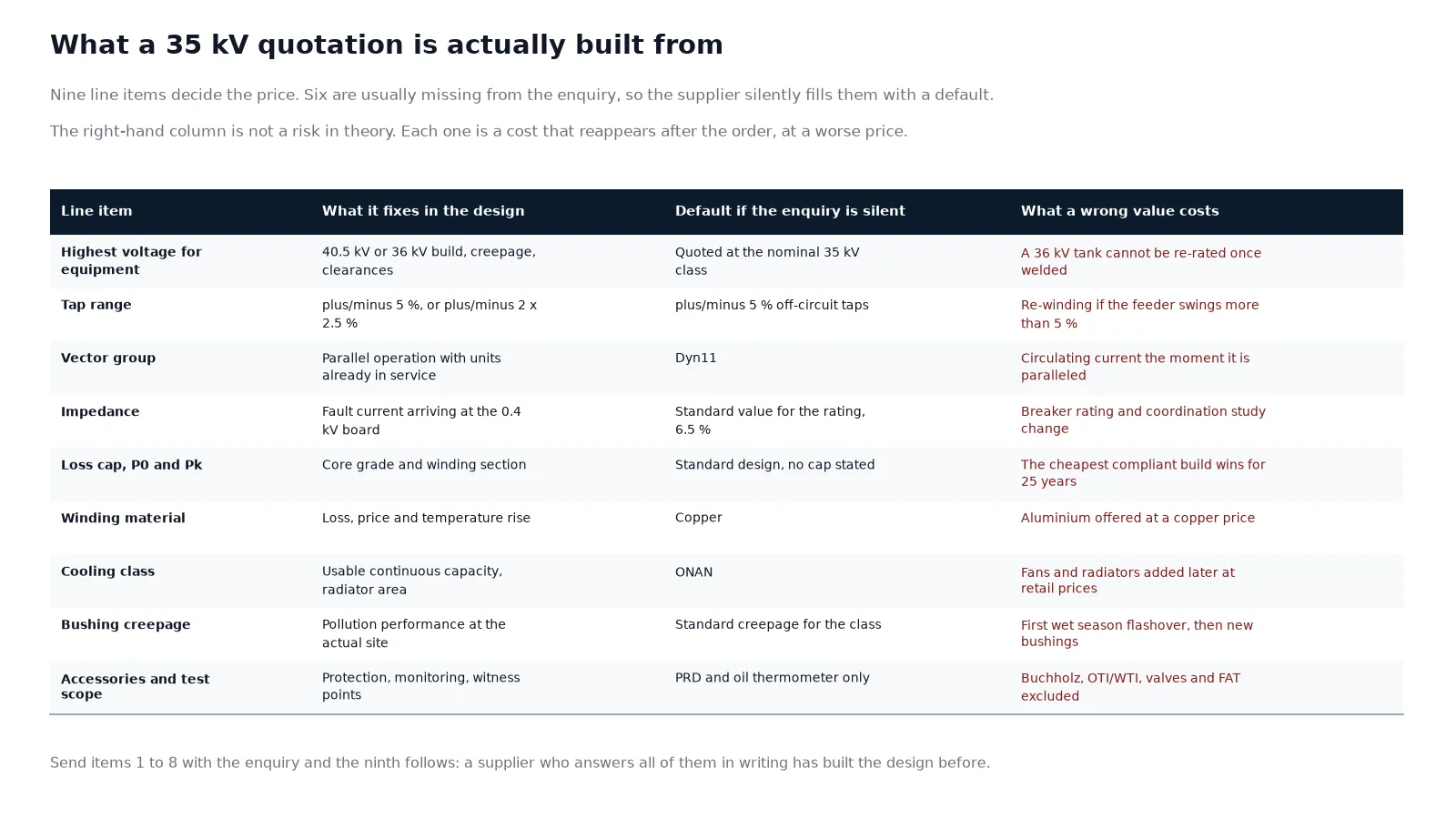
Two of the nine deserve emphasis because they are the ones that cannot be corrected later.
Vector group. Dyn11 is the default and it is right for most new plants. It is wrong for any site that has to parallel the new unit with an existing one of a different group, and the error does not show up until energisation, when the circulating current appears. Take the nameplate of the unit already in service and send a photograph of it with the enquiry.
Impedance. The standard value for a 630 kVA unit at this class is around 6.5 %, and it is quoted as a standard because most projects accept it. But impedance is what limits the fault current arriving at the 0.4 kV board, so a switchgear rating chosen for 25 kA assumes a particular impedance. Change the impedance and the downstream breaker rating may no longer coordinate.
Auditing the factory, not the brochure
A 35 kV transformer is built in a works that either has a vacuum drying plant and an impulse generator or does not. Those two items decide more about the product than any certificate on the website, and both are visible on a site visit.
What to look at, in order:
- Core cutting and stacking: a step-lap line with a burr-free cut is the difference between a quiet unit and a noisy one.
- Winding: copper or aluminium, foil or round wire, and whether the winding is dried before tanking.
- Vacuum plant: the unit has to be dried and filled under vacuum; a works without one is buying dried-out tanks from elsewhere.
- Test bay: an impulse generator rated above 200 kV, a dielectric test set and a loss-measuring bridge. Ask to see a routine test performed, not the bay in a photograph.
- Oil handling: sealed drums, a filtration and degassing unit, and a breakdown voltage test set used on every batch, to IEC 60156.
Certificates are a filter, not a proof. ISO 9001 confirms that a procedure exists; it does not confirm that the procedure produces a 200 kV impulse withstand. The audit question that separates real works from assemblers is simple: on which rating did you last perform a temperature-rise type test, and can I see the report? A factory that builds the design answers immediately, because the report is a commercial asset.
Reading the test report before you accept it
Every unit ships with routine test results and they are the only evidence the buyer receives. Read them against the purchase order, not against the nameplate.
| Test |
Category |
What the buyer should check |
| Winding resistance |
Routine, every unit |
Phase balance; a low phase usually means a joint problem |
| Ratio and polarity |
Routine, every unit |
Measured ratio at every tap against the calculated value |
| No-load loss and current |
Routine, every unit |
Watts against the guaranteed figure, not a percentage |
| Load loss and impedance |
Routine, every unit |
Watts at 75 °C and the impedance in per cent |
| Applied and induced voltage |
Routine, every unit |
85 kV applied, and the induced test time and frequency |
| Oil dielectric strength |
Routine, every unit |
Breakdown voltage before filling, with the test standard named |
| Temperature rise |
Type test, one design |
Whether the report is for this rating or borrowed from a sibling |
| Lightning impulse |
Type test for this class |
200 kV peak waveform, and which terminals were tested |
| Short-circuit withstand |
Type or by calculation |
Whether it was tested or demonstrated by calculation |
| Sound level |
Type test |
Measurement distance and the standard used |
The trap is the type-test report. Temperature rise and impulse results are design-specific: a report for a 1,000 kVA unit does not cover a 630 kVA order, and a report for a 36 kV class design does not cover a 40.5 kV one. If the supplier offers a “similar” report, ask which rating, which class and which year, and treat a vague answer as an absence. What a witnessed factory acceptance test should add to this list is covered separately, including the hold points worth travelling for.
Bulk orders: what quantity actually changes
The minimum order on a 35 kV unit is one. Quantity does not unlock a different product; it unlocks a different commercial structure, and it is worth knowing which parts of the price are actually volume-sensitive.
- Engineering is charged once. Drawings, winding design and type-test evidence are amortised across the batch, so the second identical unit is cheaper than the first by more than its material content.
- Material buying improves in steps. Core steel and conductor are bought against a batch; the price break appears at tonne quantities, not at unit quantities.
- Testing does not scale down. Every unit still gets a full routine test, and a witnessed FAT on ten units is ten FATs unless sampling is agreed in writing.
- Packing and freight do scale. Ten units in one booking is a different freight conversation from ten separate shipments, and the incoterm decides who has that conversation.
Where a repeat programme is likely, the useful move is a frozen specification plus a standing drawing number, not a larger first order. That is the structure that makes the tenth unit identical to the first, and it is the reason distributors order this way. Payment terms follow the same logic: deposit with balance against the bill of lading copy for a single unit, letter of credit for a project quantity. The commercial framework is set out in more detail under MOQ and lead time.
Lead time: six gates, not one number
Suppliers quote lead time as a single figure and buyers plan against it as if it were a delivery date. It is better read as a schedule with six gates, four of which need the buyer to act.
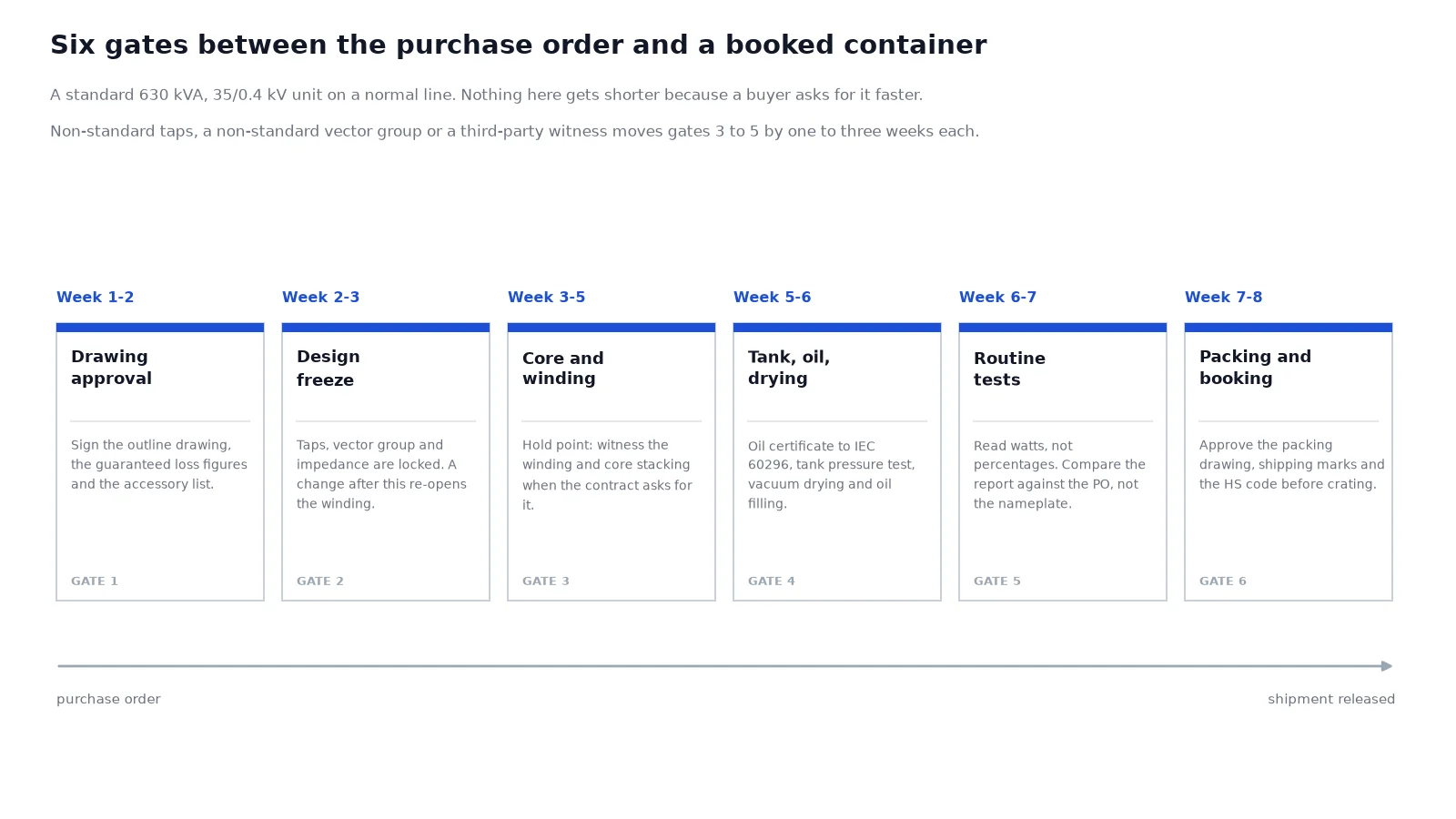
Two conclusions follow. First, the clock starts at drawing approval, not at the purchase order, so an approval that takes two weeks is two weeks added to delivery with no supplier to blame. Second, the gates where a change is still cheap are gates 1 and 2. A vector group change requested at gate 4 is not a change; it is a new winding and a new delivery date.
Non-standard tapping, a non-standard vector group or a third-party inspector on site each move gates 3 to 5. A 35 kV unit with a special tap range is a one-off winding, and one-off windings queue behind standard ones.
Packing, HS code and the documents that travel with the unit
Sea freight is where a well-built transformer gets damaged, and the packing decision is made before the unit is crated. Three practical points:
Height decides the container. A 630 kVA unit in this class measures about 2,085 x 1,200 x 2,515 mm and weighs around 3,810 kg. A 40 ft high cube has an internal height near 2.69 m and a door opening near 2.58 m, so a unit at 2,515 mm plus a skid is at the limit. Anything taller ships on a flat rack or as break bulk, and that changes both the freight cost and the insurance.
Seaworthy means sealed, not just boxed. The unit travels with dry air or nitrogen in the tank for larger builds, oil level drawn for transport on smaller ones, and all bushings either removed and crated separately or protected against the vibration of a six-week voyage.
The HS code follows capacity, not design. Liquid dielectric transformers fall in 8504.21 up to 650 kVA, 8504.22 from 650 kVA to 10 MVA, and 8504.23 above that. A 630 kVA and an 800 kVA unit sit in different subheadings, which is worth checking before the invoice is issued rather than after. The full packing and documentation sequence is in HS code and packing for transformer shipments.
With the unit goes a document pack: routine test report, oil test certificate, outline and nameplate drawing, packing list, and the declaration of conformity to the standard named in the contract. Where the destination requires it, an export certification path is agreed before production, because some marks cannot be applied to a finished unit without re-testing.
What the actual build looks like
For reference against a quotation, the published figures for the standard range at this class run from 50 kVA at 160 W no-load and 1,200 W load loss up to 2,500 kVA at 2,360 W and 23,200 W. The mid-range 630 kVA figure of 830 W and 7,860 W is the one most often quoted, and the one most often quietly substituted. A copper winding and an aluminium winding are both offered at several ratings, which is why the loss column in a datasheet sometimes shows two load-loss values for one capacity.
The full capacity table, with dimensions and weights, is on the 35 kV oil-immersed distribution transformer range page. Where the project sits at 10, 11, 20 or 33 kV instead, the oil-immersed distribution transformer range covers those classes on a different frame, and the sourcing logic above applies unchanged.
Conclusion
Sourcing a 35 kV oil-immersed transformer is a specification discipline before it is a price negotiation. The nine line items decide what gets built, the test report proves what was built, and the six gates decide when. A buyer who settles those three things before asking for a discount gets a unit that matches the drawing; a buyer who negotiates first spends the difference later on bushings, re-winding or a flat rack.
If you have a duty and a destination, send the system voltage, the required insulation class, capacity, voltages and tap range, the site pollution level and the accessories list. The reply is a datasheet with guaranteed values, an outline drawing and a test list rather than a price range, which is the only version of a quotation worth comparing.
Frequently Asked Questions
Is 35 kV a standard IEC voltage class?
Not as an equipment rating. 35 kV is a nominal system voltage, and equipment for it is normally built in the 40.5 kV class, with 200 kV lightning impulse and 85 kV power-frequency withstand. A 36 kV class build at 170 kV and 70 kV is also quoted when the specification asks for it, and the two are not interchangeable.
What is the minimum order quantity for a 35 kV transformer?
One unit for standard capacities. There is no volume threshold to reach before an order is accepted, but the engineering is charged once, so the second identical unit costs less than the first. Non-standard voltage classes, special vector groups and project packages carry a higher minimum because the winding is a one-off.
How long does a 35 kV oil-immersed transformer take to build?
On a standard 630 kVA build, roughly eight weeks from drawing approval to a booked container: two weeks of drawing and design freeze, two to three weeks of core and winding, one week of tanking, drying and oil filling, one week of testing and one week of packing. Non-standard tapping or a third-party witness adds one to three weeks at each affected gate.
Can an aluminium winding be used at 35 kV?
Yes, and it is a legitimate choice where the loss cap allows it and the loading is not continuous at nameplate. It needs a larger conductor section for the same loss, so it runs hotter at equal load. Ask for the winding material in writing on the quotation, because the two options are quoted at the same kVA and the difference is invisible on the nameplate.
What should be in the enquiry to get a comparable quotation?
System nominal voltage and the required insulation class, capacity in kVA, primary and secondary voltages, tap range, vector group, impedance if the protection study fixes it, loss values the specification caps, winding material, indoor or outdoor installation with pollution level and altitude, accessories, quantity, destination port and required delivery date.
Does a type-test report cover my order?
Only if it is for the same rating, the same insulation class and the same design. Temperature-rise and impulse reports are design-specific and cannot be transferred between ratings or voltage classes. Where a report for a “similar” unit is offered, ask for the rating, the class and the test date; if the answer is vague, treat it as no report.