An amorphous core dry type transformer trades a small amount of load-loss performance and a noticeable amount of noise for a large reduction in no-load loss. On a duty cycle where the transformer is energised around the clock but only partly loaded, that trade is worth real money, and the payback can be short. On a duty cycle where the unit runs near nameplate for two shifts and sits idle for the rest, the same transformer can be a poor buy.
Within the wider dry type power transformer range the type is usually ordered under the code SCBH: S for three-phase, C for cast-resin, B for foil winding, H for amorphous alloy core. It is not a different class of transformer. It is the same dry-type machine with a different core material, and almost every difference in cost, loss, noise and mechanical behaviour follows from that one substitution.
This guide gives you the physics in one paragraph, the loss numbers in a table, a payback model you can run with your own electricity price, and the four situations where amorphous is the wrong answer.
Quick answer
Amorphous metal cuts no-load loss by roughly 65 to 75 percent against grain-oriented electrical steel at the same rating, because the ribbon is about ten times thinner and roughly two and a half times more resistive. Load loss does not improve and typically rises slightly. The extra first cost is normally recovered in two to six years when the transformer is energised continuously and electricity costs more than about 0.08 USD per kWh. Above 2500 kVA the loss advantage is still real but the mechanical and noise penalties become harder to manage.
Why amorphous ribbon loses so much less at no load
No-load loss in a transformer core has two parts: hysteresis loss, which is the energy needed to magnetise and demagnetise the steel each cycle, and eddy-current loss, which is the energy circulating in the core laminations themselves. Eddy-current loss scales with the square of lamination thickness. That is the whole story.
| Property |
Grain-oriented electrical steel (CRGO) |
Amorphous alloy ribbon |
Consequence |
| Thickness |
0.23 to 0.30 mm |
about 0.025 mm |
Eddy loss falls by roughly two orders of magnitude for the same flux density |
| Electrical resistivity |
about 50 micro-ohm-cm |
about 130 micro-ohm-cm |
Further suppresses circulating current |
| Saturation induction |
1.9 to 2.0 T |
about 1.56 T |
More core cross-section needed for the same flux, so the core is physically larger |
| Stacking / space factor |
0.95 to 0.97 |
0.82 to 0.86 |
Extra volume again, and a larger window for the same rating |
| Magnetostriction |
Moderate |
High |
Audible noise rises, typically 5 to 8 dB(A) at the same rating |
| Mechanical behaviour |
Ductile, tolerant of handling |
Hard and brittle, stress-sensitive |
Core support, clamping and short-circuit strength need more design attention |
The net effect is that a designer works with a core that is bigger in volume, weaker mechanically, noisier, and dramatically better on no-load loss. Everything else in an SCBH specification is a consequence of managing those four facts.
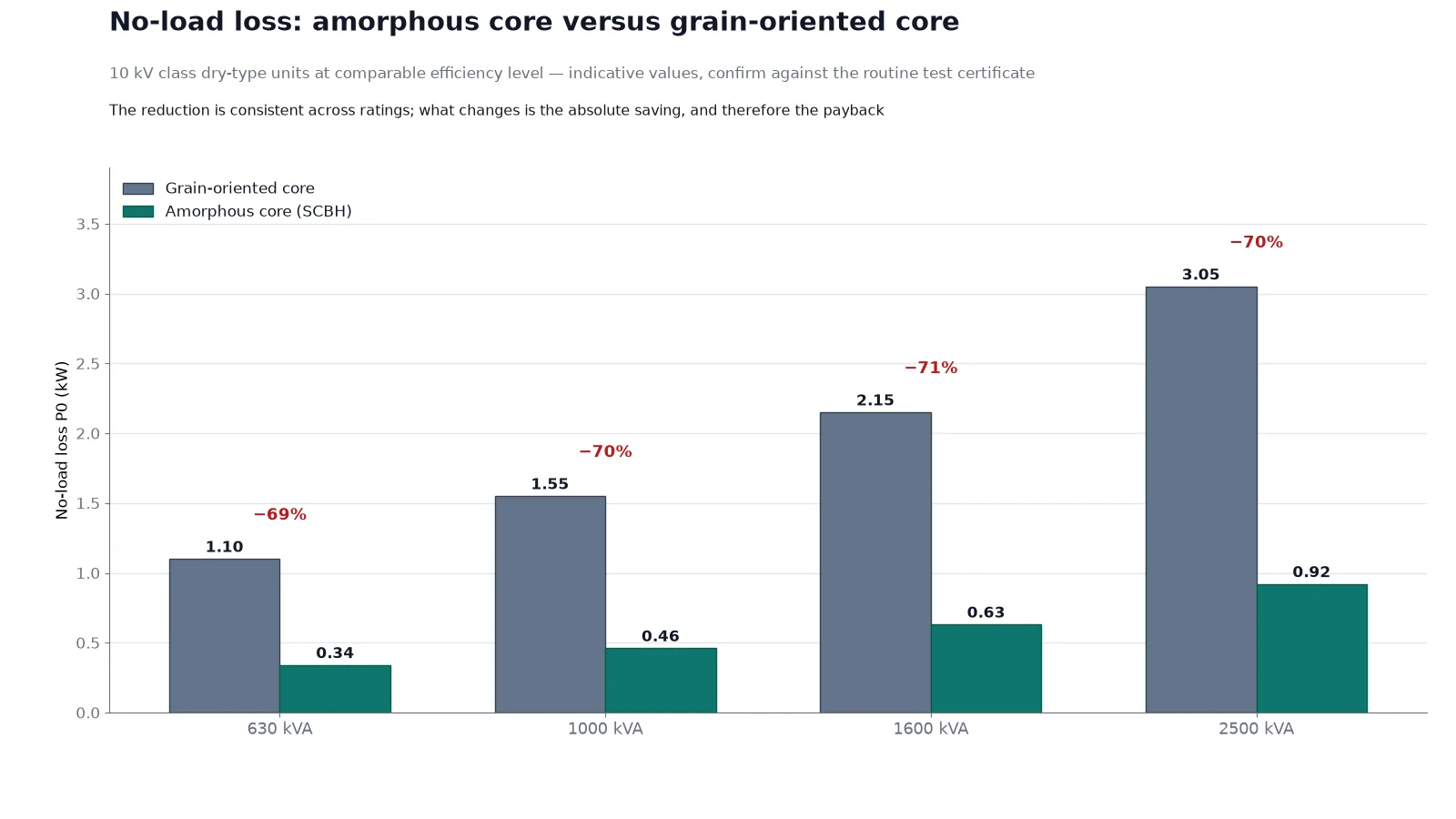
Loss comparison across ratings
The table below is an indicative comparison at 10 kV class, 50 Hz, for dry-type units built to a modern efficiency level. Absolute values vary with the efficiency level and the manufacturer’s design, so treat these as the shape of the comparison and confirm the numbers against the factory routine test certificate for the actual unit.
| Rating (kVA) |
CRGO no-load P0 (kW) |
Amorphous no-load P0 (kW) |
P0 reduction |
Saved energy at full-time energisation (kWh/yr) |
| 630 |
1.10 |
0.34 |
69% |
6,660 |
| 1000 |
1.55 |
0.46 |
70% |
9,550 |
| 1600 |
2.15 |
0.63 |
71% |
13,320 |
| 2500 |
3.05 |
0.92 |
70% |
18,660 |
Two things about this table matter more than the numbers. First, no-load loss is present every hour the transformer is energised, including nights, weekends and shutdown periods, so the annual energy figure assumes 8,760 hours. Second, load loss is unaffected by the core material, which means the amorphous advantage is largest exactly where a plant is least loaded and least where a plant is fully loaded.
Running the payback calculation yourself
Five inputs decide the answer, and three of them are almost always guessed badly.
- No-load loss difference in kW. From the two test certificates, not from a brochure.
- Energised hours per year. Use 8,760 unless the plant genuinely de-energises the transformer weekly. Most plants do not.
- Electricity price. Use the marginal cost the plant actually pays, including demand charges if the site bills them against consumption.
- First-cost premium. The delivered price difference between the amorphous and CRGO unit at the same efficiency level and the same enclosure.
- Discount rate and evaluation period. Twenty years is the usual horizon for a dry-type unit in a building or a substation.
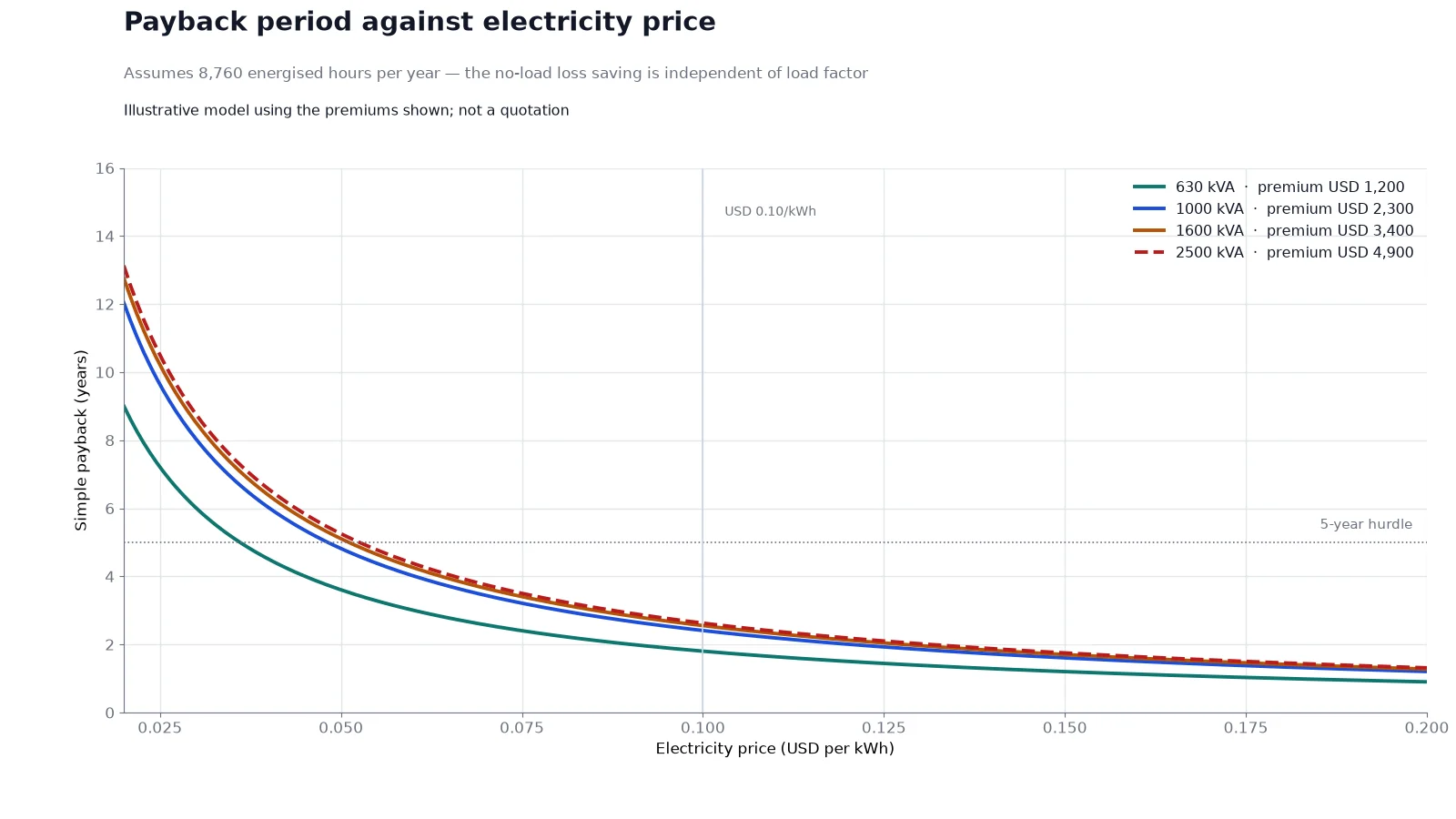
The simple undiscounted payback is the premium divided by the annual saving. For a 1,000 kVA unit the loss difference in the table above is about 1.09 kW, which at 0.10 USD per kWh saves roughly 955 USD a year. A premium of 2,000 to 2,600 USD therefore pays back in about two to three years. At 0.05 USD per kWh the same unit takes five to six years, and at 0.03 USD per kWh it takes close to ten.
What the payback model ignores
Three effects usually make the real outcome better than the simple model. In markets with an efficiency regulation that sets a minimum level, the amorphous unit may be the cheapest way to reach it, which removes part of the premium. Where a utility or a green building scheme capitalises losses, the evaluated cost gap widens in favour of the lower P0. And in a plant with a high proportion of standby hours, the energised-hours assumption of 8,760 is realistic rather than optimistic.
The model also ignores one effect that can go the other way: an amorphous core transformer is not a drop-in mechanical equivalent. If the noise limit for the room is tight, the acoustic treatment needed to bring an SCBH unit down to the same sound level can absorb part of the saving.
Where amorphous wins, and where it does not
| Situation |
Verdict |
Reason |
| Data centre, hospital, 24/7 base load at 40 to 60 percent |
Strong yes |
Maximum energised hours, minimum load-dependent loss, loss capitalisation usually in the specification |
| Renewable or storage plant with variable output |
Yes |
Long low-load periods, and the no-load saving is independent of generation |
| Industrial plant on two shifts, transformer switched off at weekends |
Marginal |
The energised-hours basis collapses to 3,000 or 4,000 and the payback doubles |
| Very tight acoustic limit near occupied space |
Caution |
The 5 to 8 dB(A) penalty may require enclosures or attenuation that erode the saving |
| High fault level with repeated through-faults |
Caution |
Amorphous cores are less tolerant of mechanical stress; short-circuit withstand must be designed and tested, not assumed |
| Above roughly 2500 kVA |
Design review |
Core volume and noise grow; the economics may still work but a bespoke design is required |
What to specify so the comparison is fair
Most amorphous-versus-CRGO comparisons fail because the two quotes are not for the same machine. Pin these down before you compare price:
- Same efficiency level. Compare SCBH against the CRGO unit at the target efficiency level, not against an older lower level. Otherwise you are pricing a regulation change, not a core material.
- Same enclosure and protection. IP class, enclosure material and cable entry affect the price more than the core does.
- Same temperature rise and insulation class. A unit quoted at a higher temperature rise is cheaper for reasons that have nothing to do with the core.
- Guaranteed loss values with a tolerance. State the guaranteed P0 and Pk and the measurement standard, and state the penalty for exceeding them.
- Sound pressure level at a stated distance. Ask for dB(A) at one metre, measured per the standard the site uses, not a “low noise” claim.
- Short-circuit withstand evidence. Ask whether the design has a type-tested short-circuit certificate and at what rating, given the mechanical sensitivity of the core.
The efficiency framework itself is worth understanding before you write the spec. Our guide to transformer efficiency classes and losses explains how P0 and Pk combine into the declared efficiency and why no-load loss dominates the annual energy bill of a lightly loaded unit.
Noise: the penalty you have to design around
Amorphous alloy has high magnetostriction, meaning the core changes dimension slightly as it magnetises, and at twice the supply frequency that produces audible sound. The result is typically 5 to 8 dB(A) more than an equivalent CRGO core at the same flux density. Because decibels are logarithmic, 7 dB(A) is roughly a doubling of perceived loudness, not a small increment.
Three measures reduce the gap without changing the core material:
- Reduce the working flux density. This costs core volume and partly erodes the loss advantage, so it is a trade the designer has to make explicitly.
- Encapsulate or enclose the core-coil assembly, which adds cost and can affect temperature rise.
- Site the unit away from occupied space and treat the room rather than the transformer, which is often the cheapest option in a new building.
If the acoustic limit is the binding constraint, decide early. Retrofitting sound treatment after the unit is installed in a plant room is expensive and frequently ineffective.
How SCBH differs on the production line
An amorphous core is not stacked from laminations in the way a CRGO core is. The ribbon is wound into a closed core and then opened slightly to receive the coils, or assembled from wound core sections, which changes the tooling, the annealing steps and the handling discipline on the shop floor. Stress introduced during cutting or clamping degrades the very loss performance you are paying for, so the process control around the core is tighter than for a conventional unit.
That difference is worth exploring during a factory audit, because it is one of the few places where you can see whether a supplier really builds amorphous units or simply resells them. Our walk-through of the dry type transformer manufacturing process covers the steps where the core is handled and where the loss guarantee is either protected or lost.
Cost and commercial context
The delivered price of an SCBH unit sits above an equivalent CRGO unit, and the gap widens at larger ratings because the core volume penalty grows. The gap also depends heavily on alloy supply: amorphous ribbon is produced by a small number of suppliers worldwide, so price and lead time are less elastic than for CRGO. That supply structure is worth knowing when you plan a project schedule around a specific delivery date.
For current price bands by rating and enclosure, the dry type transformer price page sets out what drives the number, and the epoxy resin 10 kV dry type transformer range shows the standard build that an amorphous option is derived from.
Comparing within the dry-type family
Amorphous is one axis of choice; the efficiency level is another. A common mistake is to compare an amorphous unit at a low efficiency level against a CRGO unit at a high level and conclude that amorphous is not worth it. The comparison that matters is at constant efficiency level, because that is the only comparison where the regulation does not decide the answer for you.
Our side-by-side of SCB10, SCB13 and SCB18 dry type transformers shows how much of the loss improvement comes from the efficiency level alone, and the dry type transformer technical data sheet template lists the fields you need in order to make the two quotes genuinely comparable.
FAQ
Is an amorphous core transformer the same as a low-loss transformer?
No. Low loss is a performance outcome and amorphous is one way to reach it. A high-efficiency-level CRGO unit can meet the same declared no-load loss as a modest amorphous unit, particularly at small ratings. What amorphous does is make the low-loss target easier and cheaper to hit at a given efficiency level, which is why it is usually specified where the regulation is tight or where losses are capitalised.
Does amorphous reduce load loss as well?
No, and it may slightly increase it. Load loss is dominated by the windings, not the core, so the core substitution does not help there. Some amorphous designs carry a small load-loss penalty because the larger core window requires longer mean turn length. That is why the payback calculation should use the actual P0 difference and confirm the Pk values are comparable.
How much noisier is an SCBH transformer?
Typically 5 to 8 dB(A) above an equivalent CRGO unit at the same rating and flux density. Since a 10 dB increase is perceived as roughly twice as loud, this is a material difference and not a rounding error. Check the site’s acoustic requirement before choosing the type, and ask for a measured sound level rather than a design estimate.
Can amorphous core transformers be used outdoors?
Yes, with an appropriate enclosure. The core itself is not the limiting factor for outdoor use; the enclosure protection, the anti-corrosion coating and the ventilation design are. Coastal and humid sites need the enclosure and coating specification agreed before the unit is priced, because those items change the cost more than the core does.
What is the typical payback period?
Two to six years in most continuous-duty applications, driven mainly by electricity price and energised hours. Below roughly 0.05 USD per kWh, or where the transformer is de-energised for long periods, the payback can exceed the practical evaluation horizon. Run the calculation with your own numbers rather than accepting a vendor’s typical figure.
Does the payback depend on load factor?
Almost not at all, and that is the point. No-load loss is present at any load, so the annual saving from a lower P0 is essentially fixed. A lightly loaded transformer therefore saves the same absolute energy as a heavily loaded one of the same rating, which makes the relative benefit much larger on lightly loaded units.
If you have the rating, the annual energised hours and your electricity price, send them with the target efficiency level and we will run the comparison against both core options and confirm which build pays back inside your evaluation period.