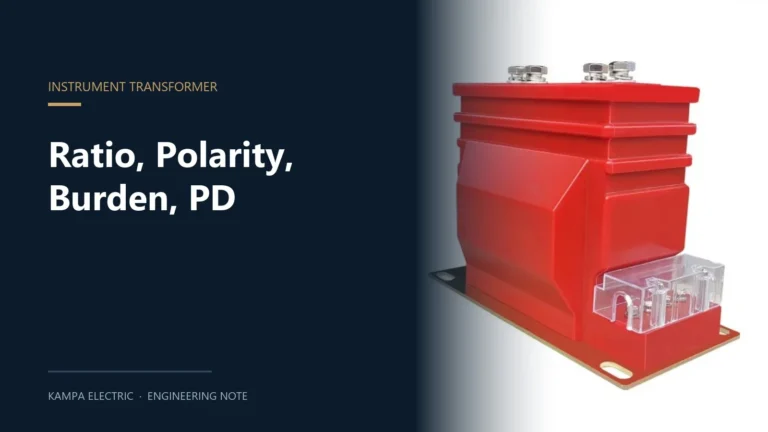
JDZ10 vs JDZX18: the short answer
If you are choosing between the JDZ10 and the JDZX18 for a 6 kV or 10 kV panel, the decision is not about accuracy. Both are single-phase cast-resin units that can be built to the same ratio and the same class. The decision is about two things the model code barely advertises: whether the primary needs its own fuse, and whether the circuit needs a residual voltage winding for earth-fault protection. For a general indoor metering bay on any earthing system, the JDZ10 fully insulated frame is the simpler and cheaper answer. For a tap that must be fused on a grounded-neutral system, the JDZX18 carries that fuse inside its own casting and removes a separate holder and its clearances from the cubicle.
Everything below is the reasoning behind that one paragraph, including the part that catches most buyers: neither code tells you whether you are getting the residual winding you actually asked for. If you are still mapping the whole family, the voltage transformer range lists the frames side by side, and this article explains where each one belongs.
What a residual voltage PT actually is
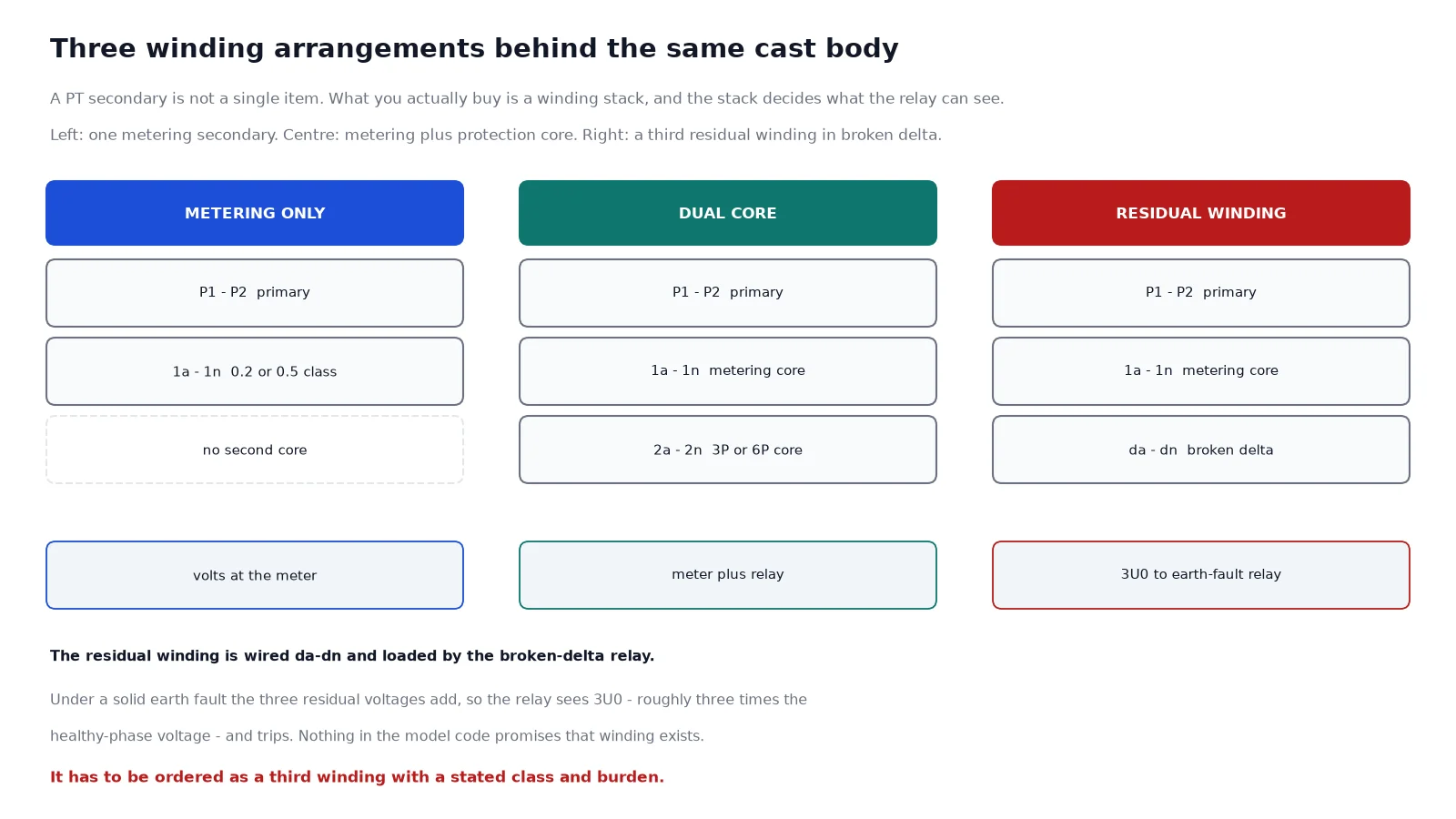
A residual voltage transformer is not a different species of device. It is an ordinary single-phase PT with one extra winding on the same core, brought out as a pair of terminals usually marked da and dn. Three of those windings, one per phase, are connected in broken delta. In normal operation the three residual voltages cancel and the relay sees almost nothing. When one phase goes to earth, the other two rise and no longer cancel, so the broken-delta loop produces a voltage proportional to three times the zero-sequence voltage. That is the 3U0 signal an earth-fault relay trips on.
The important consequence is that the residual winding only works when the PT is connected phase-to-earth and the three units are a matched set from the same production run. Three JDZ10 units bought as spares at different times will have three slightly different ratios, and the mismatch shows up as a standing 3U0 that either desensitises the relay or makes it chatter.
On a solidly earthed system the residual winding is a convenience. On an ungrounded or resonant-earthed system it is the primary means of detecting an earth fault, because the phase-to-phase voltages barely move and a simple undervoltage or overvoltage element will not see the fault at all. That is why the earthing method belongs in the inquiry and not in a footnote.
JDZ10: the fully insulated general purpose frame
The JDZ10 is a single-phase, fully enclosed, fully insulated epoxy-resin unit built for indoor 3 kV, 6 kV and 10 kV systems. Both primary ends are cast inside the body, which means the frame does not depend on one end sitting at earth potential. It can be installed in more than one orientation, which matters when you are replacing a unit inside an existing cubicle and the busbar comes in from an awkward direction.
The published envelope is indoor installation, 50 Hz or 60 Hz, altitudes up to 1,000 m, ambient from -25 to +40 degrees C, and pollution Class II or Class III. Above 1,000 m the external insulation has to be corrected for reduced air density, and the creepage distance for a heavier pollution class is fixed during casting, so both belong in the inquiry rather than in a post-order clarification.
Metering cores are normally specified at 0.2, 0.5 or 1.0 class; protection cores at 3P or 6P. A dual-core build is available and it changes the secondary terminal arrangement and the frame height, so a bay that both meters and protects should say so once, at the start. The full data set, including the ratio and burden that are set at order, sits on the JDZ10 cast voltage transformer page.
JDZX18: what the integrated fuse buys you
The JDZX18 is also single-phase and epoxy cast, but it is semi-insulated: one primary end is insulated for full voltage and the other is designed for the grounded side. It carries a primary fuse inside the same cast body, and it is published for 6 kV and 10 kV indoor duty on systems with a grounded neutral.
The fuse is not there to protect the busbar. It is there because a PT is a small load on a big circuit, and a fault inside it is a small fault that the upstream breaker may never notice. A shorted secondary overloads the primary winding; a primary insulation failure puts a fault on the busbar. The fuse clears both locally, and putting it inside the casting removes the separate holder, the extra clearances and the copper that a holder needs.
The trade is that the fuse rating and type have to be fixed at the same time as the ratio. A quotation that gives you a JDZX18 without the fuse values is an incomplete quotation, and changing the fuse later means working on the primary side of a live panel. Details and the fuse sizing discussion are on the JDZX18 fused voltage transformer page.
Semi-insulated or fully insulated: the decision that matters
This is the choice that sends buyers to the wrong page more often than any other in the instrument transformer catalogue. Semi-insulated is not a cost-reduced version of fully insulated. It is a different design premise: the frame assumes one end of the primary winding sits at or near earth potential, so the insulation system is graded rather than symmetric.
Put a semi-insulated unit on an ungrounded system and nothing goes wrong at commissioning. The mismatch appears the first time a phase goes to earth and the healthy-phase PT is asked to hold a full phase-to-phase voltage for hours. That is exactly the condition the voltage factor is meant to cover, and it is why the earthing method has to be stated before the frame is chosen rather than after.
| Attribute |
JDZ10 |
JDZX18 |
| Insulation arrangement |
Fully insulated, both primary ends cast in |
Semi-insulated, one end for the grounded side |
| Integrated primary fuse |
No |
Yes, inside the casting |
| Voltage classes offered |
3, 6 and 10 kV |
6 and 10 kV |
| Typical system |
General indoor metering, any earthing method |
Grounded neutral systems |
| Rated frequency |
50 Hz or 60 Hz |
50 Hz |
| Mounting flexibility |
Several orientations accepted |
Set by the grounded end |
| Pollution class |
Class II or Class III |
Class II, indoor |
| Residual winding |
Available as a third winding on request |
Available as a third winding on request |
The letter that is missing from both codes
Neither JDZ10 nor JDZX18 contains a letter that means residual winding. J is the PT, D is single phase, Z is cast resin. On the JDZX18, X is semi-insulated and R is the fuse. The digits are the frame family, and on the JDZ10 the digits are also used across the 3, 6 and 10 kV builds, so ordering “JDZ10” without stating the voltage class leaves the ratio undefined.
This is why the same model number can arrive as a two-winding unit on one order and a three-winding unit on the next. The residual winding is a line on the winding specification, not a character in the type code. If the earth-fault protection depends on it, it has to be written out: third winding, ratio, class, burden.
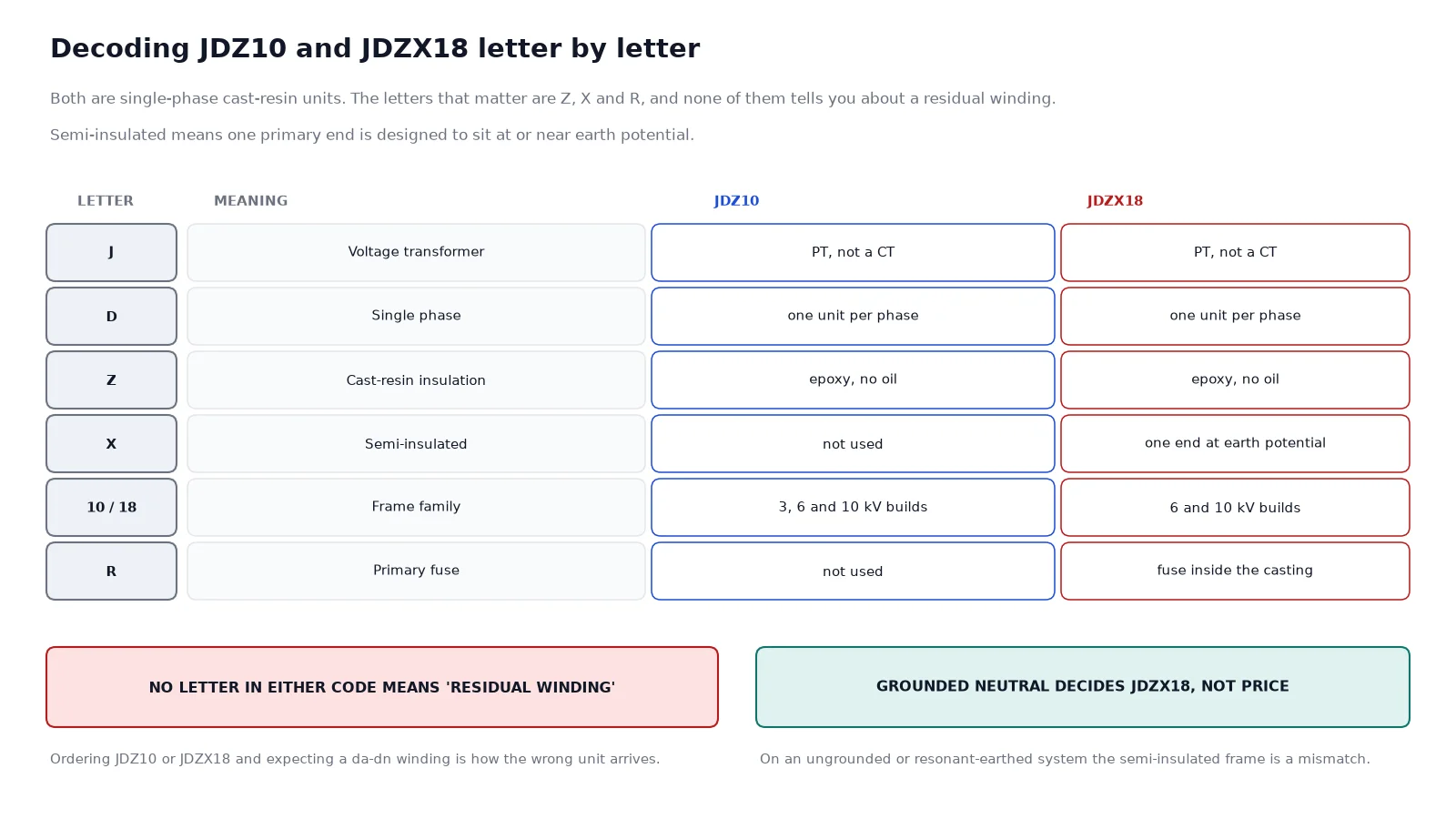
Three quarters of the confused inquiries we receive on this family are one of two mistakes. Either a buyer orders a JDZ18 or a JDZX10, mixing letters from two different frames, or a buyer orders a JDZ10 expecting it to be the residual unit because the earth-fault relay is on the same panel. Both are cheap to fix before the order and expensive after it.
Ratio, burden and class on either frame
Ratio follows the system voltage and the meter input. The common patterns for a 10 kV system are 10/0.1 kV for a single-phase connection, and 10/0.1/0.1 kV where a residual winding is included. A 6.6 kV or 11 kV board takes 6.6/0.11 kV or 11/0.11 kV so that the secondary stays near 100 V at nominal primary.
Burden is the part that quietly breaks the class guarantee. The rated burden has to exceed the sum of the connected devices, chosen with a margin rather than rounded to the nearest value on the drawing; on the voltage side the lead resistance shows up as a voltage drop at the meter rather than as extra burden. Standard burdens are 10, 15, 20, 25, 30 and 50 VA at cos 0.8. A 0.5 class unit run above its rated burden no longer holds 0.5, and the error grows gradually enough that nobody notices until a revenue meter is challenged.
The same discipline applies on the current side of the panel: the reasoning behind ratio and class limits is set out in our guide to CT accuracy classes, and the fault-current side of the same argument is in the LZZBJ9-10 against LZZBJ12-10 comparison.
Five specification mistakes we see on this family
- Ordering the frame without the voltage class. JDZ10 covers 3, 6 and 10 kV. The class, not the model, fixes the ratio.
- Assuming a residual winding is included. It is a third winding with its own class and burden, and it must be requested.
- Specifying a semi-insulated frame on an ungrounded system. The failure mode only appears during an earth fault.
- Mixing units from different batches into one broken-delta set. Mismatched ratios create a standing 3U0.
- Leaving the fuse rating off a JDZX18 order. The fuse is inside the casting, so it is fixed at build, not at site.
How to write the inquiry so it comes back right
One short paragraph is enough, and it saves the two or three rounds that usually follow a one-line request. State the system voltage and the required voltage class; the earthing method; the ratio for each winding; the accuracy class and rated burden for the metering core; the class for the protection core; the residual winding if you need one; the rated frequency; the pollution level and site altitude; and the panel or cubicle type.
If the unit is a replacement and the old nameplate disagrees with the drawing, send a photograph of the nameplate and the single-line diagram. On this family the earthing method decides more than the old part number does, and the part number is exactly what people copy from.
Which frame to order, in one line
Use the JDZ10 when the tap is already protected upstream and the system is general purpose indoor metering. Use the JDZX18 when the tap needs its own primary fuse and the neutral is grounded. In both cases, treat the residual winding as a separate line item, and do not let a model code stand in for a winding specification. The rest of the family – indoor and outdoor, 6 kV to 35 kV – is indexed under instrument transformers.
FAQ
Can a JDZ10 be supplied with a residual voltage winding?
Yes, as a third winding built into the same cast body. It is not part of the standard two-winding build, so it has to be stated at the inquiry together with its ratio, class and burden.
Is the JDZX18 a residual voltage transformer?
Not by definition. The X in the code means semi-insulated and the R means the primary fuse is inside the casting. A residual winding is an additional option on the same frame, not something the code implies.
Can I use a JDZX18 on an ungrounded system?
No. The semi-insulated construction assumes one primary end is at or near earth potential. On an ungrounded or resonant-earthed system, use a fully insulated frame built for the voltage factor that system requires.
Why does the ratio need a winding specification and not just a model number?
Because the frame family is shared across voltage classes and winding counts. JDZ10 is used on 3, 6 and 10 kV builds, and the secondary voltage, accuracy class and rated output are all set at order.
What fuse rating goes inside a JDZX18?
It follows the primary fault level and the PT’s own thermal limit, and it is fixed during build. Send the prospective fault current at the tap and the fuse is sized with the ratio in the same quotation.
Can three single-phase units be bought at different times and used as a set?
They can, but the ratios will differ slightly. In a broken-delta residual circuit that difference appears as a standing zero-sequence voltage, so a set should be ordered together and marked as a set.
Next step
If you already know the voltage class, the earthing method and the winding list, send those three items and the ratio, class and burden come back confirmed together rather than as three separate questions. If you are still deciding between this family and an outdoor frame, start from the range page and work back to the winding specification.